Plot a function y(x) = (x-1) * (x-3)^2 * (x-9)^2 using basic Simulink blocks and To run Simulink example “Suspension System Comparison” .
AIM : i) To plot the given function y(x)=(x-1)*(x-3)^2*(x-9)^2 using SIMULINK.
MATHEMATICAL EQUATION :
y(x) = (x-1)*(x-3)^2*(x-9)^2
We have to use various simulink blocks from simulink library to build this model.The simulink blocks includes
i) Ramp : The Ramp block generates a signal which is initially constant and begins to increase (or decrease )at a constant rate at specified time.
ii) Scope : The scope block displays input signals with respect to simulation time i.e., as a graph or plot.
iii) Product : The product does the multiplication of the inputs provided to it.
iv) Square : This block square the given input value.
v) Display : It shows or displays the final result of the model.
vi) Constant : This block generates real or complex constant value signal.
SIMULINK MODEL :
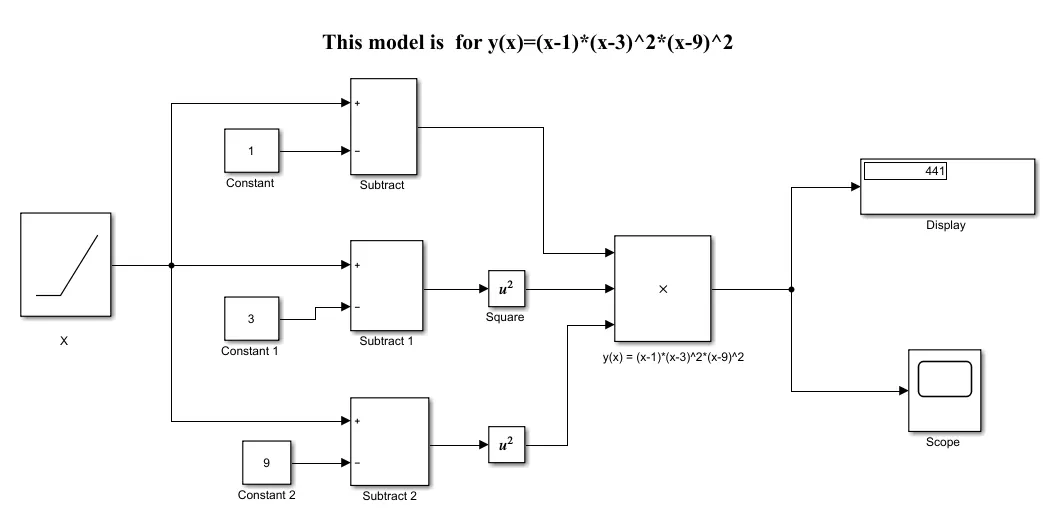
A simulink model for the given function y(x) = (x-1)*(x-3)^2*(x-9)^2.
EXPLANATION :
From the given equation we want to build a simulink model and to find the output values of the given equation. x values are to be initiated to solve the equation.To initiate the x-values a ramp block is used and constant values of 1,3 and 9 are assigned with help of a constant block.Ramp and constant blocks are connected to square block to find value of each equation.The results of (x-3) and (x-9) are squared by square block. Then the obtained three values are given as input to product block. The final valuee or result is displayed in display block and obtained graph or plot can be viewed using scope.
PLOT : A plot for the given function is displayed at t=10 sec
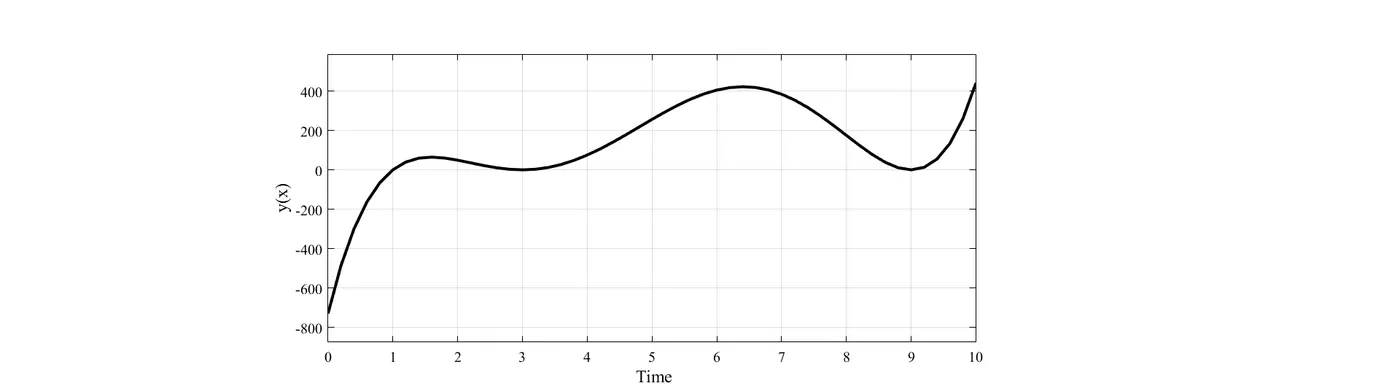
With change in each value of 'x' the value of product y(x) changes with respect to time.
CONCLUSION :
With the help of simulink a mathematical model or simulink model is built for an equation.
SUSPENSION SYSTEM COMPARISON
AIM :
To plot a function using simulink blocks and compare the performances of three different suspension systems.
THEORY :
The primary functions of the suspension system include maximizing the contact between the tires and the road surface, providing steering stability and good handling, evenly supporting the weight of the vehicle (including the frame, engine, and body), and ensuring the comfort of passengers by absorbing and dampening shock.
The suspension system consists of tires, the air in the tires, springs, shock absorbers,arms,struts,linkages,bushings and joints.
SIMULINK MODEL :
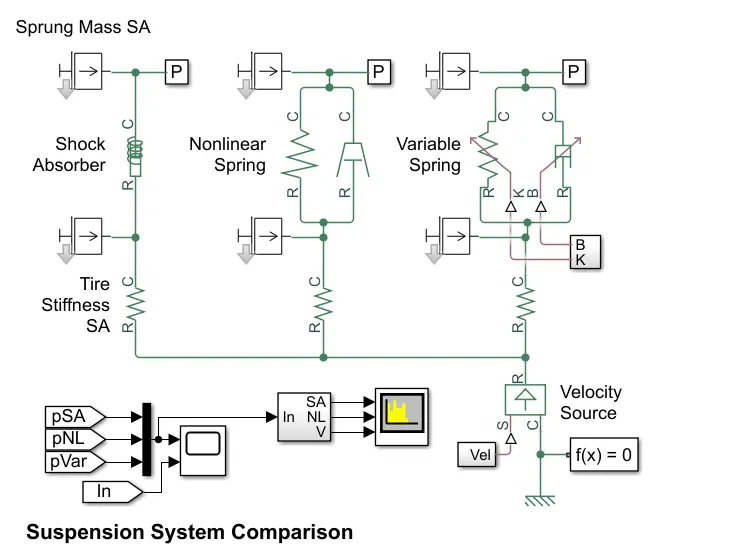
From the above simulink model we can observe that it consists of three suspension systems such as shock absorber , Non-linear spring and variable spring.The input from velocity source block is given to each of three suspension systems.Mass sprung and mass unsprung blocks are added to each system.Tire stiffness block is added to all systems to represent the effect of tires.In non-linear spring system a damper is attached parallel to the spring and in variable spring system a variable damper is attached to the variable spring.The scope displays the plot for the output from the motion sensor along with input velocity.The performance of three suspension system is compared.The output of three suspension systems from the scope is attached to spectrum analyzer to compare noise levels(dB/Hz) per frequency(Hz)
OBJECTIVE:
The objective of this simulation is to compare the performances of three suspension systems i.e., Shock absorber, non-linear spring and variable spring along with input velocity.
SIMILARITIES AND DIFFERENCES :
Shock absorber :
Shock absorber is a device that controls unwanted spring motion through a process called dampening.
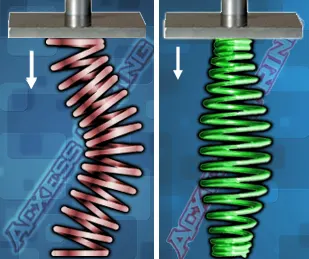
In shock absorber the diameter and pitch are same for spring coil.
For a shock absorber the graph between force and displacement is a straight line or linear.
Non-linear spring :
Non-linear springs are helical coil springs that exert an inconsistent amount of force as it is under a working load or torque.This means that the force needed to travel one inch,millimeter or degree might not be double.when it travels two inches,millimeters,or degrees.
A non-linear spring has different diameter and different pitch value.
For a non-linear spring the graph between force and displacement will be more complicated than a straight line,with a changing slope.It is non-linear.
Variable spring :
Variable springs have coils that are closer together in some areas and more widely spreaded in other areas.
The variable spring rate increases with spring deflection.The spring is not constant or linear.
RESULTS :
Observations from results:
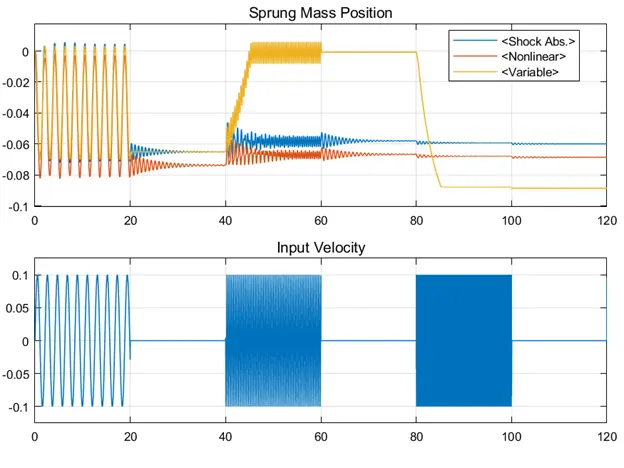
In the above image, the two plots sprung mass position and input velocity are plotted with respect to time.Initially for 0-20sec all the three systems vibrate.For 20-40 sec there is no input velocity and displacement is almost negligible.During t= 40 -60 sec variable spring rises rapidly whereas other two systems are almost constant.From t =80-100 sec variable spring decreases and experiences distortion.From the above plot we can observe that performance of shock absorber is beter than other two suspension systems.
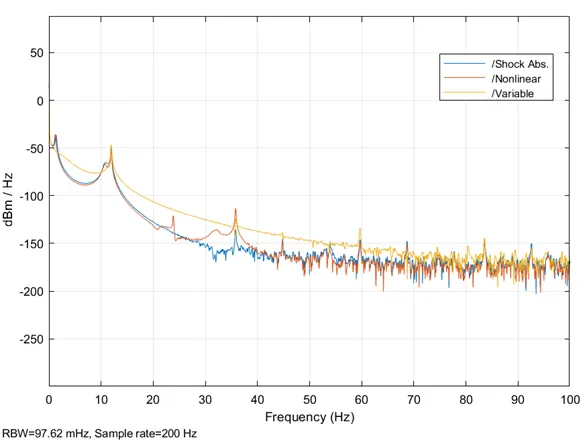
The above graph between spectral density and frequency is used to analyze noise level ratio for three suspension systems.As frequency increases spectral density decreases.
OSCILLATING VELOCITY SOURCE :
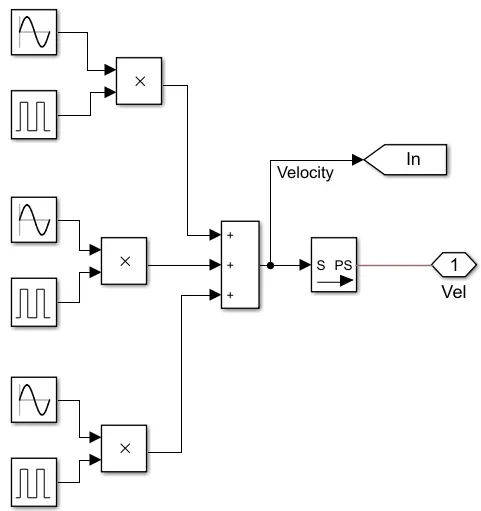
The above simulink model is used to generate input velocity values for the three suspension system.
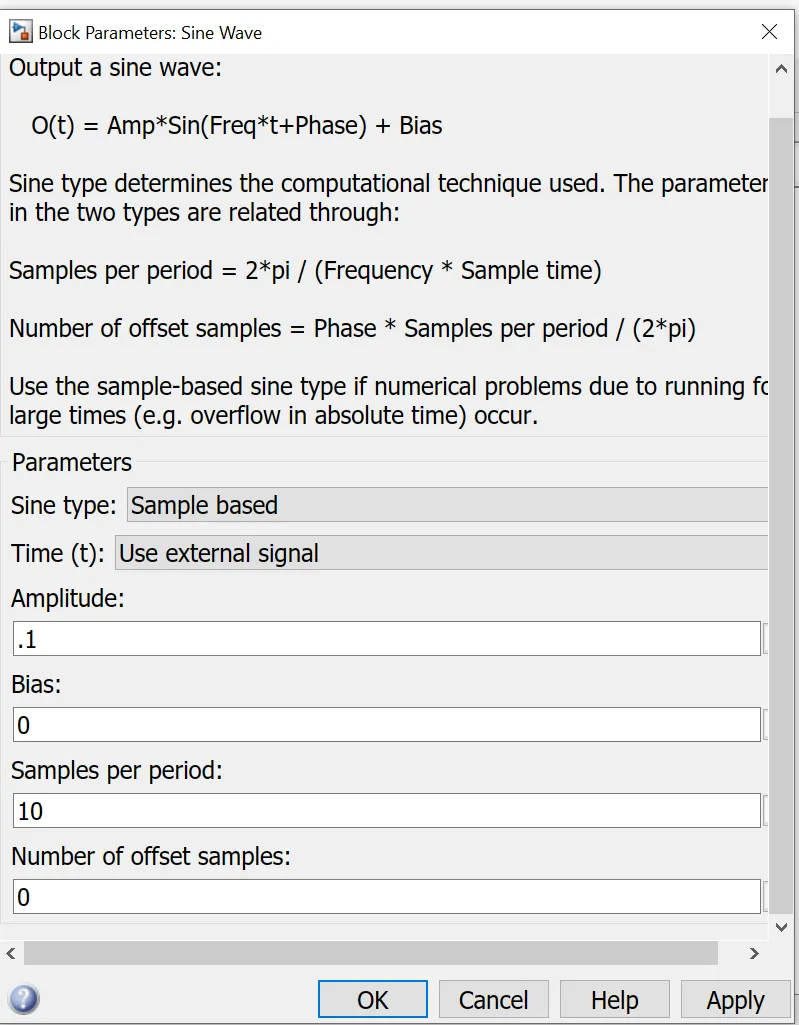
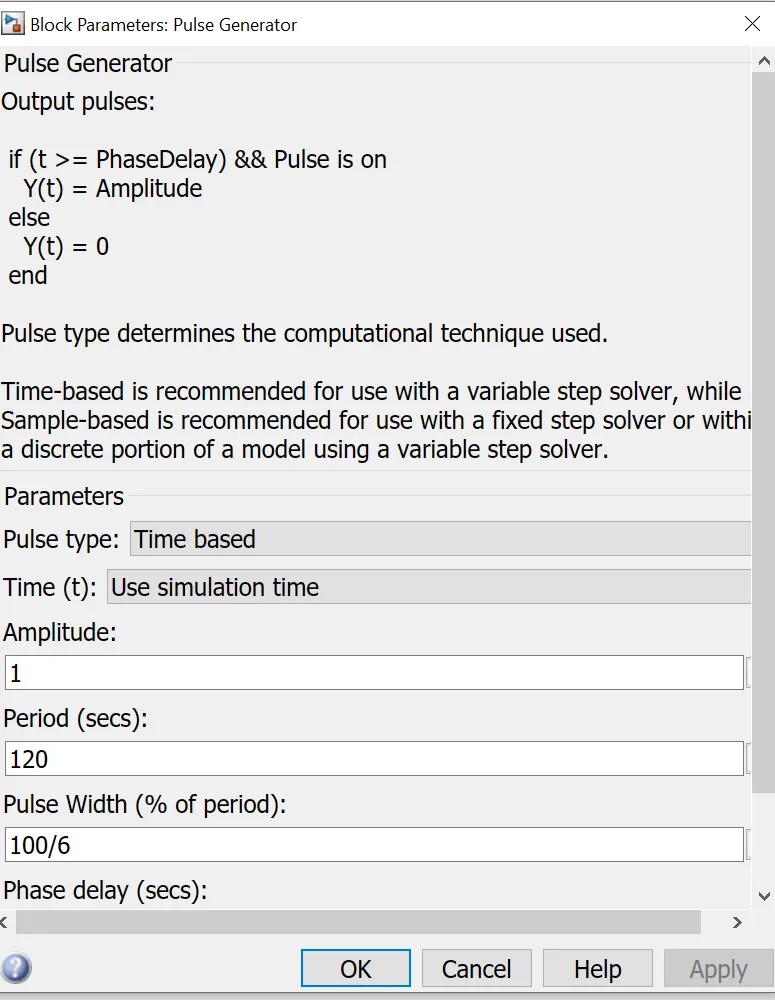
The oscillating velocity source simulink model consists of three sine waves and three pulse generators. All these blocks are merged to sum block. The sum block is attached to simulink PS- converter which converts unitless simulink input signal to a physical signal.
CONCLUSION :
Thus , we have compared the suspension systems and from graph we can conclude that shock absorbers are best as they reduce vibrations.