Hood design-Week 2
AIM
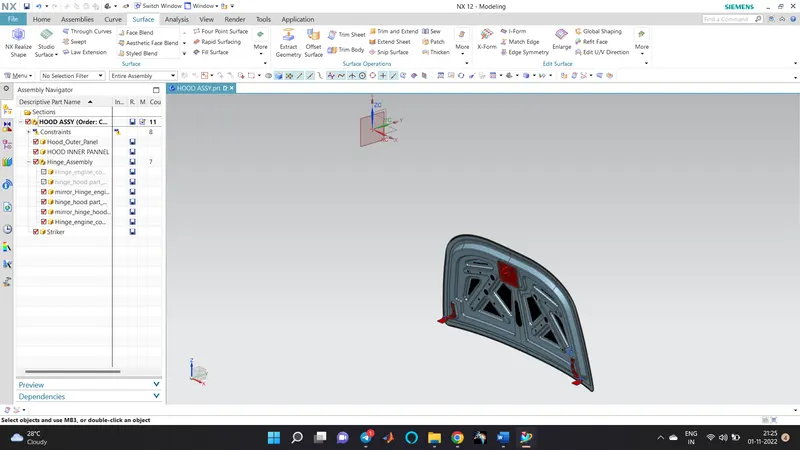
Design Hood Outer Panel, Inner Panel and the necessary reinforcements by following the Master Section mentioned with the Design parameters explained in the videos.
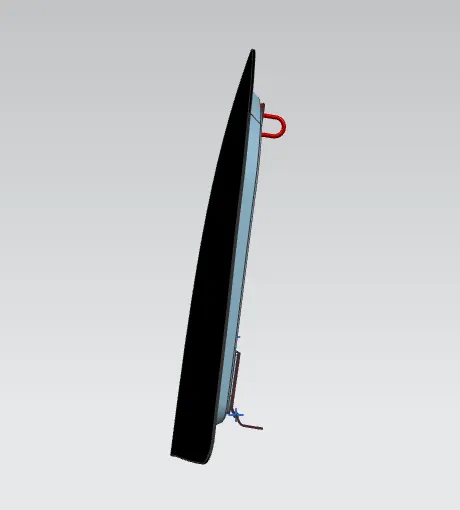
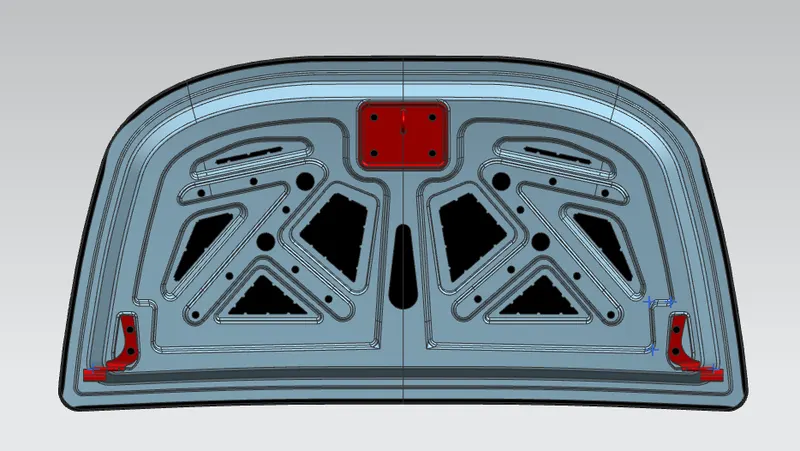
Submit an ASSEMBLY of Hood Inner Panel, Outer Panel, Latch, Hinge and the Reinforcements.
A detailed report about the Hood Design which includes a detailed explanation about hood and its components, Latch Trajectory, Mastic Data, Emboss Definitions, Manufacturing process like Deep-Drawing and Hemming, and all the parameters followed in the design.
The report should be well-formatted and should have a good flow of content. Add all the relevant images
Data to be used:
Hood Thickness Information
Outer Panel Thickness = 0.75mm
Inner Panel Thickness = 0.75mm
Reinforcement Thickness = 1.5mm
Introduction
The hood (American English) or bonnet (Commonwealth English) is the hinged cover over the engine of motor vehicles. Hoods can open to allow access to the engine compartment, or trunk (boot in Commonwealth English) on rear-engine and some mid-engine vehicles) for maintenance and repair. Bonnets are designed to reduce air resistance as the air flows around the car. It is used to decorate the car and add luxurious look. The shape of the bonnet is made aerodynamic in order to minimize the air effect.
Hood assembly consist of different parts that combine to be used in a vehicle. Various parts of the hood are:
- Inner panel
- Outer panel
- Hinge
- Striker
- Support
Inner Panel
It consists of different embosses and hole at different places. Embosses provide stiffness as well as dissipate energy towards hinges. Inner panel supports outer panel. The panel thickness is about 0.75mm. To determine the most effective position of hole, the method of modal stiffness is employed.
Outer Panel
It is actually a outer cover for the inner panel. It also provides an aesthetic look for the vehicle. Outer panel and inner panel cannot join by any welding process like spot welding or rivet, which spoil the outer look of a car. The outer panel is generally extracted model from the prototype design.
Hinge
Hinges are use to mount the bonnet to the body.it is of two joints one to mould the hood and other is mould to the body. And it is also help to arrest the movement only in one axis
Striker
Which helps to close seating in closed condition of the hood
Support
Support is of two types
- Support Rod
Support rods are widely used component because its cheap and very easy to use. This is mostly used for where the car bonnet weight is less. In this type we have to lift the hood by ourselves and place the support rod in the space provided either in the hood or engine component.
- Gas Stay
It is mostly used in cars whose bonnet weight is heavy. In gas stay bonnet vehicle initially it needs a lift only, further open automatically.
Hemming
It is used for joining the inner and outer panel. It is used in place of spot welding which reduces lots of loss. Due to the styling finish of the vehicle both the panels cannot be joined using the welded joints so in order to avoid these joints hemming is used. Hemming for the hood was done with the help of the hemming data as shown.
There are two types of hemming operations,
- Conventional die hemming
In conventional die hemming, the flange is folded over the entire length with a hemming tool.
- Roll hemming
It is the roll hemming process that is used for automotive sheet metals. Roll hemming is carried out incrementally with a hemming roller. An industrial robot guides the hemming roller and forms the flange. Roll hemming operation can also be divided into several pre-hemming and final hemming process steps. Roll hemming is very flexible to use and tool costs are significantly lower as compared to those of conventional die hemming. However, the cycle times are much higher since the hemming is realized using a hemming roller which follows a defined path.
Mastic Data
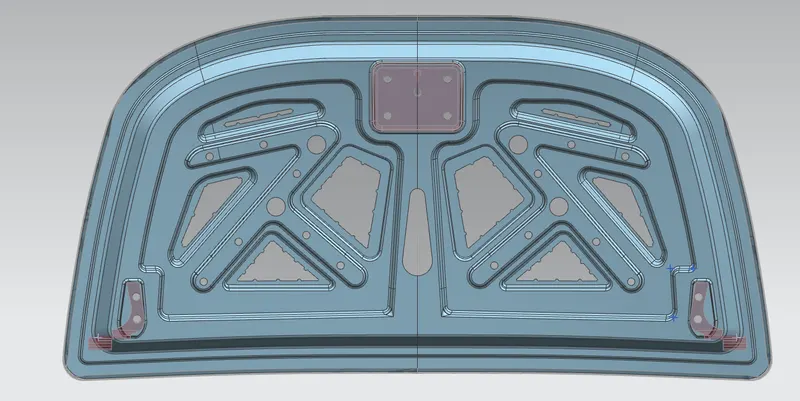
Hood commonly possess large surface area and hemming can only be provided through its boundary. We cannot use other joining techniques like welding, riveting etc because they leave marks on the outer panel which spoil its aesthetic appearance. So, mastic sealants are used to stick the inner surfaces of outer panel and inner panel. Mastic sealants are elastic compound that behave like rubber. It is applied between the inner and outer panels at specified spots. Each spot of mastic sealants has its effect around a circular region of 80mm diameter. Thus, the mastic points are arranged in such a way that it covers the areas away from the hemming which are more vulnerable to vibrate.
Latch Trajectory
Latch trajectory is given by the circle drawn from the hinge axis point. Hinge axis point is the centre point of the hinge axis. First, we can fix either the latch or the hinge. If we have fixed the hinge position then we should plot the Trajectory circle for the latch. For proper mating condition the striker axis through the tip of the striker should be tangential to the latch trajectory.
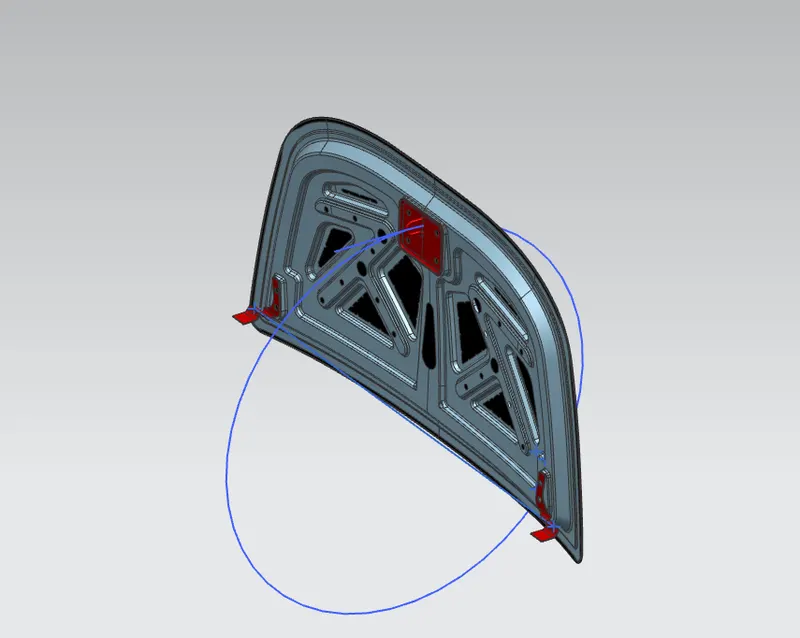
HOOD ASSEMBLY