Design of backdoor
DESIGN AND DEVELOPMENT OF BACKDOOR USING CATIA V5
I
OBJECTIVE:
- To design the back door of a car.
- To design an inner panel for the back door.
- To design the necessary reinforcements like Hinge, Gas-stay, Wiper motor, Latch and Striker on basis of engineering standards.
- The Inner panel is subjected to Draft Analysis for verifying whether it satisfies requirements of Deep Drawing.
INTRODUCTION
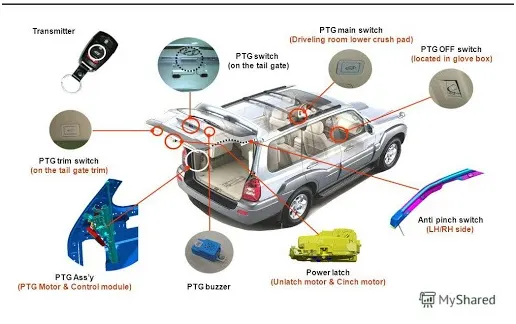
The back door of a car is used to access the boot of a car. The back door consists of two or three panels in which the outer panels and inner panel. The inner panel is used for providing strength to the outer panel. The inner panel has created by providing required embosses to give it more strength. The inner and outer panels are joined by using hemming and Mastic Sealant. The inner panel consists of latch that is used to lock the door. The back door during opening condition is supported by gas stay to maintain its position. The door is connected to the roof by sets of two hinges. The back door can be opened either by manually or powered by motor. In recent days back door is made of aluminum by many car manufactures instead of steel.
DESIGN INTENT
Design intent is a method used in computer-aided design that defines relationships between objects, so that a change to one propagates automatically to others.
DESIGN CONSIDERATIONS:
- TAILGATE OR BACK DOOR:
- Striker Position:
- Rear crash regulation.
- Gap and flushness requirement: Mastic Seals: Mastic Seals place b/w Inner and outer panel to reduce noise, vibration, and harshness. ...
- STYLING SURFACE:
- REINFORCEMENTS:
DESIGN METHODOLOGY
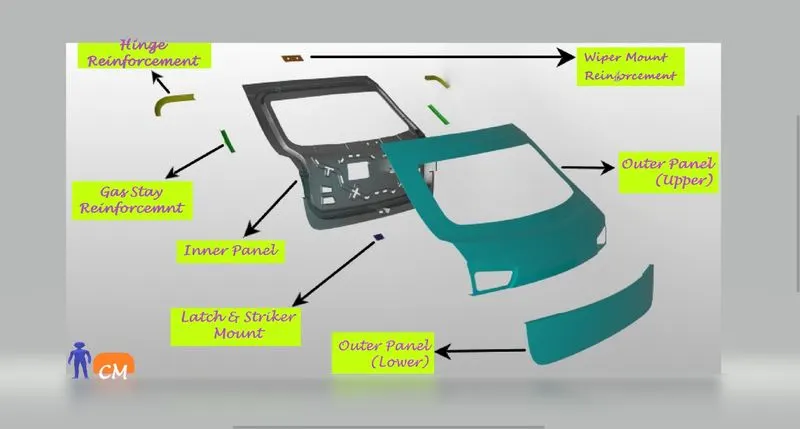
These are the following parts consists of Back door:
- Inner panel
- Upper Outer panel
- Lower Outer panel
- Hinge Reinforcements(LH&RH)
- Gas Stay Reinforcements(LH&RH)
- Latch and Striker Reinforcements
- Wiper motor Reinforcements
Tooling Direction to be considered:
- Initially the tooling direction is created for Deep drawing purpose before designing the inner panel.
- Then styling surface is analyzed and irregularities are fixed.
- Then backdoor was designed using the top down approach.
Latch and Striker positioning with respect to Hinge axis
INNER PANEL
- The inner panel is made of aluminum.
- The inner panel has thickness about 0.75mm.
- The inner panel consists of embosses. These embosses are provided to strengthen to the inner panel during impact.
- The inner panel also consists of mastic support region which is used to put mastic sealant between outer and inner panel for preventing vibration.
- The outer panel is hemmed on to the inner panel.
About Reinforcements
- The reinforcements are provided to strengthen the weaker areas after drilling.
- The thickness of the reinforcements is 1.5 mm
MASTIC SEALANT
- The mastic sealant is used to fix the inner panel with outer panel for increasing NVH factor and stiffness of the back door.
HINGE AND GAS STAY EMBOSS
- The above rounded circle denotes the emboss for hinge was created by using datum plane to get flat surface.
- The below circle denotes the emboss for gas stay which created using the surface of connecting flange.
LATCH AND STRIKER EMBOSS
- The emboss is created for placing Latch and Striker by creating a trajectory which follows the opening and closing of back door with respect to the hinge axis.
DRAFT ANALYSIS
- The draft analysis is performed to check whether part satisfies for manufacturing process on basis of the tooling direction created initially.
- The draft analysis command enables us to detect that the part drafted will be easily removed or not.
- This type of analysis is performed based on color ranges identifying zones on the analyzed element.
DESIGN OF REINFORCEMENTS:
All reinforcements are designed by extracting the required surface by using extract geometry and offsetting them to a required positioning.
- Hinge reinforcement(Violet)
- Gas stay reinforcement(Red)
- Wiper motor reinforcement(Orange)
- Latch reinforcement(Blue)
OUTER PANEL
- The outer panel was created using the styling surface.
- The panel is 0.75mm in thickness.
- The outer panel was designed as two separate parts named as outer panel upper and outer panel lower.
- This panel is joined on to the inner panel by hemming process.
HEMMING
Hemming and seaming are two similar metalworking processes in which a Sheetmetal edge is rolled over onto itself. Hemming is the process in which the edge is rolled flush to itself.
CONCLUSION
Thus the parts of back door were designed using top-down approach in NX-cad. All the required reinforcements were designed and assembled.