Hood design-Week 2
OBJECTIVE :
Design the hood outer panel , inner panel ,and the necessary reinforcements by following the master section mentioned with the design parameter explained in the videos. submit an assembly of hood inner panel ,outer panel ,latch, hinge, and reinforcements.
Introduction :
The hood or bonnet is the hinged cover over the engine of motor vehicles. Hoods can open to allow access to the engine compartment for maintenance and repair. On front-mounted cars, the hood may be hinged at either the front or the rear edge, or in earlier models it may be split into two sections. A further variant combines the bonnet and wheel arches into one section and allows the entire front bodywork to tilt forwards around a pivot near the front of the vehicle. From a design perspective, the hood should meet some specific conditions like pedestrian safety, a hood head zone for the lock striker, force distribution when subjected to frontal collision, manufacturability, etc.
A typical hood assembly consists of a hood outer panel, latch & striker, hinge, and hood stay.
The Hood is made out of the same material as the rest of the bodywork, which is steel and aluminum.
Deep drawing, hemming, blanking, and piercing are the common sheet metal operations that are used in manufacturing hoods in automotive industries.
Hood Design Parameters :
Hood Thickness Information
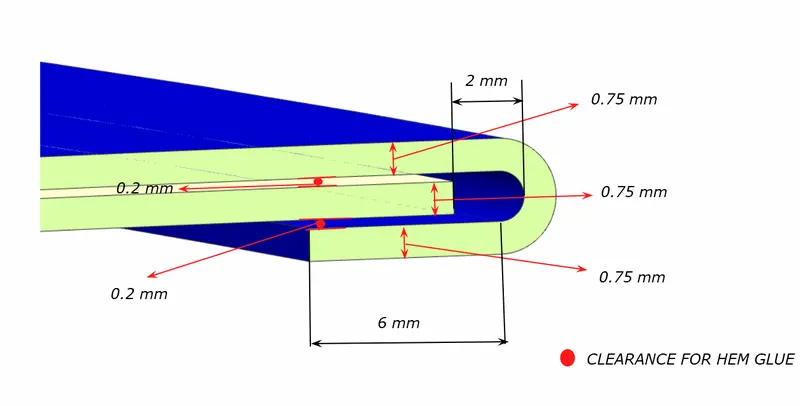
Outer Panel Thickness: 0.75mm
Inner Panel Thickness: 0.75mm
Reinforcement Thickness: 1.5mm
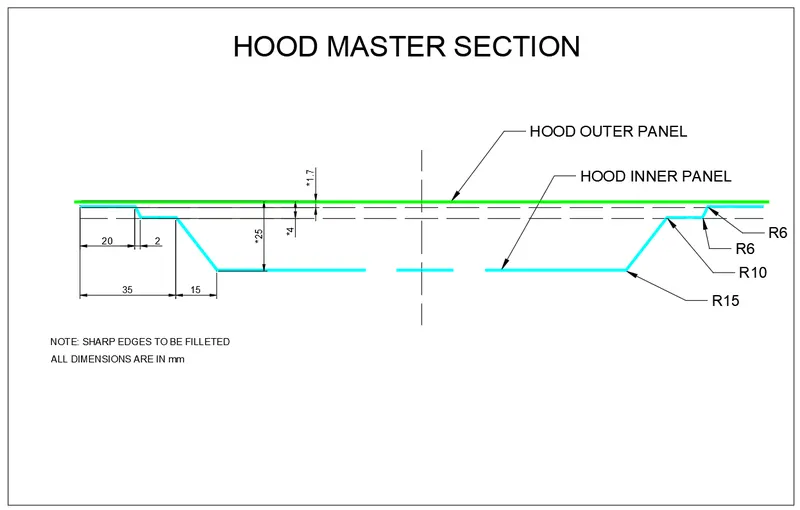
Hemming Data:
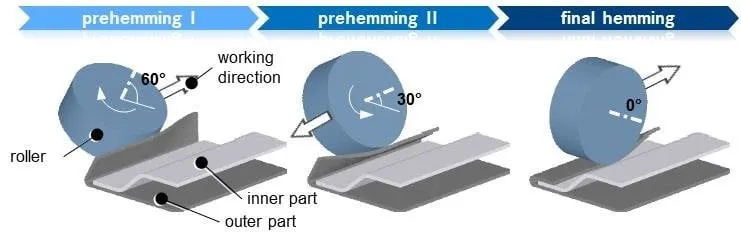
Hemming is a forming operation in which the edges of the sheet are folded over other parts or simply folded in order to achieve a tight fit. In-car part production, hemming is used in assembly as a secondary operation after deep drawing, trimming, and flanging operations to join two sheet metal parts (outer and inner) together.
Relief rear section:
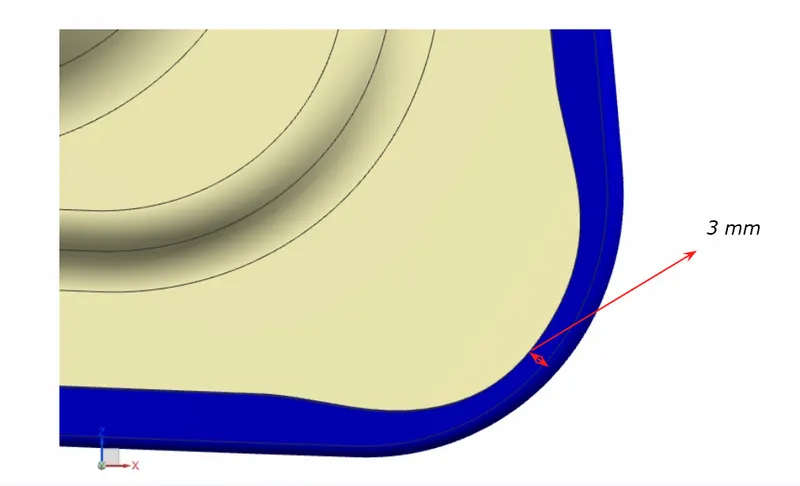
It is a shearing process in which raw sheet metal is pierced with a machining tool, resulting in the creation of a particular shape hole in the sheet. The major difference between blanking and piercing is that in blanking the cut out is the workpiece and the outer part is scrap, while in piercing, the cut out is scrap and the outer sheet is the workpiece.
Front relief:
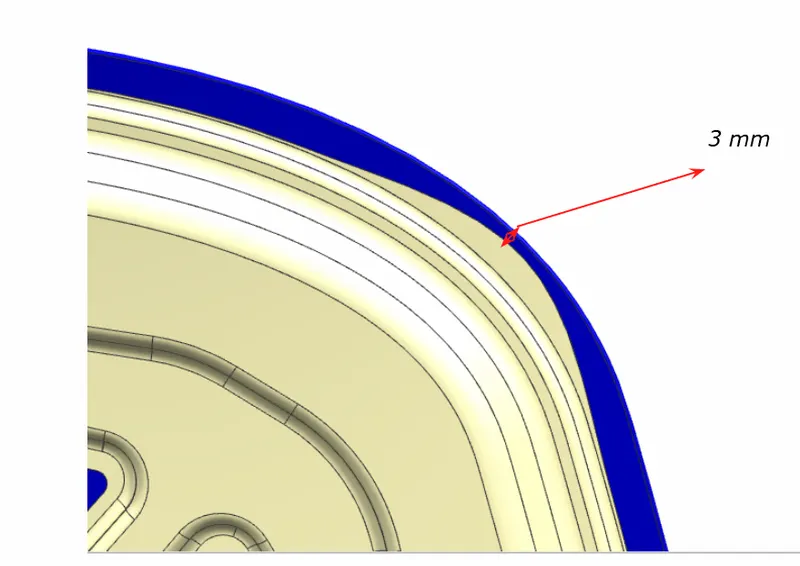
Sheet metal embossing is a stamping process for producing raised or sunken designs or relief in sheet metal. This process is carried out by means of matched male and female roller dies, or bypassing the sheet or rolls of metal between rolls of the desired pattern.