Section Modulus calculation and optimization
SECTION MODULUS OF THE HOOD
The section modulus of the cross-sectional shape is of significant importance in designing beams. It is a direct measure of the strength of the beam. A beam that has a larger section modulus than another will be stronger and capable of supporting greater loads
OBJECTIVE:
To find the sction modulus of the how and optimisation to improve the overall section modulus.
SECTION MODULUS:
The section modulus (s) is geometric property of the cross section used for designing beams and flexural members .it does not represent anything physically.
FORMULA OF SECTION MODULUS:
It may be defined as the ration of total moment resisted by the section to the stress in the extreme fibre which is equal to yield strees .
THERE FORE,
S=l/y, where
S= Section Modulus (mm^3)
l = Moment of inertia of the section about the bending axis.(mm^4)
Y =Distance between the nautral axis and extreme end of the object (mm)
# The unit of a 'section modulus" is (mm3)
SECTION MODULUS EQUATIONS
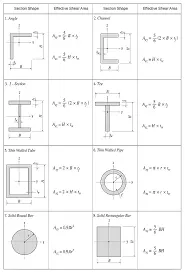
AREA MOMENT OF IERTIA:
# Plastic Section Modulus
Zp is the Plastic Section Modulus
Resisting moment Mp = fy x Zp
The plastic section modulus assumes the entire section yields.
If the failure is considered till the plastic zone
(breaking point) then we consider plastic modulus
The plastic modulus is after yielding.
Zp is used to determine the maximum bending moment at the point where all fibers have yielded elastically and the entire section is behaving plastically. This is the point when the so-called plastic hinge has developed.
# Elastic Section Modulus
Ze is the Elastic Section Modulus
Resisting moment My = fy x Zy
The elastic section modulus assumes the section remains elastic.
If the failure is considered till the elastic
zone then we consider elastic modulus.
Elastic modulus is the steel modulus based on the stress strain curve before yielding.
Ze is used to determine the maximum bending moment up to the point where the extreme fiber has yielded elastically. All other fibers will be below their elastic yield stress'
Calculation:
CASE 1: Before Optimization
The Hood which was already created is imported and the section inertia analysis is done.
We have to make sure that the curve obtained is a single/closed curve.
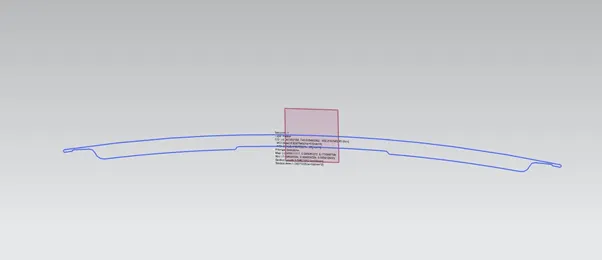
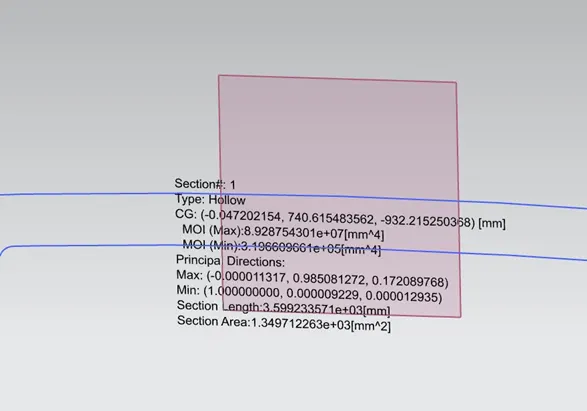
MOI (max) = 8.928754301e+07 (mm^4)
MOI (min) = 3.196609661e+05 (mm^4)
As per the section modulus equation,
S = I/Y
I = MOI (min) value is considered
Y = Total distance /2, Total distance =875.5680mm
Y = 875.5680 / 2
= 437.784 mm
Therefore, S = 319660.966 mm^4/437.784 mm
S = 730.179 mm^3
CASE 2: After optimization
The hood inner panel’s curve is offset by 0.5mm outwards and section inertia analysis is done same as case 1 for a closed curve.
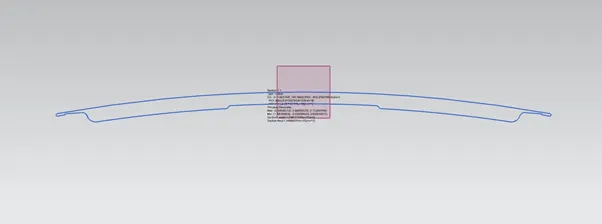
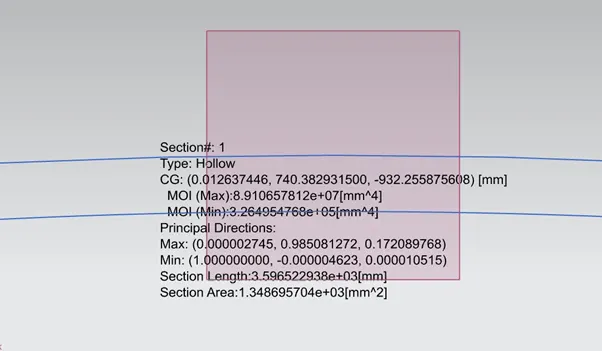
MOI (max) = 8.910657812e^07 mm^4
MOI (min) = 3.264954768e^05 mm^4
As per section modulus equation,
S = I / Y
I = MOI (min) value is considered
Y = Total distance /2, Total distance =875.5680mm
Y = 875.5680 / 2
= 437.784 mm
Therefore, S = 326495.4768 mm^4 / 437.784 mm
S = 745.792 mm^3
Conclusion:
In this study, we take the minimum of inertia moment to analyze the minimum limit of hood deformation. Thus the section modulus of the front hood was calculated and compared with the new design.
From the result we found out that increasing the cross-section area would give a better section modulus and helps in increasing the strength of the hood.