Assignment 3-2D Element Formulation Challenge
objective:
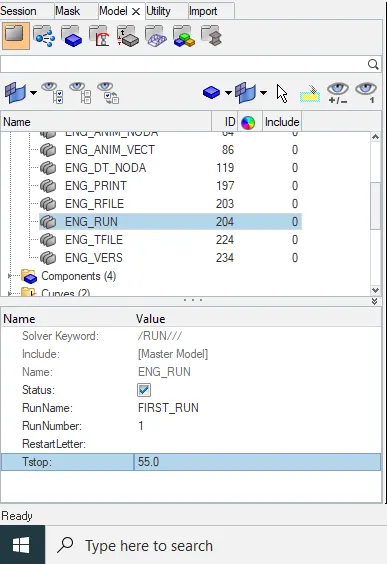
1.Using the crash beam file from the previous assignment, change the run time to 55 ms.
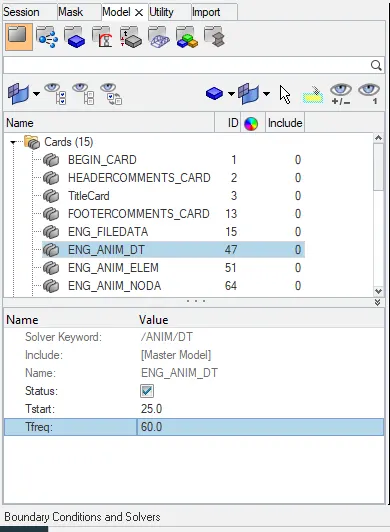
2. Change the number of animation steps during simulation to a minimum of 25 and maximum of 60.
3. Run the base simulation without any modification to element properties.
4. At the end of the simulation, do the energy error and mass error checks and determine whether results would be acceptable.
5. If acceptable, Plot rigid wall forces, internal energy, hourglass energy, contact energy, total energy of the simulations.
6. Change all the shell elements properties to recommended properties, save this as separate, rad files and run the simulation.
7. Follow steps 5 and 6.
8. Create a brief report comparing all the results from steps 5 and 6 for both simulations.
9. Comment whether there is any change in the results and why there is any change in the result.
PROCEDURE:
1.changing run time to 55 ms:
- go to import
- Change the simulation time to 55ms by selecting Model<cards
2.changing Animation steps:
- change the animation steps by goto model<cards
3.Running the Base simulation with out changing the properties:
- Keep properties as default and goto analysis<radioss
4.checking the energy error and mass error:
- open FIRST_RUN_001 out file with Text editor
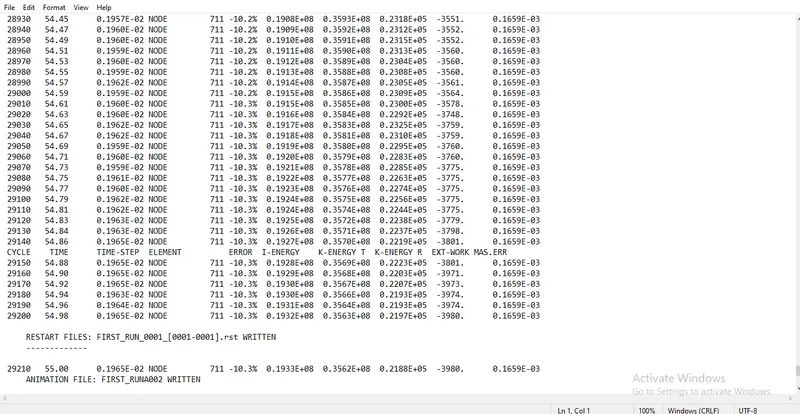
- Energy error is -10.3%.Energy error is -ve because of hourglass energy creation and it will not counted in error calculation.Mass error 0.1659E-03.during simulation solver will add mass on the model to maintain the imposed timestep because of that mass error will present.energy error up to -15% is acceptable so we can go with further analysis.
6.Plot rigid wall forces, internal energy, hourglass energy, contact energy, total energy of the simulations.
- open Hypermesh
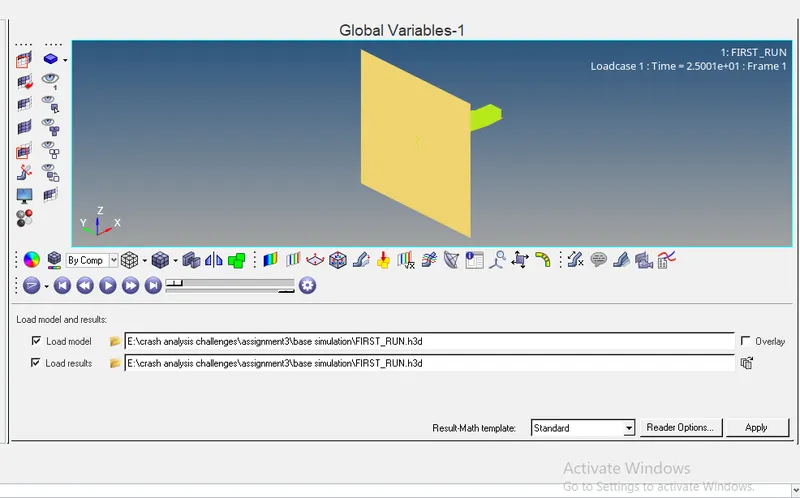
- change to hyper graph 2D
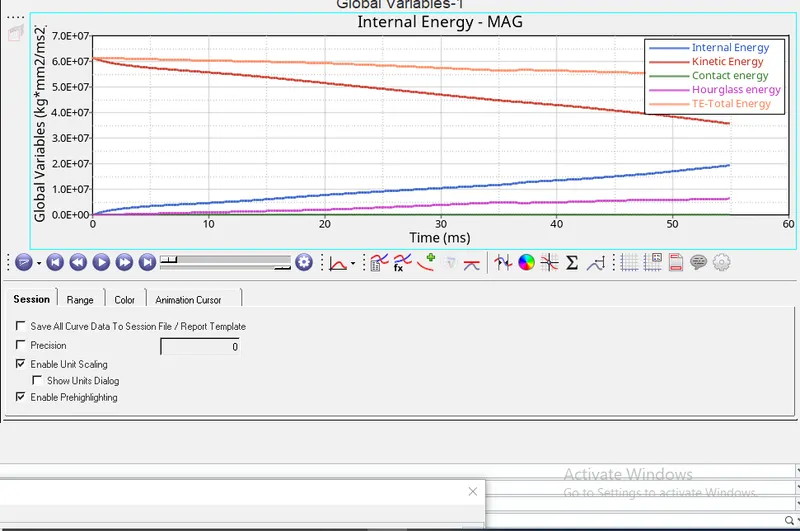
- Internal energy is 0 intial stage of simulation but as the simulation go on internal energy will increase due to deformation increases.in base simulation there is a hour glass energy.contact energy is constant i.e 0 through out simulation because there is no sliding action.kinetic energy at the begining of simulation is high because of intial velocity applied on the model.total energy=internal energy+kinetic energy.so total energy is almost constant.
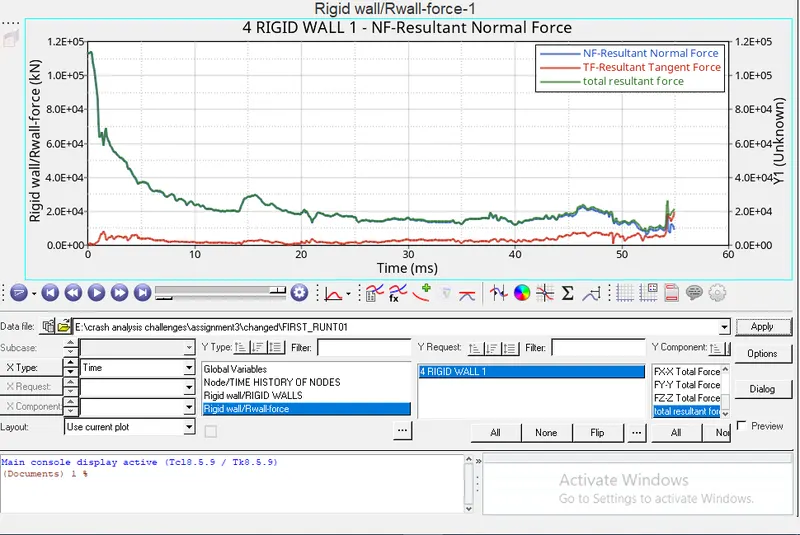
- To plot Rigidwall forces select types as Rigid wall forces< requests 4rigid wall1<select resultant normal force,resultant tangent force,total resultant force.
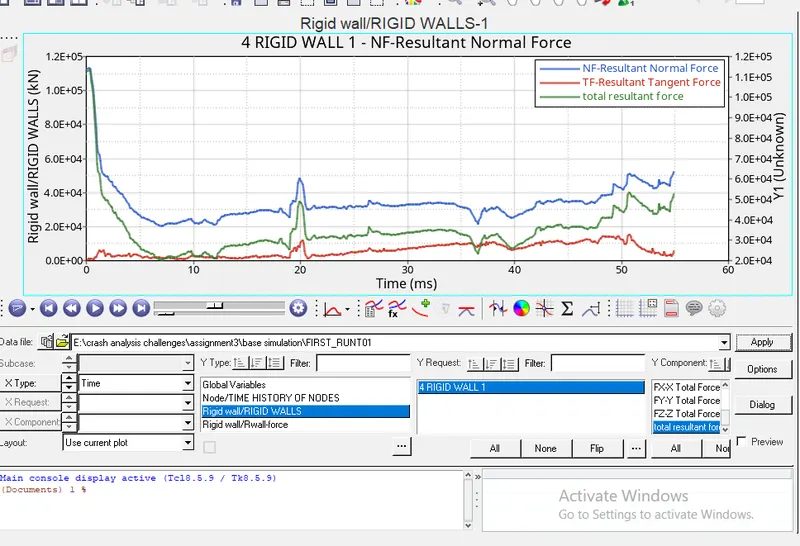
- resultant normal force and total resultant force intially high.due to deformation an opposing force will induce due to this these forces will reduce.
change the Element properties
| Parameters | Comment | |
|
Ishell =24 |
QEPH 4 nodes shells are best combination of cost and accuracy. | |
|
Ismstr=2 |
Full geometric nonlinearities (default)with possible small strain formulation activation in RADIOSS Engine. | |
|
Ish3n=2 |
Standard 3 noded shell (C0)with modification for large rotation(default) |
|
| N=5 | Number of integration points set to 5 for accuracy bending. | |
|
Ithick=1 |
Thickness change is taken into account for accuracy. |
|
|
Iplas=1 |
Iterative plasticity for good accuracy. |
Run the simulation as same as base simulation.for improved shell elements we getsimulation results as follows.
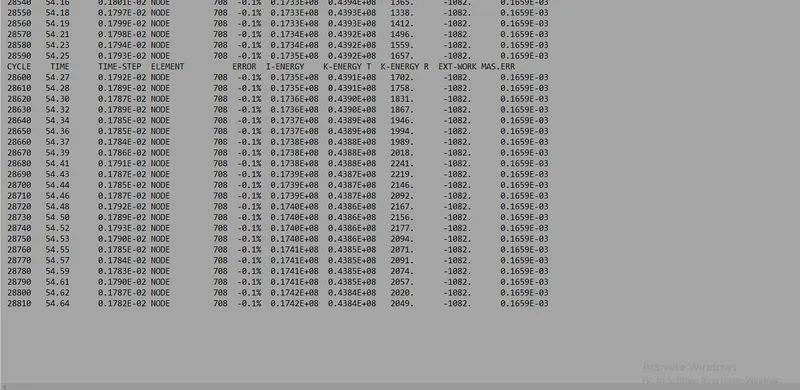
Due to improved element property energy error is reduced to -0.1%,Mass error has no change 0.1659E-03
Internal energy,Kinetic Energy,total energy,contact energy,Hour glass energy VS time
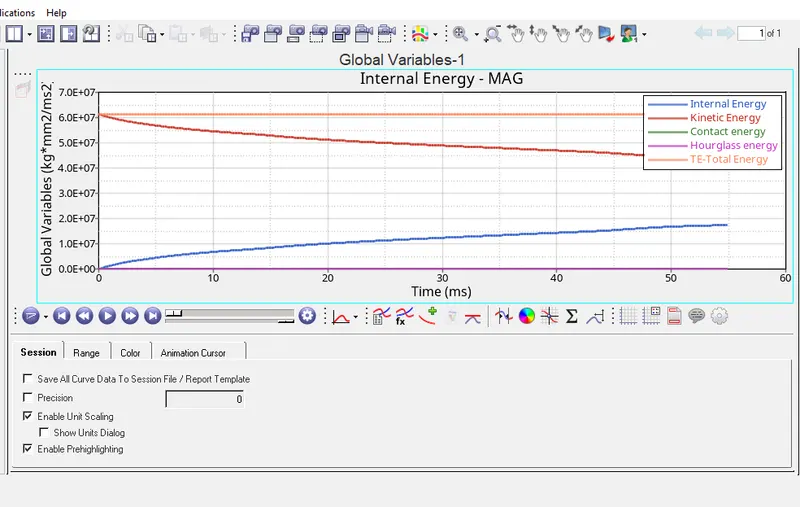
- internal energy increases and kinetic energy decreases,total energy is constant through out simulation.but due to improved element formulation there is no Hour glass energy.hour glass energy is zero and constant through out the simulation.
Rigidwall forces vs Time
Comparison of base simulation with improved shell element simulation
| s.No | Base simulation | Improved shell element simulation | |
| 1 | Energy error | -10.3% | -0.1% |
| 2 | Mass error | 0.1659E-03 | 0.1659E-03 |
| 3 | Hour glass energy | Increases 0 to 0.5E+07 | 0 |
| 4 | internal energy | increases 0 to 2.0E+07 | Increases 0 to 2.0E+07 |
| 5 | kinetic energy | Decreases 6.0E+07 to 3.5E+07 | Decreases 6.0E+07 to 3.5E+07 |
| 6 | Total Energy | decreases 6.0E+07 to 5.5E+07 | constant at 6.0E+07 |
| 7 | contact energy | constant | constant |
Conclussion:
Due to changing element property as improved shell element property we can reduce the energy error by reducing Hour glass energy from -10.3% to -0.1% by physical stabilisation method means adding energy into the model