MacPherson strut: parts, diagram and how it works
A MacPherson strut is a front suspension in which one telescopic unit, a damper with a coil spring around it, holds up the car, damps the bumps and acts as the top of the steering pivot. Here a small car's front corner is modelled in 3D, the strut is cut open and pulled apart, and run through a bump, full bump and rebound.
By Skill-Lync · Published 21 Nov 2026 · Teaching model built and rendered in Blender from code
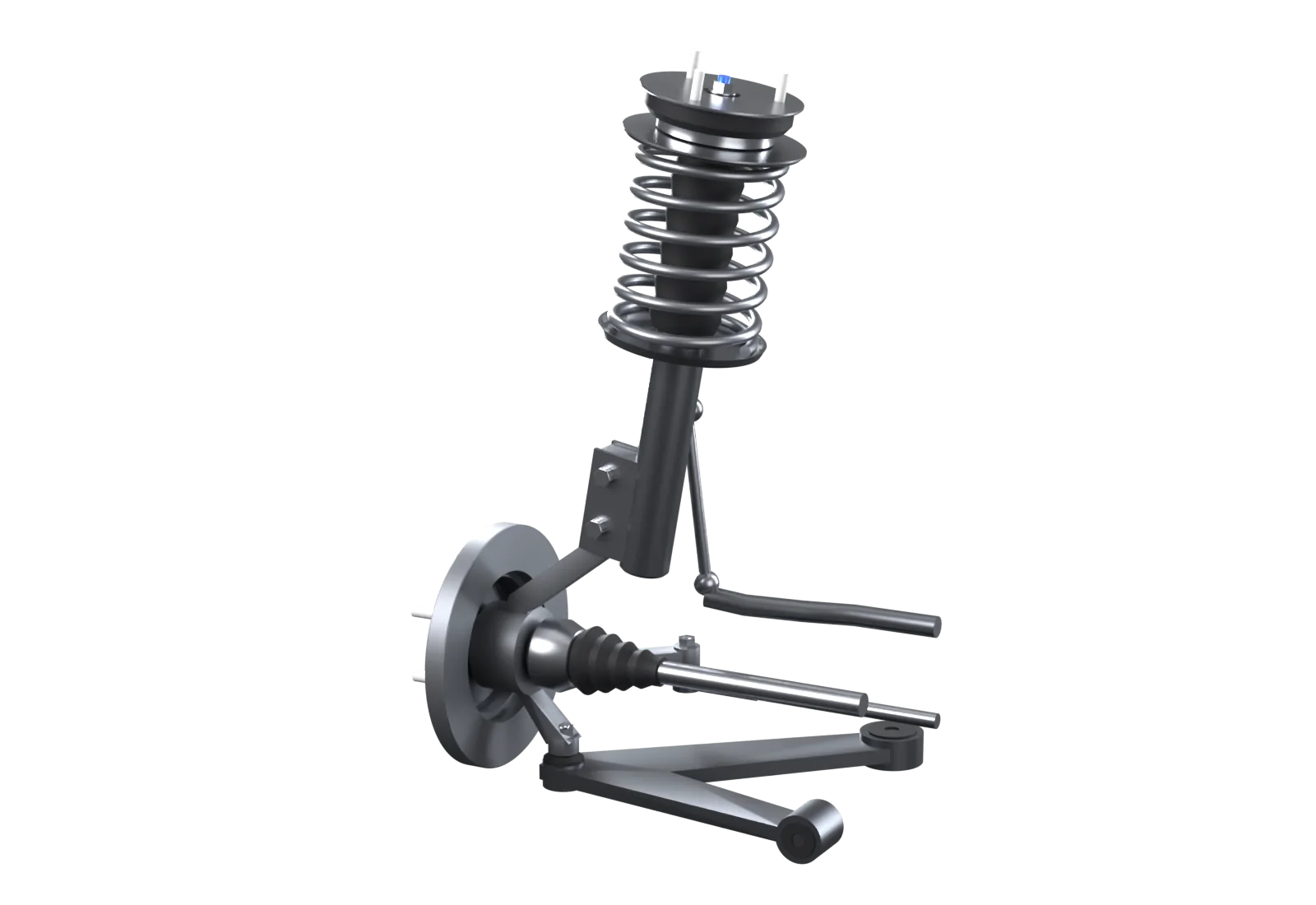
- 1Upper spring seat
- 2Coil spring
- 3Lower spring seat
- 4Strut-to-knuckle bolts
- 5Steering knuckle
- 6Driveshaft (CV joint)
- 7Brake disc
- 8Lower ball joint
- 9Top mount
- 10Strut bearing
- 11Dust boot
- 12Strut (damper) tube
- 13Anti-roll bar link
- 14Anti-roll bar
- 15Tie rod end
- 16Lower control arm
- 17Arm bush
What is a MacPherson strut?
A MacPherson strut is an independent suspension in which a strut, a damper with a coil spring around it, is bolted to the steering knuckle at the bottom and to the car body at the top through a mount with a bearing. With one lower control arm it locates the wheel, so the strut does three jobs: it carries the car's weight, damps the bumps and forms the top of the steering axis.
Think of it as a shock absorber that has been promoted to a structural part. A normal shock only slows the spring; a strut also holds the wheel in place, so it replaces the upper control arm of a double wishbone. That saves parts, weight and width, which is why the layout is used at the front of most small front-wheel-drive cars. Earle S. MacPherson filed the patent (US 2,624,592) in 1947 while at General Motors, and Ford first used it in production on the British Ford Consul and Zephyr of the early 1950s. It is often spelt McPherson strut.
Model and example figures are illustrative, not one car's specification; see the worked example.
What are the parts of a MacPherson strut and their functions?
A MacPherson strut assembly is made of the top mount and strut bearing, the upper spring seat, the coil spring, the bump stop and dust boot on the piston rod, and the strut tube with a twin-tube damper inside and a lower spring seat welded on. At its foot it bolts to the steering knuckle, which the lower control arm locates through a ball joint; an anti-roll bar link and the tie rod end also attach.
Inside a MacPherson strut: labelled cutaway
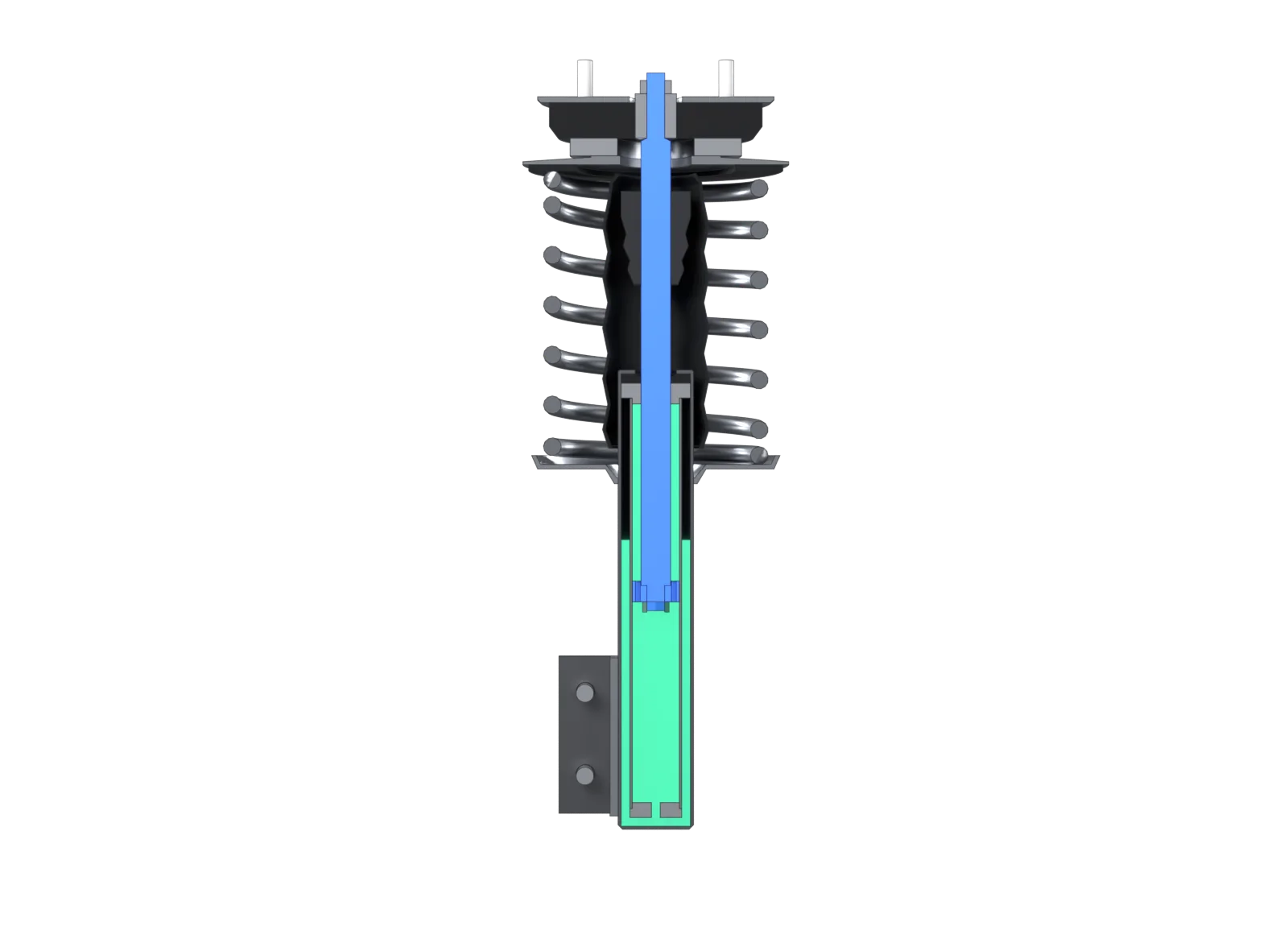
- 1Top mount (rubber)
- 2Upper spring seat
- 3Bump stop
- 4Coil spring
- 5Gas (nitrogen)
- 6Piston with valves
- 7Clamp bolts
- 8Oil below the piston
- 9Knuckle clamp bracket
- 10Top mount studs (to body)
- 11Rod nut
- 12Strut bearing
- 13Dust boot
- 14Piston rod
- 15Rod guide and oil seal
- 16Lower spring seat
- 17Oil above the piston
- 18Pressure (inner) tube
- 19Reservoir oil
- 20Reservoir (outer) tube
- 21Base valve
| Part | What it does |
|---|---|
| Top mount (strut mount) | A rubber-bonded steel plate bolted to the car's strut tower by three studs. It carries the car's weight into the spring and strut and soaks up small vibrations. The rubber is pushed and pulled every time the wheel moves. |
| Strut bearing | A bearing under the top mount that lets the spring and strut turn when you steer. On a MacPherson strut it is the top of the steering axis (Monroe: the bearing "serves as the upper pivot point and forms the steering axis"). |
| Upper spring seat and isolator | A pressed steel seat, held by the top mount, that the top of the coil spring sits in, with a rubber isolator to stop noise passing into the body. |
| Coil spring | Holds up the car's weight and lets the wheel move over bumps. It sits between the upper and lower spring seats, around the damper. |
| Bump stop (jounce bumper) | A foam polyurethane or rubber buffer on the piston rod. At the end of the bump travel the tube top hits it, so the suspension stops softly instead of metal hitting metal. |
| Dust boot | A rubber bellows over the piston rod that keeps dirt and water off the polished rod and the oil seal. |
| Piston rod | The polished steel rod joining the piston to the top mount. On a strut it is much thicker than on a shock absorber because it also takes bending loads from the wheel (Monroe: up to 7/8 in, 22.2 mm, versus up to 1/2 in, 12.7 mm). |
| Strut (damper) tube | The heavy-gauge steel outer tube. It holds the damper, carries the lower spring seat, and bolts to the steering knuckle, so it is a structural part of the suspension, not just a damper. |
| Lower spring seat | A pan welded to the strut tube that the bottom of the coil spring sits in. It moves up and down with the wheel. |
| Damper (shock absorber) inside | A twin-tube damper: an inner pressure tube with the piston, and the outer tube as an oil reservoir topped up with low-pressure nitrogen gas. Forcing oil through small valves turns the spring's bouncing energy into heat. |
| Piston and valves | The piston on the end of the rod carries valves (stacks of thin steel discs over ports) that let oil through in both directions but resist it, so the damping force rises with the speed of the movement. |
| Base valve | The valve at the bottom of the pressure tube. Monroe calls it the compression valve: it controls the oil pushed out into the reservoir as the rod goes in, and lets it back on rebound. |
| Rod guide and oil seal | A bushing that keeps the rod centred in the pressure tube and a multi-lip seal that keeps the oil in and dirt out. |
| Knuckle clamp bracket and bolts | A bracket welded to the bottom of the strut tube that bolts to the steering knuckle with two bolts. |
| Steering knuckle | The cast part that carries the wheel bearing and hub. The strut bolts to its top, the lower ball joint to its bottom and the tie rod to its steering arm. |
| Lower control arm, bushes and ball joint | The arm that locates the bottom of the knuckle. It pivots on two rubber bushes on the body or subframe, and joins the knuckle through a ball joint, the bottom of the steering axis. |
| Anti-roll bar link | A short rod with a ball joint at each end that connects the strut to the anti-roll (stabiliser) bar, which resists body roll in corners. |
| Tie rod end | The ball joint that connects the steering rack's tie rod to the knuckle's steering arm. Turning the steering pushes or pulls it, and the whole knuckle and strut turn about the steering axis. |
How does a MacPherson strut work?
When the wheel rises over a bump, the knuckle pushes the strut tube up around the piston rod, which is fixed to the body. The coil spring is compressed and stores the energy, and the damper forces oil through the piston and base valves, which slows the movement and turns the energy into heat. The spring then pushes the wheel back down, and the damper's rebound valve stops it bouncing.
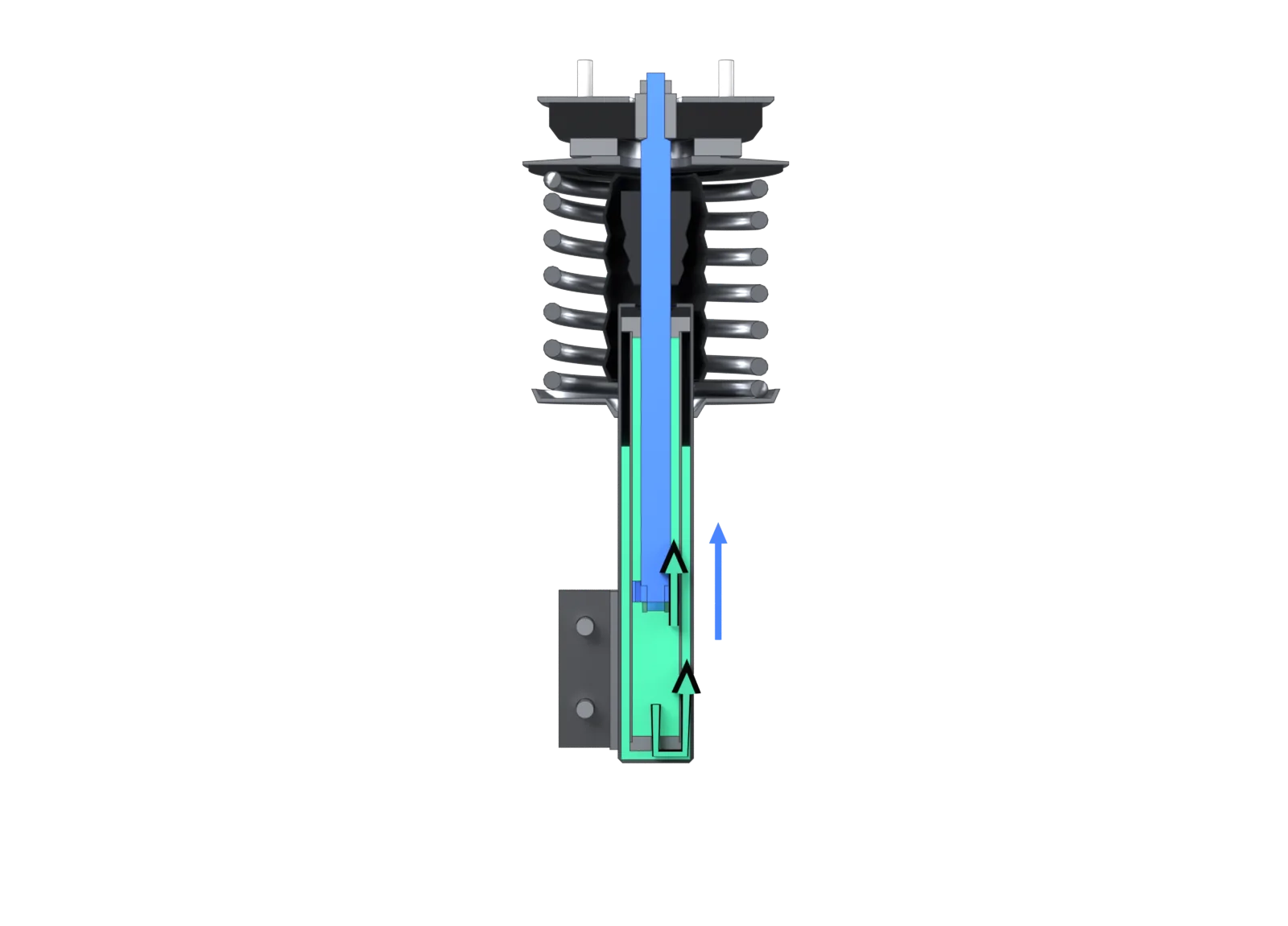
- 1Top mount (rubber)
- 2Bump stop
- 3Coil spring
- 4Gas (nitrogen)
- 5Piston with valves
- 6Oil below the piston
- 7Piston rod
- 8Lower spring seat
- 9Oil above the piston
- 10Oil up through the piston
- 11Wheel and tube move up
- 12Reservoir oil
- 13Reservoir (outer) tube
- 14Base valve
- 15Rod volume out through the base valve
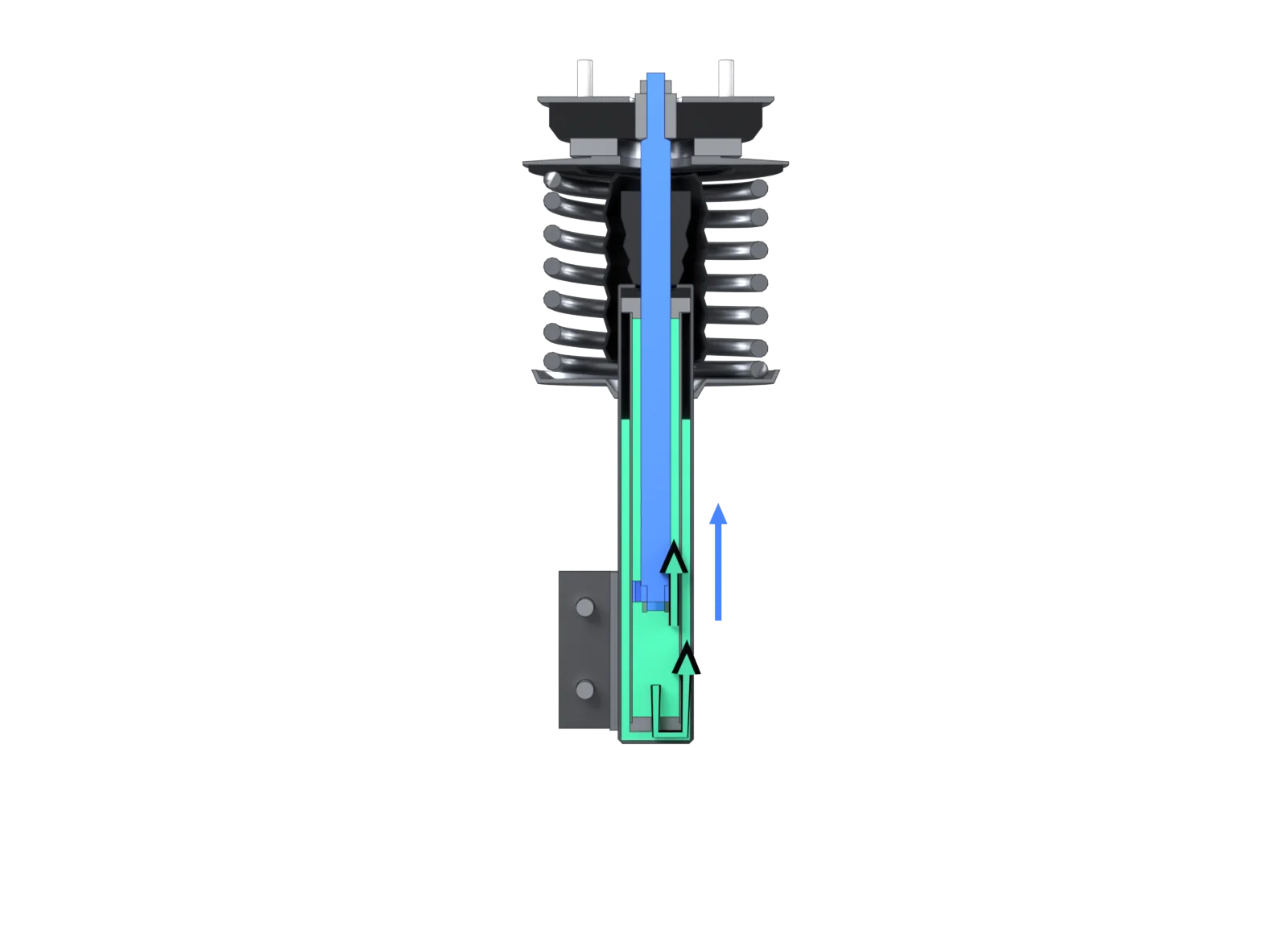
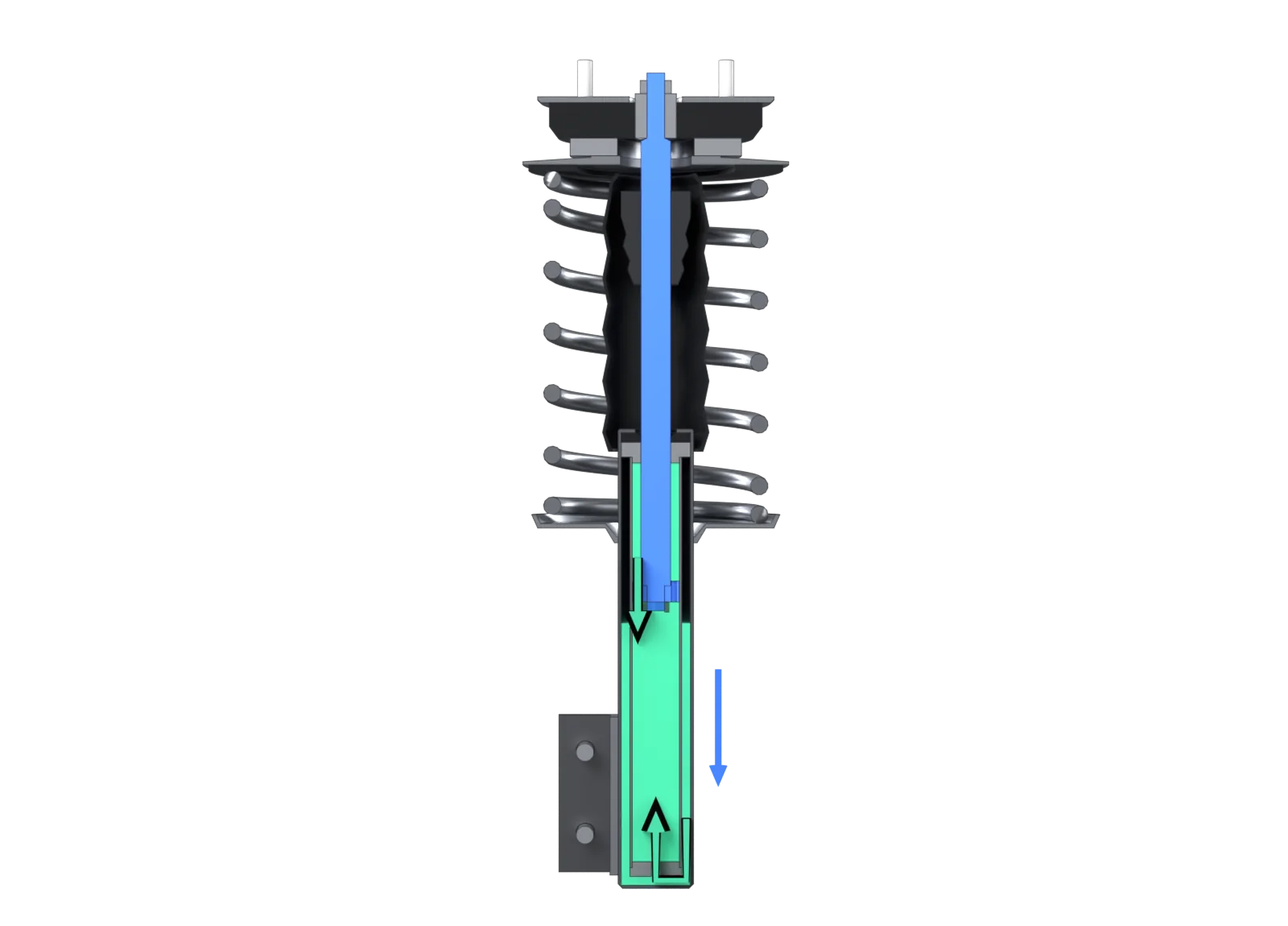
1. Bump: the wheel rises. The wheel hits a bump and pushes the knuckle, and with it the strut tube, up by 45 mm. The coil spring is squeezed and stores the energy. Inside, the piston (blue) is held by the body, so the tube slides up around it: oil below the piston is forced up through the piston's compression valve, and because the rod now takes up more room, the extra oil is pushed out through the base valve into the outer tube, where it squeezes the nitrogen gas.
2. Full bump: the bump stop touches. On a big bump the tube rises 58 mm, and the top of the tube meets the polyurethane bump stop on the rod. The bump stop cushions the end of the travel; as Monroe puts it, it limits suspension travel so that the parts do not hit together.
3. Rebound: the spring pushes back. The compressed spring now pushes the wheel back down, past ride height. The damper slows this rebound: oil above the piston has to squeeze down through the piston's rebound valve, while oil from the outer tube is drawn back in through the base valve to fill the space the rod leaves. Without this, the car would keep bouncing.
Shown in the strut's own frame: the top mount and rod stay still and the tube moves. The oil level and gas space change by the rod's volume (an 18 mm rise for 45 mm of bump in this model). Arrows show the direction of flow, not its speed.
MacPherson strut working principle, with numbers
The spring is chosen for a ride frequency, the number of times a second the body would bounce on it. Penske gives the relation, and the spring rate follows from the wheel rate through the motion ratio MR, how far the spring moves for each millimetre of wheel travel (close to 1 on a strut because it sits almost over the wheel):
Take a Swift-sized car: 885 kg kerb weight (Suzuki's European specification gives 840 to 890 kg), with an assumed 60% on the front axle and 35 kg of unsprung wheel, hub and brake per corner. That leaves 230.5 kg of sprung mass on each front spring. For a 1.2 Hz ride (OptimumG gives 0.5 to 1.5 Hz for passenger cars, Penske 1.0 to 1.5 Hz), , and with an assumed motion ratio of 0.93, .
| Step | Value | Note |
|---|---|---|
| Load on one front wheel (885 kg car, 60% on the front) | 265.5 kg | assumed weight split |
| Sprung mass per corner (minus 35 kg wheel, hub, brake) | 230.5 kg | assumed unsprung mass |
| Wheel rate for a 1.2 Hz ride | 13.1 N/mm | passenger cars: about 1.0-1.5 Hz |
| Spring rate (motion ratio 0.93) | 15.2 N/mm | this model's spring: 15.0 N/mm |
| Spring force at ride height | 2,431 N | spring squeezed about 160 mm |
| Damping for ζ = 0.25, at the damper | ≈ 1,000 N s/m | about 300 N at 0.3 m/s |
| Gas force pushing the rod out (8 bar, 20 mm rod) | 251 N | why a loose strut extends by itself |
The coil in this model is 12 mm spring-steel wire (G = 79.3 GPa, assumed) wound to a 140 mm mean diameter with five active coils, so , close to the target. At ride height it carries 2,431 N and is squeezed about 160 mm from a free length of about 360 mm. OptimumG suggests a damping ratio of about 0.25 for comfort: that is about 870 N s/m at the wheel, or about 1,000 N s/m at the damper, roughly 300 N at 0.3 m/s. Real dampers are not linear: their valves are tuned to give a different force curve in compression and in rebound.
Assumed values: 60% front weight, 35 kg unsprung per corner, 1.2 Hz, motion ratio 0.93 (spring travel over wheel travel), shear modulus 79.3 GPa, damping ratio 0.25, gas at 8 bar. Tyre stiffness is ignored. Every number here is checked by a script kept with the model files.
MacPherson strut assembly: exploded view
The lower spring seat and the knuckle clamp bracket are welded to the strut tube. The coil spring drops over the tube onto the lower seat, with the bump stop and dust boot on the piston rod inside it. The upper spring seat, the strut bearing and the top mount go on top, and one nut on the rod holds the stack together. Mechanics compress the spring with a special tool before undoing that nut.
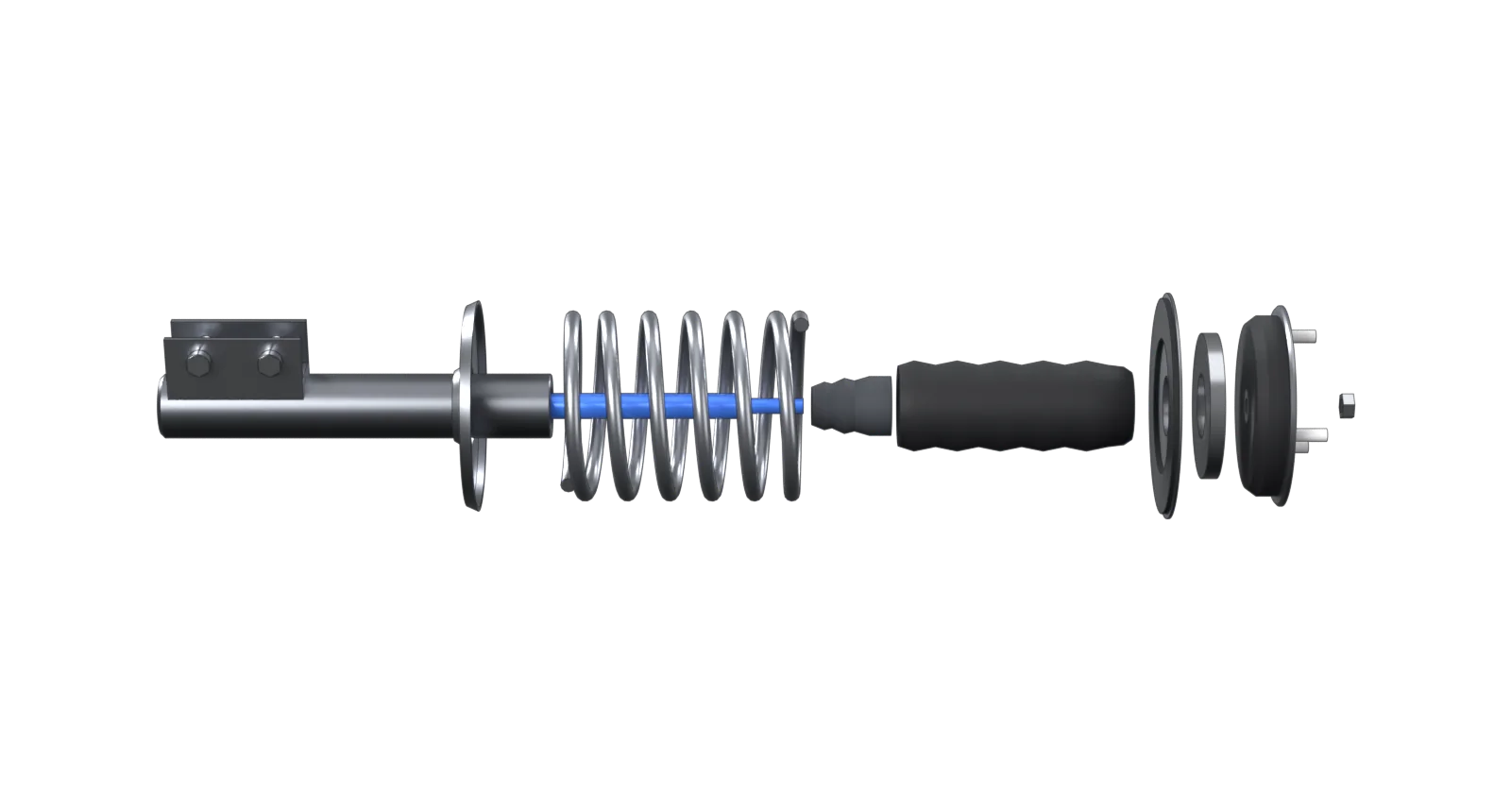
- 1Knuckle clamp bracket
- 2Lower spring seat
- 3Bump stop
- 4Dust boot
- 5Strut bearing
- 6Rod nut
- 7Strut (damper) body
- 8Piston rod
- 9Coil spring
- 10Upper spring seat and isolator
- 11Top mount
Steering axis, strut angle and scrub radius: front view
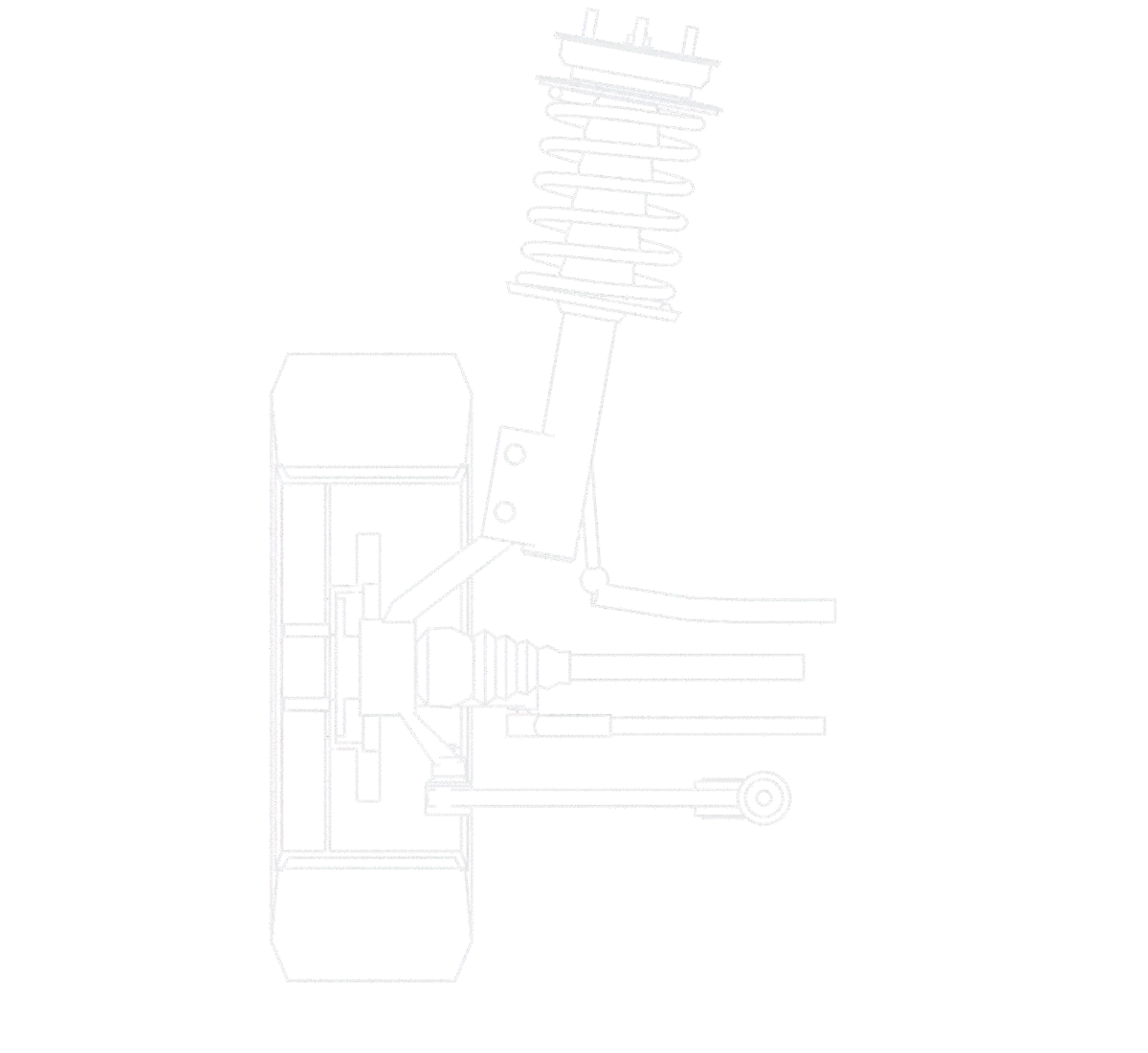
Seen from the front, the steering axis runs from the strut bearing at the top to the lower ball joint. On this model it leans 14.4° inwards at the top (steering axis inclination), while the strut itself leans 10°. Where the axis meets the ground, 28 mm inboard of the tyre's centre, sets the scrub radius.
Strut vs shock absorber: what is the difference?
Every strut contains a shock absorber (damper), but not every shock absorber is a strut. A strut is a structural suspension part that carries the spring and locates the wheel; a shock absorber only damps the spring's motion. That is why a strut's tube is heavy-gauge steel and its rod is thicker: Monroe says a strut shaft measures up to 7/8 in against up to 1/2 in for a typical shock.
| MacPherson strut | Shock absorber | |
|---|---|---|
| Job | Damps the spring and also locates the wheel and carries the spring | Only damps the spring's motion |
| Loads | Weight, braking and cornering forces, bending | Mainly along its own axis |
| Piston rod (Monroe) | Up to 7/8 in (22.2 mm) | Up to 1/2 in (12.7 mm) |
| Mounting | Top mount with a bearing; bolted to the knuckle at the bottom | Rubber bushes at both ends |
| Steering | Turns with the wheel; part of the steering axis | Not part of steering |
| After replacing | Wheel alignment needed (NAPA) | Alignment not usually affected |
MacPherson strut vs double wishbone
A MacPherson strut is simpler, cheaper and more compact than a double wishbone, with fewer joints and bushes to wear (HP Academy), and leaving out the upper arm frees width for a transverse engine. The price is geometry: the wheel's camber changes more as it moves, turning positive deep in bump, the strut is tall, and side loads on the rod add friction.
| MacPherson strut | Double wishbone | |
|---|---|---|
| Arms | One lower arm; the strut is the upper link | Upper and lower arms (wishbones) |
| Cost and parts | Lower, fewer bushes and joints | Higher, more parts |
| Packaging | Narrow but tall; room for a transverse engine | Wider, lower |
| Camber control | Limited; camber changes with travel | Good; tuned by arm lengths and angles |
| Steering axis inclination (SIU) | Typically 9° to 15° | Typically 5° to 8° |
| Typical use | Front of most small and mid-size cars | Sports and premium cars, SUVs, race cars |
At the rear, many small Indian cars pair front struts with a torsion beam: a cross-member joining the two trailing arms that twists as the wheels move, cheaper still but not fully independent.
Inside the damper: how a twin-tube strut works
A twin-tube strut has an inner pressure tube, where the piston runs, and an outer reserve tube that stores oil and a cushion of low-pressure nitrogen. ZF says the space between the tubes is filled about two-thirds with oil and one-third with gas. When the rod moves in, its volume pushes oil out through the base valve into the reserve tube; when it comes out, oil flows back.
The valves do the damping: Monroe calls the base valve the compression valve, because it controls the oil flow as the strut is compressed, while the piston's valves work on the oil passing through the piston in both directions. Because the gas sits on top of the oil, a twin-tube strut must be mounted roughly upright. A monotube damper instead keeps the gas behind a floating piston at about 25 to 30 bar (ZF) and has no base valve.
Common MacPherson strut problems and their symptoms
The usual strut problems are a leaking damper, a worn top mount or strut bearing, a sagging or broken spring, a crumbled bump stop, and worn ball joints or arm bushes. Most show up as noise, a floaty or bouncy ride, or uneven tyre wear.
| Problem | Likely cause | What you notice |
|---|---|---|
| Leaking strut | Worn or damaged rod seal (oil running down the tube; a light film on the top half is normal, Tenneco) | Bouncy, floaty ride; longer stopping on rough roads |
| Worn top mount or strut bearing | Cracked rubber, a binding or gritty bearing (Tenneco) | Clunk or creak when steering, steering vibration and noise (Monroe) |
| Crumbled bump stop | Age and heavy loads | Unwanted body movement (Monroe); harsh knocks on big bumps |
| Sagging or broken spring | Fatigue or corrosion | One corner sits low, the car leans, noise over bumps |
| Worn ball joint or arm bushes | Wear and torn boots | Clunks over bumps, vague steering, uneven tyre wear |
Replace struts in pairs on the same axle (Monroe), and have the wheel alignment checked afterwards, because small differences between struts shift the alignment and can make the car pull (NAPA). Removing the top nut needs the spring compressed with a proper strut spring compressor first.
Where are MacPherson struts used?
At the front of most small and mid-size cars, especially front-wheel-drive ones with a transverse engine; the Maruti Suzuki Swift, for example, uses MacPherson struts at the front and a torsion beam at the rear (Suzuki). Some cars also use struts at the rear. Heavier or sportier cars often switch to double wishbones or multi-link suspensions for better camber control.
MacPherson strut interview and viva questions
What is the steering axis on a MacPherson strut, and what is a typical inclination?
It is the line from the strut's top mount bearing to the lower ball joint; the wheel steers about it. Seen from the front it leans inwards at the top: Southern Illinois University's steering notes give 9° to 15° for MacPherson struts, against 5° to 8° for double wishbones. Our model's axis leans 14.4°.
Why is the coil spring on a strut often offset or tilted from the damper axis?
The tyre's force acts outboard of the strut, which tries to bend it and pushes the rod sideways against its guide and seal, adding friction that harms ride comfort. Tilting or offsetting the spring makes it push back against that side load. An ArvinMeritor patent (US 6,883,790) describes a spring shaped for exactly this. Our teaching model keeps the spring coaxial for clarity.
Why is there gas in a twin-tube strut, and at what pressure?
Nitrogen in the reserve tube pressurises the oil so it does not foam (aerate) when the oil is pushed hard through the valves, which would make damping fade. Monroe gives 100 to 150 psi (about 7 to 10 bar) for its twin-tube gas units. Monotube dampers run much higher, about 25 to 30 bar according to ZF.
Find the spring rate for a 1.2 Hz front ride with 230 kg sprung mass per corner.
The wheel rate is (2π × 1.2)² × 230.5 ≈ 13.1 N/mm. The spring moves a little less than the wheel; with a motion ratio of 0.93, the spring rate is 13.1 / 0.93² ≈ 15.2 N/mm. A 12 mm wire coiled to a 140 mm mean diameter with five active coils gives about 15.0 N/mm.
Is the bounce test a good way to check a strut?
Not really. A Tenneco technical manager explains that pushing down on a car corner moves the damper far too slowly to show how much control it gives at real driving speeds. It is useful only to find noises. Check for oil running down the tube, worn mounts and uneven tyre wear, and judge the ride on the road.
About this 3D model
This is a teaching model of a small car's front-right corner, not a CAD replica of a product. The strut is a twin-tube gas unit with a 20 mm rod, a 32 mm piston and a 51 mm outer tube; the coil spring is 12 mm wire on a 140 mm mean diameter, and the wheel is a 185/65 R15 as on the Maruti Swift. Simplifications: the spring is coaxial with the damper (real ones are often offset), the piston valves are drawn as one port each way, caster is not modelled, the knuckle and arm are blockier than real castings and pressings, and the brake caliper, strut tower and steering rack are not drawn. Skill-Lync modelled and rendered it in Blender entirely from code, so it can be checked and re-rendered.
Related Skill-Lync courses and reading
- Suspension Design using ADAMSModel MacPherson and double wishbone suspensions, and study camber, toe and spring choices.
- Vehicle Dynamics using MATLABRide, handling and load transfer models built and simulated in MATLAB.
- Basics of FEA: Explicit and ImplicitThe finite element methods used to check knuckles, arms and strut tubes.
- Automobile engineering book, chapter 16: suspension (springs, ride and roll)
- Automobile engineering book, chapter 15: steering and wheel alignment
- Independent front suspension: types, how it works and worked examples
- How shock absorbers work: types, damping ratio and signs of wear
- Roll centre of a vehicle: how to find it
- Mass-spring-damper calculator
- Disc brake in 3D: parts, cutaway and how it works
- More parts in 3D: all engineering components
FAQs
What are the main parts of a MacPherson strut?
A MacPherson strut has a top mount with a bearing, an upper spring seat, a coil spring, a bump stop and dust boot on the piston rod, and the strut tube with a damper inside and a lower spring seat welded on. At the bottom it bolts to the steering knuckle, which is located by a lower control arm and ball joint. An anti-roll bar link and the tie rod end connect to it.
How does a MacPherson strut work?
The coil spring holds up the car and lets the wheel move over bumps; the damper inside the strut slows that movement by forcing oil through small valves. Because the strut is bolted to the steering knuckle, it also locates the wheel. Its top mount bearing and the lower ball joint form the steering axis, so the whole strut turns when you steer.
What is the difference between a strut and a shock absorber?
A shock absorber only damps the spring's motion. A strut is also a structural part: it carries the spring, locates the wheel and takes braking and cornering loads, so its tube is heavy-gauge steel and its rod is thicker, up to 22 mm against about 13 mm for a shock (Monroe). Replacing a strut changes the wheel alignment; replacing a shock normally does not.
Who invented the MacPherson strut?
Earle S. MacPherson, an engineer at General Motors and later Ford. His US patent 2,624,592 was filed in March 1947 and granted in January 1953. Ford first used the design in production on the British Ford Consul and Zephyr in the early 1950s. It is also often spelt McPherson strut.
MacPherson strut vs double wishbone: which is better?
Neither is better everywhere. A MacPherson strut is cheaper, lighter and more compact, leaving room for a transverse engine, which is why most small front-wheel-drive cars use it. A double wishbone controls camber much better as the wheel moves and lets engineers tune the geometry more freely, so it is common on sports and premium cars. The strut's camber control and tall build are its main weaknesses.
When should MacPherson struts be replaced?
Inspect them for leaks, worn mounts and noise; Monroe gives about 50,000 miles (around 80,000 km) as a typical life for mounting kits and bump stop protection kits. A film of oil on the top of the tube is normal, but oil running down it means a failed seal. Replace struts in pairs on the same axle and get a wheel alignment afterwards.
Which cars in India use MacPherson struts?
Most small and mid-size cars sold in India use MacPherson struts at the front, usually with a torsion beam at the rear. The Maruti Suzuki Swift is one example: Suzuki's specifications list a MacPherson strut with coil spring at the front and a torsion beam with coil spring at the rear.
Sources
- Monroe: strut design (parts, top mount bearing as the steering pivot, rod size, jounce bumper) · gas charging (100 to 150 psi)
- ZF Aftermarket: shock absorbers and dampers (twin-tube oil and gas, monotube pressure, strut mounts)
- US patent 2,624,592, E. S. MacPherson (General Motors) · US patent 6,883,790 (ArvinMeritor), coil spring with lateral bias
- Suzuki Swift technical data (2017) (MacPherson front, torsion beam rear, kerb weight) · Autocar India: Maruti Swift specifications (185/65 R15)
- Southern Illinois University: steering and alignment notes (SAI 9° to 15° on MacPherson)
- OptimumG tech tips: springs and dampers (ride frequency, damping ratio 0.25) · Penske: ride frequency
- HP Academy: basics of MacPherson strut design (pros, camber change)
- Tenneco via Vehicle Service Pros: ride control tech talk (leaks vs misting, mounts, the bounce test) · Monroe via PMM: replacement (pairs, 50,000 miles) · NAPA: strut installation tips (alignment, spring compressor)