Disc brake: parts, diagram and how it works in a car
A disc brake slows a wheel by squeezing a spinning disc between two friction pads. Here a small car's front disc brake is modelled in 3D, cut open, pulled apart and run through press, clamp and release, with every part of the caliper labelled.
By Skill-Lync · Published 21 Nov 2026 · Teaching model built and rendered in Blender from code
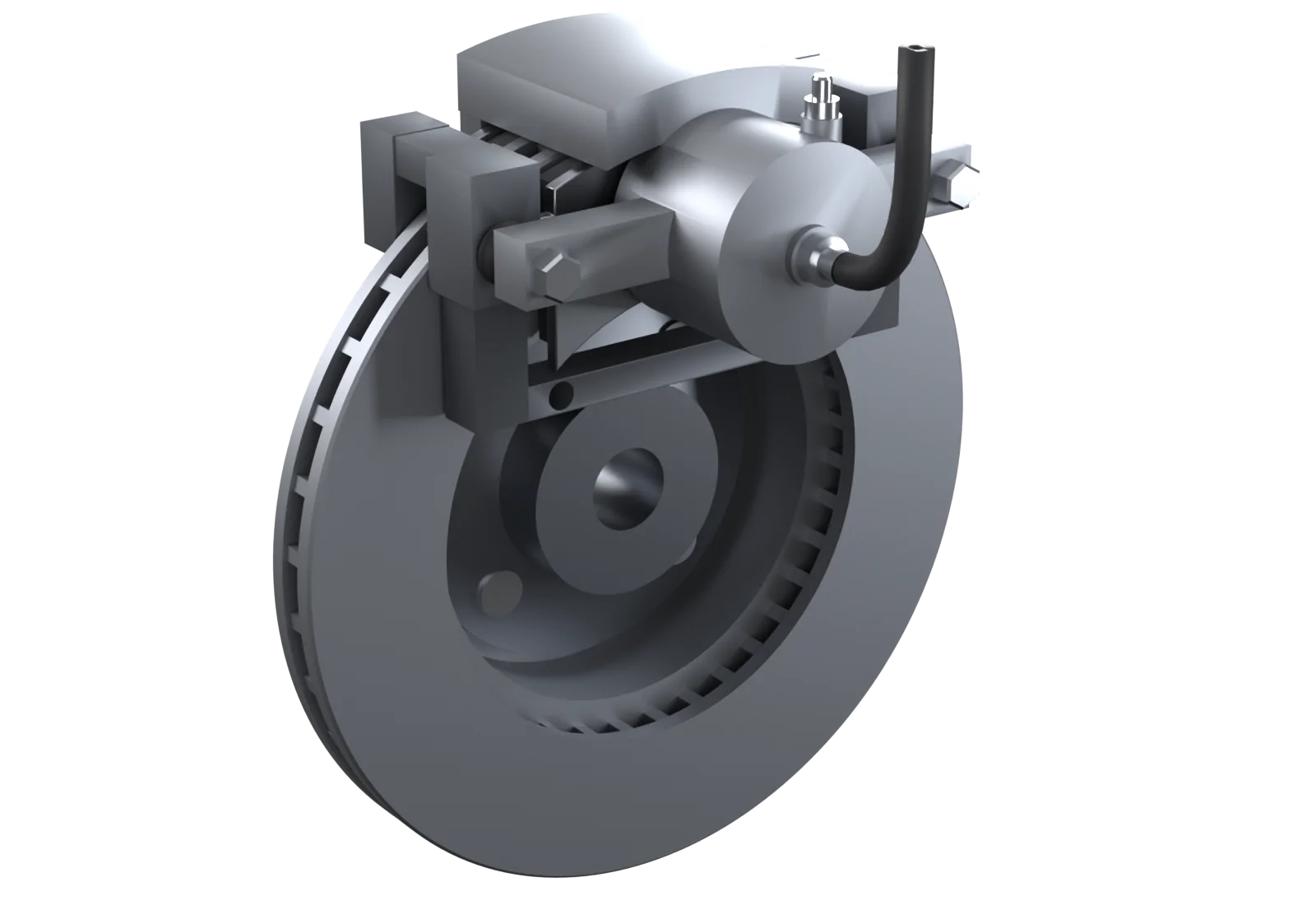
- 1Guide pin boot
- 2Guide pin bolt
- 3Caliper bracket (carrier)
- 4Cooling vents
- 5Brake disc (rotor)
- 6Brake hose
- 7Bleed screw
- 8Caliper body
- 9Wheel hub
What is a disc brake?
A disc brake is a brake in which a caliper squeezes two friction pads against a disc that turns with the wheel. Friction turns the car's motion into heat, and the wheel slows. Cars use hydraulic disc brakes: pressing the pedal sends brake fluid to the caliper, whose piston clamps the pads onto the disc.
Think of stopping a spinning plate by pinching its rim between your thumb and finger. The disc is the plate, the pads are your fingertips and the caliper is your hand. The harder you pinch, and the further from the centre you grip, the faster it stops; the plate also gets hot, which is why a brake's real job is getting rid of heat. Frederick Lanchester patented a disc brake in 1902, and in 1953 a Jaguar C-Type became the first car with disc brakes to win the Le Mans 24 Hours.
Figures come from the worked example on this page and are illustrative, not one car's specification.
What are the parts of a disc brake and their functions?
A disc brake has three main groups of parts: the brake disc (rotor) bolted to the wheel hub; the brake pads, which press on its faces; and the caliper that clamps them, made up of the caliper body, the piston with its seal and dust boot, the bracket and guide pins it slides on, the bleed screw and the brake hose.
Inside a disc brake caliper: labelled cutaway
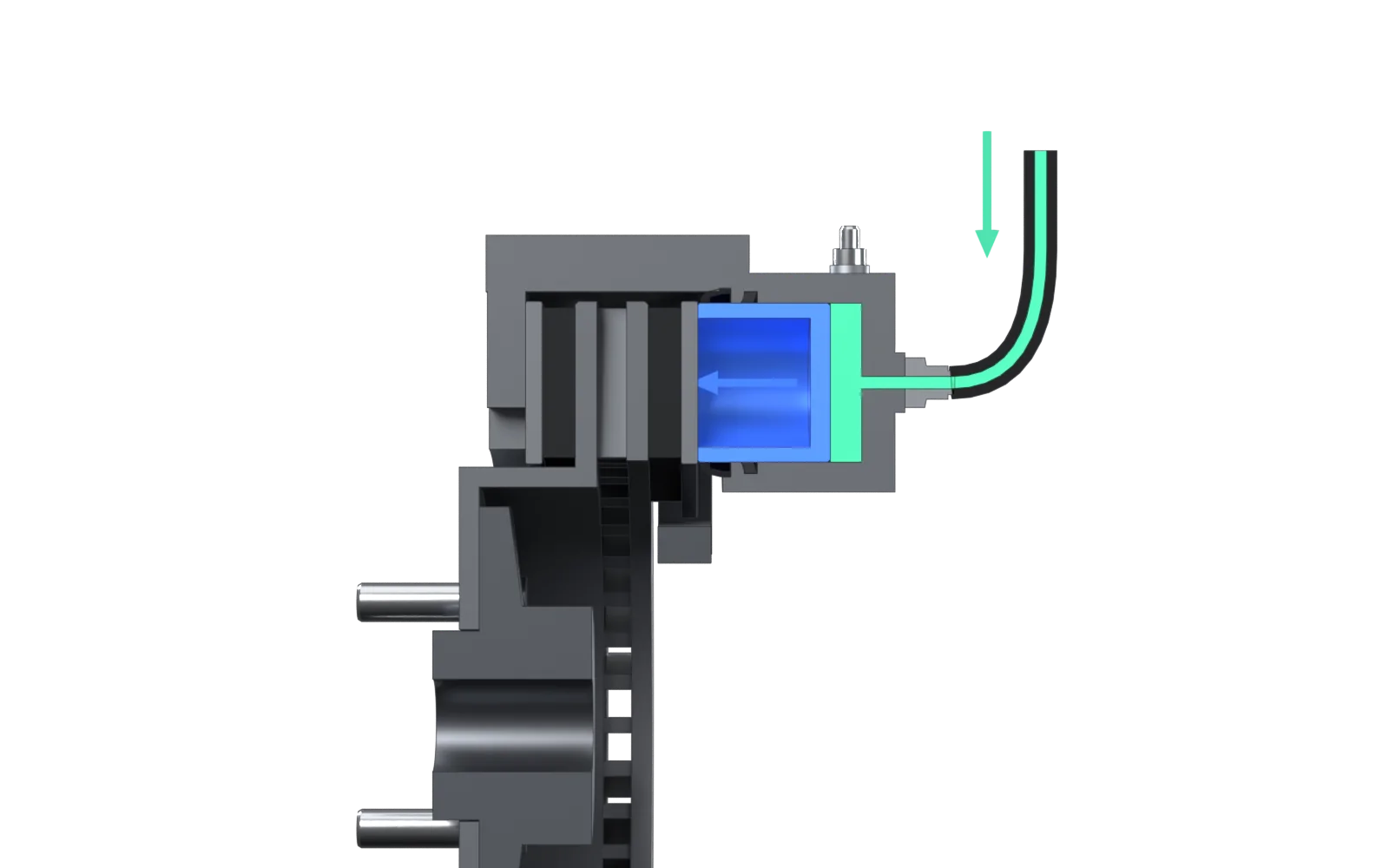
- 1Caliper body
- 2Brake disc (rotor)
- 3Cooling vent
- 4Caliper fingers
- 5Outer pad
- 6Friction material
- 7Disc hat
- 8Caliper bracket
- 9Wheel hub
- 10Wheel stud
- 11Fluid from master cylinder
- 12Bleed screw
- 13Piston seal
- 14Piston
- 15Backing plate
- 16Hose fitting (fluid inlet)
- 17Brake fluid
- 18Dust boot
| Part | What it does |
|---|---|
| Brake disc (rotor) | The cast-iron disc bolted to the wheel hub that turns with the wheel. The pads squeeze its two flat faces. Most discs are grey cast iron, and the disc soaks up most of the braking heat (Brembo says more than 80%). |
| Cooling vanes (ventilated disc) | Internal channels between the disc's two friction faces. As the disc turns it pumps air through them, like a centrifugal fan, which carries the heat away. Front discs on most cars are ventilated; many rear discs are solid. |
| Hat (bell) | The centre of the disc that bolts to the hub, with holes for the wheel studs. The wheel is clamped against it. |
| Caliper body | The cast housing that straddles the disc. On the inboard side it holds the piston bore and fluid inlet; on the outboard side, fingers press on the outer pad. Floating calipers are generally spheroidal graphite cast iron (Brembo). |
| Piston | A hollow steel cup in the caliper bore. Fluid pressure pushes it out against the inner pad's backing plate. Its area turns pressure into clamping force. |
| Piston seal | A square-section rubber ring in a groove in the bore. It seals the fluid in, and it flexes as the piston moves out and springs back when pressure drops, pulling the piston back (Brembo calls this the roll-back function). |
| Dust boot | A rubber cover between the piston and the mouth of the bore. It keeps water and grit off the piston; a split boot lets the piston corrode and seize. |
| Brake pads | Two pads, one on each side of the disc. Each is a steel backing plate with a layer of friction material bonded to it (Hella lists the base plate, glue, underlayer and friction material), often with an anti-noise shim behind. |
| Wear indicator | A spring-steel tab on one pad that starts to scrape the disc and squeal when the friction material is nearly worn out. Some cars use an electric sensor that lights a warning instead. |
| Caliper bracket (carrier) | Bolted to the steering knuckle. It holds the pads at their ends, takes the braking torque from them, and carries the two guide-pin bores. It does not move. |
| Guide pins and boots | Two greased pins bolted to the caliper that slide in the bracket, so the caliper can float sideways. Rubber boots keep dirt and water out. |
| Bleed screw | A small valve at the top of the caliper, opened during servicing to let trapped air out of the fluid. |
| Brake hose and fitting | A flexible hose that brings fluid from the steel brake pipes (and the master cylinder) to the caliper while letting the wheel steer and move with the suspension. |
| Brake fluid | The hydraulic fluid (usually DOT 3, DOT 4 or DOT 5.1) that carries the pedal force to every caliper. It must not boil near hot brakes. |
How does a disc brake work in a car?
Pressing the brake pedal pushes fluid from the master cylinder to each caliper. The pressure pushes the piston out, pressing the inner pad onto the disc; in a floating caliper the reaction slides the caliper body inboard so its fingers press the outer pad onto the other side. Friction at the pads slows the disc and the wheel. On release, the piston seal pulls the piston back.
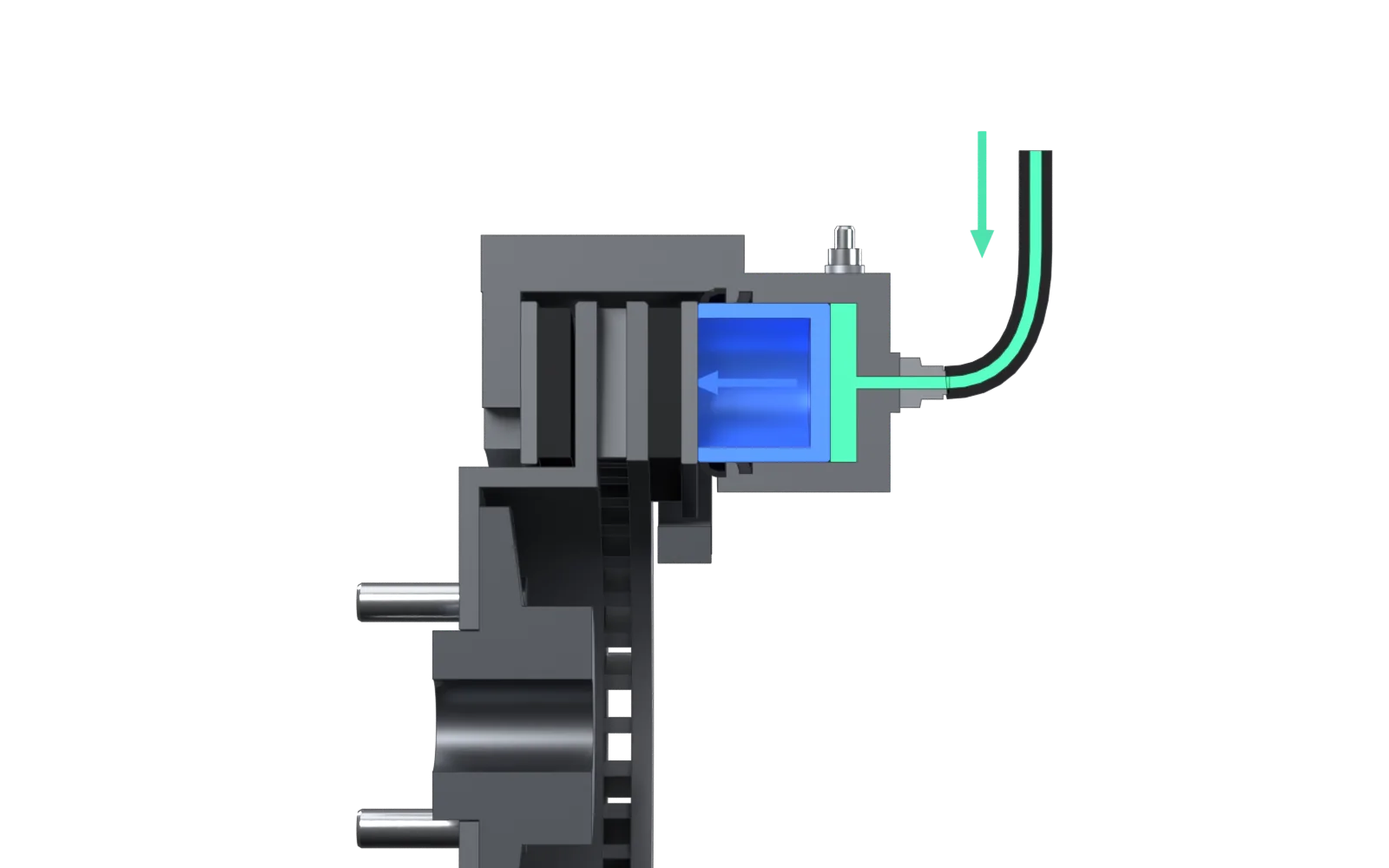
- 1Caliper body
- 2Brake disc (rotor)
- 3Caliper fingers
- 4Outer pad
- 5Friction material
- 6Caliper bracket
- 7Fluid in
- 8Piston seal
- 9Piston moves out
- 10Hose fitting (fluid inlet)
- 11Brake fluid
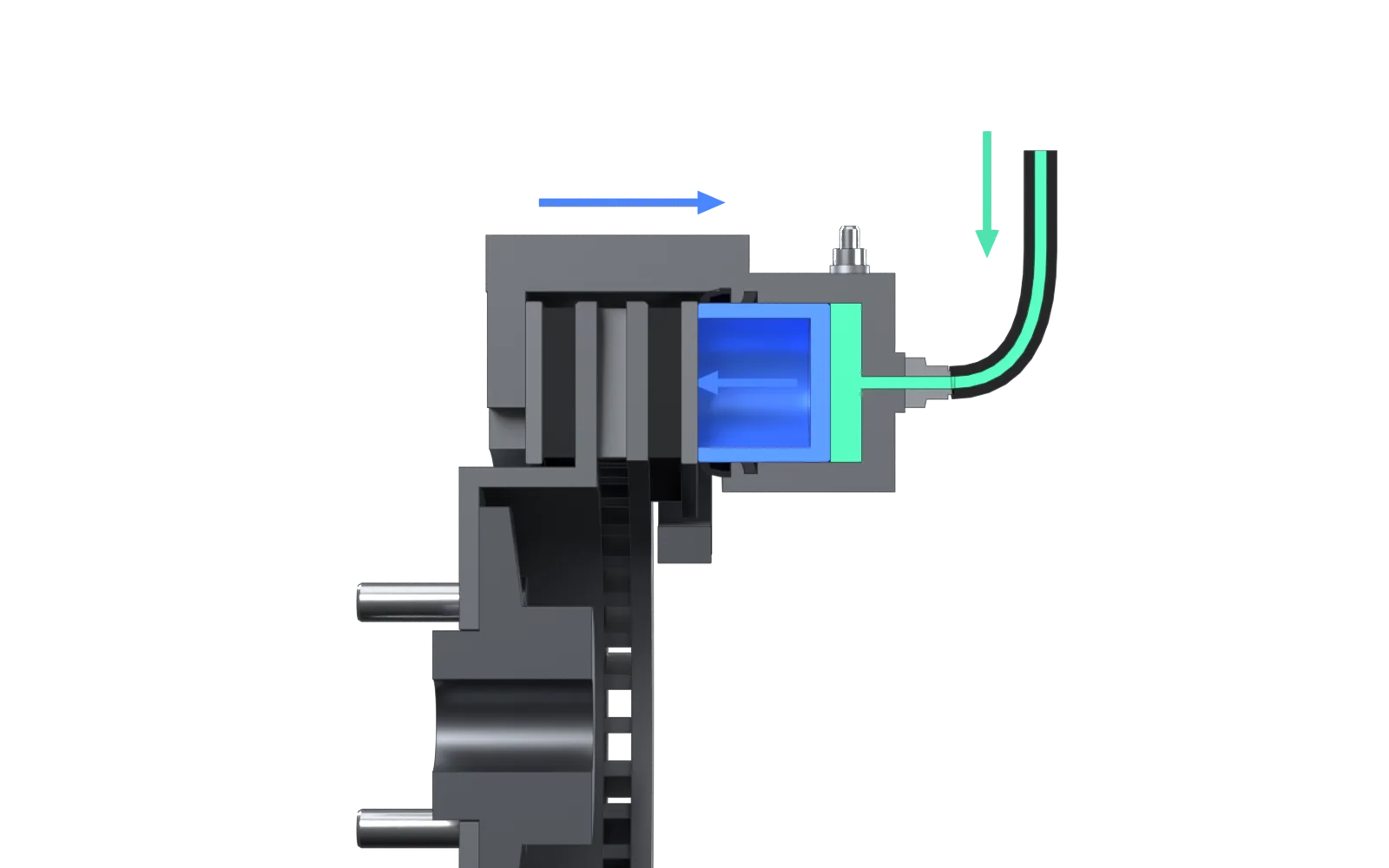
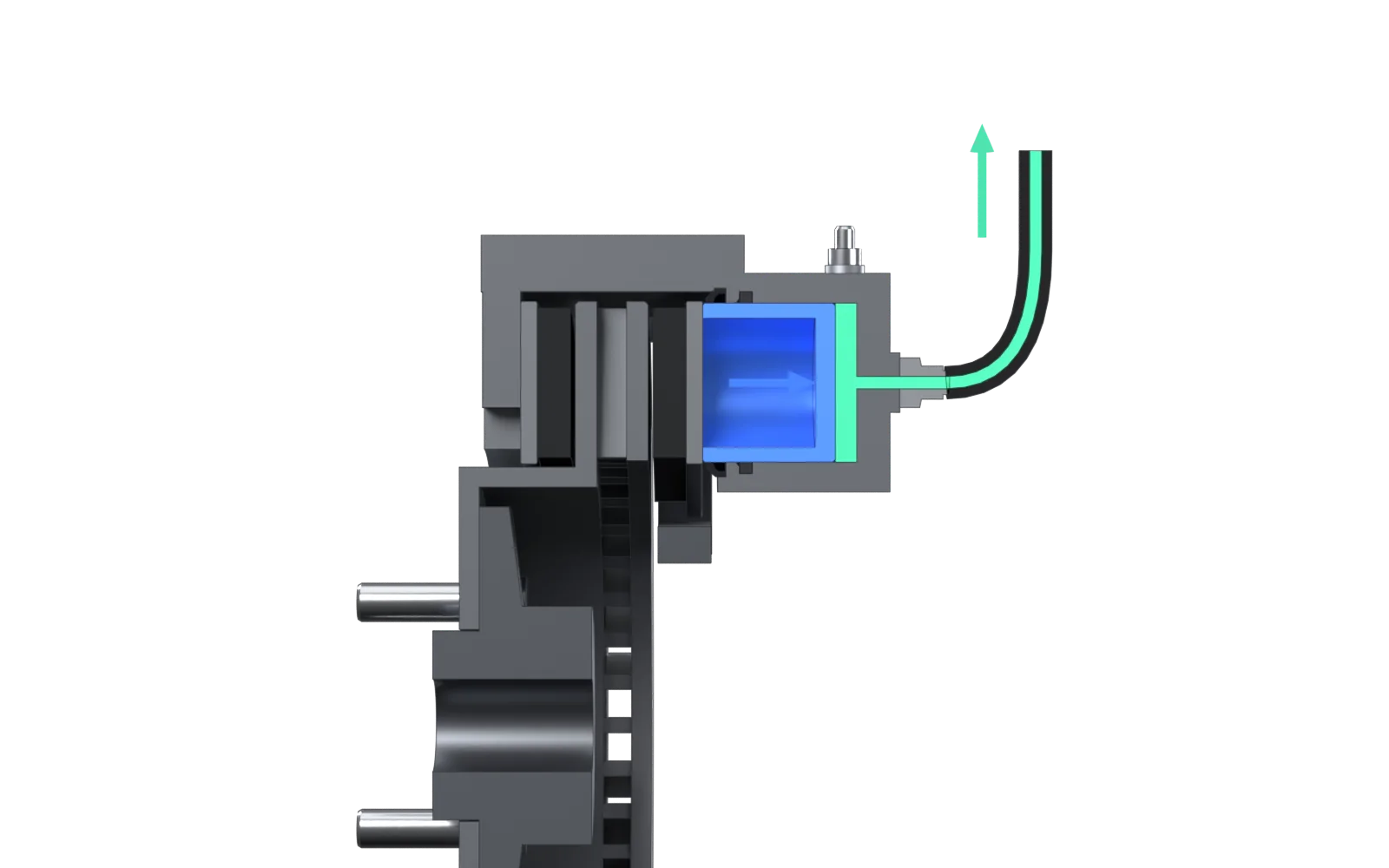
1. Piston pushes the inner pad. Pressing the pedal pushes brake fluid (mint) down the hose into the caliper. The fluid cannot be squashed, so its pressure pushes the piston (blue) out of its bore and the inner pad onto the disc. The square seal in the bore grips the piston and flexes with it. The outer pad still has its gap.
2. Caliper slides, both pads clamp. The same pressure pushes back on the bottom of the bore. Because the caliper body can slide on its guide pins, that reaction moves the whole body inboard, and its fingers pull the outer pad onto the other face of the disc. The disc is now squeezed with equal force from both sides, and friction slows it.
3. Seal pulls the piston back. Release the pedal and the pressure drops. The flexed seal springs back to its square shape and drags the piston back by a fraction of a millimetre, and the caliper floats back off the outer pad, so the pads stop rubbing. As the pads wear, the piston simply slides further through the seal, so the brake adjusts itself.
Schematic: the pad gaps (1.5 mm) and the seal's flex are drawn several times larger than real so you can see them, and not to the same scale as each other; real running clearances are a few tenths of a millimetre. In a real stop, steps 1 and 2 happen together in a split second.
Disc brake working principle, with numbers
Two relations do most of the work. The clamp force is the fluid pressure times the piston area; the braking torque is that force times the friction coefficient µ, times two (one for each face of the disc), times the effective radius at which the pads grip:
For this model's 48 mm piston, . At an assumed 60 bar (6 N/mm²) in a firm stop, . With a friction coefficient of 0.38 (Mercedes-Benz notes original-equipment pads are "well into the 0.30s"; the common "F" grade is 0.35 to 0.45) and the pads centred 103.5 mm from the axle, on each front wheel.
| Step | Value | Note |
|---|---|---|
| Line pressure (assumed, firm stop) | 60 bar | – |
| Clamp force on the disc | 10.9 kN | 181 N for every bar |
| Friction force, both faces (µ 0.38) | 8.3 kN | – |
| Braking torque per front wheel | 854 N m | at the pad centre, 103.5 mm |
| Car deceleration | 7.1 m/s² | 0.72 g |
| Heat into one front disc, stop from 100 km/h | 124 kJ | about +55 °C on average |
On a 1,150 kg car with 0.30 m tyre radius, the two front brakes give 5,694 N of braking force at the road. If the front axle does 70% of the braking, the whole car decelerates at about 7.1 m/s², or 0.72 g. A stop from 100 km/h turns 444 kJ of kinetic energy into heat; each front disc takes 155 kJ, and with 80% of that going into the disc (Brembo says more than 80%), a 4.9 kg disc warms by about 55 °C on average. The friction faces get much hotter than that average, and repeated hard stops add up, which is why discs are ventilated.
Assumed values: line pressure 60 bar, friction coefficient 0.38, car mass 1,150 kg, loaded tyre radius 0.30 m, 70% of braking on the front axle, grey iron density 7.2 g/cm³ and specific heat 460 J/kg K. The disc mass (4.92 kg) is computed from this model's geometry. Real pressures, friction and brake balance vary with the car, pads, temperature and speed. Every number here is checked by a script kept with the model files.
Disc brake exploded view: how the parts fit together
The disc slips over the wheel studs onto the hub. The bracket bolts to the steering knuckle behind the disc and holds both pads. The caliper body fits over the pads, with the piston, seal and dust boot in its bore, and is held by two bolts into the guide pins, which slide in the bracket under their rubber boots.
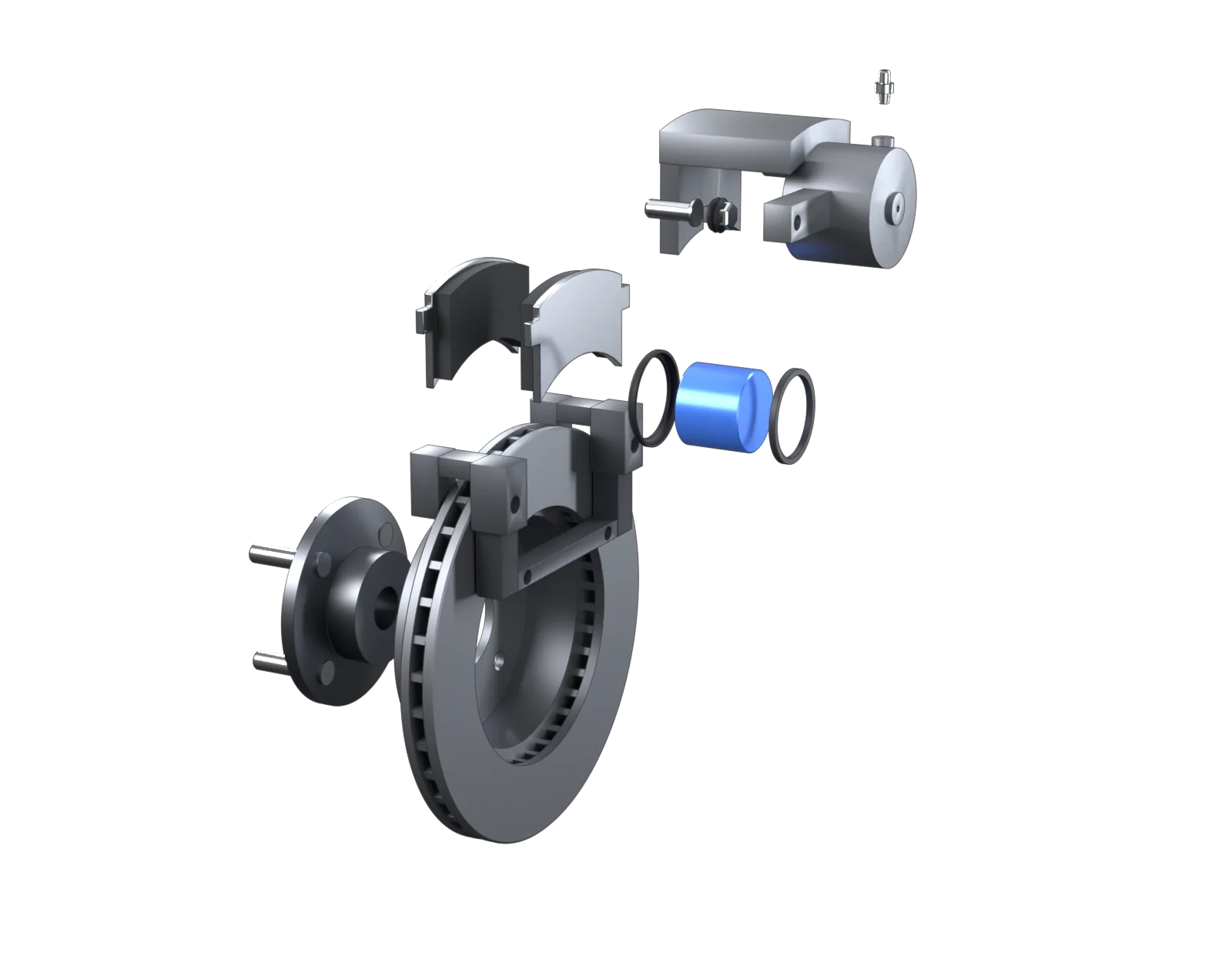
- 1Inner pad
- 2Outer pad
- 3Wear indicator
- 4Piston
- 5Caliper bracket
- 6Wheel hub and studs
- 7Brake disc (rotor)
- 8Bleed screw
- 9Caliper body
- 10Guide pins
- 11Guide pin boots
- 12Dust boot
- 13Piston seal
Disc brake dimensions: wheel-side and top views
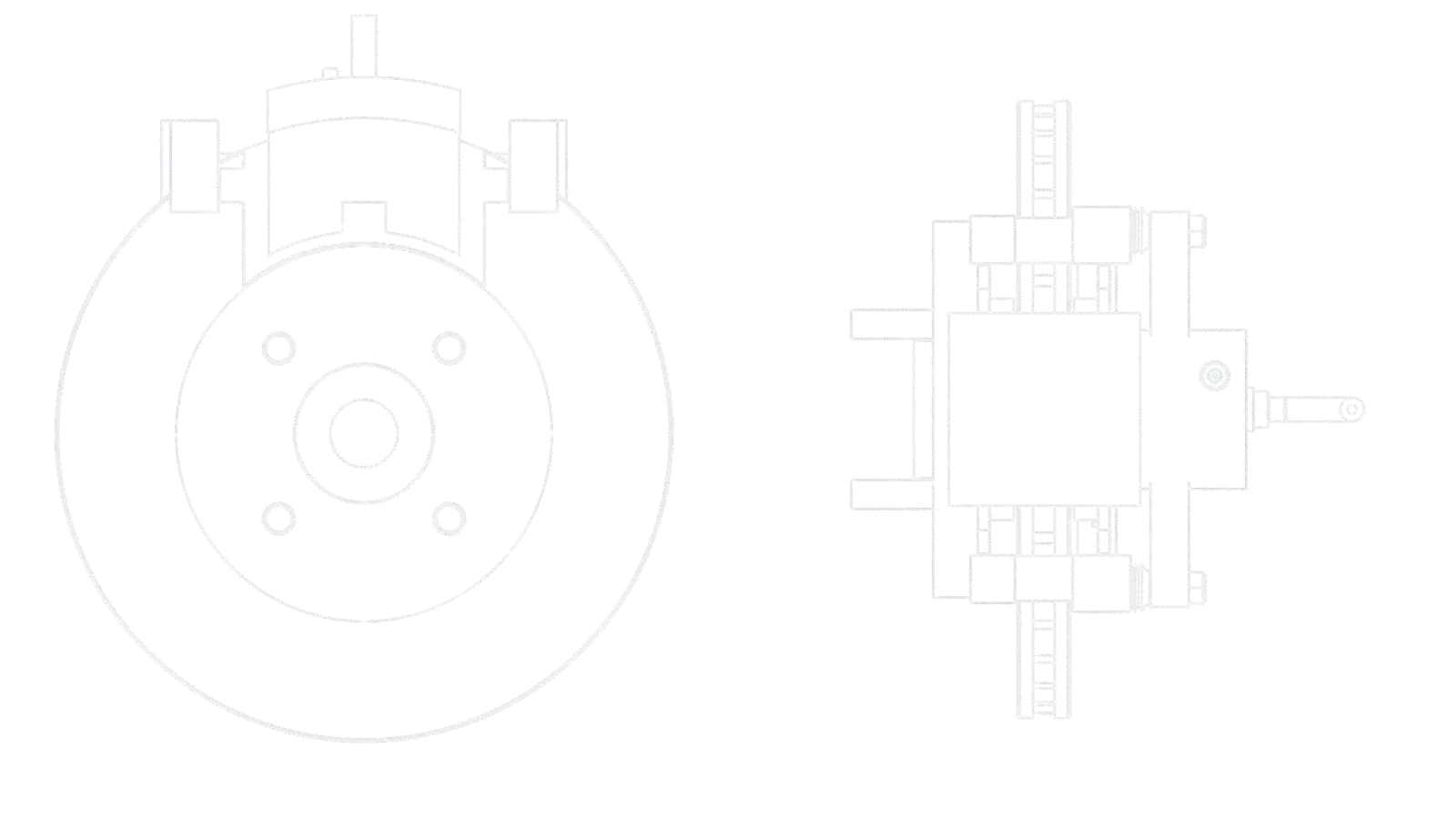
| Dimension | Value | Basis | |
|---|---|---|---|
| A | Disc diameter | 256 mm | This model; the Hyundai i20 (2014-18) front disc is 256 mm (Brembo catalogue) |
| B | Disc thickness, new / minimum | 22 / 20 mm | Same i20 disc: 22 mm new, 20 mm minimum. The Suzuki Swift's front disc is 252 × 20 mm, minimum 18 mm |
| C | Hat face to inboard friction face | 57 mm | This model |
| – | Piston diameter | 48 mm | This model; the Swift's single-piston front caliper is listed at 54 mm |
| – | Pad friction material, new / wear limit | 10 / ~2 mm | This model / Hella's usual wear limit |
| – | Running clearance (nominal) | 0.18-0.35 mm | Continental Teves patent: 0.35 mm for earlier designs, 0.18 mm for its improved seal (drawn as 1.5 mm in the step views) |
What are the types of disc brakes?
Disc brakes are grouped by the caliper (floating or fixed), by the disc (solid, ventilated, or drilled and slotted) and by how they are worked (hydraulic on cars, cable or hydraulic on bikes). Most small cars use a ventilated front disc with a single-piston floating caliper, as modelled here, and a solid disc or a drum at the rear.
| Type | How it differs | Where you find it |
|---|---|---|
| Floating (sliding) caliper (this model) | Piston(s) on the inboard side only; the body slides on guide pins so the reaction clamps the outer pad | Most mass-market cars; Brembo: cheaper, smaller, usually SG cast iron |
| Fixed (opposed-piston) caliper | Bolted rigidly, with pistons on both sides of the disc pushing the two pads | Mid- to high-end and sports cars; usually aluminium, lighter, more even pad wear (Brembo) |
| Solid disc | A single plate of cast iron | Rear brakes of many cars, scooters and motorcycles |
| Ventilated disc (this model) | Two friction faces with cooling vanes or pillars between them that pump air through as the disc turns | Front brakes of most cars |
| Drilled or slotted disc | Holes or grooves in the friction faces | Performance cars and motorcycles |
Floating caliper vs fixed caliper
A floating caliper uses fewer pistons and relies on sliding guide pins, which makes it cheaper and more compact; a fixed caliper pushes both pads with its own pistons, so it is stiffer, lighter when made of aluminium and wears the pads more evenly. The catch with a floating caliper is that its guide pins must slide freely: Hella warns that sluggish or seized pins cause uneven pad wear and one-sided braking.
| Floating caliper | Fixed caliper | |
|---|---|---|
| Pistons | Usually one or two, inboard side only | On both sides of the disc |
| Mounting | Slides on two guide pins in a bracket | Bolted rigidly to the knuckle |
| Material (Brembo) | Generally spheroidal graphite cast iron | Generally aluminium alloys |
| Strengths | Cheaper, smaller, robust | Lighter, more even pad wear, less residual drag |
| Typical use | Most hatchbacks, sedans and SUVs | Sports and premium cars |
Disc brake vs drum brake in a car
Disc brakes cool better and work better in the wet, because the disc is open to the air and water is flung off it; drum brakes are cheaper. Hyundai India notes that discs are common on the front wheels of most of its models, while drums are usually found on the rear wheels of some cars.
| Disc brake | Drum brake | |
|---|---|---|
| How it brakes | Pads squeeze a disc from both sides | Shoes press outward on the inside of a drum |
| Heat | Open design sheds heat well | Heat builds up inside the drum |
| Wet roads | Water is thrown off the disc quickly | Water can stay inside the drum |
| Cost | Higher | Lower |
| Where on a car | Front wheels, often all four | Rear wheels of many smaller cars |
Brake pads and brake fluid: what to know
Brake pads are graded by friction: on the common SAE J866 edge code, "E" pads have a friction coefficient of 0.25 to 0.35 and "F" pads 0.35 to 0.45. Brake fluid must stay liquid when the brakes are hot, so each DOT grade has a minimum boiling point, new ("dry") and after it has absorbed water ("wet").
| Fluid grade (FMVSS 116) | Minimum dry boiling point | Minimum wet boiling point |
|---|---|---|
| DOT 3 | 205 °C | 140 °C |
| DOT 4 | 230 °C | 155 °C |
| DOT 5.1 | 260 °C | 180 °C |
The wet figure is the one that matters as a car ages: Motul notes the wet test represents fluid after about a year of use. Use the grade printed on the reservoir cap or in the owner's manual.
Common disc brake problems and their symptoms
The usual disc brake problems are squeal, judder, uneven pad wear from seized guide pins or a sticking piston, and fade or a soft pedal when the pads or the fluid overheat. Most can be traced to one part of the caliper.
| Problem | Likely cause | What you notice |
|---|---|---|
| Squeal | Vibration of the pads or caliper (300-5,000 Hz, Ferodo): a sticking piston or slides, wrongly fitted pads or shims, or the wear indicator touching the disc | High-pitched noise when braking |
| Judder | Disc thickness variation; Delphi gives about 0.015 mm as the maximum allowable variation | Pulsing pedal or steering wheel when braking |
| Seized guide pins | Dirt, old or wrong grease, split boots | Uneven pad wear, pulling to one side, overheating (Hella) |
| Seized floating caliper or sticking piston | Corrosion behind a damaged dust boot | Inner pad wearing much faster than the outer; brake dragging (Know Your Parts) |
| Fade | Pads overheated on long or repeated hard stops | Less braking for the same pedal effort |
| Vapour lock | Old fluid that has absorbed water boils | Soft, sinking pedal; change fluid every two years (Brembo) |
Where are disc brakes used?
On the front wheels of almost every modern car, and on all four wheels of many; on motorcycles, scooters and bicycles; and on trains, aircraft wheels and industrial machines. Bikes use the same principle as this model, usually with a solid disc and either a floating or a fixed caliper. In India, car braking is approved to AIS-151, which is aligned with the UN regulation R13-H.
Disc brake interview and viva questions
How does a floating caliper clamp both pads with a piston on only one side?
By Newton's third law. Fluid pressure pushes the piston towards the disc and pushes equally hard on the bottom of the bore the other way. The caliper body is free to slide on its guide pins, so that reaction pulls the body inboard until its fingers press the outer pad onto the disc. In steady braking the two clamp forces are equal.
What pulls the pads back off the disc when you release the brake?
Mainly the square-section piston seal. It deforms as the piston moves out and springs back when the pressure drops, pulling the piston back slightly. A Continental Teves patent puts typical running clearances at about 0.18 to 0.35 mm. Because the piston slides through the seal when the pads wear, the brake adjusts itself automatically.
Why do front brakes have bigger discs than rear brakes?
When a car brakes, weight transfers to the front axle, so the front tyres can carry most of the braking force. Our worked example assumes the front axle does 70% of the braking; the front brakes therefore need more torque and must absorb more heat, which is why they get larger, ventilated discs.
What is the difference between brake fade and vapour lock?
Brembo defines fade as a temporary loss of braking because the pads overheat: gases form between pad and disc and the friction coefficient falls. Vapour lock is when the brake fluid boils, forming vapour bubbles that compress, so the pedal goes soft. One is a friction problem, the other a hydraulic one.
What causes brake judder?
Usually disc thickness variation (DTV): if the disc is thicker in some places, the pads are pushed apart and spring back once per turn, which you feel through the pedal and steering. Hella says thickness differences of only 0.012 to 0.015 mm can already cause judder. Delphi also recommends keeping disc run-out below about 0.05 to 0.10 mm.
About this 3D model
This is a teaching model of a small car's front disc brake, not a CAD replica of a product. The disc is sized like the Hyundai i20's 256 × 22 mm ventilated front disc, with 36 straight radial vanes, and the caliper is a single-piston floating type with a 48 mm piston, two guide pins and a carrier bracket. Simplifications: the steering knuckle, the brake pipe and the pad shims and anti-rattle clips are not drawn, the caliper and bracket are blockier than real castings, and the pad gaps and seal flex are exaggerated in the step views. Skill-Lync modelled and rendered it in Blender entirely from code, so it can be checked and re-rendered.
Related Skill-Lync courses and reading
- Vehicle Dynamics using MATLABBraking, load transfer and tyre forces, modelled and simulated in MATLAB.
- Automotive Safety StandardsThe regulations cars are tested against, from brakes and crash to occupant safety.
- Basics of FEA: Explicit and ImplicitThe finite element methods used to check parts like discs and calipers for stress and heat.
- Suspension Design using ADAMSThe corner the brake bolts onto: knuckles, links and how they move.
- Automobile engineering book, chapter 17: brakes (drum, disc, hydraulic and air)
- Structural analysis of a disc brake and brake pad assembly
- How regenerative braking works
- Air brakes on heavy vehicles
- MacPherson strut in 3D: the suspension the brake bolts to
- Turbocharger in 3D: parts, cutaway and how it works
- Carburetor in 3D: parts, cutaway and how it works
- More parts in 3D: all engineering components
FAQs
What are the main parts of a disc brake?
A car disc brake has a brake disc (rotor) that turns with the wheel, two brake pads, and a caliper that squeezes the pads onto the disc. The caliper holds one or more hydraulic pistons with their seals and dust boots, and on most cars it slides on two guide pins in a bracket bolted to the steering knuckle. A hose brings brake fluid to it and a bleed screw lets air out.
How does a disc brake work?
Pressing the pedal pressurises brake fluid, which pushes the caliper piston out. The piston presses the inner pad onto the disc, and in a floating caliper the reaction slides the caliper body so its fingers press the outer pad onto the other side. Friction between the pads and the spinning disc turns the car's motion into heat, which slows the wheel.
What is the difference between a floating and a fixed caliper?
A floating caliper has its piston (usually one or two) on the inner side only and slides on guide pins, so the reaction pulls the outer pad in. A fixed caliper is bolted rigidly and has pistons on both sides of the disc. Brembo says floating calipers are cheaper and smaller, while fixed calipers, usually aluminium, are lighter, wear the pads more evenly and are used on mid- to high-end and sports cars.
Disc brake vs drum brake: which is better in a car?
Disc brakes get rid of heat better because they are open to the air, and they recover faster in the wet because water is flung off the disc. Drum brakes cost less. That is why most cars, Hyundai India notes, use discs on the front wheels, which do most of the braking, and many smaller cars still use drums at the rear.
When should brake pads and discs be replaced?
Replace pads before the friction material wears down to its limit, which Hella puts at usually about 2 mm; a squealing wear indicator or a dashboard warning tells you it is close. Replace discs when they are worn below the minimum thickness stamped on them (MIN TH), measured at four or more points, and always in pairs on the same axle.
Which brake fluid is used in cars, and why change it?
Most cars use DOT 3, DOT 4 or DOT 5.1 fluid; use the grade in the owner's manual. The fluid absorbs water from the air over time, which lowers its boiling point: DOT 4 must boil above 230 °C when new but only above 155 °C in the 'wet' test. Brembo recommends changing it every two years or as the car maker says.
Who invented the disc brake?
Frederick Lanchester patented a disc brake in 1902 in Britain. Disc brakes became famous in 1953, when a Jaguar C-Type with Dunlop disc brakes became the first car fitted with them to win the Le Mans 24 Hours.
Sources
- Brembo: brake caliper technology and operation (floating vs fixed calipers, materials, seal roll-back and knock-back)
- Hella TechWorld: floating calliper guide pins (how the reaction moves the caliper; seized pins) · the disc brake pad · brake pad wear indicator · brake disks
- Brembo: vane vs pillar ventilation (more than 80% of the heat goes into the disc) · minimum disc thickness · fade vs vapour lock
- Brembo 09.C171.11 disc for the Hyundai i20 (256 × 22 mm, minimum 20 mm) · Brembo catalogue, Suzuki Swift V (252 × 20 mm disc, 54 mm single-piston caliper)
- 49 CFR 571.116 (FMVSS 116) (brake fluid boiling points) · Motul DOT 5.1 datasheet
- Mercedes-Benz, "Friction" (2019) (SAE J866 pad friction codes) · US patent 5,076,593 (Continental Teves) (running clearance)
- Ferodo: explaining brake noise · Delphi: brake judder · Know Your Parts: servicing brake calipers
- Hyundai India: disc brake vs drum brake · TÜV: India AIS-151
- Motor Sport: disc brakes (Lanchester's 1902 patent) · 24 Hours of Le Mans: Jaguar's 1953 disc-brake win