Will AI Replace Mechanical Engineers? The Skills You Need to Work Alongside AI Agents
No credible source predicts AI replacing mechanical engineers, but the tasks in a fresher's week are changing fast. Here is what the evidence says, which tasks agents are taking over, a worked example of catching a wrong AI answer with a hand calculation, and a 90-day skills plan.
 Skill-Lync·25 Oct 2026·10 min read
In short
- No credible source we found predicts AI replacing mechanical engineers. Employers, researchers and the AI vendors themselves describe engineers staying in charge.
- What is changing is the task mix. Repetitive modelling, pre-processing, standard checks and report writing are being automated first. Those tasks fill much of a fresher's week today.
- The skills that grow in value are the ones AI is weakest at: physics fundamentals, setting up the problem correctly, checking answers, and taking responsibility for them.
- Add two practical skills on top: driving your engineering tools with Python, and enough data literacy to judge an AI model. The plan at the end of this post shows how in 90 days.
If you are studying mechanical engineering or starting your first job, you have probably asked this question. AI writes code, drafts reports and now sets up simulations. Is there still a career in designing and analysing physical things?
Yes. But the job you get will not look exactly like the one your seniors started in. This post looks at the evidence, then gets practical about what to learn.
What the evidence says
Employers: skills shift, not disappearance
The World Economic Forum's Future of Jobs Report 2025 surveyed more than 1,000 employers representing over 14 million workers. Its findings relevant to engineers:
- Workers can expect about 39% of their existing skills to be transformed or become outdated between 2025 and 2030.
- AI and big data top the list of fastest-growing skills, followed by networks and cybersecurity and technological literacy.
- Analytical thinking remains the most sought-after core skill, with seven in ten companies calling it essential.
- Autonomous and electric vehicle specialists are among the fastest-growing jobs, alongside renewable energy and environmental engineers.
- Two-thirds of employers plan to hire people with specific AI skills, while 40% expect to reduce staff where AI can automate tasks.
Read together: the work is shifting towards people who can think analytically and use AI, and away from tasks that can be automated.
Engineering leaders and vendors: engineers stay in the driver's seat
IEEE Spectrum's April 2026 report on physics AI found that everyone it spoke to, including the companies selling the technology, expected human design engineers to remain in charge. Neural Concept's managing director told the magazine: "We still need engineers more than ever." Siemens, launching an agent that writes PLC code, said its goal "is not to replace engineers, but to shorten repetitive, error-prone phases". At GE Appliances, which runs hundreds of agents on its shop floor, the logistics vice president said the company manages them "the same way we manage people", because they can drift and make mistakes.
McKinsey's 2025 R&D Leaders Forum recap put the direction in one line: as agentic AI matures, "engineers will shift from task execution to orchestration."
Researchers: AI speeds up the standard, not yet the subtle
Machine Design asked Kai Lin Woon, an associate professor at the University of Malaya, what AI means for mechanical engineers. His view: AI accelerates the simple and the standard, but not yet the subtle, complex and novel, and on complex tasks the need to review AI output can slow work down. He expects engineers' work to shift towards "defining the real-world goal, the limits, the safety requirements and the tests that a solution must pass", and stresses that every mechanical engineer should be able to check AI answers against physical reality.
Which tasks are changing
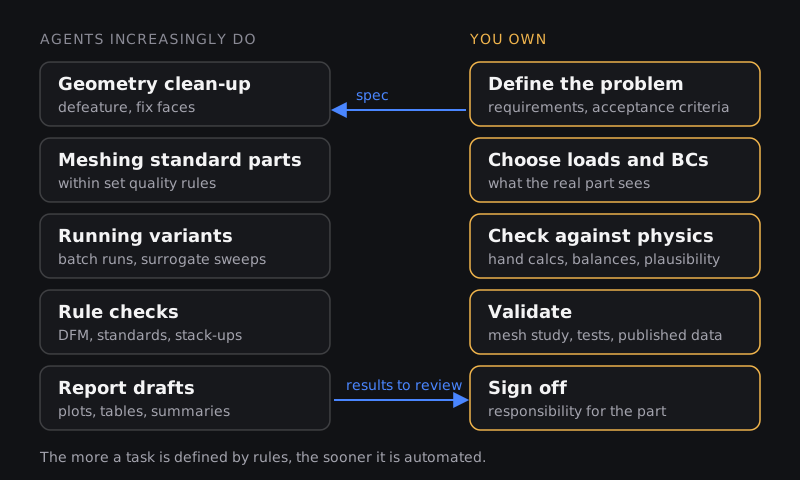
| Task | What AI tools already do | What stays with you |
|---|---|---|
| Geometry clean-up and pre-processing | Defeaturing, meshing standard parts, setting up repeat load cases (simulation agents from SimScale, Rescale and others) | Deciding which features matter to the physics |
| Simple part modelling | Text-to-CAD for prismatic parts; copilots that execute CAD commands | Design intent, sheet-metal and casting rules, tolerancing |
| Running simulation variants | Batch runs, surrogate models that answer in seconds | Choosing what to explore and judging the trade-offs |
| Design and drawing checks | DFM flags, standards checks, tolerance stack-ups (review agents) | Knowing the rules and deciding which flags matter |
| Reports and documentation | Drafting reports, specifications and summaries | The recommendation and the signature |
| Problem definition | Little; it fills gaps with guesses | Loads, boundary conditions, requirements, acceptance criteria |
| Verification and validation | Automatic checks such as convergence and mass balance | Hand calculations, test correlation, judging plausibility |
The pattern is consistent: the more a task is defined by rules, the faster it is being automated. The more it needs judgement about the physical world, the longer it stays human.
Worked example: catching a wrong AI answer with a hand calculation
This is the single most valuable habit you can build, so here it is in full. The scenario is an illustration.
An AI agent sets up and runs an FEA check on a steel cantilever bracket arm and reports:
Max von Mises stress: 60 MPa
Tip deflection:       0.76 mm
Material:             IS 2062 E250, yield 250 MPa
Factor of safety:     4.2   PASS
The arm is 200 mm long, with a solid rectangular section 20 mm wide and 10 mm deep, fixed at one end, with 1 kN at the free end acting across the 10 mm depth. Steel has E ≈ 210 GPa. Before accepting the report, check it with beam theory:
- Second moment of area: I = b·h³ / 12 = 20 × 10³ / 12 = 1,667 mm⁴
- Bending moment at the fixed end: M = F·L = 1,000 N × 200 mm = 200,000 N·mm
- Bending stress: σ = M·c / I = 200,000 × 5 / 1,667 ≈ 600 MPa (c = h/2 = 5 mm)
- Tip deflection: δ = F·L³ / (3·E·I) = 1,000 × 200³ / (3 × 210,000 × 1,667) ≈ 7.6 mm
The hand calculation gives 600 MPa and 7.6 mm. The agent reported 60 MPa and 0.76 mm. Both are exactly ten times too low.
That pattern is a clue. Stress and deflection both scale linearly with load, so a clean factor of ten in both points to the load: the model almost certainly applied 100 N instead of 1,000 N, perhaps through a unit slip. And the real answer changes the decision completely. At 600 MPa, the factor of safety is 250 / 600 ≈ 0.42. The bracket does not have a comfortable margin; it yields.
Two minutes of beam theory caught an error that a colour plot and a confident "PASS" would have hidden. (The FEA peak at the fixed root will be somewhat higher than 600 MPa because of stress concentration; the hand calculation's job is to get the order of magnitude right.) Our guide to FEA basics has a similar worked example with a plate.
Six skills that make you more valuable alongside AI
1. Physics and hand calculations
Strength of materials, fluid mechanics, heat transfer, dynamics. The worked example above is the whole argument: if you cannot estimate the answer, you cannot tell when the AI is wrong. Keep a notebook of standard checks (beams, pressure vessels, pipe flow, fin heat transfer) and use them on every result.
2. Problem definition
Loads, boundary conditions, materials, operating cases, acceptance criteria. Practitioners quoted in Digital Engineering warn that an underdefined request to an AI tool forces it to fill the gaps, which is where hallucinated results start. Writing a precise specification is now a technical skill, not paperwork.
3. Verification and validation
Mesh studies, convergence checks, force and mass balances, comparison with tests and published data. Agents make it cheap to produce results, so the ability to show a result is right becomes the scarce part. See our explainer on mesh quality and convergence.
4. Python and tool automation
Almost every engineering agent works by scripting the tools: PyAnsys, OpenFOAM case files, NX Open, Fusion's API. If you can write and read those scripts, you can direct an agent, check what it did and automate your own work. Start with Python for Mechanical Engineers; for CAE-specific automation, the PG Program in Automation & Pre-Processing for FEA & CFD Analysis goes further.
5. Data literacy for physics AI
Surrogate models are trained on simulation data. To use them responsibly you need to understand training and validation sets, error metrics and the envelope a model was trained in. You do not need to become a data scientist. Machine Learning Fundamentals In Depth covers the basics, and our post on surrogate models vs solvers shows how they are checked.
6. Depth in one domain
General AI tools are broad. Value sits in depth: crash and safety, CFD and thermal, EV battery packs, vehicle dynamics, sheet-metal and BIW design. The WEF's fastest-growing roles include EV and autonomous vehicle specialists. Pick one domain and get good enough to be the person who checks the AI there.
Underneath all six sits communication: explaining what you checked, what you assumed and what you recommend, in plain language, to people who will build the part.
A 90-day plan
| Weeks | Focus | Output you can show |
|---|---|---|
| 1 to 4 | Fundamentals and one tool. Revise strength of materials or fluid mechanics. Learn one CAE tool properly (for example Ansys Mechanical or OpenFOAM). | Three small analyses, each with a hand-calculation check written beside it |
| 5 to 8 | Automate that tool with Python. Script a parameter sweep. Use an AI assistant to help write the scripts, and verify every line it gives you. | A script that runs ten variants and plots the results, plus notes on what the AI got wrong |
| 9 to 12 | One portfolio project done properly: problem definition, mesh study, validation against published data or a test, and a two-page report. | A project you can defend line by line in an interview |
In interviews, the strongest answers in 2026 sound like this: "I used an AI assistant to write the sweep script. It got the units wrong on the pressure load, which I caught because the reaction forces did not balance. Here is my mesh study." That shows the tool skill and the judgement in one breath.
A note for engineering students in India
If your first role is likely to be CAD modelling, meshing or running standard analyses, a common starting point in engineering design and analysis services, know that these are the tasks AI tools are aimed at first. Expect that work to change sooner than roles built around testing, manufacturing or system integration.
That is a reason to start early, not to switch fields. The same tools are being built in India too: engineering.com's 2026 feature on surrogate models included SimulationHub, from Pune's Centre for Computational Technologies, which trained valve CFD surrogates on 20,000 simulations. Teams like that need engineers who understand both the physics and the AI.
Frequently asked questions
Will AI take away fresher CAD and CAE jobs?
It will take away a share of the routine tasks those jobs are built on, such as simple modelling, meshing and report formatting. Roles will increasingly expect freshers to set up problems, check results and automate work. Freshers who show those skills will be in a stronger position, not a weaker one.
Should I switch from mechanical engineering to software or data science?
Not because of AI alone. The evidence points to demand for people who combine domain knowledge with AI and data skills. A mechanical engineer who can script and validate is harder to replace than a generalist on either side.
Do I need to learn prompt engineering?
Learn to write precise specifications: units, loads, boundary conditions, acceptance criteria. That is what makes AI tools work well, and it is a core engineering skill anyway.
Is CAE still a good career in 2026?
Yes, with a shift in emphasis. Running the solver is becoming easier; defining the problem, judging the mesh and validating the result are becoming more valuable. See what a fresher needs to know about becoming an FEA engineer.
Which programming language should a mechanical engineer learn?
Python first. It is the scripting language of PyAnsys, most OpenFOAM tooling, CAD APIs such as CadQuery, and nearly all machine-learning work. MATLAB remains common in controls and vehicle dynamics.
Sources and further reading
- World Economic Forum, The Future of Jobs Report 2025: Digest (January 2025)
- IEEE Spectrum, AI Models Trained on Physics Are Changing Engineering (Dina Genkina, 9 Apr 2026)
- Machine Design, Will AI Replace Programmers? What Elon Musk's Prediction Means for Mechanical Engineers (Treena Hein, 13 Jul 2026)
- Siemens, The new AI agent doesn't just make suggestions (press release, 19 Jun 2026)
- engineering.com, Inside GE Appliances' AI agent rollout (28 May 2026)
- engineering.com, How real engineers are using AI surrogate models for simulation (21 Sep 2026)
- McKinsey & Company, Breakthroughs in AI-augmented R&D: Recap from the 2025 R&D Leaders Forum (22 Sep 2025)
- Digital Engineering 24/7, Catching Your AI's Hallucination (Kenneth Wong, 30 Jun 2026)