AI Surrogate Models vs CFD and FEA Solvers: When Can You Trust Physics AI?
GM now gets a drag estimate in minutes instead of two weeks, and a crash result in under a minute instead of 15 hours. Physics AI is real, but it only knows what it was trained on. Here is how surrogate models are built, a worked validation, the break-even maths and a checklist for when to trust one.
 Skill-Lync·25 Oct 2026·11 min read
In short
- A surrogate model is a machine-learning model trained on past simulation (and sometimes test) results. It predicts new results in seconds instead of hours, without solving the physics again.
- The speed-ups are real. GM told IEEE Spectrum its in-house model gives a drag coefficient in minutes instead of a two-week simulation loop, and an AI method cut a front-crash computation from 15 hours to under a minute.
- A surrogate is only reliable inside the range of designs and physics it was trained on. Outside that range it can be confidently wrong, with no warning.
- Use surrogates to explore many designs early. Use a trusted solver, and then a test, to confirm the few designs you will build.
For forty years, simulation has been replacing physical prototypes. Now a new layer is starting to replace some of the simulations. The industry calls these tools surrogate models, AI physics or, at the larger end, large physics models. Every major CAE vendor and several well-funded start-ups now sell one.
For a CFD or FEA engineer, the useful question is not "is this the future?" It is "when can I put my name on a number that came out of one?" This guide answers that, with the evidence and the arithmetic.
What a surrogate model is
A solver works the answer out from the laws of physics every time. Give it a new shape and it builds a mesh and solves millions of equations, which is why a CFD run can take hours.
A surrogate works more like an experienced engineer's intuition. It has seen thousands of past answers and learned the pattern linking shape and inputs to outputs. Give it a new shape and it predicts the answer in seconds, without solving anything. Like intuition, it is excellent for designs similar to ones it has seen, and unreliable for anything genuinely new.
Ansys principal engineer Felipe Mercado, speaking to engineering.com, separates two kinds:
- Parametric surrogates take a handful of numbers (pressure, inlet diameter, valve length) and predict an output. They suit sensitivity studies and optimisation around known variables.
- Geometric surrogates take the shape itself, as a mesh or point cloud, and predict fields such as surface pressure or stress. They suit problems where the topology changes and a few scalars cannot describe the design.
At the large end, IEEE Spectrum describes "large physics models" built with three families of neural network: transformers (the architecture behind large language models), geometric deep learning (networks that read 3D meshes directly, the way image networks read pixels) and neural operators (networks that learn how a whole solution field responds to its inputs, rather than predicting one number).
What the evidence says
Automotive: drag and crash at GM
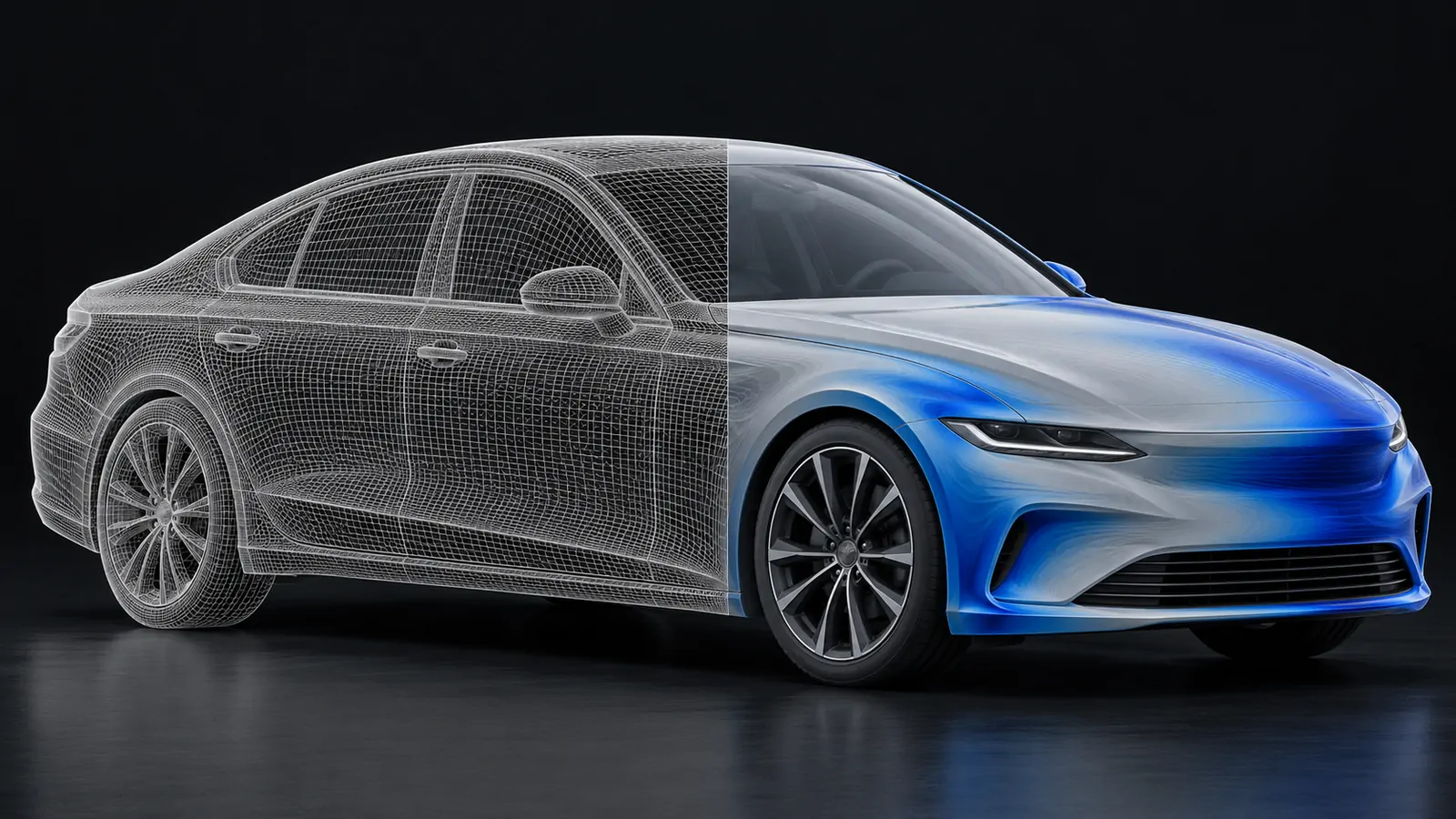
IEEE Spectrum reported in April 2026 that GM had trained an in-house large physics model on its own aerodynamics simulation results. Previously, a design studio's concept went to aerodynamics specialists and the drag result came back after about two weeks. Now the model takes a 3D car shape and returns a drag coefficient in minutes, so designers and aerodynamicists can iterate together in the same room.
Two details from that report matter more than the speed. GM keeps separate models for different vehicle types, such as SUVs and sedans. And GM's director of virtual integration engineering said accuracy is not a big concern at the design stage, but when the drag figure feeds the energy calculation behind the official efficiency label, a physical model goes into a wind tunnel.
In a June 2026 Spectrum article, GM also said that an AI method had cut a front-end crash computation that used to take 15 hours to under a minute, letting engineers look at scenarios that would be impractical to test physically.
The vendors' range of views
The companies selling these tools disagree about how far they go. In the same Spectrum piece, PhysicsX's chief executive said inference can be "anywhere between 10,000 to close to a million times faster" than simulation, depending on the physics and resolution, and that the aim is to take numerical simulation out of the workflow. Neural Concept's managing director said simulation will never be fully replaced, only used more selectively. Treat both as positions, not results.
Neural Concept's CEO, Pierre Baqué, also warned in a 2025 essay that judging surrogates like solvers on toy benchmarks misleads, because data-driven models do not generalise the way physics codes do. What matters, he argued, is the data distribution and how the model fits a real workflow.
Smaller teams
engineering.com's September 2026 feature on surrogate models in practice gives three useful data points:
- A Geneva research team optimising the sound of a luxury watch's chime found its neural-network surrogate about 60 times faster than the boundary element model. The optimum striking angle came out at 52.70° from the surrogate against 50.37° from the full model. Generating the training data took four days on a machine with 2.3 TB of RAM, and the whole machine-learning process took 20 days.
- SimulationHub, from Pune's Centre for Computational Technologies, trained valve surrogates on 20,000 valve CFD runs accumulated over ten years. A CFD run takes a couple of hours; the surrogate returns the flow-coefficient curve in about 10 to 20 seconds. Their first attempt at one model for all valve types "got confused", so they trained one model per valve type.
- Ansys showed its GeomAI tool generating GPU cold-plate concepts for roughly 650 W of heat, exploring different topologies rather than sweeping a few parameters.
How a surrogate is built
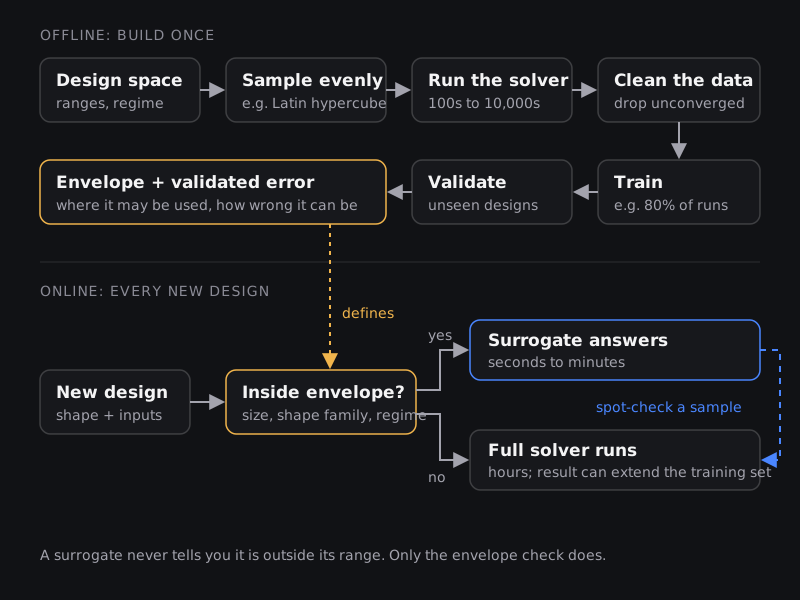
- Define the design space. Which parameters vary, over what ranges, and which physics regime applies. This is the envelope the model will be trusted in, so write it down.
- Sample it evenly. Methods such as Latin hypercube sampling spread design points across the space like seeds scattered evenly over a field, instead of in clumps. Comsol's machine-learning guide recommends it for this reason.
- Run the solver. Hundreds to tens of thousands of runs. This is usually the biggest cost, and every run must be a good one.
- Clean the data. Mercado's point to engineering.com is easy to miss: archived runs often lack mesh-error or uncertainty estimates, so under-converged runs slip in and contaminate training. Failed runs, if valid and labelled, are useful too.
- Split and train. Hold back data the model never sees during training. The watch team used 80% for training and 20% for validation.
- Validate on unseen designs, including some near the edges of the envelope (worked example below).
- Deploy with guardrails. Flag inputs outside the training envelope, and spot-check some predictions with the full solver.
Worked example: validating a valve surrogate
Suppose you have trained a surrogate that predicts a butterfly valve's flow coefficient Cv at full opening, trained on valves from 50 mm to 200 mm nominal size. You run the full CFD on six designs the model has never seen. The numbers below are made up for illustration.
| Test design | Size (mm) | CFD Cv | Surrogate Cv | Error |
|---|---|---|---|---|
| A | 65 | 212 | 205 | -3.3% |
| B | 100 | 560 | 571 | +2.0% |
| C | 125 | 905 | 889 | -1.8% |
| D | 150 | 1,320 | 1,344 | +1.8% |
| E | 200 | 2,410 | 2,330 | -3.3% |
| F | 250 (outside range) | 3,900 | 3,190 | -18.2% |
How to read it:
- Inside the range (A to E), the absolute errors are 3.3, 2.0, 1.8, 1.8 and 3.3%, a mean of about 2.4% and a worst case of 3.3%. For screening concepts, that is usually good enough.
- Notice where the errors are largest: at the two ends of the range (A and E). Surrogates are least reliable near the edges of their training data.
- Design F is outside the range, and the error jumps to 18%. Nothing in the surrogate's output tells you this. A 3,190 looks exactly as confident as a 571. Only the envelope check catches it.
The practical rule: a validation report is only meaningful together with the envelope it was measured in. Ask for both.
When does a surrogate pay for itself?
Training is an investment, so it only pays back if you run many evaluations. Mercado's advice to engineering.com was direct: if the case solves in a few minutes, or you rarely run it, building and maintaining a surrogate does not make sense.
A rough check, using the watch team's real effort figures and an assumed solver time. Say the full model takes 10 minutes per evaluation (our assumption) and the surrogate is 60 times faster (their measured speed-up). Each surrogate evaluation saves about 9.8 minutes. Their machine-learning process took 20 days, which is 28,800 minutes. Break-even is about 28,800 / 9.8 ≈ 2,900 evaluations.
That number is small for an optimisation loop that calls the model thousands of times, or for a design tool used by a whole team for years. It is large for a one-off study of twenty variants. Do this arithmetic before you start collecting data.
A checklist: can I trust this prediction?
| Question | Green light | Red flag |
|---|---|---|
| Is the input inside the training envelope? | All parameters and the shape family are covered by training data | New size, new topology, new material, extrapolation |
| Is it the same physics regime? | Same flow regime, same load type, same material behaviour | Trained on laminar flow, asked about turbulent; trained on linear elastic, asked near yield |
| Is the quantity smooth? | Integrated values: drag, pressure drop, overall stiffness | Sharp, local features: shock positions, peak stress at a notch, onset of separation |
| What decision hangs on it? | Ranking concepts, narrowing the design space | Certification, safety factor sign-off, warranty-critical parts |
| Has a solver checked a sample? | Recent spot-checks agree within the validated error | No spot-checks since the design space or the solver changed |
| Is the training data clean? | Converged, mesh-independent runs with known provenance | Archived runs of unknown quality, mixed solver versions |
The second row is the one Keysight's Santosh Kini warned about in Digital Engineering: if the whole dataset is laminar flow and you ask about turbulent flow, "you're asking for trouble." He and others recommend a "solver in the loop": the AI proposes, the trusted solver confirms with spot checks.
Surrogates and agents work together
Surrogates and AI agents are different things, but they are converging. A surrogate answers "what is the drag of this shape?" fast. An agent decides which shapes to ask about, runs the surrogate hundreds of times, sends the promising ones to the full solver and writes the report. SimScale's solution engineering director described exactly this pattern on engineering.com: agents coordinating large numbers of simulations, often together with physics-based AI models, to evaluate dozens or hundreds of designs early. Our guide to AI agents for mechanical engineering covers the agent side.
McKinsey's 2025 R&D Leaders Forum recap goes further, claiming that deep learning surrogates trained on high-fidelity simulation data allow rapid iteration and can halve development time. That is a consultancy's estimate, not a measured industry average, but it shows why manufacturers are investing.
What this means for CFD and FEA engineers
Surrogates do not remove the need for simulation specialists. They change what the specialist spends time on:
- Producing training data you can trust. Every surrogate is only as good as the solver runs behind it, so mesh studies and convergence checks become more valuable, not less.
- Defining and policing the envelope. Someone has to decide where the model may be used and catch requests outside it.
- Validation. Choosing the spot-checks, comparing with tests, deciding when to retrain.
- Data skills. Python, basic statistics, train/validation splits and error metrics are now part of a simulation engineer's toolkit.
Neural Concept's managing director put the vendor view plainly to Spectrum: "We still need engineers more than ever." The engineers in demand will be the ones who can do both the physics and the data.
To build that combination, pair a strong simulation foundation such as the PG Program in Computational Fluid Dynamics or the PG Program in CAE with Machine Learning Fundamentals In Depth and Python for Mechanical Engineers. For broader background, see our post on applications of machine learning in mechanical engineering.
Frequently asked questions
What is the difference between a surrogate model and a reduced-order model?
Both are fast stand-ins for a full simulation. A reduced-order model is usually built from the physics itself, for example by projecting the equations onto a few dominant modes. A surrogate in today's sense is usually a machine-learning model trained on simulation or test data. The terms overlap in practice.
How much data does a surrogate need?
It depends on how many parameters vary and how non-linear the response is. Published examples range from focused studies to the 20,000 valve runs SimulationHub used. Digital Engineering's sources note that new users often underestimate how many validated runs they need.
Can a surrogate be more accurate than the solver it learned from?
PhysicsX's CEO argued to IEEE Spectrum that fine-tuning with experimental data can make it so. On its own, a surrogate trained only on simulations inherits the solver's errors and adds its own.
Is Ansys SimAI a surrogate model?
Yes, in the sense used here. Ansys says SimAI makes fast predictions by "learning from your legacy simulation data". Neural Concept, PhysicsX and others offer similar platforms.
Do I need to learn deep learning to work with surrogates?
To use one, you mainly need to understand training data, validation and envelopes. To build one, you need Python and machine-learning fundamentals on top of solid simulation skills.
Sources and further reading
- IEEE Spectrum, AI Models Trained on Physics Are Changing Engineering (Dina Genkina, 9 Apr 2026)
- IEEE Spectrum, General Motors Is Cutting Its Development Cycles in Half (Lawrence Ulrich, 17 Jun 2026)
- engineering.com, How real engineers are using AI surrogate models for simulation (21 Sep 2026)
- engineering.com, Opinion: AI agents are stepping up for engineering simulation (12 Mar 2026)
- Digital Engineering 24/7, Catching Your AI's Hallucination (Kenneth Wong, 30 Jun 2026)
- Neural Concept, Finding the Path to Value in Engineering AI: Why We Need to Rethink Benchmarking (Pierre Baqué, 18 Sep 2025)
- McKinsey & Company, Breakthroughs in AI-augmented R&D: Recap from the 2025 R&D Leaders Forum (22 Sep 2025)
- Ansys (part of Synopsys), Ansys SimAI (product page)