What Is an Assessment Test? Types, Scoring and How to Prepare
What an assessment test is, the main types and why they matter, then the tests engineering students in India actually face: GATE 2027 (pattern, dates, negative-marking maths), the TCS NQT, coding and psychometric rounds, how much one score can be trusted, and a five-step preparation plan.
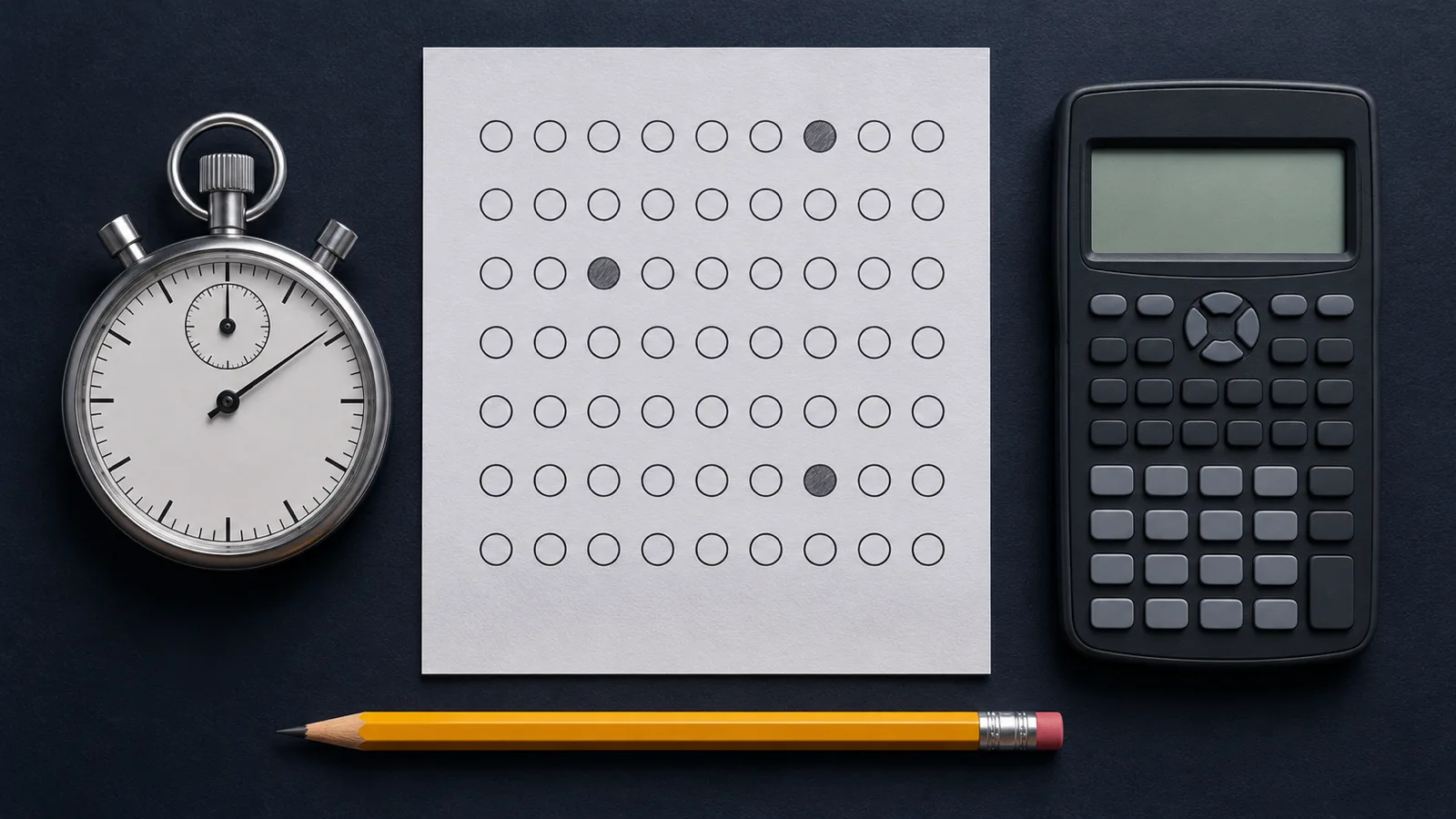
An assessment test is a structured, usually timed, way of measuring what someone knows or can do against a fixed standard, so that a decision can be made: who gets admitted, hired or promoted, who needs more teaching, or whether a course worked. It matters because it turns a vague impression ("she seems good at maths") into evidence that can be compared fairly across thousands of people.
For an engineering student in India, the assessment tests that shape a career are university exams, GATE, campus aptitude tests such as the TCS National Qualifier Test (NQT), coding and technical rounds, and psychometric tests. This guide explains the types, how the big ones are scored, the maths of negative marking, how much a single score can be trusted, and a preparation plan that works for all of them.
Key numbers
- GATE 2027 runs on 6, 7, 13, 14, 20 and 21 February 2027, with results on 19 March 2027 (IIT Madras). That is 80 days from 18 November 2026.
- Every GATE 2027 paper has 65 questions for 100 marks in 180 minutes. A wrong 1-mark MCQ costs 1/3 mark and a wrong 2-mark MCQ costs 2/3; MSQ and numerical questions have no negative marking (IIT Madras).
- Because of those penalties, answering a GATE MCQ adds marks on average only when you are more than 25 % sure of your choice. A blind guess among four options earns exactly zero on average (our calculation).
- The TCS NQT for engineering hiring is one 190-minute test: a 75-minute Foundation part and a 115-minute Advanced part, and the Advanced part is mandatory for Digital and Prime offers (TCS hiring page, read 18 November 2026).
What is an assessment test?
An assessment test is a set of tasks, given under the same conditions to everyone, whose answers are scored by fixed rules to estimate a person's knowledge, skill, aptitude or traits. "Assessment" is the wider process of gathering evidence; a test is one tool for it, alongside projects, interviews, assignments and observation.
Three things separate a real assessment test from a quiz someone threw together:
- A purpose. It is built to support one decision: rank applicants, certify a skill, find learning gaps.
- Standard conditions. Same questions (or questions of equal difficulty), same time, same rules, so scores can be compared.
- Fixed scoring. The marking scheme, including any negative marking, is published before the test.
What are the different types of assessment?
Assessments are grouped by when they happen and why: diagnostic (before learning, to find the starting point), formative (during learning, to give feedback), and summative (at the end, to grade or certify). They are also grouped by what they measure (aptitude, knowledge, skills, personality) and by how scores are read: against other candidates (norm-referenced) or against a fixed standard (criterion-referenced).
| Type | Question it answers | Engineering example |
|---|---|---|
| Diagnostic | Where am I starting from? | A first mock GATE paper before you plan your revision |
| Formative | What should I fix next? | Weekly quizzes, lab viva, project reviews from a mentor |
| Summative | Did I reach the standard? | End-semester exams, a certification exam |
| Aptitude | How well can I reason and calculate? | GATE General Aptitude, the TCS NQT Foundation part |
| Technical / skills | Can I do the job's tasks? | A coding round, a CAD or meshing test, a design calculation |
| Psychometric | How do I work and behave? | Work-style and personality questionnaires in hiring |
| Norm-referenced | How do I compare with others? | GATE scores and ranks, campus cut-offs |
| Criterion-referenced | Did I clear the bar? | A pass mark, a minimum academic aggregate |
One test can be several types at once. GATE is summative, aptitude-plus-knowledge and norm-referenced; a weekly quiz in a course is formative and criterion-referenced.
Why are assessment tests important?
Assessment tests are important because they give everyone the same questions, time and marking, so thousands of candidates can be compared fairly; they show learners exactly which topics are weak; and they give colleges and employers evidence to act on. Their limit is that one score has measurement error, so it should guide a decision, not settle it alone.
- For you, a test is the cheapest honest feedback you will get. A mock paper tells you in three hours what weeks of re-reading notes will not: which topics you can actually solve under time pressure.
- For a college or exam body, standard conditions make selection defensible. A valid GATE score is used for admission to master's and doctoral programmes and for recruitment by some public sector undertakings, and a qualifying score unlocks M.Tech financial assistance of ₹12,400 a month, generally for 22 months (IIT Madras). With that much riding on it, the same paper has to be fair to every candidate.
- For an employer, a test filters a large applicant pool before the expensive step, the interview. TCS states that "based on the test performance, candidates will qualify for Prime, Digital or Ninja interviews."
Which assessment tests do engineering students face in India?
Most engineering students in India meet five kinds: university internal and end-semester exams, GATE (for M.Tech admission and PSU jobs), company aptitude tests such as the TCS NQT, technical or coding rounds, and psychometric questionnaires. Each one rewards slightly different preparation, so it pays to know which one you are facing.
| Test | Who runs it | What it checks | Format, as published |
|---|---|---|---|
| GATE 2027 | IIT Madras (organising institute) | General aptitude, engineering maths, core subject | Computer-based, 65 questions, 100 marks, 3 hours; MCQ, MSQ and numerical answers |
| TCS NQT (engineering hiring) | TCS, at TCS iON centres | Numerical, verbal and reasoning ability; advanced quant, reasoning and coding | 190 minutes: Foundation 75 min, Advanced 115 min |
| TCS iON NQT (open to other employers) | TCS iON | Aptitude, domain skills or work values, by product | Scorecard valid for 2 years; open to students passing between 2022 and 2028 and to people with up to 2 years' experience |
| Technical or coding round | The hiring company | Job tasks: code, calculations, CAD, CAE basics | Varies by company; often online, then an interview |
| Psychometric questionnaire | The hiring company or a test vendor | Work style, values, behaviour | Usually untimed or lightly timed; no right answers |
A test pattern can change between hiring drives, so always read the current notice. For the full TCS route for a mechanical graduate, including eligibility (60 % aggregate in Class 10, 12 and degree, no pending backlog) and the pay of each track, read Skill-Lync's guide on how to get placed in TCS as a mechanical fresher. For the companies that hire freshers in each branch, see companies hiring freshers.
How is GATE 2027 structured and marked?
GATE 2027 is a 3-hour computer-based test with 65 questions worth 100 marks: 10 General Aptitude questions (15 marks) and 55 subject questions (85 marks). In Mechanical and most engineering papers, 13 of the subject marks are engineering mathematics. Questions carry 1 or 2 marks, and only wrong MCQ answers lose marks.
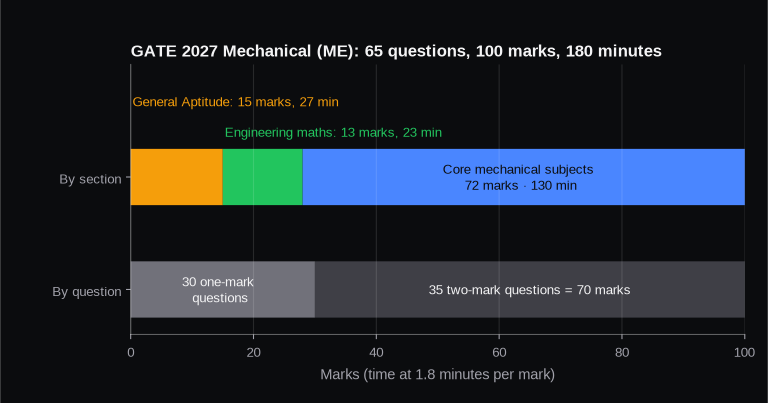
Two practical numbers fall out of the official pattern:
- Time per mark. 180 minutes for 100 marks is 1.8 minutes per mark: 1.8 minutes for a 1-mark question and 3.6 minutes for a 2-mark question. If a 1-mark question has taken 5 minutes, move on.
- Where the easy marks are. General Aptitude and engineering maths together are 28 marks, and their question styles repeat year to year. Skill-Lync has solved all 60 General Aptitude questions from the GATE Mechanical papers of 2022 to 2026: quantitative, verbal and reasoning and spatial aptitude.
For exam dates, admit card and result updates, see Skill-Lync's GATE exam dates page, and for a day-by-day plan to February, the GATE 2027 study plan.
Should you guess in a test with negative marking?
In GATE 2027, answer an MCQ when you are more than 25 % sure your choice is right. With a 1/3 penalty on 1-mark MCQs and 2/3 on 2-mark MCQs, expected marks are zero at exactly 25 %, the chance of a blind guess among four options. Rule out even one option and an attempt is worth it on average. Always answer MSQ and numerical questions: they have no penalty.
The expected marks from answering a question you get right with probability are:
where is the question's marks (1 or 2) and the GATE penalty. Setting gives for both question values.
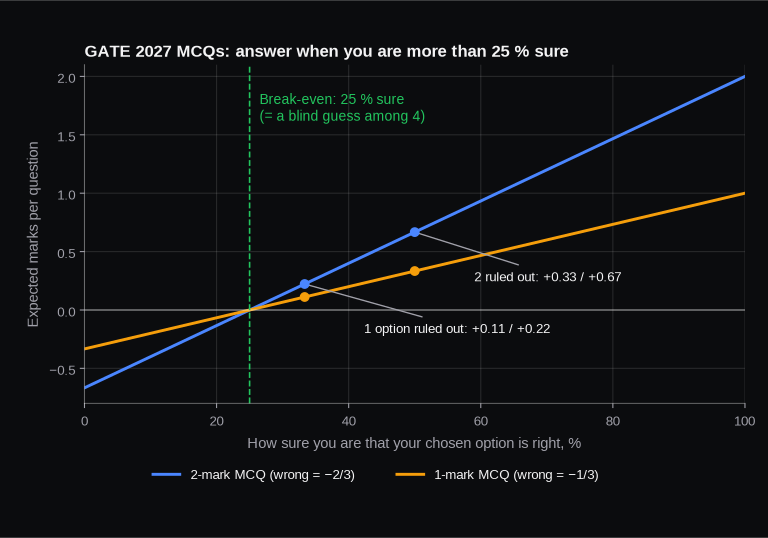
Worked through for a 1-mark MCQ:
- Blind guess, 4 options left: . On average you gain nothing, and you add risk: ten blind guesses swing your score by about ±1.8 marks (one standard deviation) for no expected gain.
- One option ruled out, 3 left: marks (+0.22 on a 2-mark question).
- Two ruled out, 2 left: marks (+0.67 on a 2-mark question).
The same logic works for any test once you know its penalty: the break-even confidence is penalty divided by (marks + penalty). With no negative marking, the break-even is zero, so never leave a question blank. TCS's hiring page does not state a penalty for the NQT, so check the instructions screen on the day.
How much can you trust one test score?
Every test score carries measurement error: a different but equally fair paper, or the same paper on a different day, would give a slightly different mark. Testing experts express this as the standard error of measurement (SEM). Roughly 95 % of the time, your "true" level lies within about two SEMs of the score you got.
The NCME instructional module on SEM gives the formula, where is the spread of scores among candidates and the test's reliability (0 to 1):
Take illustrative numbers: a 100-mark test where scores spread with marks and reliability . Then marks, and a score of 60 really means "somewhere between about 51 and 69" at 95 % confidence (±9.1 marks).
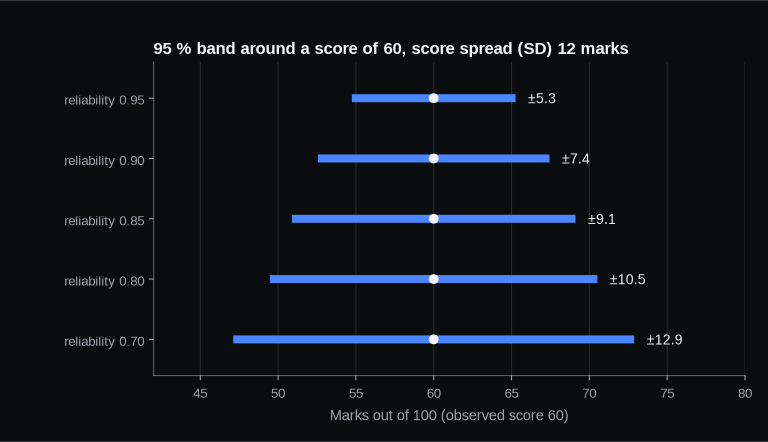
Two lessons follow. First, don't panic over one bad mock: a 5-mark drop can be noise. Track the trend over several tests. Second, this is why serious selection rarely rests on one number. Companies add interviews, and the Standards for Educational and Psychological Testing (published jointly by AERA, APA and NCME) ask test makers to report this precision, especially near cut-off scores.
How do you prepare for an assessment test?
Prepare for an assessment test in five steps: read the official pattern and marking scheme, take one full diagnostic test under real time limits, fix the topics that cost the most marks, practise timed sections with an error log, and finish with two or three full mock tests. Most marks are lost to timing and careless errors, not to unknown topics.
- Read the rules first. Number of questions, time, sections, negative marking, whether you can move between sections. For GATE 2027, the IIT Madras question-pattern page; for a company test, the current hiring notice.
- Take a diagnostic test in week one. Full length, timed, no notes. Mark each wrong answer as "didn't know", "knew but slow" or "careless". The three need different fixes.
- Fix by marks, not by comfort. In GATE ME, 28 marks are aptitude and maths. Those patterns repeat, so they return more marks per hour than a hard core topic you have never liked.
- Practise against the clock. Use the 1.8 minutes per mark budget. Do sections in timed blocks and keep a one-line error log for every mistake; re-read the log before each mock.
- Finish with full mocks. Two or three in the last weeks, at the same time of day as the real exam, on a computer if the real test is computer-based, so the interface and the MSQ and numerical-answer input are familiar on the day.
For interviews after the test, Skill-Lync's engineering interview questions hub and the mechanical fresher interview prep guide cover the technical rounds. If you are weighing a job-focused programme alongside GATE or campus tests, talk to a Skill-Lync counsellor about which suits your background; Skill-Lync's PG Program in CAD and PG Program in CAE build the design and simulation skills that technical rounds test.
Frequently asked questions
What is the purpose of an assessment test?
Its purpose is to support a specific decision with evidence: admit or reject, hire or not, pass or fail, or what to teach next. A good assessment test gives every candidate the same questions, time and marking rules, so scores can be compared fairly, and it measures the skill the decision actually needs.
What is the difference between an assessment and an exam?
Assessment is the wider process of collecting evidence about learning or ability; an exam is one formal, usually summative, tool for it. Projects, assignments, lab vivas, interviews and quizzes are assessments too. An end-semester exam or GATE is an assessment that is also an exam.
Is there negative marking in GATE 2027?
Yes, only for wrong MCQ answers: 1/3 mark is deducted for a wrong 1-mark MCQ and 2/3 mark for a wrong 2-mark MCQ. There is no negative marking for multiple select (MSQ) or numerical answer (NAT) questions, and no partial marks in MSQ, according to IIT Madras's GATE 2027 question-pattern page.
When should you skip a question in a test with negative marking?
Skip a GATE MCQ only when you cannot rule out any option and have no real hunch, because a blind guess among four options earns zero on average. If you can rule out one option, attempting adds 0.11 marks on average on a 1-mark question; two options out, 0.33 marks. Never skip MSQ or numerical questions.
What is a psychometric test in a job assessment?
A psychometric test measures how you tend to work and behave, such as your preferences, values and approach to teamwork, rather than what you know. There are usually no right answers. Answer honestly and consistently: such questionnaires often ask about the same trait in several ways, and inconsistent answers stand out.
How many mock tests should I take before GATE?
Take one full diagnostic mock at the start, timed section tests while you revise, and two or three full mocks in the final weeks, at the same time of day as your exam slot. More mocks without analysing the errors add little; the error log is where the improvement comes from.
Sources and further reading
- IIT Madras, GATE 2027 question paper pattern (accessed 18 Nov 2026).
- IIT Madras, GATE 2027 important dates (accessed 18 Nov 2026; "all dates are liable to change").
- Tata Consultancy Services, TCS All India NQT Hiring (read in a browser on 18 Nov 2026).
- TCS iON, TCS iON National Qualifier Test (accessed 18 Nov 2026).
- L. M. Harvill, Standard Error of Measurement, NCME instructional module (PDF, accessed 18 Nov 2026).
- AERA, APA and NCME, Standards for Educational and Psychological Testing, 2014 edition (open access, accessed 18 Nov 2026).
- Skill-Lync, GATE ME General Aptitude questions, 2022-2026, solved.