Top 14 US Universities for CFD (Fall 2027): Labs, GRE and Costs
Stanford, MIT, Purdue, UIUC and ten more US universities with active CFD labs, checked on their official pages for fall 2027: what each lab works on, GRE rules, thesis options, deadlines from 1 December 2026, and 2026-27 tuition and full cost in rupees.
The strongest US universities for computational fluid dynamics (CFD) are the ones with active fluids, combustion and propulsion labs: Stanford, MIT, Caltech, Princeton, Michigan, Georgia Tech, UT Austin, UIUC, Cornell, Purdue, Penn State, Minnesota, UW-Madison and Iowa State. Choose by lab, not by brand: the right group for turbulence is not the right one for engine sprays or hypersonics.
This guide is for Indian mechanical and aerospace graduates applying for an MS or PhD in fall 2027. For each university we checked the official pages on 18 Nov 2026: which CFD-related labs are active, whether the MS has a thesis, the GRE rule, the first deadline and one year of tuition in rupees. Most fall 2027 deadlines fall between 1 December 2026 and mid-January 2027, so the first ones are less than two weeks away.
Key takeaways
- Fall 2027 deadlines start on 1 December 2026 (Stanford, MIT, Princeton, UIUC, UT Austin, Purdue for funding) and run to 2 March 2027 (Georgia Tech MSME).
- The GRE is fading: Stanford ME, MIT MechE, Princeton MAE, Cornell MAE and Minnesota ME do not accept it for 2027; Purdue Aeronautics and Astronautics still expects it.
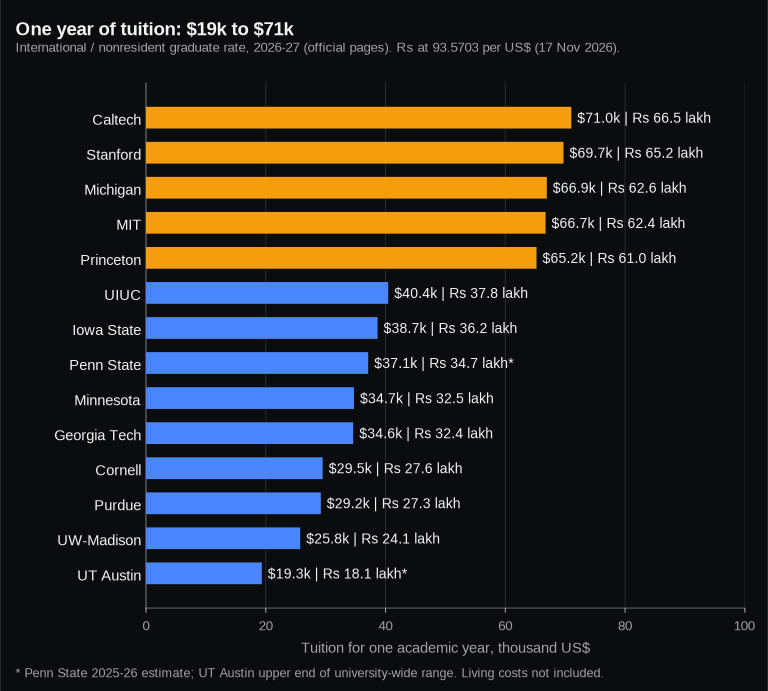
- One year of tuition at these 14 schools ranges from about $19,000 (₹18 lakh) to $71,000 (₹66 lakh), at ₹93.57 per US dollar (17 Nov 2026). MIT's own 9-month cost of attendance for 2026-27 is $109,017 (₹1.02 crore).
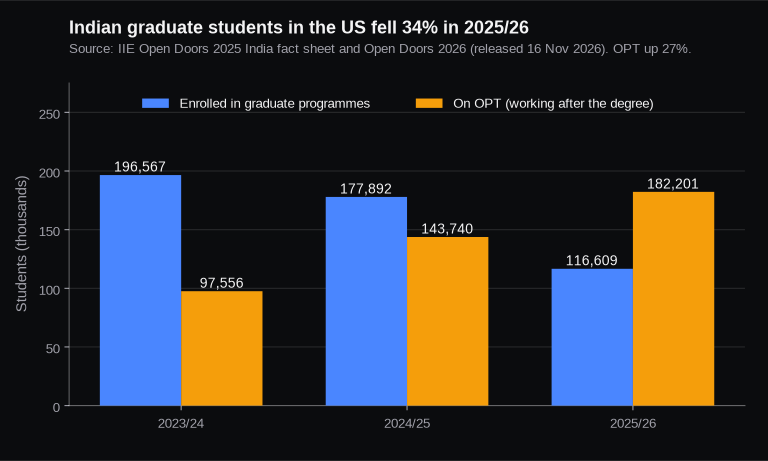
- Indian graduate students in the US fell 34% to 116,609 in 2025/26, while Indians on OPT (work after the degree) rose 27% to 182,201 (IIE Open Doors 2026, released 16 Nov 2026).
Which are the top US universities for CFD in 2027?
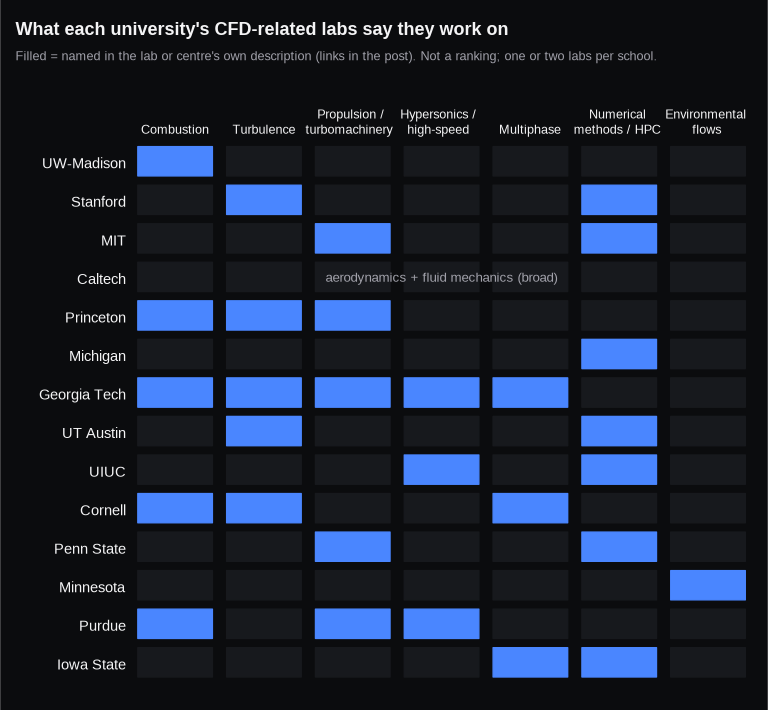
For CFD research, the 14 universities below have well-known, currently active labs in turbulence, combustion, propulsion, high-speed flow or numerical methods. They are listed by the kind of CFD they are best known for, not by a ranking. Pick two or three labs whose recent papers you would like to have written, then apply to those departments.
1. Stanford University: turbulence
Stanford's Center for Turbulence Research "brings engineers, physicists and computational scientists under one roof to unlock the secrets of turbulence" and runs a summer program each year. The ME department's Flow Physics and Computational Engineering group sits alongside it. Note that the Stanford ME master's is a non-thesis, 45-unit degree; research is mainly a PhD route.
2. Massachusetts Institute of Technology (MIT): propulsion and computational design
MIT's Gas Turbine Laboratory focuses on "advanced propulsion systems and turbomachinery", and the Aerospace Computational Science and Engineering Lab works on computational methods for designing aerospace systems. The MechE SM requires a thesis, which suits a CFD research profile. Older lab pages you may find online, such as the Reacting Gas Dynamics Lab site, have not been updated since 2009.
3. California Institute of Technology (Caltech): aerodynamics and fluid mechanics
Caltech's aerospace department, still widely called GALCIT, is known for "pioneering aerodynamics and fluid mechanics". Its MS is a one-year, coursework-only programme with no thesis, and Caltech's mechanical engineering department admits PhD students only. Caltech is a strong target if you are ready to apply straight to a PhD.
4. Princeton University: combustion and turbulent reacting flows
Princeton MAE has Yiguang Ju's combustion lab (green fuels, advanced propulsion) and Michael Mueller's computational turbulent reacting flow group, which models "multi-physics turbulent flows" including combustion. The M.S.E. needs a master's thesis and admits only a small number of students each year. The Combustion Energy Frontier Research Center that older lists mention shows no news since 2015.
5. University of Michigan, Ann Arbor: numerical methods for CFD
Michigan Aerospace hosts Krzysztof Fidkowski's CFD group, which develops "robust, scalable, and adaptive solution techniques for computational fluid dynamics", and Karthik Duraisamy's computational aerosciences lab. The ME MSE offers coursework, research-project and thesis options, and the GRE is optional for fall 2027.
6. Georgia Institute of Technology: combustion, propulsion and multiphase flow
The Ben T. Zinn Combustion Lab describes itself as "a globally leading hub for research in combustion, propulsion, and energy", and ME's Flow Physics and Computational Science lab works on multiphase, turbulent and compressible flows. The MSME has thesis and non-thesis options, but the department says there is no funding for the non-thesis option.
7. University of Texas at Austin: predictive computational science
The Oden Institute "advances the field of computational science and engineering", and its PECOS centre focuses on predictive simulation, "especially those involving fluid mechanics", including turbulent flows. UT Austin ME offers thesis and report options and makes the GRE optional.
8. University of Illinois Urbana-Champaign (UIUC): scramjets and HPC
UIUC's Center for Exascale-enabled Scramjet Design (CEESD), a PSAAP III centre, builds "physics-faithful predictive simulations" to advance scramjet designs. MechSE offers thesis and non-thesis MS options and will not review GRE scores.
9. Cornell University: turbulent multiphase flows
Cornell's Sibley School has Olivier Desjardins's Computational Thermo-Fluids Lab (large-scale simulation of "turbulent reacting multiphase flows") and Greg Bewley's Applied Turbulence Lab. Its research MS requires a thesis over four terms, but Cornell says it does not provide financial aid for the MS.
10. Purdue University: propulsion and hypersonics
Purdue's Maurice J. Zucrow Laboratories calls itself "the largest academic propulsion lab in the world", covering combustion, turbines and compressors, hypersonics and fluid mechanics. Purdue ME offers thesis and non-thesis MS options with the GRE optional; the Aeronautics and Astronautics school still asks for official GRE scores.
11. Pennsylvania State University: turbomachinery
Penn State's START Lab works on turbine technologies for propulsion and power, and the Applied Research Laboratory covers fluid dynamics, turbomachinery and computational mechanics. Most ME master's students choose the thesis option, and the Aerospace MS is thesis-based.
12. University of Minnesota, Twin Cities: environmental and geophysical flows
The St. Anthony Falls Laboratory does "experimental and computational fluid mechanics, hydrology, and earth-surface dynamics", a good fit if you want CFD for rivers, wind or the atmosphere. ME's Plan A includes 10 thesis credits; the coursework-only Plan C gets no department funding.
13. University of Wisconsin-Madison: engines and combustion
The Engine Research Center studies "the fundamental thermo-physical processes that control combustion performance" and still holds an annual symposium. It is also where Skill-Lync's founders studied. The research MS needs a thesis defence, and UW says funding goes only to thesis-based MS students.
14. Iowa State University: multiphase CFD
Iowa State's Center for Multiphase Flow Research and Education (CoMFRE) lists "excellence in computational fluid dynamics (CFD) since the 1980's" with a focus on multiphase flow. The ME MS is thesis-only, and its fall deadline of 7 February is later than most.
Do US universities still need the GRE for an MS in mechanical engineering?
Mostly no. For fall 2027, Stanford ME, MIT MechE, Princeton MAE, Cornell MAE and Minnesota ME and AEM do not accept GRE scores, UIUC MechSE will not review them, and most others make the GRE optional. Purdue's Aeronautics and Astronautics school is the main exception that still expects it.
| University | GRE (MS) | MS thesis? | Fall 2027 deadline |
|---|---|---|---|
| Stanford (ME) | Not accepted | No | 1 Dec 2026 |
| MIT (MechE) | Not accepted | Required | 1 Dec |
| Princeton (MAE) | Not accepted | M.S.E. yes | 1 Dec |
| UIUC (MechSE) | Not reviewed | Optional | 1 Dec |
| UT Austin (ME) | Optional | Optional | 1 Dec |
| Purdue (ME / AAE) | Optional / expected | Optional | 1 Dec (funding) |
| Caltech (Aero) | Optional | No | 15 Dec |
| UW-Madison (ME) | Not used | Research MS | 15 Dec |
| Penn State (ME) | Not required | Mostly | 1 or 15 Dec |
| Michigan (ME) | Optional | Optional | 15 Jan |
| Cornell (MAE) | Not accepted | Required | 18 Jan |
| Minnesota (ME) | Not considered | Plan A | 31 Jan (priority) |
| Iowa State (ME) | Not required | Required | 7 Feb |
| Georgia Tech (ME) | Not required | Optional | 2 Mar 2027 |
Where a department page prints a date without a year, it is the date it lists for the next fall intake. Penn State ME's own pages give both 1 and 15 December, and Minnesota ME lists both 31 January and 1 December for priority consideration, so go with the earlier date. Always confirm on the department page before you pay the fee.
How much does an MS in the US cost for CFD in 2026-27?
Tuition alone for one year ranges from about $19,000 (₹18 lakh) at UT Austin to $71,000 (₹66 lakh) at Caltech for international graduate students. Add living costs and health insurance and a full year costs roughly $44,000 to $109,000 (₹41 lakh to ₹1.02 crore), depending on the university and city.
Where the university publishes a full cost of attendance (tuition, fees, housing, food, insurance and books), it is the better number to plan with:
| University | Full year, US$ | In ₹ |
|---|---|---|
| Princeton (12-month living) | 109,200 | ₹1.02 crore |
| MIT (9 months) | 109,017 | ₹1.02 crore |
| Michigan | 94,852 | ₹88.8 lakh |
| UIUC | 67,686 | ₹63.3 lakh |
| Cornell (research MS) | 66,345 | ₹62.1 lakh |
| Minnesota | 65,670 | ₹61.4 lakh |
| Penn State (2025-26) | 62,000 | ₹58.0 lakh |
| Georgia Tech | 57,208 | ₹53.5 lakh |
| Purdue | 49,798 | ₹46.6 lakh |
| UT Austin (upper end) | 44,279 | ₹41.4 lakh |
Worked example: two years of an MS. Most thesis MS degrees take about two academic years. Using each university's own one-year cost of attendance, two years come to:
For scale, the US Bureau of Labor Statistics puts the median pay of mechanical engineers at $104,110 in May 2025 ($134,960 for aerospace engineers). Two years at Purdue cost about 0.96 of one year's median mechanical salary, before tax and US living costs. These are list prices: thesis students who win a research assistantship usually get tuition covered and a stipend, which changes the sum completely. The full-year figures for Princeton, UIUC, Cornell and Georgia Tech are our own sums of components each university lists separately (tuition, fees and its own living-cost estimate).
Is a US master's in CFD still worth it for Indian students in 2026?
It can be, but the numbers have moved. Open Doors 2026, released on 16 Nov 2026, shows Indian graduate enrolment in the US fell 34% to 116,609 in 2025/26, even as Indians working on OPT after their degree rose 27% to 182,201. Fewer Indians are enrolled in degrees, while more of the earlier cohorts are working there on OPT.
Four rules decide what happens after the degree, as of November 2026:
- STEM OPT. Mechanical engineering (CIP code 14.1901) and aerospace engineering (14.0201) are STEM-designated, so graduates can add a 24-month STEM extension to the standard 12 months of OPT, with an E-Verify employer. Check the CIP code on your I-20.
- The $100,000 H-1B payment. The proclamation of 19 Sep 2025 added a $100,000 payment for new H-1B petitions. USCIS guidance of 20 Oct 2025 says petitions for a change of status inside the US, such as F-1 to H-1B, are exempt; people abroad are not.
- The H-1B lottery is now weighted by wage. A DHS final rule published on 29 Dec 2025 and effective 27 Feb 2026 gives each registration one to four entries according to the wage level offered, so higher-paid offers have better odds.
- The "duration of status" rule. A July 2026 DHS rule to replace open-ended student status with fixed admission periods of up to four years was blocked by a nationwide preliminary injunction on 14 Sep 2026. Ask your international student office for the latest position before you travel.
The honest summary: a US MS still gives access to the deepest CFD research groups and to US aerospace and energy employers, but you should plan the cost as if you will repay it from an Indian salary if the US job does not come through. A funded thesis MS or a PhD reduces that risk a lot. If you are still deciding between CFD and another track, see how the MS mechanical engineering specialisations compare, or the US universities for energy engineering if your CFD interest is in power and energy systems.
Thesis or non-thesis MS: which is better for a CFD career?
For CFD, choose a thesis MS if you can. A thesis gives you a year of real simulation work, a professor who knows your work, a paper or two, and the only realistic route to an assistantship that pays tuition. Several schools say outright that non-thesis students get no departmental funding.
- UW-Madison: "Fellowship and research assistantship funding is only considered for thesis-based MS students."
- Georgia Tech: for the non-thesis MSME, "There is no funding available."
- Minnesota ME: the coursework-only Plan C gets no department funding.
- Cornell: "Financial aid is not provided for the M.S. degree program", even though the MS requires a thesis.
A non-thesis MS (Stanford ME, Caltech Aero's one-year MS, coursework options elsewhere) can still lead to industry CFD jobs, but you then need projects that prove you can set up, run and validate simulations on your own.
How do you get into a top CFD lab as an Indian student?
Show that you can already do CFD, not just that you studied fluid mechanics. Admissions committees and professors look for evidence: a simulation project with validation against data, code you wrote, and a statement of purpose that names specific labs and papers. Here is a practical order of work.
- Pick the sub-field first. Turbulence modelling, combustion, multiphase and high-speed flow are different communities. Use Figure 1 and each lab's publication list to shortlist six to eight groups.
- Read three recent papers per lab. Write two lines on each: the method and the open problem. This becomes your statement of purpose.
- Build two validated projects. For example, a lid-driven cavity or backward-facing step in OpenFOAM compared with published benchmark data, and one application case (a nozzle, an airfoil, a spray). Put the cases and post-processing scripts on GitHub.
- Write one small solver. A 1D or 2D finite-volume code in Python or MATLAB shows you understand discretisation, stability and convergence, not just a GUI.
- Email professors briefly, after reading their work. Mention one paper, one result of yours and one question. Many will not reply; the ones who do matter.
Skill-Lync's CFD master's programme and its introduction to CFD with MATLAB and OpenFOAM are built around exactly these projects: solver coding, OpenFOAM cases and validated industrial simulations. If you want help choosing between a US MS and a CFD job in India, talk to a Skill-Lync counsellor.
What if you want a CFD career in India instead?
CFD is a strong career in India too, and you can always apply for a PhD later. In Skill-Lync's placement records, learners placed in CFD roles had a median starting salary of 3.5 LPA (n = 240; middle half 2.81 to 4.5 LPA; top 10% above 5.6 LPA), based on 3,711 records up to 7 Nov 2026 (snapshot of 15 Nov 2026).
That sample is self-reported Skill-Lync learners, mostly early-career offers from 2021-23, so treat it as a starting point rather than a market average; recent years are thin. Mechartes, Cyient, Analyzer CAE, Expleo and Alten were among the most frequent CFD employers in it. Our CFD engineer salary guide breaks this down further, and how to become a CFD engineer covers the skills employers test.
Frequently asked questions
Which US university is best for CFD?
There is no single best. For turbulence, Stanford's Center for Turbulence Research is the best known; for engine combustion, UW-Madison's Engine Research Center; for propulsion and hypersonics, Purdue's Zucrow Labs and UIUC; for numerical methods, Michigan and UT Austin's Oden Institute. Choose the lab whose recent papers match what you want to work on.
Is the GRE required for an MS in mechanical engineering in the US for 2027?
Usually not. For fall 2027, Stanford ME, MIT MechE, Princeton MAE, Cornell MAE and Minnesota ME do not accept GRE scores, UIUC MechSE will not review them, and Michigan, UT Austin and Purdue ME make it optional. Purdue Aeronautics and Astronautics still expects official GRE scores. Always check the department page.
How much does an MS in the US cost in Indian rupees?
For 2026-27, one year of international graduate tuition at these 14 universities ranges from about ₹18 lakh to ₹66 lakh at ₹93.57 per dollar. A full year including living costs runs from about ₹41 lakh to ₹1.02 crore. A two-year MS at Purdue costs about ₹93 lakh at its published cost of attendance.
Can I get funding for an MS in CFD in the US?
Possibly, but mainly on a thesis MS. Research assistantships come from professors' grants and usually cover tuition plus a stipend. UW-Madison funds only thesis-based MS students, Georgia Tech gives no funding for its non-thesis MSME, and Cornell gives no aid for its MS. PhD admits are normally funded.
Can I work in the US after an MS in mechanical engineering?
Yes, under current rules. Mechanical engineering (CIP 14.1901) is STEM-designated, so you can get 12 months of OPT plus a 24-month STEM extension. An F-1 to H-1B change of status inside the US is exempt from the $100,000 payment under USCIS guidance of 20 Oct 2025, but the H-1B lottery is now weighted by wage level.
Is CFD a good career in India without a US degree?
Yes. CFD engineers work in automotive, aerospace, HVAC, energy and consulting firms in India. In Skill-Lync's placement data (snapshot 15 Nov 2026, n = 240), CFD hires had a median starting salary of 3.5 LPA. Strong solver, meshing and validation skills matter more to most Indian employers than where you studied.
Sources and further reading
- IIE, Open Doors 2026: International students, released 16 Nov 2026; Open Doors 2025 India fact sheet, accessed 18 Nov 2026.
- US Bureau of Labor Statistics, Occupational Outlook Handbook: Mechanical engineers and Aerospace engineers (May 2025 pay), accessed 18 Nov 2026.
- Drexel University ISSS, USCIS guidance on the $100,000 H-1B fee proclamation, 24 Oct 2025.
- Greenberg Traurig, Wage-weighted H-1B cap selection rule effective 27 Feb 2026, Feb 2026.
- The Ohio State University, Duration of status final rule, updated 16 Sep 2026.
- FBIL reference rate via MSEI archive: ₹93.5703 per US$ on 17 Nov 2026.
- University pages for labs, MS rules, GRE policies, deadlines, tuition and cost of attendance (all accessed 18 Nov 2026): Stanford tuition, MIT cost of attendance, Caltech budget, Princeton rates, Michigan cost estimate, Georgia Tech costs, UT Austin cost of attendance, UIUC tuition, Cornell tuition, Penn State estimate, Minnesota cost of attendance, Purdue tuition, UW tuition schedule, Iowa State cost of attendance.
- Skill-Lync placement records, snapshot of 15 Nov 2026 (3,711 records up to 7 Nov 2026), CFD domain n = 240.