Robotic Sewer Cleaning in India: What NAMASTE Says and How Robots Work
On 23 November 2026 the social justice ministry profiled a Mysuru sanitation worker who now runs a Bandicoot robot after NAMASTE training. Here is what the release says and does not say, the scheme's dated official figures, what the 2013 law and Rules require, why H2S, methane and low oxygen make sewers deadly, and how a manhole-cleaning robot's arm, sensors and tether are engineered, with a worked torque example.

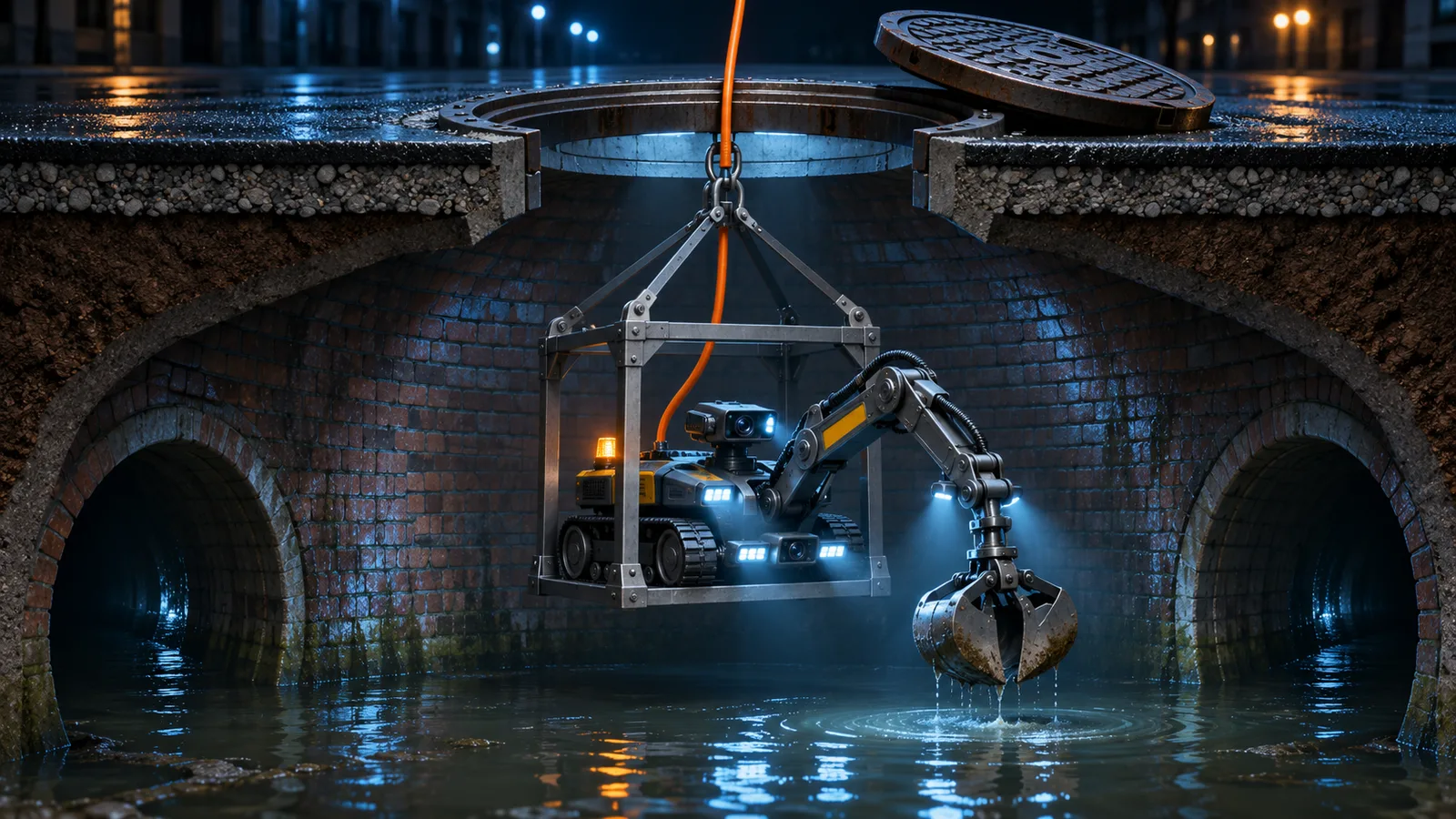
On 23 November 2026 the Ministry of Social Justice and Empowerment put out a short case study through PIB. It follows a sanitation worker from Mysuru who spent nearly 15 years cleaning sewers and septic tanks by hand. After training under the NAMASTE scheme in 2026, he now operates a Bandicoot manhole-cleaning robot. The release has no new figures on robots, cities or money. The scheme's latest official totals (July 2026) are 89,915 validated sewer and septic tank workers, 87,037 PPE kits and 753 emergency response units equipped with safety devices. A 2013 law bans hazardous manual cleaning of sewers. The engineering answer is a remotely operated arm with a grab bucket, cameras and a gas sensor, lowered into the manhole while the operator stays at street level.
Below, government figures (each dated), the robot maker's claims and our own calculations are kept apart.
Key numbers at a glance
- 23 Nov 2026, 6:09 PM: MoSJE's PIB release 2340462 describes one worker's move from manual sewer cleaning to operating a Bandicoot robot after NAMASTE training, in a batch of 45 workers.
- 89,915: sewer and septic tank workers validated under NAMASTE, with 87,037 PPE kits issued and health cards for 76,845 (PIB, 19 Jul 2026).
- ₹34.17 crore: upfront capital subsidy released to 983 sanitation workers to buy 364 vehicles (PIB, 23 Apr 2026).
- 317: sanitation workers who died during hazardous cleaning of sewers and septic tanks in 2021-2025, per the National Commission for Safai Karamcharis (Rajya Sabha reply, PIB, 1 Apr 2026).
- 100 ppm: the hydrogen sulphide level NIOSH lists as immediately dangerous to life or health. India's 2013 Rules bar entry if oxygen is below 19.5%.
Courses: the robot described here is a mechatronic system: sensors, embedded control, actuators. Skill-Lync's Fundamentals of Embedded Systems and Developing IoT Applications courses cover the sensing and control side.
What does the 23 November PIB release say?
The release, titled "From Manual Sewer Cleaning to Robotic Sanitation Operations", was issued by the Ministry of Social Justice and Empowerment (MoSJE) through PIB Delhi at 6:09 PM on 23 November 2026 (Release ID 2340462). It is a human-interest backgrounder, not an announcement of a new programme, purchase or deployment.
- The worker, a 41-year-old from Mysuru, Karnataka (the release changes his name), spent nearly 15 years in manual sewer and septic tank cleaning, with long direct exposure to hazardous waste.
- In 2026 he received "Occupational Safety and Mechanised Sanitation Training" under the National Action for Mechanised Sanitation Ecosystem (NAMASTE), as one of a batch of 45 sanitation workers.
- The training covered occupational health hazards, safe work practices and operation of the Bandicoot robotic sanitation system.
- He now works as a Bandicoot operator, which the ministry says means less direct exposure to hazardous waste.
What the release does not say: how many robots NAMASTE has funded, where the 45 trainees work, who paid for the Mysuru robot, or what it cost. For numbers, we went to the ministry's earlier releases and parliamentary replies, listed below with their dates.
What is the NAMASTE scheme and what has it delivered?
NAMASTE is a central scheme run jointly by MoSJE and the Ministry of Housing and Urban Affairs (MoHUA). It was launched in July 2023 to end hazardous manual cleaning of sewers and septic tanks. It identifies sewer and septic tank workers (SSWs) and gives them PPE, training and health insurance. It also funds safety devices for municipal emergency units and gives capital subsidies for cleaning machines and vehicles.
A PIB backgrounder of 10 September 2025 put the outlay at ₹349.70 crore over three years up to 2025-26, covering all 4,800+ urban local bodies. The July 2026 releases describe the scheme as running. We did not find a PIB release giving a new outlay beyond 2025-26.
| Measure | Sep 2025 | Latest official figure |
|---|---|---|
| SSWs validated | 88,448 | 89,915 (19 Jul 2026) |
| PPE kits to SSWs | 83,901 | 87,037 (19 Jul 2026) |
| Health cover / health cards | 65,805 covered | 76,845 health cards (19 Jul 2026) |
| Safety devices for Emergency Response Sanitation Units (ERSUs) | 555 kits | 753 ERSUs equipped (19 Jul 2026) |
| Upfront capital subsidy | ₹23.06 crore to 769 workers | ₹34.17 crore to 983 workers, 364 vehicles (23 Apr 2026) |
| Workshops on preventing hazardous cleaning | 1,112 | 1,562 (23 Apr 2026) |
Sources: PIB releases 2171213 (10 Sep 2025), 2255017 (23 Apr 2026) and 2286362 (19 Jul 2026). The health row compares slightly different measures (insurance cover versus cards issued), as the releases do.
Three things stand out when you work the numbers (script in our run folder):
- PPE kits have reached 96.8% of validated workers, and health cards 85.5%.
- The capital subsidy averages about ₹3.48 lakh per worker and ₹9.39 lakh per vehicle. In 2025-26 the ceiling rose from ₹5.00 lakh to ₹7.50 lakh for individuals and from ₹18.75 lakh to ₹25.00 lakh for groups of up to five, and a new 25% subsidy opened to private operators for mechanised equipment.
- The government has no measure of the gains: a Rajya Sabha reply (PIB, 4 Feb 2026) said "no measurable indicators have been identified" for productivity from mechanisation.
The scheme's stated aim is zero deaths in sanitation work. The record so far falls short of that: NCSK counted 471 deaths in hazardous cleaning of sewers and septic tanks from 2019 to 31 October 2025 (Lok Sabha reply, PIB, 16 Dec 2025), and 317 in 2021-2025.
Is manual sewer cleaning illegal in India?
Yes, in the form the law calls "hazardous cleaning". Section 7 of the Prohibition of Employment as Manual Scavengers and their Rehabilitation Act, 2013 says no person, local authority or agency shall engage or employ anyone, directly or indirectly, for hazardous cleaning of a sewer or septic tank. A first offence can bring up to two years in prison, a fine of up to ₹2 lakh, or both. A repeat offence can bring up to five years and ₹5 lakh (Section 9). Every offence under the Act is cognizable and non-bailable (Section 22).
The definition matters. Section 2(1)(d) defines "hazardous cleaning" as manual cleaning where the employer has not provided protective gear and cleaning devices or ensured the safety precautions. Section 33 then makes it the duty of every local authority to use "appropriate technological appliances" for cleaning sewers and septic tanks, and asks governments to fund that technology. NAMASTE's subsidies and robots are, in effect, Section 33 in practice.
The Prohibition of Employment as Manual Scavengers and their Rehabilitation Rules, 2013 (G.S.R. 776(E), 12 December 2013) add the engineering detail:
- Machines first (Rule 3). Nobody may clean a sewer manually, even with protective gear, except in listed cases. These include a damaged manhole cover where machines cannot work, connecting a new sewer main above 300 mm to an existing one, or a written order from the local authority's CEO giving specific reasons.
- Gear (Rule 4). A list of 44 items, including air-line breathing apparatus, a safety tripod set and a "Gas Monitor (4 gases)".
- Machines (Rule 5). Jetting machines, suction machines (gully emptiers), combined jetting-cum-suction machines, and hydraulic, truck-mounted and winch-operated grab buckets.
- Before and during any entry (Rule 6). At least three workers including a supervisor; tests for oxygen deficiency, H2S, carbon monoxide, methane and petrol vapours; at least 19.5% oxygen at the bottom, middle and top; the manhole opened an hour ahead; daylight work of no more than 90 minutes at a stretch; the entrant watched by signal, camera or CCTV; explosion-proof equipment.
Why are sewers dangerous to enter?
A sewer is a confined space where decomposing sewage can produce toxic and flammable gases and push out oxygen. The three hazards are hydrogen sulphide (H2S), which NIOSH rates immediately dangerous at 100 parts per million; methane (CH4), which explodes between 5% and 15% in air; and oxygen deficiency, which US OSHA defines as below 19.5% oxygen, the same floor India's Rules set for entry.
H2S is the hardest of the three to notice. It smells of rotten eggs, but NIOSH warns that the sense of smell "becomes rapidly fatigued" and cannot be relied on. It is also 1.19 times as dense as air, so it collects low in a chamber. Methane, at 0.6 times the density of air (ILO safety card 0291), rises instead. That is one good reason to test every level, as the Rules require for oxygen (bottom, middle and top).
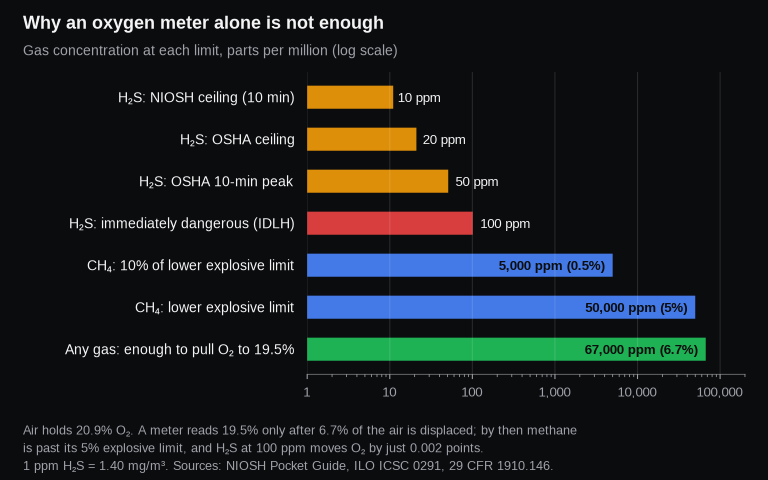
The chart shows why the Rules ask for a four-gas monitor and not just an oxygen meter. Normal dry air is 20.9% oxygen. If another gas displaces a fraction of the air, oxygen falls to . For an oxygen meter to show the 19.5% alarm level:
That is 6.7% of the air, or 67,000 ppm. Now compare it with the other two gases:
- Methane: 6.7% methane is 134% of its 5% lower explosive limit. At the explosive limit itself, oxygen is still 20.9 × 0.95 = 19.85%, above the alarm. The mixture can ignite before the oxygen meter reacts. OSHA treats any space above 10% of the limit (0.5% methane) as a hazardous atmosphere.
- Hydrogen sulphide: at 100 ppm, the immediately dangerous level, oxygen reads 20.898%. The meter moves by 0.002 percentage points. Only an H2S sensor sees it. For scale, the NIOSH 10-minute ceiling is 10 ppm (15 mg/m³, since 1 ppm of H2S is 1.40 mg/m³).
So each gas needs its own sensor, and a robot carries those sensors into the chamber so no person has to be there when they read.
How does a manhole-cleaning robot work?
A manhole-cleaning robot is a remotely operated arm lowered into the manhole from a stand at street level. Legs brace it against the chamber wall, a grab bucket lifts silt and solid waste to the surface, and cameras, lights and gas sensors let the operator work from a screen through a power and data tether.
Genrobotics, the Indian company that makes the Bandicoot, describes this sequence on its product page. It claims a 6-degree-of-freedom arm, four HD cameras, gas detection, IP68 waterproofing and a working depth of up to 12 m. These are company claims, and the page gives no lifting capacity or bucket volume, so we quote none.
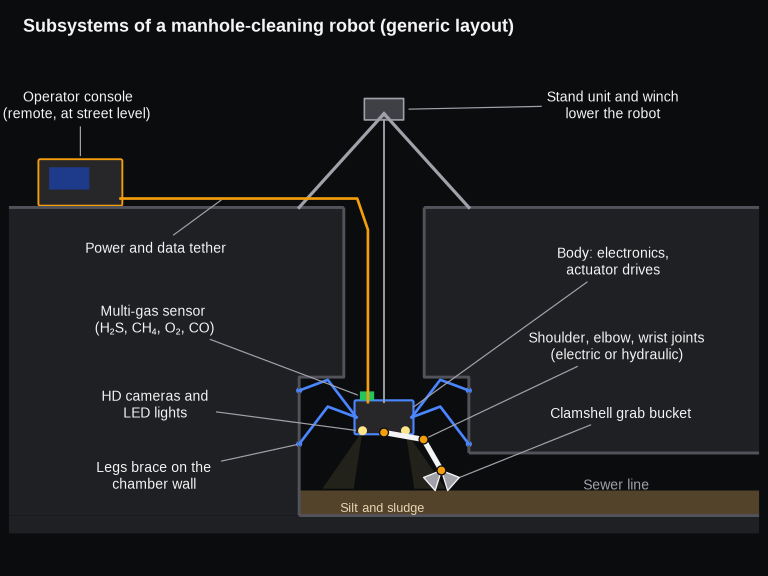
Arm and grab bucket
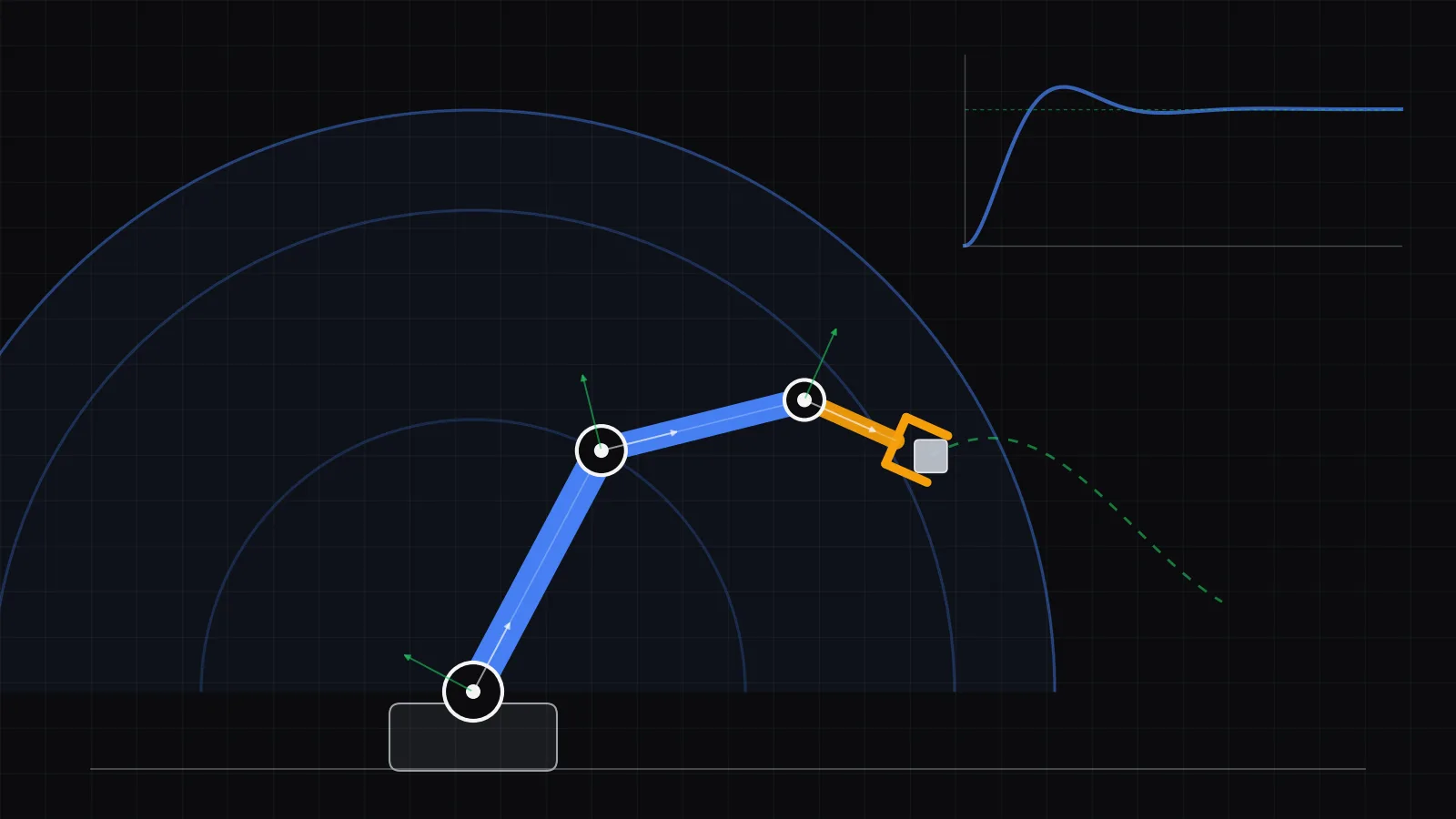
The bucket is a clamshell grab: two jaws that open, bite into the deposit and close. CPHEEO's equipment guidance (MoHUA, November 2020) describes manhole grabbers, "including 'Bandicoot'", as a grab bucket closed by wire ropes or a pneumatic cylinder. A robot adds joints so the bucket reaches anywhere in the chamber, and every joint adds an actuator and a seal that must survive sewage (gripper force analysis).
Electric or hydraulic joints? A worked example
The hardest joint is the shoulder, because it holds everything beyond it at arm's length. Take an illustrative arm. These are our assumptions, not any product's specification:
- A 0.5 m upper arm (4 kg) and a 0.5 m forearm (3 kg), with a 2.5 kg elbow actuator.
- A 6 kg bucket holding 15 L of wet silt at an assumed 1.5 kg/L, so 22.5 kg of load.
- The arm held straight out, which is the worst case.
Treating each link as a uniform bar, the static torque at the shoulder is:
The bucket and its load make up 86.4% of that, so reach and payload dominate the design. With a 1.5 margin for digging and acceleration, the actuator must deliver about 486 N·m. Here is what that means for each type of drive:
- Electric: through a 160:1 gearbox at 75% efficiency, the motor needs N·m. At a shoulder speed of 20°/s the joint uses only about 170 W, with the motor turning at 533 rpm. The challenge is torque, not power, which is why robot joints use high-ratio gearboxes (robotics book, chapter 12).
- Hydraulic: a cylinder on a 0.10 m lever must push 4,856 N. At 100 bar that needs a bore of just 24.9 mm. A designer would pick 32 mm for margin, which gives 8,042 N. That force density is the main advantage of hydraulics for heavy arms (cylinder sizing).
- Pneumatic: the same force at 6 bar of shop air needs a 101.5 mm bore. Air is also compressible, so holding a bucket steady in mid-air is harder.
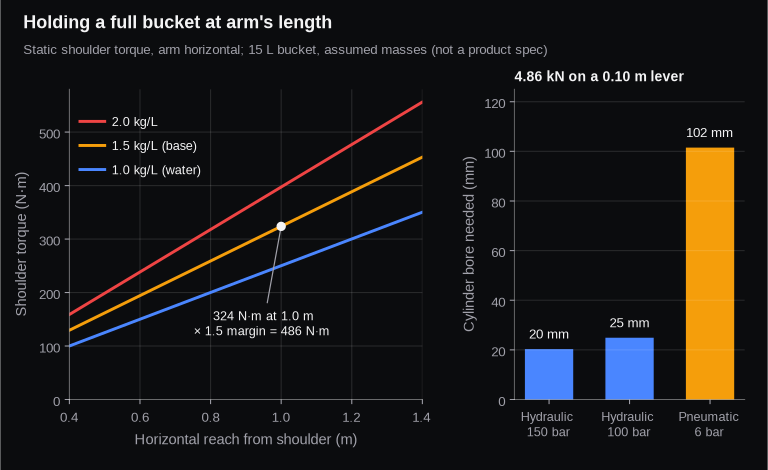
Hydraulics are compact and stiff but bring a pump, hoses and fluid into a wet, dirty space; electric joints are cleaner and easier to control but need larger sealed gearmotors. Either way, Rule 6(3)(y) requires sewer-cleaning equipment to be explosion-proof and fire-proof, which constrains every motor, connector and light. See our chapter on robot drive systems.
Cameras, lights and gas sensing
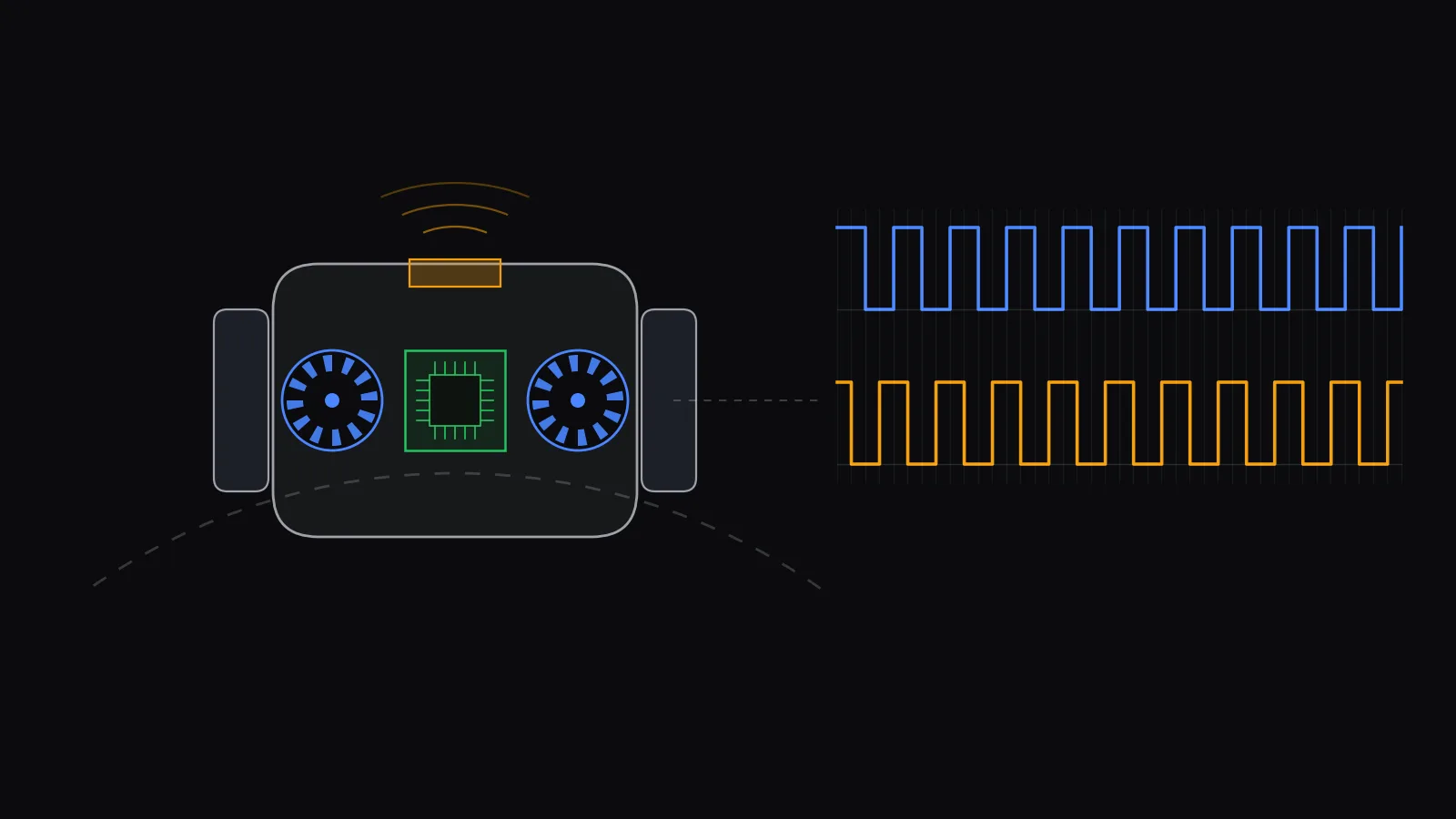
The operator cannot see into a chamber up to 12 m deep (the Bandicoot's claimed working depth), so the robot carries its own lights and cameras, the remote version of the "signal or camera or CCTV" monitoring Rule 6(3)(u) requires when a person enters. Its gas sensors do the job of the Rule 4 four-gas monitor inside the chamber, before and during cleaning.
Tether and power
In our generic layout, power and video come up a tether, which must be sized like any cable. Take 48 V at 20 A (960 W) over a 20 m run (12 m deep plus 8 m on the street). With 4 mm² copper (0.017241 Ω·mm²/m, the annealed copper standard) the round-trip resistance is 0.172 Ω, so the drop is 3.45 V (7.2%) and 69 W heats the cable. At 6 mm² the drop falls to 2.3 V (4.8%), for a heavier tether. Assumed numbers, our script.
Jetting and suction machines or robots: which does what?
Robots do not replace sewer trucks; they cover a different part of the network. Jetting and suction machines clean the pipe runs between manholes, and combined "super-sucker" machines are needed for large sewers. Grab-bucket machines and robots clear the manhole chambers, where silt, stones and solid waste collect and where workers used to go down.
| Machine | What it does | Best at |
|---|---|---|
| Hydro-jetting machine | Fires high-velocity water at pipe walls to break up debris and grease | Routine cleaning of small, low-flow sewers |
| Suction machine (gully emptier) | Vacuums liquid and sludge into a tank | Emptying gullies and chambers |
| Combined jetting-cum-suction ("super-sucker") | Jets and vacuums in one pass | Large-diameter sewers, where CPHEEO says it is "invariably required" |
| Power rodding | Rotating rods and blades cut roots and grease | Lines up to 300 mm |
| Bucket machine | Cylinder with hinged jaws that scrape deposits into it | Silt, sand and gravel deposits |
| Manhole grabber or robot | Grab bucket lowered into the chamber, robotic arm in newer designs | Manhole chambers, solid waste, no human entry |
Sources: CPHEEO/MoHUA guidance on equipment and workforce norms (November 2020); Rule 5 of the 2013 Rules.
CPHEEO also gives planning norms, written for MoHUA's Safaimitra Suraksha Challenge. They assume one manhole cleaned in about an hour and one grabber per 1,300 manholes or 50 km of sewer. For every 100 km of sewer they list one inspection camera set, one hydro-jetting machine and one power bucket machine. On those norms, a city with 500 km of sewers needs 10 grabbers, 5 jetting machines, 5 bucket machines and 5 camera sets. These are benchmarks for planning, not design rules; a city with old, narrow or heavily silted lines will need more.
What do the numbers not tell us?
- No robot count. No PIB release we found states how many robots NAMASTE or SBM-Urban have funded. Genrobotics says the Bandicoot runs in 19 states and 3 union territories, across "120+ cities". It lists, for example, 9 robots in Gujarat municipalities, 5 in Indore and 5 in Coimbatore. Those are the company's figures, not the government's.
- No outcome measure. The ministry told the Rajya Sabha it has no indicator for productivity gains from mechanisation and keeps no income data.
- Manual entry is still allowed in narrow cases. Rule 3 permits it for damaged covers, sewer connections and CEO-approved cases. Even then, gear, gas testing and the three-person rule apply.
- Deaths have not stopped. 317 in five years is about 63 a year, and the ministry's March 2026 reply attributes such deaths to safety precautions not being followed.
What jobs and skills does robotic sanitation create?
The most direct job is the one in the release: trained operators who run the robot from the surface. Behind each robot sit mechanical and mechatronics engineers (arm, seals, stand), embedded engineers (motor-control and sensor firmware), field service technicians, and municipal and ERSU engineers who plan fleets. The "Sanipreneur" subsidies also fund small businesses that own and run cleaning vehicles.
The skills follow the subsystems in this post:
- Statics and kinematics to size joints, as in the torque example above. Our robotics book covers these.
- Hydraulic and electric actuation, including gearbox and cylinder sizing (hydraulics and pneumatics book).
- Embedded control and sensor integration: reading gas sensors, motor drives and camera links (mechatronics book). For pay data, see our embedded engineer salary page.
- Safety engineering: explosion protection, ingress protection (IP ratings) and confined-space procedures.
Students aiming for public-sector or research roles can look at the GATE Robotics and Automation paper, explained in our GATE 2027 RA guide. For how robots sense and act through embedded hardware, see embedded systems in robotics.
Frequently asked questions
Which ministry issued the 23 November 2026 release on robotic sanitation?
The Ministry of Social Justice and Empowerment issued it through PIB Delhi at 6:09 PM on 23 November 2026 (Release ID 2340462). It is a case study of one NAMASTE-trained worker in Mysuru who now operates a Bandicoot robot. It does not announce new funding or deployments.
What is the NAMASTE scheme?
NAMASTE (National Action for Mechanised Sanitation Ecosystem) is a MoSJE-MoHUA scheme launched in July 2023 to end hazardous manual cleaning of sewers and septic tanks. It profiles workers and gives PPE, training, health cover, safety devices for emergency units, and capital subsidies for machines. By 19 July 2026 it had validated 89,915 sewer and septic tank workers.
Is it legal to send a worker into a sewer in India?
Only in narrow cases. The 2013 Act bans engaging anyone for hazardous cleaning (Section 7), with up to two years in prison, a ₹2 lakh fine, or both for a first offence. The 2013 Rules allow manual entry only in listed situations, such as a damaged cover where machines cannot work. Even then, protective gear, gas testing and at least 19.5% oxygen are required.
Do sewer-cleaning robots replace jetting and suction machines?
No. Jetting and suction machines clean pipe runs and tanks, while grab-bucket robots clear manhole chambers without human entry. CPHEEO's 2020 norms plan one grabber per 50 km of sewer and one jetting machine per 100 km, so a city needs both.
Sources and further reading
- PIB (Ministry of Social Justice and Empowerment), From Manual Sewer Cleaning to Robotic Sanitation Operations (23 Nov 2026, Release ID 2340462)
- PIB (MoSJE), National Action for Mechanised Sanitation Ecosystem (NAMASTE), backgrounder (10 Sep 2025)
- PIB (MoSJE), NAMASTE: Rajya Sabha reply with state-wise validated workers (4 Feb 2026)
- PIB (MoSJE), Safety and welfare of sanitation workers (1 Apr 2026)
- PIB (MoSJE), Empowering Lives: NAMASTE Scheme Delivers Tangible Change for Sanitation Workers (23 Apr 2026)
- PIB (MoSJE), NAMASTE scheme figures (19 Jul 2026) and Rajya Sabha reply on the MS Act survey (2 Aug 2026)
- PIB (MoSJE), National survey conducted under NAMASTE scheme, Lok Sabha reply (16 Dec 2025); Rehabilitation of manual scavengers (18 Mar 2026)
- India Code, The Prohibition of Employment as Manual Scavengers and their Rehabilitation Act, 2013 (Act 25 of 2013)
- MoSJE, Prohibition of Employment as Manual Scavengers and their Rehabilitation Rules, 2013, G.S.R. 776(E), 12 Dec 2013 (Gazette copy hosted by the Goa Social Welfare Department)
- CPHEEO, MoHUA, Guidance Document on Equipment and Workforce Norms for Managing Waterborne Sanitation in India (Nov 2020)
- NIOSH, Pocket Guide to Chemical Hazards: Hydrogen sulfide
- ILO/WHO, International Chemical Safety Card 0291: Methane
- US eCFR, 29 CFR 1910.146, Permit-required confined spaces
- NASA/NOAA, U.S. Standard Atmosphere, 1976 (composition of dry air); NIST, Handbook 100: Copper Wire Tables
- Genrobotics, Bandicoot: Advanced Manhole Cleaning Robot (company page; claims labelled as such)