GATE 2027 Robotics and Automation (RA) Paper: Syllabus, Pattern, PSU Scope
IIT Madras has added a new Robotics and Automation (RA) paper to GATE 2027 (exams 6-21 February 2027). Here is the official pattern (GA 15 + Part A 60 + Part B 25), the full syllabus in plain words, how much of it you already know from GATE ME or EE, four worked problems with verified answers, what is known about PSU and M.Tech use, and an 11-week plan.

GATE 2027 has a brand-new paper, Robotics and Automation (RA), introduced by IIT Madras, the organising institute. It is a 3-hour, 65-question, 100-mark computer-based test: General Aptitude (15 marks), a common Part A on engineering maths, mechatronics and robotics (60 marks), and a Part B (25 marks) where you pick either Electrical or Mechanical during the exam. Exams run on 6, 7, 13, 14, 20 and 21 February 2027, and results are due on 19 March 2027.
GATE 2027 RA at a glance (as of 16 Nov 2026)
- New paper: Robotics and Automation (code RA), one of 30 GATE 2027 papers (IIT Madras press release, 20 Jul 2026; Information Brochure, 17 Oct 2026).
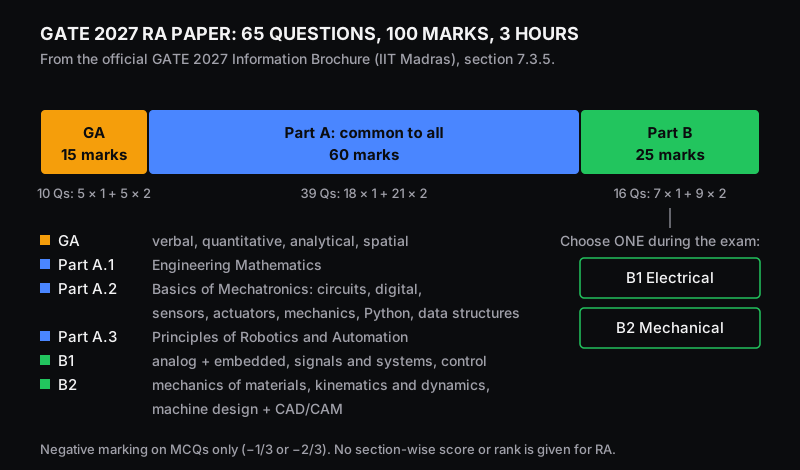
- Structure: GA 15 marks (10 questions) + Part A 60 marks (39 questions) + Part B 25 marks (16 questions), with B1 Electrical or B2 Mechanical chosen in the exam hall (brochure, section 7.3.5).
- Registration: closed on 16 October 2026. The paid correction window, which allowed a paper change for ₹500, closed on 14 November. The free defect-rectification window runs until 30 November 2026, and it is only for applicants who received a defect email.
- Exam days: 6, 7, 13, 14, 20 and 21 February 2027. The date of the RA paper itself has not been announced yet. Results: 19 March 2027.
- PSU acceptance: not yet known. The two GATE 2027 PSU notices we checked (GAIL and NPCIL) do not list RA.
This guide covers the official pattern and syllabus, how much of RA you already know from GATE ME or EE (shown in a chart), who the paper suits, four worked problems in RA topics with answers checked by script, what is and isn't known about PSU and M.Tech use, and an 11-week plan to the first exam day.
What is the GATE Robotics and Automation (RA) paper?
RA is a new GATE test paper, first held in GATE 2027. It tests engineering mathematics, the basics of mechatronics (circuits, sensors, actuators, mechanics, Python programming and data structures) and the principles of robotics and automation, followed by an electrical or mechanical specialisation. IIT Madras announced it on 20 July 2026, along with a syllabus revision across papers.
The idea is a single paper for the space between mechanical and electrical engineering, where robotics and factory automation actually sit. Until now, a mechatronics or robotics student had to pick ME, EE or Instrumentation (IN) and study a large block of material unrelated to robotics. RA puts kinematics, sensors, PLCs and controls in one paper.
The official count for GATE 2027 is 30 test papers, as stated in the brochure, on the home page and in the July press release. You may see "31 papers" elsewhere, but that is not the official figure. RA was added, and Textile Engineering and Fibre Science (TF) stopped being a separate paper and became section XE9 of Engineering Sciences.
Can I still register for GATE RA or switch to it?
No, not for GATE 2027. New registration closed on 16 October 2026, after the late-fee window to 12 October and a special window on 15 and 16 October. The only way to change papers was the paid data-correction window from 10 to 14 November 2026 (₹500 per paper for "change of existing paper"), and that window has now closed.
The window still open, to 30 November 2026, is the free application rectification for scrutiny defects. It is for candidates whose application was flagged by a zonal GATE office in a defect email, for example over a document or photograph. It is not a paper-change window. If you got such an email, fix the defect before 30 November.
If you did not choose RA this time, this guide is still useful for GATE 2028. RA is now part of the GATE syllabus set, and the 2027 paper will be the first real question paper anyone has seen.
What is the GATE 2027 RA exam pattern and marking scheme?
The RA paper has 65 questions and 100 marks in 3 hours. General Aptitude carries 15 marks. Part A, which every candidate answers, carries 60 marks. Part B carries 25 marks, and you answer either B1 (Electrical) or B2 (Mechanical), choosing in the exam. Wrong MCQ answers lose 1/3 or 2/3 of a mark. MSQ and NAT questions have no negative marking.
| Section | Questions | Marks | Who answers it |
|---|---|---|---|
| General Aptitude (GA) | 10 (5 × 1 mark, 5 × 2 marks) | 15 | Everyone |
| Part A: Engineering Mathematics, Basics of Mechatronics, Principles of Robotics and Automation | 39 (18 × 1, 21 × 2) | 60 | Everyone |
| Part B1: Electrical | 16 (7 × 1, 9 × 2) | 25 | Your choice of B1 or B2, made during the exam |
| Part B2: Mechanical | 16 (7 × 1, 9 × 2) | 25 | |
| Total | 65 | 100 | 3 hours (180 minutes) |
Four details matter for strategy:
- Part A is 70.6% of the subject marks (60 of 85). Whatever your branch, most of your preparation goes into Part A, not the B section you already know.
- No separate 13-mark maths block. In papers like ME and EE, engineering mathematics is a fixed 13 marks. RA belongs to the group of papers (with AR, DA, GE and others) where the brochure gives GA 15 + subject 85, and maths is simply part of Part A.
- One score, no section rank. The brochure says section-wise scores and ranks will not be given for RA. B1 and B2 candidates are ranked together on one RA score.
- Question types are the same as every GATE paper: MCQ (one correct option), MSQ (one or more correct) and NAT (type a number on a virtual keypad), with no partial marks. Only the on-screen virtual calculator is allowed.
Can RA be taken with another paper? Yes. The brochure's tentative two-paper table allows RA with EE, ME, DA, CS, EC or IN. The fee is paid per paper, so two papers cost twice as much: ₹2,000 for one paper and ₹4,000 for two in the regular period for general candidates, and ₹1,000 and ₹2,000 for female, SC, ST and PwD candidates.
What is the GATE robotics and automation syllabus 2027?
The official RA syllabus has a common Part A in three sections: A.1 Engineering Mathematics, A.2 Basics of Mechatronics and A.3 Principles of Robotics and Automation. Part B1 (Electrical) covers analog and embedded systems, signals and systems, and control systems. Part B2 (Mechanical) covers mechanics of materials, kinematics and dynamics, and machine design with CAD/CAM. A plain-language summary follows. Always check the official RA syllabus PDF for the exact wording.
Part A.1: Engineering Mathematics
- Linear algebra: matrices, determinant, rank, trace, adjoint, eigenvalues and eigenvectors, linear systems.
- Calculus: limits, continuity, mean value theorems, definite, improper and multiple integrals, partial and total derivatives, Taylor series, maxima and minima, gradient, divergence and curl.
- Differential equations: first-order and constant-coefficient higher-order ODEs, Euler-Cauchy, initial and boundary value problems, Laplace transforms, heat, wave and Laplace equations, Fourier series.
- Probability and statistics: conditional probability, mean, median, mode, standard deviation, binomial, Poisson and normal distributions, PDF and CDF, and hypothesis testing (not listed in ME or EE).
- Numerical methods: roots of equations, trapezoidal and Simpson's rules, finite differences, single and multi-step ODE methods.
Part A.2: Basics of Mechatronics
- Electric networks: sources and R, L, C, M elements, KCL and KVL, node and mesh analysis, Thevenin, Norton, superposition and maximum power transfer, DC and AC transients, resonance, two-port networks, three-phase circuits, power factor.
- Digital circuits: Boolean algebra, multiplexers, encoders and decoders, flip-flops and counters.
- Sensors: resistive, capacitive, inductive, piezoelectric and Hall-effect sensors with signal conditioning, and transducers for displacement, velocity, acceleration, force, torque and pressure.
- Actuators: operating principles and torque-speed characteristics of hydraulic and pneumatic actuators, and of DC, stepper and servo motors.
- Engineering mechanics: free-body diagrams, friction (rolling friction, belt and pulley), trusses and frames, and plane kinematics and dynamics of rigid bodies.
- Programming in Python: flowcharts and pseudocode, data types, operators, if/elif/else and case, while and for loops, break and continue, functions, arrays, dictionaries, strings, recursion.
- Data structures: stack, queue, linked list, binary search tree, binary heap, graph.
Part A.3: Principles of Robotics and Automation
- Robotics: serial and parallel manipulators, geometric configurations, links, joints, coordinate systems and degrees of freedom; 2D and 3D rotation matrices; homogeneous transformations; forward kinematics; point-to-point and continuous-path control; end-effectors; robot accuracy and repeatability.
- Computer integrated manufacturing: automation in manufacturing, PLCs, automated material handling, automated storage and retrieval systems (AS/RS), automated identification and data capture, CNC, single and multi-axis positioning systems, concurrent design and manufacturing planning.
Note what is not listed: inverse kinematics, the Jacobian, trajectory planning and robot dynamics are not named. Forward kinematics and homogeneous transforms are the core. The Denavit-Hartenberg (DH) convention is not named either, but it is the standard way to write forward kinematics for a serial arm, so learn it (Example 1 below uses it).
Part B1: Electrical (choose B1 or B2)
- Analog circuits and embedded systems: filters, amplifiers, op-amps, oscillators, VCOs and timers, Schmitt triggers, sample-and-hold, A/D and D/A converters, SMPS; microcontroller components, interrupts, memory and I/O interfacing, data acquisition.
- Signals and systems: continuous and discrete signals, LTI and causal systems, Fourier series and transform, sampling theorem, Laplace and Z transforms, RMS and average values.
- Control systems: modelling, transfer functions, block diagrams and signal flow graphs, transient and steady-state response, Routh-Hurwitz and Nyquist stability, Bode plots, root locus, lag and lead compensators, P, PI and PID controllers.
Part B2: Mechanical (choose B1 or B2)
- Mechanics of materials: stress, strain and elastic constants, Mohr's circle, thin cylinders, SFD and BMD, bending and shear stress, shear centre, beam deflection, torsion, Euler columns, Castigliano, thermal stress, strain gauges and rosettes, material testing.
- Kinematics and dynamics: velocity and acceleration analysis of plane mechanisms, linkage dynamics, gears and gear trains, balancing, gyroscope, free and forced single-DOF vibration, damping, isolation, resonance, critical speeds.
- Machine design and CIM: static and fatigue design, failure theories, S-N diagram, joints, shafts, bearings, brakes, clutches, springs, CAD/CAM integration, additive manufacturing.
How much of the RA syllabus overlaps with GATE ME and EE?
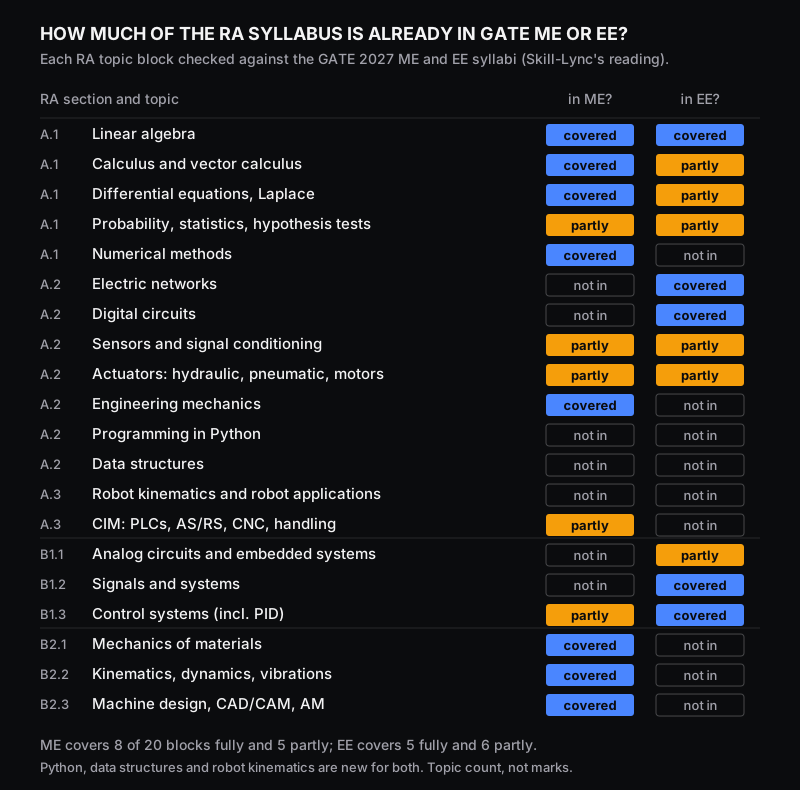
A lot, but different parts for each branch. Skill-Lync checked each of the 20 RA topic blocks against the GATE 2027 ME and EE syllabi. ME fully covers 8 blocks and partly covers 5. EE fully covers 5 and partly covers 6. Python, data structures and robot kinematics appear in neither, so every candidate starts those from zero.
What this means in practice:
- From ME: Part B2 is almost all familiar, because mechanics of materials, theory of machines and machine design are core ME. In Part A, maths, engineering mechanics and numerical methods carry over. The new work is electric networks, digital circuits, Python, data structures and robotics, plus the electrical half of sensors and actuators. GATE ME 2027 now also lists PID controllers and transfer functions, so you have a head start on basic control.
- From EE: Part B1 is almost all familiar, and in Part A so are networks and digital circuits. The new work is engineering mechanics, numerical methods, Python, data structures, robotics and CIM (PLCs, CNC, AS/RS).
- From Instrumentation (IN): the GATE IN syllabus already covers sensors and signal conditioning, control (including PID tuning and PLC basics), and analog and digital electronics with microcontrollers. IN graduates line up closely with Part A.2 and B1.
- From ECE: circuits, digital, analog and signals carry over to Part A.2 and B1. Mechanics and robotics are new.
The grid counts topic blocks, not marks, and the 2027 paper will be the first one, so nobody knows the marks per topic yet. Treat it as a map of what to learn, not a weightage chart.
Who should take the GATE RA paper?
RA suits students in mechatronics, robotics and automation, instrumentation and control, and ME or EE students who have already done robotics projects and want an M.Tech in robotics, mechatronics or automation. Eligibility is the same as every GATE paper: you must be in the third year or higher of an undergraduate degree, or have completed one.
A simple way to decide:
- You want a PSU job through GATE: write your core paper (ME, EE, IN or EC). As of 16 November 2026, no PSU notice we found accepts RA (details below). RA can be your second paper.
- You want an M.Tech in robotics, mechatronics or automation: RA is a natural fit, but check each institute's 2027 admission notice for the GATE papers it accepts. Those notices usually come out after the results.
- You are a mechatronics student: RA matches your degree better than ME or EE does. If you can, pair it with ME or EE to keep PSU options open.
- You are ME or EE and have never coded: budget real time for Python and data structures. They are two of the seven topic groups in Part A.2, and both are new territory.
Worked examples: what RA questions could look like
No RA question paper exists yet. IIT Madras has not published a sample paper (checked 16 Nov 2026), and 2027 is the first sitting. The four problems below are original Skill-Lync problems written to the official syllabus, at GATE difficulty, in NAT or MCQ style. Every number was computed by a script, which also drew the figures.
Example 1 (Part A.3): forward kinematics of a two-link planar arm
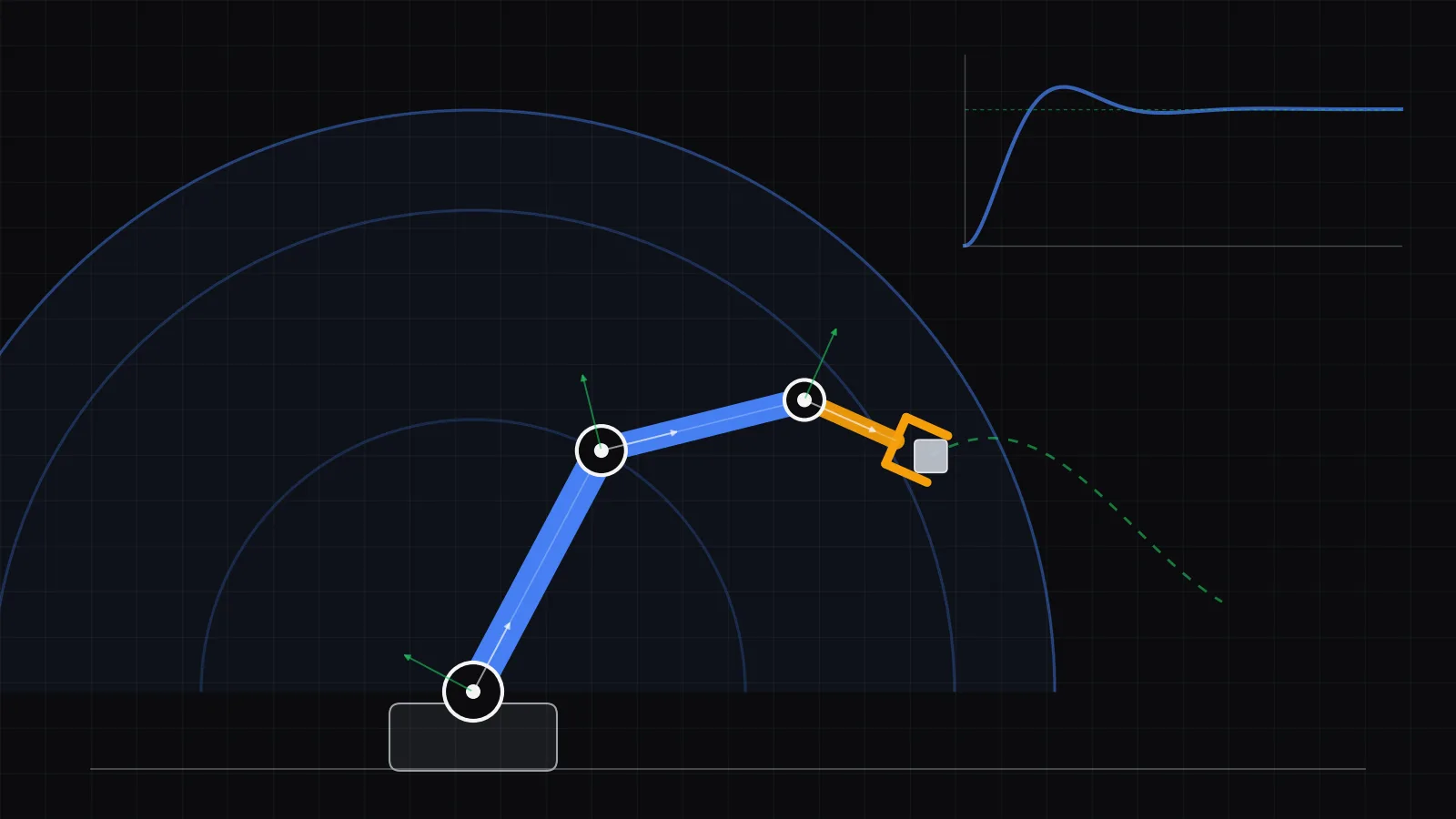
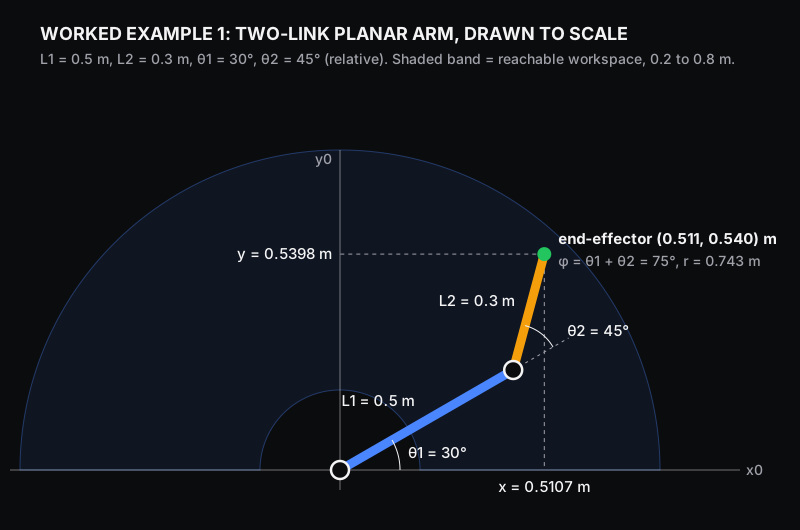
Question (NAT): A planar RR arm has link lengths m and m. Joint 1 is at from the base x-axis, and joint 2 is at relative to link 1. Find the x and y coordinates of the end-effector and its distance from the base.
Solution. Each link turns through the sum of the joint angles before it, so the tip sits at
The distance from the base follows from the cosine rule, with no need for x and y:
The tool points at . The arm can reach anywhere between m and m from the base.
The same answer with DH and homogeneous transforms. For a planar arm, each DH row is , , , with joint angle . Each link transform is a rotation about z followed by a translation along the new x-axis:
Multiplying out gives a rotation block of (entries 0.2588 and 0.9659) and a last column of (0.5107, 0.5398, 0). That is the same tip position, now with the tool orientation included. This matrix method is what scales to 6-axis industrial arms.
Example 2 (Part A.3): a homogeneous transformation
Question (NAT): Frame {1} is obtained from frame {0} by a rotation of about , and its origin sits at (0.4, 0.2, 0.1) m in frame {0}. A point has coordinates m in frame {1}. Find its coordinates in frame {0}.
Solution. Use , which is the 4×4 homogeneous transform applied to :
So m. Two quick checks examiners like: a valid rotation matrix has determinant +1 (this one does), and the inverse transform is . Here , and applying to returns (0.2, 0.1, 0).
Example 3 (Part B1, also in GATE ME 2027): step response under proportional control
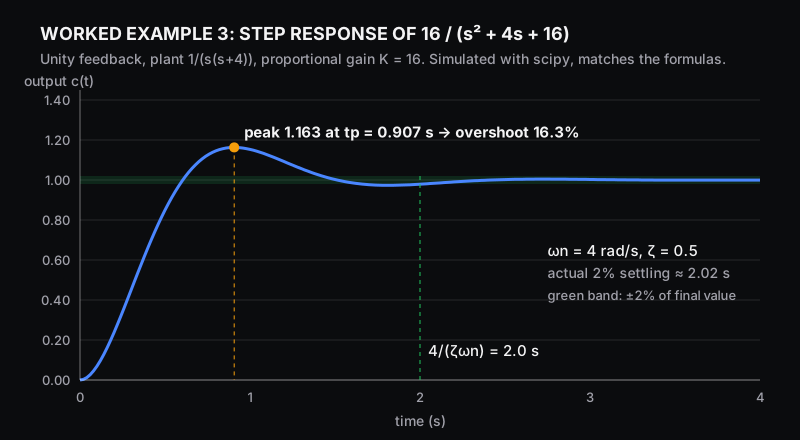
Question: A plant is under unity feedback with a proportional controller of gain . Find the damping ratio, percentage overshoot, peak time and 2% settling time for a unit step, and the steady-state error for a unit ramp.
Solution. The closed-loop transfer function is
Matching with and :
For the ramp, the velocity error constant is , so .
A simulation of the same system gives an overshoot of 16.30% at 0.907 s, matching the formulas. The response actually enters the ±2% band for good at 2.02 s, so the rule of thumb is close here. A follow-up GATE might ask what gain gives . The answer is rad/s, so : lower gain, less overshoot, but a larger ramp error.
Example 4 (Part A.2): trace a recursive Python function
Question (NAT): What does this program print?
def f(n):
    if n <= 1:
        return n
    return f(n - 1) + 2 * f(n - 2)

print(f(5))
Solution. Build up from the base cases and : , , , . It prints 11. Computed top-down, the call f(5) makes 15 function calls in total, because it recomputes the same values repeatedly. That is the reason memoisation, or a loop, beats naive recursion. Expect GATE-style programming questions to test tracing like this, not syntax trivia.
If Python is new to you, Skill-Lync's Python for Mechanical Engineers course starts from engineering problems rather than abstract exercises. Our guide to why Python matters for mechanical engineers shows four real scripts.
Will PSUs and IITs accept the GATE RA score?
As of 16 November 2026, PSU acceptance of GATE RA is not known. The brochure lists PSUs that have used GATE scores in the past, but none has announced RA. GAIL's GATE 2027 notice maps its trainee posts only to the CH, IN, EE and ME papers. NPCIL's ET-2027 notice lists engineering disciplines without RA. For M.Tech, each institute decides which GATE papers it accepts.
What the official documents actually say:
- IIT Madras (brochure, section 5.3.2): several PSUs "have used" GATE scores, and "some other organizations may also utilize GATE 2027 score". The brochure and the official website both state that GATE qualification "does not assure a PSU job" and that recruitment depends on each employer's procedure. Neither names any employer for RA.
- GAIL (advertisement of 1 September 2026): recruits Executive Trainees in Chemical, Electrical, Instrumentation and Mechanical using GATE 2027 marks only. Its table maps these posts to the CH, IN, EE and ME papers, so an RA score does not qualify. Applications open on 17 February 2027.
- NPCIL (ET-2027 advertisement): accepts GATE 2025, 2026 or 2027 scores in Chemical, Civil, Computer Science, Electrical, Electronics, Instrumentation and Mechanical. RA is not named.
Because RA is new, PSUs will decide case by case in their own advertisements, and many 2027-cycle notices are still to come. Until a PSU's notice names RA, assume it doesn't count for that PSU, and write your core paper as well if a PSU job is the goal. Our GATE 2027 Mechanical guide lists which PSUs have announced ME recruitment through GATE 2027.
For higher studies, GATE qualifies you to seek admission, with possible financial assistance, to MoE-supported M.Tech and PhD programmes. The current assistance is ₹12,400 a month for M.Tech students, generally for 22 months. Which papers are accepted for which M.Tech is set by each institute in its own notice, typically released around the results. Check the robotics, mechatronics and automation programmes you want before assuming RA is accepted.
How to prepare for GATE 2027 RA in the 11 weeks left
There are 82 days from today, Monday 16 November 2026, to the first exam day on 6 February 2027. The RA date isn't announced yet, so plan for the earliest one. Spend about two-thirds of your time on Part A, starting with the topics nobody has studied before, and keep your B section for later because you already know most of it.
| Week | Dates | Focus |
|---|---|---|
| 1 | 16-22 Nov | Python: flowcharts, data types, loops, functions, strings, dictionaries, recursion. Start a daily 45-minute maths slot (linear algebra, calculus). |
| 2 | 23-29 Nov | Data structures: stack, queue, linked list, BST, heap, graph (trace operations by hand). Probability, including hypothesis testing. |
| 3 | 30 Nov-6 Dec | Robotics: classification, configurations, DOF, rotation matrices, homogeneous transforms, DH, forward kinematics. |
| 4 | 7-13 Dec | Robot applications (PTP vs continuous path, end-effectors, accuracy vs repeatability) and CIM: PLC ladder basics, AS/RS, material handling, CNC, positioning systems. |
| 5 | 14-20 Dec | ME background: electric networks and digital circuits (your biggest gap). EE background: engineering mechanics (FBDs, friction, trusses, rigid-body dynamics). |
| 6 | 21-27 Dec | Sensors and signal conditioning. Actuators: hydraulic, pneumatic, DC, stepper and servo torque-speed curves. |
| 7 | 28 Dec-3 Jan | Remaining maths: differential equations, Laplace, Fourier series, numerical methods. Swap in whichever of networks or mechanics you skipped in week 5 for a second pass. |
| 8-9 | 4-17 Jan | Your Part B, B1 or B2. Decide now and prepare only one; you choose in the hall, but splitting effort wastes it. |
| 10 | 18-24 Jan | Part A revision with previous-year GATE questions on the overlapping topics (ME, EE and IN papers), and General Aptitude practice. |
| 11 | 25-31 Jan | Two or three full 3-hour timed papers. Assemble them yourself: 10 GA, 39 Part A and 16 Part B questions, in the official ratio. |
| - | 1-5 Feb | Formula sheet, error log, light revision. Download the admit card when it is released. |
Rules that matter more than the timetable:
- Use the overlapping papers' previous-year questions. For maths, mechanics, machine design and theory of machines, Skill-Lync's solved GATE question hub has official ME questions with checked solutions, for example linear algebra, engineering mechanics and theory of machines and vibrations.
- Don't over-study robotics beyond the syllabus. Inverse kinematics, Jacobians and dynamics are not listed. Master forward kinematics and transforms until they are fast.
- Practise with the virtual calculator. Matrix products and trigonometry by on-screen calculator are slow. Time yourself on a few 4×4 transform problems.
- Watch the official site. The RA paper date, admit card and any sample paper will appear on gate2027.iitm.ac.in, and IIT Madras notes that all dates may change.
Beyond the exam, the controls and embedded parts of RA are what robotics and automation employers actually test. Skill-Lync's System Modelling and Simulation using Simulink and Simscape, Fundamentals of Embedded Systems and Data Structures and Algorithms using Python cover that ground with projects. For background on the field itself, read what mechatronics and control systems are. If you are unsure which route fits you, talk to a Skill-Lync counsellor.
Frequently asked questions
When is the GATE 2027 Robotics and Automation exam?
GATE 2027 runs on 6, 7, 13, 14, 20 and 21 February 2027 in forenoon and afternoon sessions. The date and session of the RA paper had not been announced as of 16 November 2026; IIT Madras will publish the paper-wise schedule on gate2027.iitm.ac.in. Results are due on 19 March 2027.
Is GATE RA harder than GATE ME or EE?
Nobody can say yet, because 2027 is the first RA paper and there are no past papers or cut-offs. It is broader rather than deeper. It mixes circuits, mechanics, Python, data structures and robotics, so almost every candidate has to learn some topics from scratch, even when Part B is familiar.
Can I choose Part B1 or B2 in the exam hall?
Yes. The brochure says the choice between B1 (Electrical) and B2 (Mechanical) can be made during the examination. Each is 16 questions and 25 marks. Prepare one properly rather than half of each, because there is no section-wise score: everyone gets a single RA score.
Is DH parameter notation in the GATE RA syllabus?
Not by name. The syllabus lists rotation matrices in 2D and 3D, homogeneous transformations and forward kinematics. DH parameters are the standard way to build those transforms for a serial arm, so they are worth learning. Inverse kinematics and Jacobians are not listed.
Do PSUs recruit through GATE RA?
Not known yet. No PSU notice we found as of 16 November 2026 names RA. GAIL's GATE 2027 notice maps its posts only to the CH, IN, EE and ME papers. IIT Madras says GATE qualification does not assure a PSU job. If a PSU job is your aim, also write your core paper.
Can I write both GATE ME and GATE RA?
Yes, for future cycles. ME + RA is an allowed two-paper combination in GATE 2027, and so are EE, EC, IN, CS and DA with RA. For 2027, though, registration and the paper-change window have both closed. You pay the fee for each paper.
Sources and further reading
- IIT Madras, GATE 2027 Information Brochure (17 Oct 2026): highlights, pattern, section 7.3.5 (RA test paper), two-paper combinations, PSU section
- IIT Madras, GATE 2027 RA syllabus, with the ME, EE and IN syllabi used for the overlap chart (accessed 16 Nov 2026)
- IIT Madras, GATE 2027 important dates, application fees and correction charges, question paper pattern and examination opportunities (accessed 16 Nov 2026)
- IIT Madras, press release: dates, syllabus revision and new paper in GATE 2027 (20 Jul 2026)
- GAIL (India) Limited, recruitment of Executive Trainees through GATE 2027, advertisement GAIL/OPEN/ET/1/2026 (1 Sep 2026)
- NPCIL, recruitment of Executive Trainees (ET-2027) through GATE (accessed 16 Nov 2026)
- Skill-Lync, GATE 2027 Mechanical (ME): dates, syllabus, pattern, plan and PSUs (14 Nov 2026)