EV Sales in India, October 2026: Record 3.55 Lakh EVs, 11.5% Share
India retailed a record ~3.55 lakh electric vehicles in October 2026, about 11.5% of the market. Here are the official Vahan and FADA numbers by segment, the top makers in two-wheelers, three-wheelers, cars and buses, why EV share dipped from September, where PM E-DRIVE stands, and what it means for EV engineering jobs.

In short
- India retailed about 3.55 lakh electric vehicles in October 2026, the highest monthly figure on record and 44.9% more than October 2025, according to FADA's retail data released on 6 November 2026.
- That is roughly 11.5% of all two-wheeler, three-wheeler, car and commercial-vehicle sales, up from about 6% a year earlier. The share was higher in September (about 13.6%), because petrol two-wheeler sales jumped more than EV sales in the festive month.
- Vahan registrations (pulled 14 November 2026): 2,24,920 electric two-wheelers (+49% YoY), 89,285 electric three-wheelers (+26%), 38,109 electric cars (+82%) and 762 electric buses.
- Leaders: TVS, Bajaj, Ather and Hero in two-wheelers; Bajaj and Mahindra Last Mile Mobility in three-wheelers; Tata, Mahindra and JSW MG in cars; Olectra, JBM and PMI in buses.
- The most striking trend: electric autos and loaders (L5) more than doubled year on year even though their PM E-DRIVE incentive ended on 26 December 2025, while low-speed e-rickshaws fell 22%.
India sold about 3.55 lakh electric vehicles in October 2026, a record for any month. The Federation of Automobile Dealers Associations (FADA), which compiles retail sales from the government's Vahan registration system, puts EV penetration at roughly 11.5% of all two-, three- and four-wheelers and commercial vehicles sold in the month, against about 6% in October 2025.
This post is the first in a monthly series. It uses only official registration data: FADA's October 2026 release and the Ministry of Road Transport and Highways' Vahan dashboard, which we queried ourselves on 14 November 2026 for maker-wise and segment-wise EV numbers. Where a number is our own calculation from those sources, we say so. At the end we look at what the numbers mean for engineers who want to work in EVs.
How many EVs were sold in India in October 2026?
Here are the October registrations of battery-electric vehicles by segment from Vahan, with the previous month and October 2025 for comparison. "Registrations" means vehicles that were actually registered at an RTO, which is the closest public measure of what customers bought.
| Segment (Vahan, battery-electric) | Oct 2026 | Sep 2026 | Oct 2025 | Month on month | Year on year |
|---|---|---|---|---|---|
| Two-wheelers | 2,24,920 | 2,08,824 | 1,50,892 | +7.7% | +49.1% |
| Three-wheelers (L5 autos + e-rickshaws) | 89,285 | 86,547 | 70,996 | +3.2% | +25.8% |
| Cars and UVs (incl. taxis) | 38,109 | 38,586 | 20,981 | −1.2% | +81.6% |
| Buses | 762 | 818 | 331 | −6.8% | +130.2% |
| Total of these four | 3,53,076 | 3,34,775 | 2,43,200 | +5.5% | +45.2% |
Two-wheelers are close to two thirds of all EVs registered. Three-wheelers are a quarter, cars about a tenth, and buses a fraction of a percent by count.
FADA's own headline, "about 3.55 lakh" EVs up 44.88% year on year, is a little higher than our four-segment total because it also counts electric goods vehicles, such as small e-trucks and e-loaders, inside commercial vehicles. Vahan shows 4,104 battery-electric goods carriers registered in October 2026, up from 1,535 a year earlier.
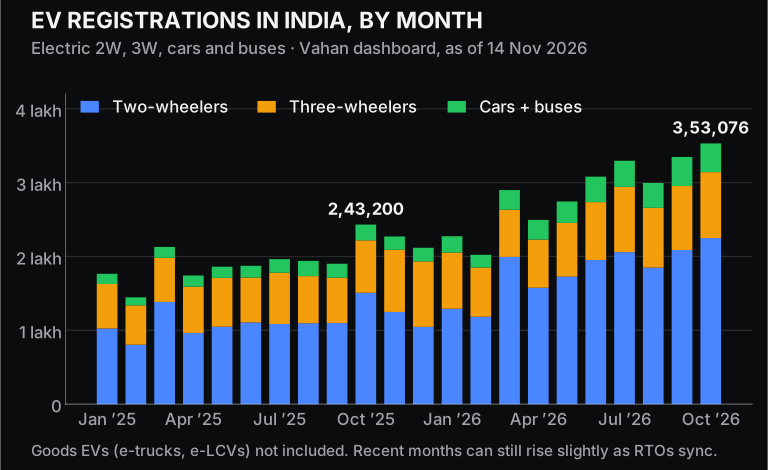
The year-to-date picture is stronger than any single month. From January to October 2026, Vahan recorded 17.97 lakh electric two-wheelers (+61.5% over January to October 2025), 7.68 lakh electric three-wheelers (+22.2%) and 2.97 lakh electric cars (+84.8%). In ten months, India has already registered more electric two-wheelers and cars than in the whole of calendar 2025 (13.42 lakh and 1.96 lakh).
What share of vehicles sold were electric?
Penetration is the number most people quote, and October's tells a slightly counter-intuitive story.
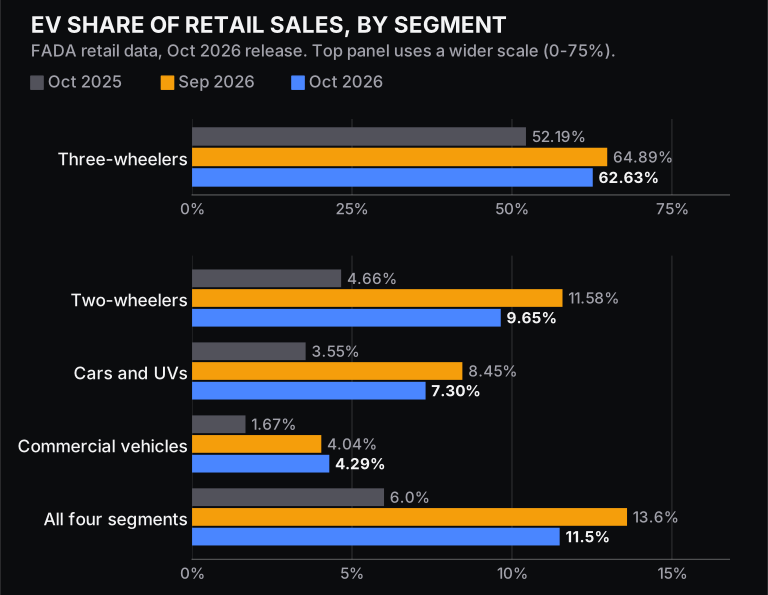
- Three-wheelers: 62.63% electric. Almost two of every three three-wheelers sold in India now run on batteries.
- Two-wheelers: 9.65%, roughly double October 2025's 4.66%, but down from 11.58% in September.
- Cars and UVs: 7.30%, up from 3.55%, and down from 8.45% in September.
- Commercial vehicles: 4.29%, up from 1.67%. This is still small, but it is the only segment whose share rose month on month.
Why did the share fall from September to October while EV sales rose? Because October is a festive month, and festive buying is heavily petrol two-wheelers bought in rural India. Working from FADA's numbers, electric two-wheeler retail rose about 8% from September to October, while non-electric two-wheeler retail rose about 32%. More EVs were sold, but the pie grew faster than the EV slice. The same arithmetic, on all four segments, takes overall penetration from about 13.6% in September to about 11.5% in October.
The calendar also distorts the year-on-year view of total sales. FADA reports that total vehicle retail fell 23.80% year on year in October 2026, because October 2025 contained both Navratri and Diwali (plus pent-up demand after the GST rate cuts of 22 September 2025), while in 2026 Dhanteras and Diwali fell in November. EVs grew 44.9% against that tough base, which is why their share of the market roughly doubled.
Which companies sold the most EVs in October 2026?
Electric two-wheelers: the legacy makers now lead
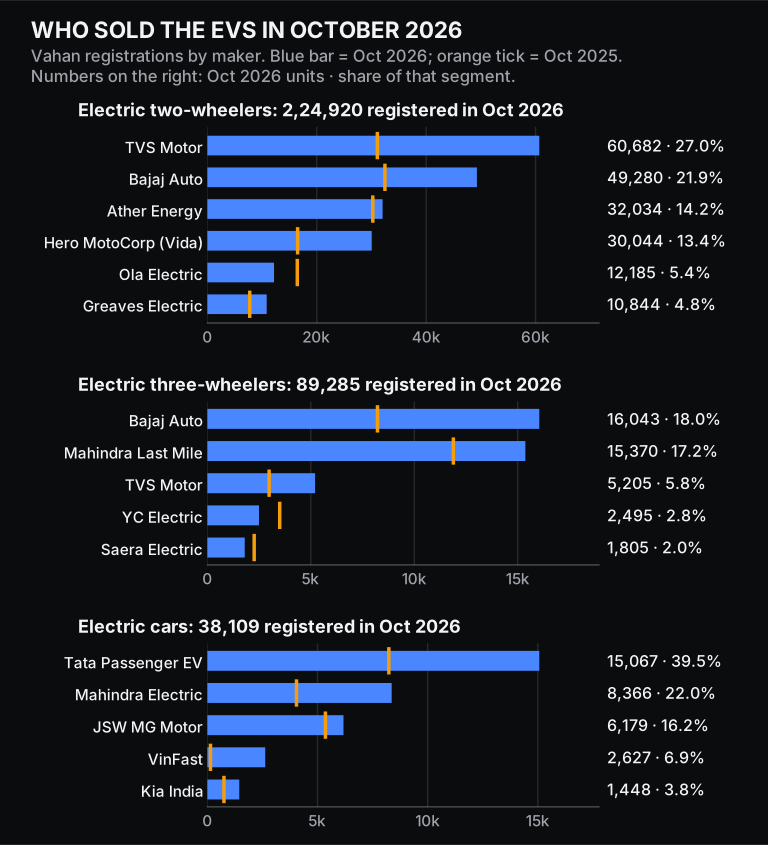
TVS Motor registered 60,682 electric two-wheelers (27.0% of the segment), nearly double its 31,075 a year earlier. Bajaj Auto was second with 49,280 (+52%). Ather Energy (32,034) and Hero MotoCorp, which sells EVs under the Vida brand (30,044, +82%), were close behind. Ola Electric registered 12,185, down 26% year on year, for a 5.4% share. Greaves Electric (Ampere), River and BGauss make up most of the rest; 111 makers registered at least one electric two-wheeler in October.
The top four now hold about 76.5% of the segment, and three of them (TVS, Bajaj and Hero) are long-established petrol two-wheeler makers with large dealer and service networks. Ather is the only EV-only company in the top four.
Electric three-wheelers: two leaders and a very long tail
Bajaj Auto (16,043, almost double October 2025) and Mahindra Last Mile Mobility (15,370) together hold about 35% of electric three-wheeler registrations. TVS is a distant third with 5,205. Behind them, 560 makers registered at least one electric three-wheeler in October, most of them small e-rickshaw assemblers. Piaggio, the third-largest three-wheeler maker overall, registered 1,504 electric units.
Electric cars: Tata leads, VinFast and Maruti arrive
Tata Passenger Electric Mobility registered 15,067 electric cars (39.5%), up 83% year on year. Mahindra Electric Automobile more than doubled to 8,366 (22.0%), and JSW MG Motor registered 6,179 (16.2%). Two newer names matter: VinFast, which registered 142 cars in October 2025, registered 2,627 this October, and Maruti Suzuki, which had no electric registrations a year ago, registered 1,245 (and 12,104 in January to October). Kia (1,448), Hyundai (782) and BYD (749) complete the top eight.
Electric buses
| Bus maker (Vahan) | Oct 2026 | Jan to Oct 2026 |
|---|---|---|
| Olectra Greentech | 202 | 1,192 |
| JBM Auto | 186 | 1,513 |
| PMI Electro Mobility | 130 | 1,059 |
| Pinnacle Mobility | 103 | 534 |
| Switch Mobility | 43 | 1,146 |
| All electric buses | 762 | 6,163 |
Bus registrations are lumpy because they follow fleet deliveries to state transport undertakings and city operators, so a single month's ranking says little. Over January to October 2026, India registered 6,163 electric buses, 57% more than in the same months of 2025.
What drove October's EV sales?
The festive calendar
Navratri ran from 11 to 20 October 2026, and FADA's festive data shows EV retail over those ten days at 1,19,429 units, 28.9% more than in Navratri 2025. Dhanteras (6 November) and Diwali (8 November) fall in November this year, so part of the festive wave is still to come. FADA expects November to carry the deferred rural, two-wheeler-led demand.
What dealers say: fuel prices, range and price parity
FADA's statement attributes the record to petrol and diesel prices that "continue to remain elevated", materially better EV driving ranges, and EV prices "increasingly at par" with comparable petrol and diesel models. It also says that availability, not demand, became "the binding constraint" in October. That is the dealers' view, not a measured number, but it is consistent with what Vahan shows: electric car registrations dipped slightly from September even as dealers reported strong demand.
Subsidies matter less than they used to
The clearest evidence is in three-wheelers. Under PM E-DRIVE, the incentive for electric L5 three-wheelers (the autos and loaders that run at normal road speeds) was capped at 2,88,809 vehicles. The Ministry of Heavy Industries wrote to SIAM on 23 December 2025 that 2,85,931 had been registered by 22 December, and that L5 vehicles registered after 26 December 2025 would not get the incentive.
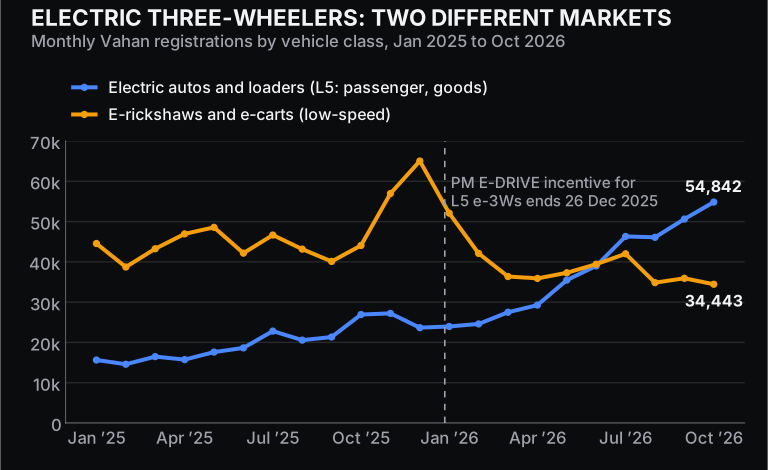
Registrations did not fall after the incentive ended. Electric L5 three-wheelers went from 26,924 in October 2025 to 54,842 in October 2026, more than double. Meanwhile, low-speed e-rickshaws and e-carts, which remain eligible for a small incentive, fell 22% to 34,443. Our reading: in this segment, running-cost economics rather than the subsidy now drives purchases. The shift from e-rickshaws to L5 autos also matters for engineering, because L5 vehicles are faster, type-approved motor vehicles with bigger batteries and motors.
What is the status of the PM E-DRIVE scheme?
PM E-DRIVE (PM Electric Drive Revolution in Innovative Vehicle Enhancement) is the central government's main EV incentive scheme, run by the Ministry of Heavy Industries. Its position as of 14 November 2026, from the gazette notifications on the scheme portal:
| Component | Current terms | Notification |
|---|---|---|
| Electric two-wheelers | ₹2,500 per kWh, capped at ₹5,000 per vehicle (and at 15% of ex-factory price), for vehicles with ex-factory price up to ₹1.5 lakh registered from 1 April 2025 to 31 March 2028; up to 45,79,120 vehicles; ₹2,767 crore | S.O. 4424(E), 10 August 2026 |
| E-rickshaws and e-carts | ₹2,500 per kWh, capped at ₹12,500 per vehicle, ex-factory price up to ₹2.5 lakh, until 31 March 2028; up to 39,034 vehicles; ₹50 crore | S.O. 1617(E), 27 March 2026 |
| Electric three-wheelers (L5) | Closed for vehicles registered after 26 December 2025 (target reached) | MHI letter to SIAM, 23 December 2025 |
| Whole scheme | Outlay ₹11,900 crore; runs to 31 March 2028; fund-limited, so a component closes early if its money runs out; last date for claims 31 December 2027 | S.O. 4424(E), 10 August 2026 |
Two points matter for engineers. First, the two-wheeler incentive is now small: ₹5,000 at most, against ₹10,000 in 2024-25. Second, the scheme ties support to local manufacturing through a Phased Manufacturing Programme (PMP). An amendment notified on 3 September 2026 for electric buses requires traction-motor assembly (rotor and stator fitment, bearings, enclosure, connectors, cables) to be done in India from 1 September 2026, and magnet and shaft fitment as well from 1 April 2027. Localisation rules like these move manufacturing and testing work, not just sales, into India.
What does this mean for EV engineering jobs and skills?
Sales data doesn't tell you how many engineers companies will hire, so treat this as a reading of direction, not a jobs forecast. Still, a few things follow from the numbers.
- Two-wheeler scale is the biggest pool of work. At around 2 lakh units a month since mid-2026, electric two-wheelers need engineers for battery packs, battery management systems (BMS), motor controllers, chargers, thermal management and validation, and the work now sits mostly at established makers (TVS, Bajaj, Hero) and their suppliers. If you want to understand what a BMS actually does, start with our BMS explainer.
- Electric cars grew fastest in percentage terms (+84.8% in January to October), with more makers in the race (Tata, Mahindra, MG, VinFast, Maruti, Kia, Hyundai, BYD). Car programmes need high-voltage system integration, crash and battery-safety simulation (CAE), NVH and thermal engineering.
- L5 three-wheelers and e-goods carriers are now real vehicle programmes, not low-speed assemblies. They need durable powertrains, structures that pass type approval, and duty-cycle-based battery sizing.
- Localisation rules create manufacturing roles. Motor assembly, magnet handling, cell-to-pack lines and end-of-line testing are manufacturing and quality jobs that mechanical and electrical engineers can both fill.
The skills that keep showing up across these roles are vehicle and battery modelling in MATLAB/Simulink, cell chemistry and pack design, power electronics, motor design and control, thermal simulation, and the basics of functional safety. Skill-Lync's PG program in EV design and development and PG program in battery technology cover these with project work. For a broader view of where a mechanical degree can take you, including EV roles, see our guide to career options after mechanical engineering.
How to read these numbers
- Registrations, not factory dispatches. Vahan and FADA count vehicles registered at RTOs. SIAM publishes wholesale dispatches from factories to dealers, which can run ahead of or behind retail. SIAM's October 2026 figures had not been published when we wrote this (14 November 2026).
- Coverage. FADA's October data was collated as on 4 November 2026 from 1,468 of 1,469 RTOs, and its 3W and CV numbers exclude Telangana for October. Our Vahan queries cover the 1,468 of 1,469 RTOs running Vahan 4 and were pulled on 14 November, so they can differ slightly from FADA's.
- What counts as an EV. In Vahan we counted fuel types "ELECTRIC(BOV)" and "PURE EV". Hybrids, including strong and plug-in hybrids, are not included.
- Revisions. Late registrations keep arriving. For example, FADA's first print for October 2025 total retail was 40,23,923; its October 2026 release compares against a revised 41,63,555. Expect small upward revisions to recent months.
- Our calculations. EV units from FADA are category totals multiplied by FADA's fuel-wise share, so they are approximate. The "all four segments" share and the September-to-October changes are our arithmetic from FADA's tables.
Frequently asked questions
How many electric vehicles were sold in India in October 2026?
About 3.55 lakh, according to FADA's retail data released on 6 November 2026, the highest monthly figure on record. Vahan shows 2,24,920 electric two-wheelers, 89,285 three-wheelers, 38,109 cars and 762 buses registered in the month.
What is India's EV market share in October 2026?
About 11.5% of two-wheeler, three-wheeler, car and commercial-vehicle retail sales, up from about 6% in October 2025. By segment: 62.63% of three-wheelers, 9.65% of two-wheelers, 7.30% of cars and 4.29% of commercial vehicles.
Which company sold the most electric two-wheelers in October 2026?
TVS Motor, with 60,682 registrations (27.0% of the segment), followed by Bajaj Auto (49,280), Ather Energy (32,034) and Hero MotoCorp (30,044).
Which is the best-selling electric car maker in India?
Tata Passenger Electric Mobility, with 15,067 registrations in October 2026 (39.5%), followed by Mahindra Electric Automobile (8,366) and JSW MG Motor (6,179).
Is the PM E-DRIVE subsidy still available?
Yes for electric two-wheelers (up to ₹5,000 per vehicle until 31 March 2028, while funds last) and for e-rickshaws and e-carts (up to ₹12,500). The incentive for L5 electric three-wheelers closed for vehicles registered after 26 December 2025.
Why did EV share fall in October if sales hit a record?
Because petrol two-wheeler sales grew much faster in the festive month (about 32% over September, against about 8% for electric two-wheelers), so EVs were a smaller slice of a bigger market.
Sources and further reading
- FADA Releases Oct'26 Vehicle Retail Data, Federation of Automobile Dealers Associations, 6 November 2026 (category totals, fuel-wise shares, Navratri EV data, OEM tables, dealer commentary).
- FADA press releases, monthly vehicle retail data, October 2025 to September 2026 (monthly EV shares), accessed 14 November 2026.
- Vahan dashboard, Ministry of Road Transport and Highways: Maker x Month-wise and Vehicle Class x Month-wise reports for 2025 and 2026, fuel ELECTRIC(BOV) and PURE EV, queried 14 November 2026.
- PM E-DRIVE policy documents, Ministry of Heavy Industries: S.O. 4424(E) of 10 August 2026, S.O. 1617(E) of 27 March 2026, S.O. 4884(E) of 3 September 2026 (e-bus PMP), accessed 14 November 2026.
- Intimation of last date for sale of e-3Ws (L5) eligible for demand incentive, Ministry of Heavy Industries letter to SIAM, 23 December 2025.