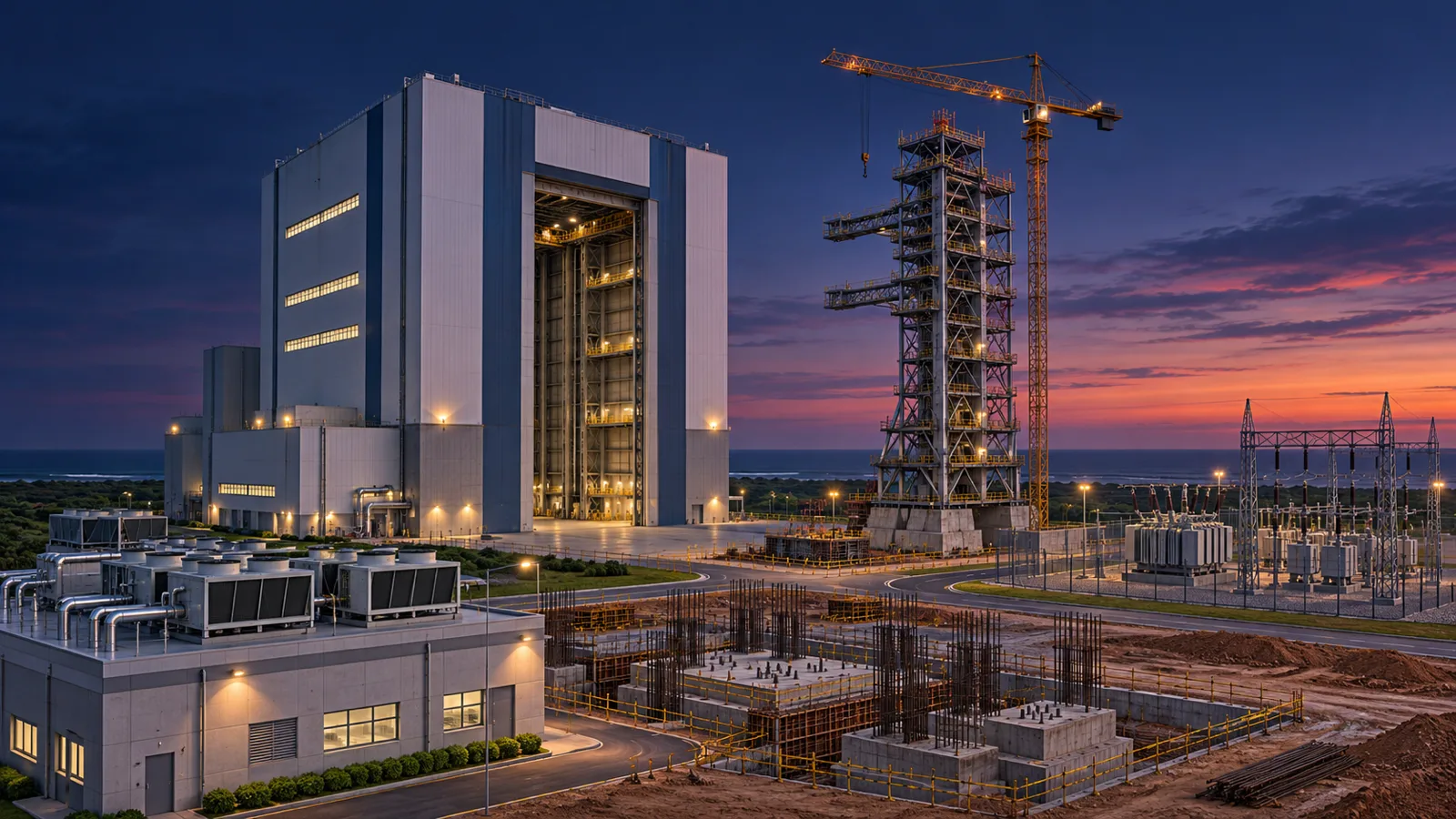
ISRO Mission ANTARIKSH EoI: The Analog Facility HSFC Wants Built
On 26 Nov 2026 ISRO's Human Space Flight Centre issued EoI HSFC/EoI/02/2026-27 for Mission ANTARIKSH, an Earth-based human-spaceflight analog facility with 1:1 Gaganyaan and Bharatiya Antariksh Station modules, a mission control centre, a 10 x 10 x 5 m neutral buoyancy pool and 15 task simulators. The dates (EoI due 30 Dec 2026), who can respond, what must be built, how NASA and ESA analogs compare, a worked CO2 air-budget calculation, and the engineering roles involved.

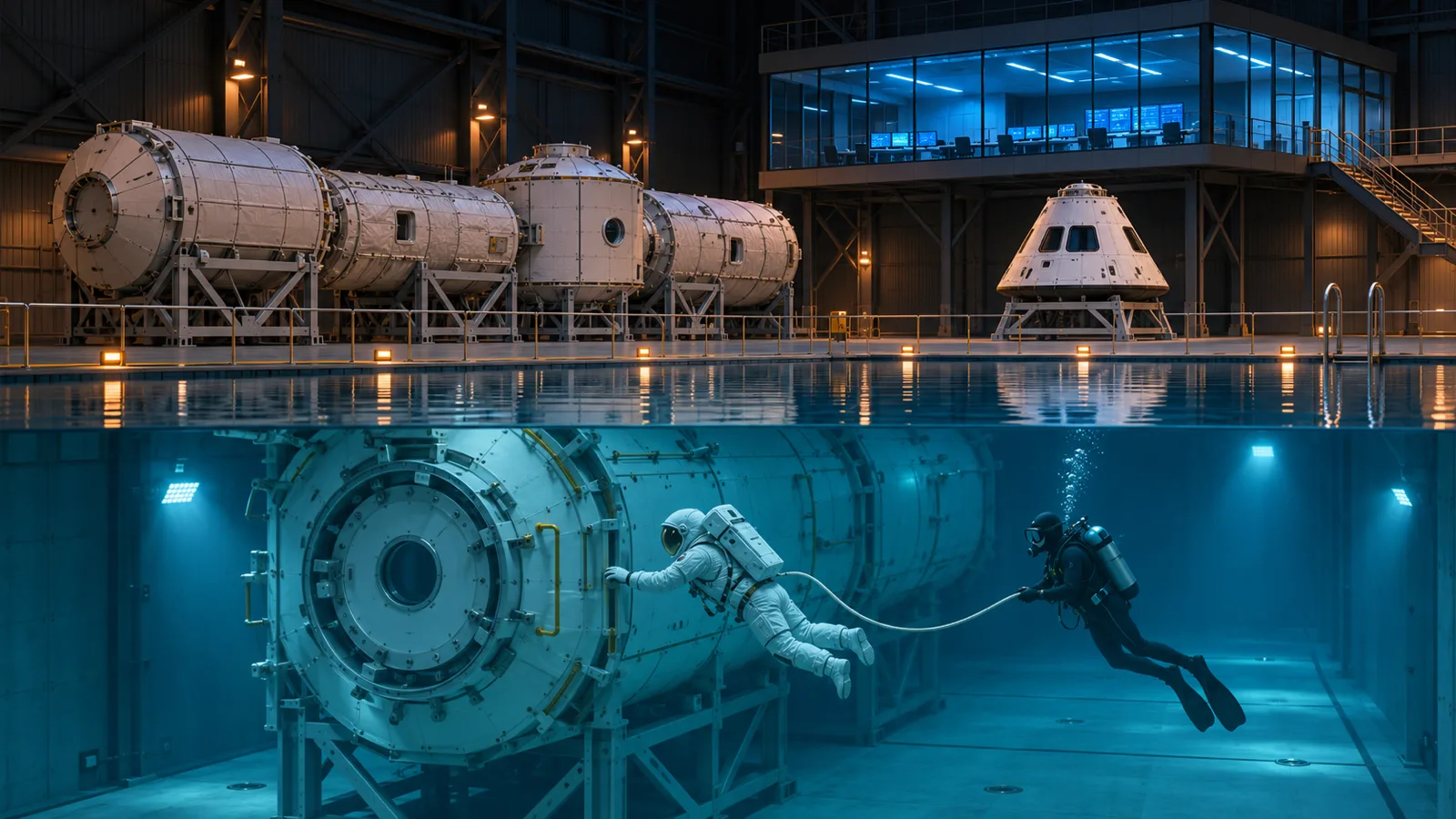
On 26 November 2026, ISRO's Human Space Flight Centre (HSFC) in Bengaluru issued an Expression of Interest, HSFC/EoI/02/2026-27, asking Indian companies to build and then operate "Mission ANTARIKSH": an Earth-based human-spaceflight analog facility with full-scale Gaganyaan and Bharatiya Antariksh Station (BAS) mock-up modules, a Mission Control Centre, a 10 m × 10 m × 5 m neutral buoyancy pool and fifteen task simulators, all under one blacked-out roof. Indian industries or consortia can respond; responses are due in hard copy at HSFC on 30 December 2026 (ISRO's tenders listing shows a 16:00 deadline), after a hybrid pre-EoI meeting on 11 December and vendor presentations on 18 December. The contract that follows is three years long: one year to build and commission, two years to run six analog mission campaigns.
Below: the dates and rules, what must be built (sizes as HSFC states them), what an analog facility is, the engineering inside one with a worked air-budget calculation, who qualifies, and what it means for Indian industry and engineering students.
Key facts at a glance
- 26 Nov 2026: EoI HSFC/EoI/02/2026-27 issued; the 36-page bilingual PDF is linked from ISRO's tenders page (HSFC, 26 Nov 2026).
- 30 Dec 2026: last date for the EoI and its opening date, submitted in hard copy to the Purchase and Stores Officer, HSFC, Doddenakundi, Bengaluru 560037; email or fax responses are not accepted (EoI, Table 1 and page 5). ISRO's tenders page lists the deadline as 30 Dec 2026, 16:00.
- 3 years, 6 campaigns: one year of facility realisation, then two years of operations with six analog campaigns in two phases of three, extendable by up to three more years (EoI, sections 2 and 6).
- 3,600 m², 15 m, 850 m²: minimum built-up area, clear height and analog-module clearance of the Closed Roof Facility; the neutral buoyancy simulator is 10 m × 10 m × 5 m deep (EoI, Appendix).
- Rs 50 crore: minimum verifiable turnover, from other businesses, of at least one promoter or founding board member of the bidder; plus a pre-built analog habitat and at least five documented analog missions totalling 30 days (EoI, section 10).
What did HSFC issue, and who can respond?
HSFC issued an Expression of Interest, not a tender. Its purpose is to find Indian vendors or consortia with the capability to take on the "End-to-End Realization of Mission ANTARIKSH", shortlist them, and then issue a Request for Proposal (RFP) with a two-part technical and price bid. Only companies that respond to this EoI will be allowed to bid in the RFP. The document says so explicitly in section 10.
HSFC is the ISRO centre inaugurated on 30 January 2019 at the ISRO headquarters campus in Bengaluru to implement the Gaganyaan project, including crew selection and training. Gaganyaan itself aims to fly a crew of three to a 400 km orbit for three days and bring them back to Indian waters (ISRO). Mission ANTARIKSH is a ground facility to rehearse that kind of mission, and the station that follows, without leaving Earth. The name is also an acronym: "Advanced Native Testbed for Analog Research in Indian Kinetography & Station Hardware".
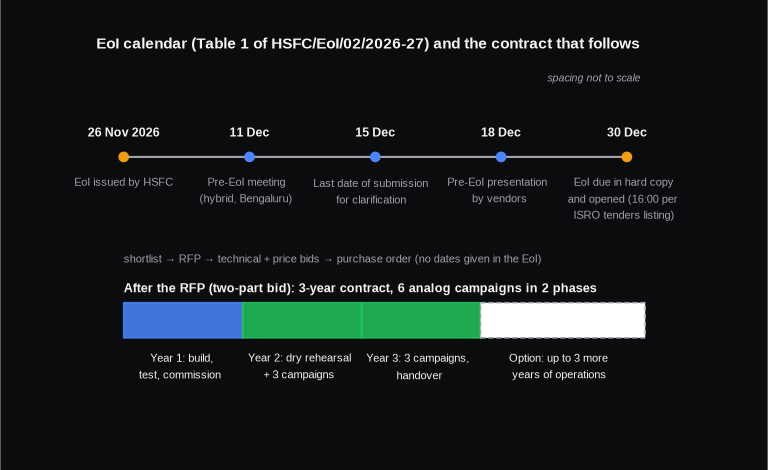
The calendar in Table 1 of the EoI:
| Step | Date |
|---|---|
| EoI issued (cover letter date) | 26 Nov 2026 |
| Pre-EoI meeting (hybrid) | 11 Dec 2026 |
| Last date of submission for clarification | 15 Dec 2026 |
| Pre-EoI presentation by vendor | 18 Dec 2026 |
| Last date for submission of the EoI | 30 Dec 2026 (16:00 per ISRO's tenders listing) |
| Opening date of the EoI | 30 Dec 2026 |
The PDF gives dates only; the 16:00 deadline appears on ISRO's tenders page. Other rules from the document: pre-EoI queries go to HSFC's focal point by email at least five days before the meeting, so by 6 December; at most two representatives per company, with an authorisation letter and security clearance; an NDA is signed before the meeting; a consortium names one lead agency; and HSFC will visit bidders' sites to verify their claims.
What exactly does HSFC want built?
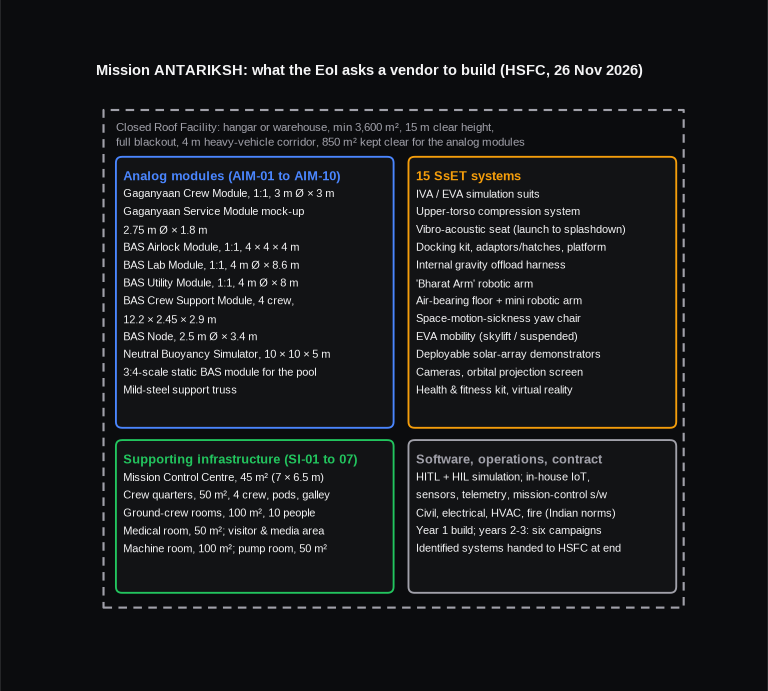
The Appendix of the EoI lists the facility in three groups: a building, the analog modules inside it, and fifteen "Space-Specific Engineering Task" (SsET) systems. HSFC says the final configurations, quantities and acceptance criteria will come in the RFP; the numbers below are the minimums stated now.
The building: a blacked-out hangar
The Closed Roof Facility is an existing, leased or owned industrial warehouse or hangar with a heavy-duty concrete floor: at least 3,600 m² of clear internal area, 15 m clear height, three heavy-vehicle entries with rolling shutters of at least 6 m × 6 m, a 4 m peripheral corridor, forklift and crane provision, and parking for 10 cars and 20 two-wheelers. Windows must be blacked out completely because the simulations run in darkness, and the construction must be modular and reversible.
The analog modules
Inside an 850 m² clearance zone the vendor builds representative Gaganyaan and BAS hardware (EoI tables AIM-01 to AIM-10):
| Module | Stated size | Note |
|---|---|---|
| Gaganyaan Crew Module | 3 m Ø × 3 m high, 1:1 | With a crew ingress ladder |
| Gaganyaan Service Module | 2.75 m Ø × 1.8 m | Scaled, visually representative mock-up |
| BAS Airlock Module | 4 m × 4 m × 4 m, 1:1 | |
| BAS Lab Module | 4 m Ø × 8.6 m, 1:1 | With adapter extension |
| BAS Utility Module | 4 m Ø × 8 m, 1:1 | With adapter extension |
| BAS Crew Support Module | 12.2 m × 2.45 m × 2.9 m | Cuboid, houses four astronauts |
| BAS Node | 2.5 m Ø × 3.4 m | Connects Lab, Crew and Utility modules |
| Neutral Buoyancy Simulator | 10 m × 10 m × 5 m deep | Temporary or semi-permanent pool with a submerged 3:4-scale static BAS module |
A mild-steel truss supports the modules. Around them sit a 45 m² Mission Control Centre, 50 m² of crew quarters for four with sleeping pods, galley and a tabletop trainer, 100 m² for ten ground crew, a 50 m² medical room, a visitor and media area, a 100 m² machine room and a 50 m² pump room for the pool.
The fifteen task simulators
The SsET list covers every physical cue an astronaut meets: IVA and EVA simulation suits; an upper-torso compression system and a vibro-acoustic seat for the loads and noise of launch, abort, re-entry and splashdown; a docking kit with joysticks and real-time visuals, operable docking adaptors and hatches, and a motion platform for physical capture; a body-weight offload harness for microgravity movement inside the modules; the "Bharat Arm" robotic arm and an air-bearing floor for low-friction docking tests; a yaw-rotation chair for space-motion-sickness studies; suspended and skylift EVA rigs; deployable solar-array demonstrators; cameras; an orbital projection screen behind the viewports; exercise and crew-monitoring kit; and virtual-reality training.
What is an analog mission facility, and why do space agencies build them?
An analog is a place or facility on Earth that reproduces some part of spaceflight, physically or psychologically, so that crews, hardware and procedures can be tested before anyone is launched. NASA's definition: analog missions "help NASA test systems, protocols, and scenarios on Earth before crews are sent to space", in locations "that have natural or engineered physical similarities to extreme space environments" (NASA, page updated 18 Aug 2026).
Three examples from the agencies' own pages show the range:
- Isolation and confinement. NASA's HERA at Johnson Space Center, Houston, is a 650-square-foot habitat used for missions of up to 45 days to study isolation, confinement and remote conditions (NASA HERA page). ESA uses Concordia station in Antarctica, on a plateau 3,200 m above sea level where winter temperatures drop to −80 °C, as "isolated, confined and extreme"; ESA has sent a medical doctor there for 13-month stays (ESA Concordia page).
- Weightlessness for spacewalk training. NASA's Neutral Buoyancy Laboratory is a 61.5 m × 31.1 m × 12.2 m indoor pool holding 6.2 million gallons of chlorinated fresh water at 28.9–30 °C, used for "mission planning, procedure development, hardware verification, astronaut training, and refinement of time-critical operations" for spacewalks (NASA NBL page). NASA's ARGOS offload system and parabolic flights cover partial gravity in other ways.
- Whole-mission rehearsal. NASA's CHAPEA simulates year-long stays on the Martian surface, and its Moon and Mars Exploration Analog combines several Johnson facilities into one integrated, year-long campaign (NASA analog-missions page).
Mission ANTARIKSH is in the "engineered" category: a hangar built around India's own spacecraft geometry, covering several of these functions in one footprint. Its 500 m³ pool is about 1/47th of the NBL's volume by our arithmetic, but it only has to hold one 3:4-scale static BAS module, not a station.
What engineering goes into an analog facility?
The EoI names four technical threads: the habitat modules and their internal architecture, the neutral buoyancy simulator, the mission control and telemetry software, and Human-in-the-Loop (HITL) and Hardware-in-the-Loop (HIL) simulation. Each is an engineering discipline of its own.
Habitat modules and the air inside them
A 1:1 module is a steel or composite shell with the real spacecraft's internal volume, hatches, racks and lighting. What makes it a spaceflight analog is the environmental control and life-support (ECLSS) simulation: the crew's oxygen use, CO₂ production, heat and humidity must be measured, shown in mission control and, in a sealed test, removed.
How big a job is that? NASA's Life Support Baseline Values and Assumptions Document (BVAD, February 2022) gives the reference numbers engineers size these systems with: an 82 kg crew member produces 1.085 kg of CO₂ a day, consumes 0.895 kg of oxygen and drinks 3.217 kg of water (BVAD Table 3-31). For the four-person BAS Crew Support Module in the EoI, that is 4.34 kg of CO₂ to remove every day, 3.58 kg of oxygen to supply and 12.9 kg of drinking water: about 130 kg of CO₂ over a 30-day campaign.
Now suppose the hatch is closed and nothing scrubs the air. The module envelope is
At 101.325 kPa and 25 °C the air in it is
Four crew add CO₂ at
so the CO₂ partial pressure climbs by
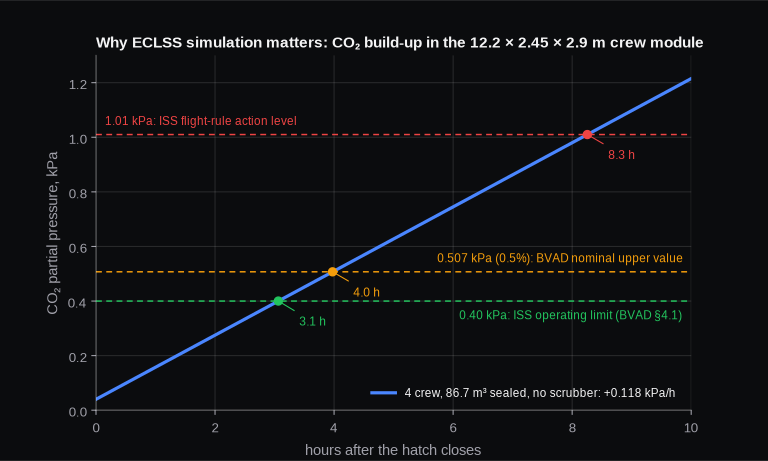
Starting from Earth's 0.04 kPa, the air reaches 0.40 kPa, the operating limit ISS mission control has adopted, in about 3.1 hours; 0.507 kPa (0.5%), the BVAD's nominal upper design value, in about 4.0 hours; and 1.01 kPa, the ISS flight-rule level at which crews must take action, in about 8.3 hours. The BVAD notes that fatigue and "full headedness" are reported between 0.307 and 0.360 kPa, and missed procedure steps between 0.360 and 0.400 kPa. Real free volume is smaller than the envelope (racks, equipment), so a real module would get there sooner. This is why even an Earth-based habitat needs a CO₂ removal loop, sensors and alarms sized for the crew, and why the EoI lists "emergency egress and medical contingency support" among the vendor's safety duties.
Neutral buoyancy: making a suited person weightless in water
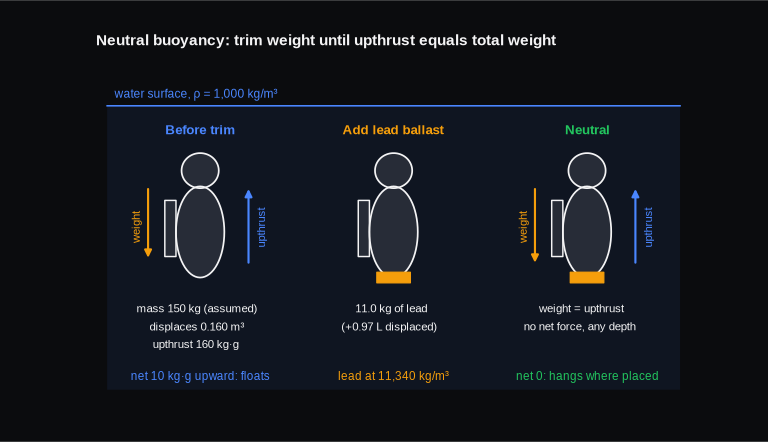
Underwater, a body feels two vertical forces: its weight downward and Archimedes' upthrust upward, where is the volume of water it displaces. When the two are equal the body is neutrally buoyant: it neither rises nor sinks, and it stays wherever a diver leaves it. That is the closest Earth can get to the feel of a spacewalk, which is why spacewalk procedures are rehearsed in pools.
The trimming problem is simple to state. A suited trainee is almost always positively buoyant because the suit holds air. Suppose, for illustration, that trainee, suit and backpack together have a mass of 150 kg and displace 0.160 m³. The upthrust is then equivalent to 160 kg, so there is a net 10 kg·g pushing up. Adding lead ballast fixes it, but lead displaces water too, so you need slightly more than 10 kg:
Divers then shift small weights between the suit's pockets until the trainee is also balanced in pitch and roll, otherwise they would slowly rotate head-up or head-down. The 150 kg and 0.160 m³ are assumed numbers for the arithmetic; the EoI gives no suit masses.
The pool itself is an engineering job: 10 m × 10 m × 5 m is 500 m³, or 500 tonnes of water, to be filtered, circulated, drained and kept at a temperature divers can work in for hours. The EoI requires dedicated water supply, filtration, circulation and drainage and a 50 m² pump room; safety divers and lifting gear for the mock-up follow from that.
Mission control, telemetry and human-in-the-loop simulation
The 45 m² Mission Control Centre is where the facility becomes a mission. Every sensor in the modules, suits, exercise kit and pool reports to operator stations through what the EoI calls "IoT frameworks, sensor arrays, telemetry modules and mission control software", which the vendor must develop in-house (2.5 marks each in the evaluation matrix). Voice loops, cameras and the projection screen run on one mission timeline, so a "launch" on the vibro-acoustic seat, a "docking" on the motion platform and an "EVA" in the pool happen in sequence, with anomalies injected by controllers.
Two acronyms describe the two kinds of simulation. Hardware-in-the-Loop (HIL) means a real piece of hardware, say a docking hand-controller or a hatch mechanism, is driven by a simulated spacecraft model running in real time, so the hardware "thinks" it is in orbit. Human-in-the-Loop (HITL) means a real person is part of that loop: their inputs change the simulation and the simulation's outputs (motion, visuals, alarms) change their behaviour. HSFC wants both integrated. The modelling side is the same discipline used in automotive controls work; our notes on state-space representations are the starting point, and Skill-Lync's system modelling with Simulink and Simscape course teaches the plant-model-plus-controller workflow that HIL rigs are built on.
Who can qualify, and how will HSFC score responses?
This is not an open invitation. Section 10 sets five conditions. The bidder, or the consortium lead, must be a Private Limited Company incorporated in India; must not be blacklisted; must already own a pre-built, operational analog habitat with human-in-the-loop capability, independently validated under the "IGSA (International Guidelines for Space Analogs) standard Adherence Matrix"; must have run at least five documented analog missions totalling at least 30 days with field deployments; and at least one promoter or founding board member must show, with a CA certificate for FY 2024-25, a turnover of Rs 50 crore or more from other businesses.
Section 9 then scores qualified bidders out of 100, with 50 needed to pass:
| Criterion | Marks | How marks are earned (EoI section 9) |
|---|---|---|
| Operational track record in analog missions | 50 (min 25) | More than 8 missions: 15; field deployment in a cold desert and/or a hyper-arid saline desert: 5 each; international collaboration in the past year: 10; more than 60 cumulative simulation days: 15 |
| Infrastructure | 40 (min 20) | IGSA-validated habitat: 20 (mandatory); fabrication facility, owned or by agreement: 5; in-house IoT, sensors, telemetry and mission-control software: 2.5 each; three analog infrastructures, two already used with people: 5 |
| Financial soundness | 10 (mandatory) | Promoter turnover of Rs 50 crore or more from other businesses |
The weighting shows what HSFC values: experience running real analog missions with real crews, in harsh terrain, over fabrication capacity. A metal shop with no mission history cannot qualify alone; it would join a consortium led by an analog-mission operator. A bare "yes" in the compliance matrix without evidence counts as non-compliance.
What does the EoI mean for Indian industry and for engineering students?
For industry, HSFC states in writing that it wants "to increase industry participation in the establishment of ground-based facilities for human spaceflight engineering, crew training and mission simulation" (section 1.1). The vendor designs, builds, operates and maintains the facility; HSFC defines requirements, reviews designs, witnesses acceptance tests, sets mission profiles and crews, and may transfer identified know-how and simulation logic under ISRO procedures (sections 4 and 5). No contract value appears in the EoI, so any rupee figure you read elsewhere is an estimate, not HSFC's number.
For engineering students the document is a job description for a new field. From the vendor duties in section 8 and the SsET list, the roles are:
- Systems engineers for requirements, interfaces, FAT/SAT procedures and the quality system the EoI demands.
- Mechanical and structural engineers for the module shells, hatches and docking adaptors, the support truss, the motion platform, the gravity-offload rigs and the robotic arm; CAD, FEA and fabrication skills apply directly. Skill-Lync's design programme and HyperMesh FEA for sheet-metal applications cover the tools.
- Controls and simulation engineers for the HIL/HITL models, the docking dynamics on the air-bearing floor and the vibro-acoustic seat profiles.
- Embedded, IoT and software engineers for the sensor arrays, telemetry and mission-control software that HSFC wants developed in-house; see Skill-Lync's IoT applications course.
- Human-factors, medical and safety engineers for suit ergonomics, crew monitoring, fire safety to Indian norms and emergency egress.
- Civil, HVAC and plumbing engineers for the hangar fit-out, blackout, the 500 m³ pool and its pump room.
If your aim is to be on the HSFC side of the table rather than the vendor's, the route is ISRO's Scientist/Engineer 'SC' recruitment; our ISRO Scientist/Engineer data page tracks cut-offs, the written test and answer keys, and the November 2026 result post covers the latest panels. For the physics behind the crew module the trainees will sit in, see why capsules have blunt noses and, for a vacuum effect the hatches and docking adaptors must be designed against in the real thing, cold welding in space.
What is confirmed and what is not?
| Item | Status | Where it comes from |
|---|---|---|
| EoI HSFC/EoI/02/2026-27 dated 26 Nov 2026 for Mission ANTARIKSH | Confirmed | PDF on isro.gov.in tenders page |
| Dates: pre-EoI meeting 11 Dec, clarifications 15 Dec, vendor presentations 18 Dec, EoI due and opened 30 Dec 2026; hard copy to HSFC Bengaluru | Confirmed | EoI Table 1 (page 6) and page 5 |
| 16:00 deadline on 30 Dec 2026 | Listed, not in the PDF | ISRO tenders page entry for HSFC/EoI/02/2026-27 |
| Module sizes, 10 × 10 × 5 m pool, 3,600 m² hangar, 15 SsET systems | Confirmed as minimums; final configuration in the RFP | EoI Appendix |
| 3-year contract, 6 campaigns, extension up to 3 years | Confirmed | EoI sections 2 and 6 |
| Contract value, site location, crew identities, RFP date | Not stated | Not in the EoI; site is "identified/approved by HSFC" |
| Link to ISRO's earlier field analog mission in Ladakh | Not claimed here | We found no ISRO page on it to cite; the EoI does not mention it |
Frequently asked questions
What is Mission ANTARIKSH?
Mission ANTARIKSH is an Earth-based human-spaceflight analog and engineering simulation facility proposed by ISRO's Human Space Flight Centre. It will hold full-scale Gaganyaan and Bharatiya Antariksh Station mock-up modules, a Mission Control Centre, a 10 m × 10 m × 5 m neutral buoyancy pool and fifteen task simulators, used for crew training, mission rehearsal, systems validation and crew-system interaction studies (EoI HSFC/EoI/02/2026-27, 26 Nov 2026).
When is the Mission ANTARIKSH EoI due?
Responses must reach HSFC in hard copy on 30 December 2026, which is also the opening date; ISRO's tenders listing gives the deadline as 16:00. Before that, the hybrid pre-EoI meeting is on 11 December, clarification submissions close on 15 December and vendors present on 18 December 2026. Email and fax submissions are not accepted.
Can a startup or an MSME respond?
Only if it meets the eligibility rules: an Indian Private Limited Company (or consortium lead) that already owns an IGSA-validated analog habitat, has run at least five analog missions totalling 30 days, and has a promoter with Rs 50 crore turnover from other businesses. Smaller firms can take part as consortium members under a lead that qualifies; the lead is HSFC's single point of contact.
How long will the facility operate?
The contract is three years: one year to design, build and commission, then two years of operations with six analog mission campaigns in two phases of three, each phase preceded by a dry rehearsal. HSFC may extend operations by up to three more years. At the end the vendor hands over the identified systems to HSFC.
What is the difference between an analog mission and a simulator?
A simulator reproduces one task, such as docking, on a console. An analog mission puts a crew through a whole mission timeline, often for days or weeks, in a facility or terrain that resembles space physically or psychologically: confinement, darkness, weightlessness in water. Mission ANTARIKSH integrates many simulators into one such facility.
Sources and further reading
- Invitation for Expression of Interest for End-to-End Realization of Mission ANTARIKSH, HSFC/EoI/02/2026-27, Human Space Flight Centre, ISRO, 26 Nov 2026 (PDF, 36 pages); listed on ISRO Tenders.
- Inauguration of Human Space Flight Centre (HSFC), ISRO, 30 Jan 2019.
- Gaganyaan, ISRO, page dated 23 Nov 2022.
- Analog Missions, NASA, page updated 18 Aug 2026.
- HERA (Human Exploration Research Analog), NASA, page updated 5 Aug 2026.
- Neutral Buoyancy Laboratory, NASA Johnson Space Center, page updated 31 Mar 2026.
- Concordia, European Space Agency.
- Life Support Baseline Values and Assumptions Document, NASA/TP-2015-218570 Rev 2, Ewert, Chen and Powell, NASA Johnson Space Center, February 2022 (Tables 3-31 and 4-1, section 4.1).