Is Engineering Worth It in 2026? Costs, Jobs and Salaries in India
Is engineering still worth it? We put 2026 fee circulars, NIRF placement data, the India Skills Report and 3,711 Skill-Lync placement records side by side, and work out how many years of salary a B.Tech really costs.

Yes, engineering is still worth it in 2026 for most students who finish with real, usable skills, but the degree alone no longer guarantees a job. The India Skills Report 2026 rates 70.15% of B.E./B.Tech test-takers employable, so roughly three in ten are not yet job-ready. Costs range from about ₹1.3 lakh to ₹9.3 lakh in institute fees at IIT Madras, depending on family income, and far more at some private colleges, while typical first salaries run from ₹3.5 lakh a year to well above ₹14 lakh at top institutes.
In short
- Scale: 43.2 lakh students were enrolled in B.E./B.Tech in 2023-24, 12.7% of all undergraduates, and 8.2 lakh graduated that year (AISHE 2023-24, Ministry of Education).
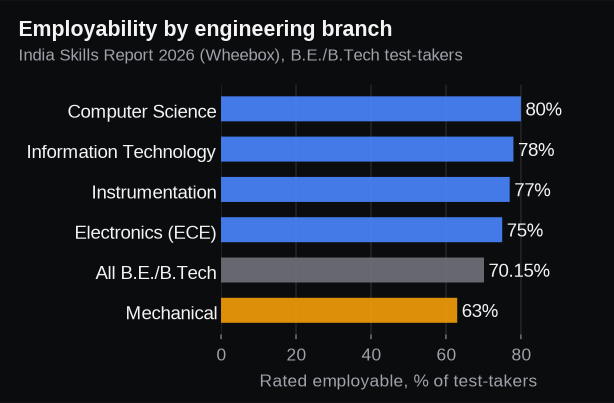
- Job-readiness: 70.15% of B.E./B.Tech test-takers were rated employable in the India Skills Report 2026; computer science scored 80%, mechanical 63%.
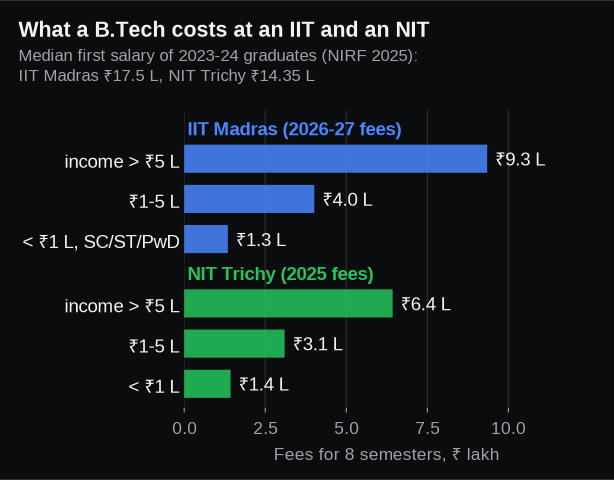
- Cost: eight semesters of institute fees come to about ₹9.3 lakh at IIT Madras (2026-27) and ₹6.4 lakh at NIT Trichy (2025 batch) for families earning over ₹5 lakh, before hostel and mess. Lower-income families pay a fraction.
- Pay: 2023-24 B.Tech graduates placed from IIT Madras had a median salary of ₹17.5 lakh; from NIT Trichy, ₹14.35 lakh (NIRF 2025 data). Skill-Lync learners' median starting offer is ₹3.5 lakh (n = 3,711).
- Worked answer: four years of NIT Trichy fees equal 0.45 years of its median graduate salary, but 1.8 years of a ₹3.5 lakh salary. Where you study and what you learn there decide the return.
Data note: Our own figures in this article are based on 3,711 Skill-Lync placement records up to 7 Nov 2026 (data snapshot of 15 Nov 2026). They come from learners who reported a placement, mostly starting offers from 2021-23, so treat them as a starting point, not the whole market. We will update them as new placements come in.
This guide is for Class 12 students and parents deciding on a B.Tech, and for engineering students wondering whether they made the right call. It uses official numbers where they exist (fee circulars, NIRF data, AISHE, PLFS), says when a figure comes from a news report instead, and works the money out with a script Skill-Lync keeps with this article.
Is engineering still worth it in 2026?
Yes, for a student who picks a college with a real placement record and builds job skills during the four years. IIT Madras and NIT Trichy each placed about three in four of their 2023-24 B.Tech graduates. The risk is a costly degree from a weak college with no skills on top, which leaves many graduates under-employed.
The honest version of the answer has two halves. On one side: India has 2,117 global capability centres employing 2.36 million people (Zinnov-Nasscom, FY2026 data), a tech industry Nasscom estimates added 1.35 lakh direct jobs in FY26, 12 approved semiconductor projects worth about ₹1.64 lakh crore (PIB, May 2026) and electric vehicles at 8% of new registrations in 2025 (Vahan data reported by IANS). On the other: the PLFS 2025 puts unemployment among 15-29 year-olds at 9.9% (13.6% in cities), and an engineering degree is now common enough that it no longer sets you apart by itself.
How many engineering students are there in India, and how many get jobs?
India had 43.2 lakh students in B.E. and B.Tech programmes in 2023-24 and turned out 8.2 lakh engineering graduates that year, according to the Ministry of Education's AISHE report. AICTE data reported by ThePrint shows 47.7% of UG engineering students enrolled from 2019-20 to 2022-23 were placed through their colleges; many others find jobs off-campus or study further.
A few more numbers put that in context:
- Intake keeps rising. AICTE's approved B.Tech intake reached 14.90 lakh seats in 2024-25, with enrolment of 12.53 lakh, the highest in eight years (EducationPost, citing AICTE data). Engineering and technology enrolment grew about 21.8% from 2019-20 to 2023-24 (AISHE).
- More women. 31.1% of the 43.9 lakh students in engineering and technology courses are women (AISHE 2023-24).
- Employable is not the same as employed. The India Skills Report is based on more than 1 lakh candidates who took Wheebox's Global Employability Test. A 70.15% employability rate means that share cleared the test's bar, not that they had jobs.
- Top institutes do much better. In their NIRF 2025 submissions, IIT Madras placed 549 of 714 B.Tech graduates of 2023-24 (76.9%) and 153 more went on to higher studies; NIT Trichy placed 791 of 1,029 (76.9%), with 158 going to higher studies.
What does a B.Tech cost in India in 2026?
At an IIT, eight semesters of institute fees for the 2026-27 batch come to about ₹9.3 lakh if your family earns over ₹5 lakh a year, ₹4.0 lakh between ₹1 lakh and ₹5 lakh, and ₹1.3 lakh below ₹1 lakh or for SC/ST/PwD students. NITs cost less: about ₹6.4 lakh at NIT Trichy before income-based waivers. Hostel and mess are extra.
How the IIT Madras figure is built, from its fee circular dated 4 May 2026:
- One-time fees of ₹21,000, plus ₹1,13,000 every semester (₹1,00,000 of it tuition), plus medical insurance of ₹2,402 a year. A ₹5,000 caution deposit is refundable and left out.
- Eight semesters, in rupees: .
- Families earning ₹1-5 lakh get two-thirds of tuition waived (about ₹4.0 lakh in total); below ₹1 lakh, and all SC/ST/PwD students, pay no tuition (about ₹1.3 lakh).
NIT Trichy's 2025 circular lists a semester total of ₹1,22,950 in the first semester, falling to ₹62,500 in even semesters. Over eight semesters that is ₹6,52,100, or ₹6,43,000 after taking out ₹9,100 of refundable deposits. Tuition is ₹62,500 a semester, fully waived below ₹1 lakh family income and two-thirds waived between ₹1 lakh and ₹5 lakh.
Private and self-financing college fees vary widely and are not covered by the figures above. Check the fee your state's fee regulatory committee has approved for that college, not a brochure, and ask what is excluded.
What do engineering graduates earn in their first job?
It depends heavily on the college and branch. Placed B.Tech graduates of 2023-24 had a median salary of ₹17.5 lakh at IIT Madras and ₹14.35 lakh at NIT Trichy (NIRF 2025 data). Across Skill-Lync's placement records, which cover a much wider set of colleges, the median starting offer is ₹3.5 lakh a year, with the middle half between ₹3.0 and ₹4.3 lakh.
| Group | n | Median | 25th-75th percentile |
|---|---|---|---|
| All placements | 3,711 | 3.5 | 3.0-4.3 |
| Freshers | 2,430 | 3.5 | 3.0-4.2 |
| Experienced hires | 444 | 4.5 | 3.5-6.0 |
| Design engineer | 1,208 | 3.4 | 3.0-4.2 |
| Embedded engineer | 155 | 4.0 | 3.5-5.0 |
| FEA / CAE engineer | 272 | 3.3 | 2.85-3.74 |
Two things stand out. Experienced hires in the records earn a median 4.5 lakh, about 29% more than freshers, so the first job is a starting point rather than a ceiling. And the companies hiring most often are engineering services and automotive firms: Cyient (212 placements), Tata Technologies (98), Tata Elxsi, Expleo and Hyundai Motor lead the design list. You can browse every role and company on our salary pages and the list of companies hiring freshers.
Is an engineering degree worth the money? A worked example
A simple test is how many years of first-year salary the fees cost. Four years of NIT Trichy fees equal 0.45 years of its median graduate salary, and IIT Madras fees 0.53 years. The same NIT fees against a ₹3.5 lakh salary take 1.8 years; a college charging ₹4 lakh a year takes 4.6 years.
| Case | Fees, 4 yrs | Salary, yr 1 | Ratio |
|---|---|---|---|
| IIT Madras median | ₹9.35 L | ₹17.5 L | 0.53 |
| NIT Trichy median | ₹6.43 L | ₹14.35 L | 0.45 |
| NIT Trichy fees, ₹3.5 L job | ₹6.43 L | ₹3.5 L | 1.84 |
| Example: ₹2 L/yr college | ₹8 L | ₹3.5 L | 2.29 |
| Example: ₹4 L/yr college | ₹16 L | ₹3.5 L | 4.57 |
The last two rows are illustrations, not real colleges; the ratio is years of first-year salary: put your own college's approved fee and its actual median salary in their place. What the table shows is that the return on an engineering degree is decided less by "engineering" than by the gap between what you pay and what your college's graduates actually earn. A low fee with good outcomes is an excellent deal; a high fee with ₹3.5 lakh outcomes takes years to pay back, before living costs and any education loan interest.
To find the real numbers for a college you are considering, open its NIRF data file (every ranked institute publishes one on its website). The "Placement and higher studies" table lists, for each graduating year, how many students graduated, how many were placed and their median salary.
Which engineering branches have the best prospects in 2026?
By employability, computer science (80%), IT (78%), instrumentation (77%) and electronics (75%) lead, with mechanical at 63% (India Skills Report 2026). By hiring signals, software and electronics benefit from 2,117 global capability centres and a ₹1.64 lakh crore semiconductor push; mechanical and electrical gain from EVs and automotive engineering services.
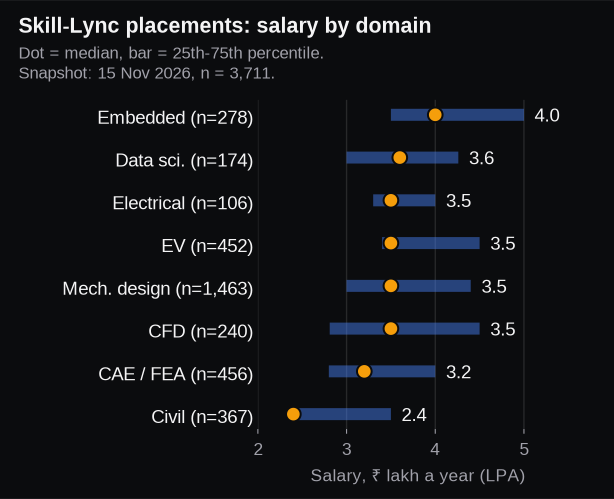
Branch is not destiny, though. Skill-Lync's records are grouped by the domain of the job, not the degree, and median starting offers in embedded (4.0 lakh, n = 278) and EV roles (3.5 lakh, n = 452) sit at or above mechanical design (3.5 lakh, n = 1,463); these roles hire engineers who have learned the tools, whatever their branch. Civil roles show the lowest starting medians in our data (2.4 lakh, n = 367). If you are weighing a core job against software, our guide to core vs IT jobs for mechanical engineers compares the two paths in detail, and the mechanical jobs guide lists the roles.
When is engineering not worth it?
Engineering is a poor bet when the fee is high and the college's own data shows weak placements, when you are choosing it only because others expect you to, or when you plan to spend four years on exams alone. A degree with no projects, internships or tool skills is the profile most likely to fall in the 30% not rated employable.
Some specific warning signs:
- The college will not show you its NIRF placement table, or, as a rough rule of thumb of ours (not an official one), its total fee is more than two to three years of its graduates' median salary.
- You would study a branch you have no interest in just to get "any B.Tech". Employability gaps between branches are real, and motivation decides how much you learn.
- You need a job in four years and have no plan for internships, projects or off-campus applications. Nationally, AICTE data shows fewer than half of enrolled students were placed through their colleges.
How do you make an engineering degree worth it?
Treat the degree as the base and build three things on top: fundamentals you can explain, hands-on projects you can show, and the industry tools your target role uses. Technical interviews test what you can do with the theory, not your marks.
That was the core of the original version of this article, written from what our mentors saw: learners with modest marks who built real skills often had an easier start than peers who focused only on exams. In practice:
- Learn the fundamentals properly. Strength of materials, thermodynamics, circuits or data structures come up in every technical interview, and they are what lets you pick up new tools quickly.
- Build projects that look like real work. A mechanical student can model and analyse a bracket in CAD and FEA; an electronics student can build and test an embedded controller. Put them on GitHub or LinkedIn with numbers.
- Learn the tools of your target role. For mechanical design that means CAD (SolidWorks, CATIA, Creo), GD&T and sheet-metal or plastic design; for CAE, FEA and meshing; for EV, MATLAB/Simulink and battery modelling.
- Get an internship before final year. It is the single most useful line on a fresher's CV.
- Keep the public-sector and higher-studies routes open. GATE scores open M.Tech seats and many PSU recruitments.
Free courses are a low-risk way to start. Our free courses include full-length CATIA, AutoCAD, SOLIDWORKS FEA and CFD courses and a GD&T workshop, and the recent placements page shows which skills our learners were hired for.
How hard is it to get into a top engineering college?
Very hard at the top, much easier overall. JoSAA 2026 allocates seats at 138 institutes, including 23 IITs and 31 NITs, and offered 62,853 seats in 2025 (Careers360), about 4% of AICTE's 14.90 lakh approved B.Tech seats. More than 16 lakh candidates registered for JEE Main 2026 (Careers360, from NTA figures).
That gap is why the choice of college matters so much in the money calculation above. Most students will study outside the JoSAA institutes, at state and private colleges whose outcomes vary widely, so checking a college's own placement data before paying is the most useful hour you can spend.
Where do Skill-Lync courses fit?
Our job-oriented programmes are built for the gap this article describes: engineering students and graduates who have the degree but need industry tools and portfolio projects. Mechanical students usually start with the pre-graduate program in engineering design or the Post Graduate Program in CAD, which teach CAD, GD&T and design projects of the kind employers in our placement data hire for. Not sure which path suits your branch and year? Talk to a Skill-Lync counsellor.
Frequently asked questions
Is engineering a good career in India in 2026?
Yes, if you combine the degree with skills. Nasscom estimates India's tech workforce at 59.5 lakh direct employees in FY26, capability centres employ 2.36 million people, and EV and semiconductor programmes are adding core jobs. But 70.15% employability means many graduates need extra preparation, so plan projects, internships and tools from your first year.
Which engineering branch is best for the future?
Computer science and electronics currently show the highest employability (80% and 75% in the India Skills Report 2026) and the most hiring. Mechanical and electrical remain strong for students interested in automotive, EV, energy and manufacturing, especially with CAD, CAE or embedded skills. Choose a branch you will enjoy enough to go deep in.
Is a B.Tech from a private college worth it?
It can be, if the fee is reasonable and the college's own data shows good placements. Compare the total four-year fee with the median salary in its NIRF placement table. If the fee is more than two or three years of that salary (our rule of thumb), the degree pays off only if you add strong skills and internships yourself.
What is the starting salary of an engineer in India?
It ranges widely. Skill-Lync's placement records (snapshot 15 Nov 2026, n = 3,711) show a median starting offer of ₹3.5 lakh a year, with the middle half between ₹3.0 and ₹4.3 lakh. Placed B.Tech graduates of top institutes earn far more: medians of ₹17.5 lakh at IIT Madras and ₹14.35 lakh at NIT Trichy in 2023-24.
Can I get an engineering job without campus placement?
Yes. AICTE data shows fewer than half of enrolled engineering students were placed through their colleges, so many graduates find jobs off-campus through job portals, referrals and company tests. A portfolio of projects in the tools the role uses, plus an internship, is what gets an off-campus application shortlisted.
Sources and further reading
- All India Survey on Higher Education 2023-24, final report, Ministry of Education, released Jul 2026 (accessed 21 Nov 2026).
- India Skills Report 2026, Wheebox (accessed 21 Nov 2026).
- PLFS Annual Report 2025, press note, MoSPI, 27 Mar 2026.
- Fee structure for 2026 admission (UG and PG), IIT Madras, 4 May 2026.
- B.Tech fee structure, 2025 admission batch, NIT Tiruchirappalli (accessed 21 Nov 2026).
- NIRF 2025 Engineering data, IIT Madras and NIRF 2025 Engineering data, NIT Trichy (accessed 21 Nov 2026).
- India's engineering courses are losing their sheen, ThePrint, 7 Mar 2025 (AICTE placement data).
- AICTE data shows BTech enrolment hits eight-year high, EducationPost, 3 Aug 2025.
- India GCC Landscape 2026, Zinnov and Nasscom (accessed 21 Nov 2026).
- India FY26 tech revenues seen up 6.1%, jobs also grow: Nasscom, PTI via Devdiscourse, 24 Feb 2026.
- India Semiconductor Mission approved projects reach 12, PIB, 5 May 2026.
- India's EV sales hit 2.3 million in 2025, market share rises to 8%, IANS, 12 Jan 2026 (Vahan data).
- JoSAA 2026, Joint Seat Allocation Authority; JoSAA 2025 seats and JEE Main 2026 registrations, Careers360.
- Skill-Lync placement records, snapshot 15 Nov 2026 (3,711 records up to 7 Nov 2026), and the fee and ratio calculations in calc.py, kept in this article's run folder (Skill-Lync blog engine, 21 Nov 2026).