MS in Biomechanics in the USA: 8 Programmes, Fees and Jobs (2027)
Where to study biomechanics in the US after a mechanical degree: eight verified master's programmes at Stanford, Columbia, Purdue, Michigan, Georgia Tech, Penn, UC San Diego and Delaware, what each requires, one-year costs in rupees, BLS pay and jobs, STEM OPT, and a worked hip-joint force calculation.
Few US universities sell a master's degree called "biomechanics". Most teach it as a concentration inside a Master of Science in Mechanical Engineering (MSME) or in Biomedical Engineering (BME). For a mechanical graduate from India aiming at the 2027 intake, the real choice has three parts. Which department do you want on your degree, how much of it is biomechanics, and what does one year cost? We checked eight such programmes on the universities' own pages: Stanford, Columbia, Purdue, Michigan, Georgia Tech, Penn, UC San Diego and Delaware.
In short
- Biomechanics sits in three kinds of homes: a mechanical engineering MS with biomechanics electives or a concentration (Stanford, Columbia, Purdue), a biomedical engineering MS with a mechanics track (Michigan, Georgia Tech, Penn, UC San Diego), or a research-led interdisciplinary MS (Delaware).
- Published one-year costs for international students run from about ₹44 lakh to ₹110 lakh, counting tuition, fees and the university's own living budget. That is at ₹92.68 per US dollar, the European Central Bank cross rate of 20 Nov 2026.
- The US Bureau of Labor Statistics counts 23,800 bioengineer and biomedical engineer jobs (2025, median pay $109,370) against 298,500 mechanical engineer jobs (median $104,110). That is 12.5 times more mechanical jobs.
- Both degree families are on the US government's STEM Designated Degree Program list (CIP 14.0501 and 14.1901), which matters for the 24-month STEM OPT work extension.
- A worked example below shows the core skill: the hip joint of a 70 kg person carries about 1,705 N in single-leg stance, 2.48 times body weight.
This guide is for B.E. and B.Tech mechanical, production and automobile graduates who like mechanics and want to apply it to the human body: implants, prosthetics, sports equipment, injury prevention and medical devices. It is part of our master's series. Read it after the overview of what biomechanics is and the roles it leads to, and the guide to choosing an MS specialisation in mechanical engineering. Skill-Lync is not ranking these programmes. Every fact below comes from the university's own catalogue, fee or admissions page, read on 20-21 Nov 2026 and listed under Sources. Where a page would not load for us, we say so instead of guessing.
Is biomechanics a mechanical or a biomedical engineering master's?
It can be either, and the department changes the degree you graduate with. In a mechanical department you take continuum mechanics, finite element analysis and dynamics, then add tissue or human-motion courses. In a biomedical department you take more physiology and cell biology, with mechanics as one track among several. The mechanical route keeps the far larger mechanical job market open.
Stanford's Biomechanical Engineering programme states the split plainly. You can apply to the MS in Mechanical Engineering or the MS in Bioengineering and take biomechanical courses as breadth or technical electives. Or you can take the MS in Engineering: Biomechanical Engineering, which keeps the maths and engineering depth of the MSME but allows more life-science courses. All three are 45-unit programmes.
For a mechanical graduate the practical test is simple. Read the required core courses. If half of them are biochemistry and physiology, expect to spend your first term on biology you never took. If the core is elasticity, continuum mechanics and numerical methods, you start on familiar ground.
Which US universities offer a master's with biomechanics?
The table lists the eight programmes we verified, grouped by the department that awards the degree. The order inside each group is alphabetical, not a ranking.
| University | Degree and department | Biomechanics route | Length |
|---|---|---|---|
| Columbia University | MS Mechanical Engineering | Named concentration in biomechanics, at least 5 courses from a set list | 30 points, at least 10 courses; usually one academic year |
| Purdue University | Professional MSME, Sports Engineering (Indianapolis) | Human motion, sports biomechanics and tissue mechanics courses | 30 credit hours; 1-2 years; no thesis |
| Stanford University | MSME, MS Bioengineering or MSE: Biomechanical Engineering | Biomechanical engineering courses as electives, or the dedicated MSE | 45 units |
| Georgia Tech | MS Biomedical Engineering (Coulter Department, with Emory) | Areas include cellular engineering and mechanics, biomedical robotics | 30 credit hours; 12 months possible from a fall start |
| University of Michigan | MS Biomedical Engineering | Biomechanics and Biotransport, one of five concentrations | See department curriculum page |
| University of Pennsylvania | MSE Bioengineering | Optional Multiscale Biomechanics concentration, 4 courses | Most students take two years |
| UC San Diego | MS Bioengineering | Tissue and cell mechanics core; Advanced Biomechanics elective | 48 units; 1-2 years |
| University of Delaware | MS Biomechanics and Movement Science (BIOMS) | Whole programme; research plan built with an adviser | Research-led; see programme policy |
Columbia University: MS in Mechanical Engineering, biomechanics concentration
Columbia's MS needs at least 30 points of approved coursework in no fewer than ten courses, normally one academic year full time. The biomechanics concentration was built with the Department of Biomedical Engineering. You take at least five courses from a list that runs from molecular mechanics in biology to mixture theories for biological tissues and advanced continuum biomechanics. Biomedical engineering courses such as solid biomechanics, cardiac mechanics and finite element modelling of biological tissue can also count. One approved 3-credit biomechanics research course can count too. The bulletin names the advisers (Professors Gerard Ateshian, Karen Kasza, Kristin Myers and Vijay Vedula) and says the concentration prepares students for the biomedical devices industry and engineering consulting. The concentration name appears on the transcript.
Purdue University: Professional MSME in Sports Engineering
This is the most applied option on the list. It is an on-campus MSME with a Sports Engineering concentration, taught in Indianapolis. It needs 30 credit hours: 9 in professional development, 12 in core sports engineering, 3 in applied maths and 6 in technical electives, with at least 6 in ME courses. The core list includes Human Motion Kinetics, Cell and Tissue Mechanics, Wearable Sensors in Healthcare and Human Performance Engineering, and Biomechanics in Sports and Rehabilitation is an option. Purdue is clear about the trade-off. There is no thesis, it is not a path to a PhD, and students cannot get assistantships that waive tuition. Purdue also states it is a STEM programme with CPT and OPT eligibility.
Stanford University: MSME, MS Bioengineering or MSE in Biomechanical Engineering
Stanford has three 45-unit routes into its biomechanical engineering group, described above. The MSE: Biomechanical Engineering has the same admission requirements as the MSME, plus introductory undergraduate biology. Admitted students who lack it must make up the gap. If you want to keep a pure mechanical degree title, the MSME with biomechanical electives does that.
Georgia Tech: MS in Biomedical Engineering
Georgia Tech's MS in Biomedical Engineering is offered by the Wallace H. Coulter Department, a joint department of Georgia Tech and Emory University. The 2026-27 catalogue lists 30 credit hours with thesis and non-thesis options. Full-time students who want to finish in 12 months should start in the fall. Its areas include cellular engineering and mechanics, biomedical robotics, biomaterials and regenerative technologies, imaging, neuroengineering and systems modelling.
University of Michigan: MS in Biomedical Engineering, Biomechanics and Biotransport
Michigan's BME master's students choose one of five concentrations. The department describes Biomechanics and Biotransport as a hybrid of classic engineering mechanics, physiology and cell biology. It links to tissue engineering and to mechanotransduction, the study of how cells sense and respond to mechanical load. The department also runs a separate MEng in Advanced Medical Product Engineering and Development (AMPED) for students aiming at device industry roles. We could not load the MS curriculum page itself, so check credit counts there.
University of Pennsylvania: MSE in Bioengineering, Multiscale Biomechanics
Penn's Bioengineering MSE offers thesis and non-thesis tracks, and most students take two years (four semesters). Concentrations are optional. To earn Multiscale Biomechanics you complete at least four courses in the area, at least two of them from Bioengineering. Penn Engineering's admissions page lists the GRE as optional. For Fall 2027 it gives an early deadline of 1 November and a regular deadline of 1 February, with decisions by 1 April.
UC San Diego: MS in Bioengineering
UC San Diego's MS needs 48 units. Plan I has 36 units of coursework plus 12 of research and a thesis. Plan II has 48 units of coursework and a comprehensive exam. Full-time students can finish in one to two years. The engineering core includes Foundations of Bioengineering I, on tissue and cell properties, and the catalogue's elective lists include Advanced Biomechanics.
University of Delaware: MS in Biomechanics and Movement Science
Delaware's BIOMS programme is the only one here named for biomechanics. Faculty come from the colleges of Arts and Sciences, Engineering and Health Sciences, and you design a plan of study with your faculty adviser. The 2026-27 tuition rate is $1,149 per credit. The graduate college says that all or nearly all students get a stipend and a full tuition scholarship. Fall deadlines are 15 January for priority funding consideration and 1 July to apply. Because it is research-led, write to faculty whose labs fit you before you apply.
How much does a master's in biomechanics in the USA cost an Indian student?
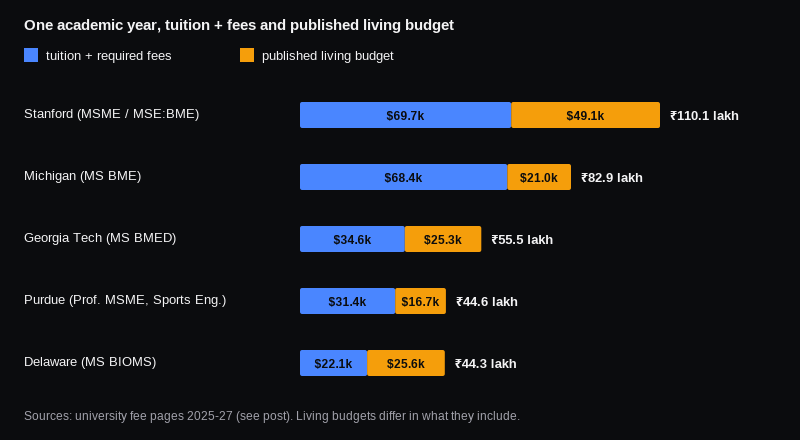
For one academic year, the five programmes with complete published figures range from $47,788 (₹44.3 lakh) at Delaware to $118,833 (₹110.1 lakh) at Stanford. These totals add tuition and required fees to the university's own living budget. Two caveats matter. Each university counts living costs differently, and degree length varies from one year to two.
| Programme | Tuition and fees, one year | Published living budget | Total (₹ lakh) |
|---|---|---|---|
| Stanford | $69,717 (3 quarters at $23,239, Engineering, 2026-27) | $49,116 (2026-27, on campus; includes health insurance $8,808) | 110.1 |
| Michigan | $68,428 (2 terms at $33,714, non-resident graduate Engineering, fall 2026, plus $500 a term international fee) | $21,016 (2025-26, latest published) | 82.9 |
| Georgia Tech | $34,596 (2 semesters at $17,298, out-of-country, fall 2026) | $25,256 (2026-27, off campus) | 55.5 |
| Purdue (Sports Engineering) | $31,428 (2 semesters at $15,214, 2026-27, plus $500 a semester international fee) | $16,734 (2026-27, housing and food only) | 44.6 |
| Delaware | $22,144 (18 credits at $1,149 plus mandatory fees, 2026-27) | $25,644 (12 months off campus) | 44.3 |
Three programmes publish tuition in a form we could not put on the same one-year basis. Columbia's Engineering bulletin lists $2,700 per point for MS students (a 2025-26 estimate), which is $81,000 or ₹75.1 lakh in tuition for the 30-point degree. UC San Diego's 2026-27 graduate registration fees for a non-resident come to $38,087 for three quarters, including $6,660 of health insurance. Penn bills per course unit, so check its Student Registration and Financial Services page for the current rate.
Read the table with care. Stanford's budget includes health insurance and personal costs, while Purdue's covers only housing and food. A Georgia Tech student who uses the summer term to finish in 12 months pays for a third term. Funded research places change the picture completely, as Delaware's note on stipends shows. Always budget for the full degree length, not one year.
What does a biomechanics engineer actually calculate?
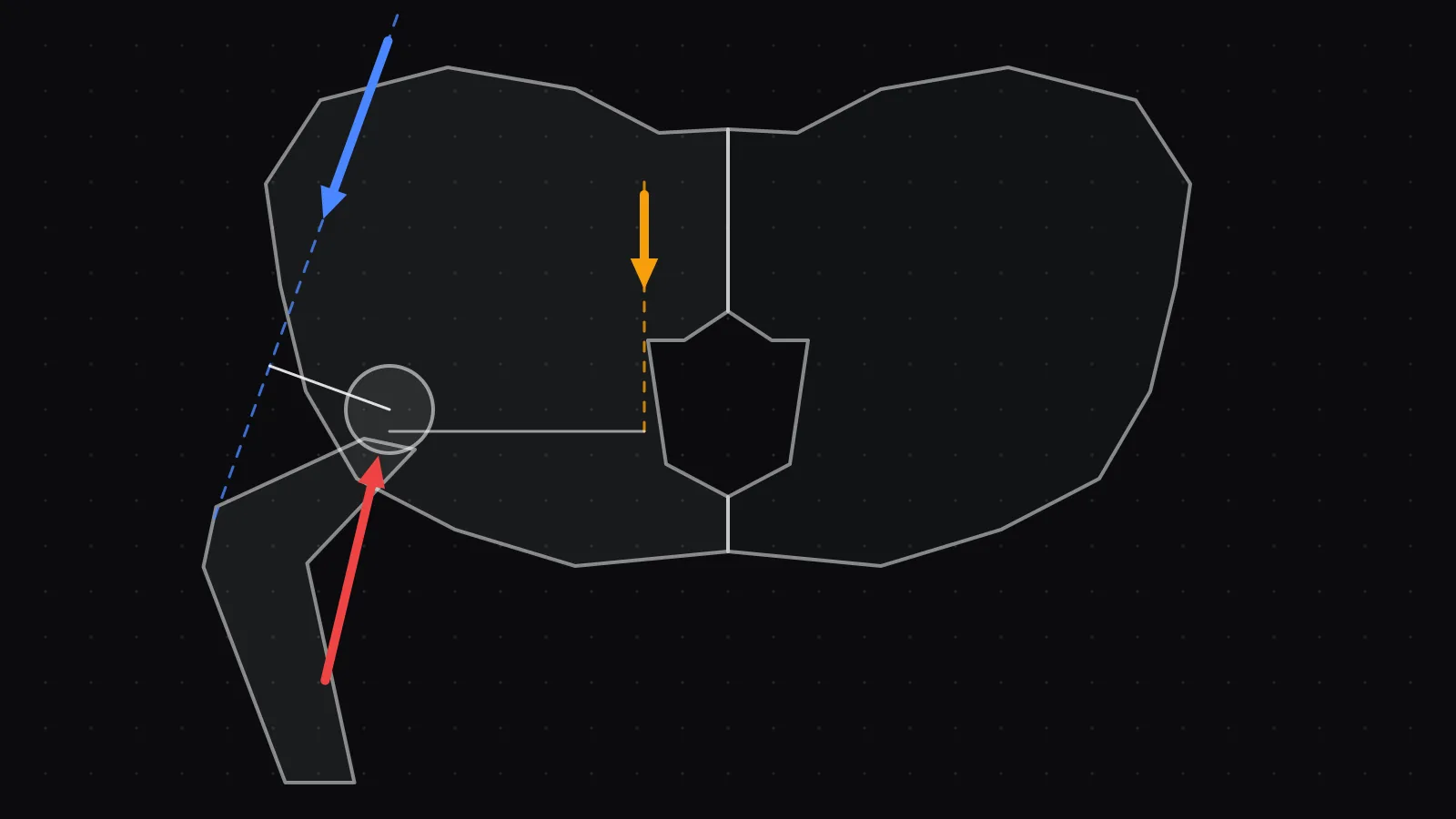
A classic first problem is the force inside the hip joint when you stand on one leg. Your hip abductor muscles must stop the pelvis tipping over. They have a much shorter lever arm than your body weight, so they pull hard, and the joint carries the sum. The answer, about 2.5 times body weight, is why hip implants are tested for loads far above a person's weight.
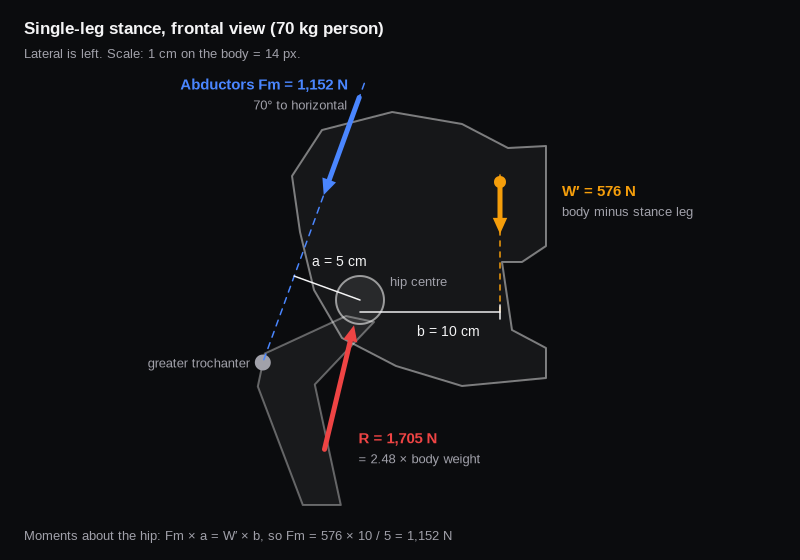
Take a 70 kg person. The weight above the stance hip is the whole body minus the stance leg. Standard segment data put the thigh, shank and foot at 10.0 %, 4.65 % and 1.45 % of body mass, 16.1 % in total.
Take moments about the centre of the hip joint. The supported weight acts at b = 10 cm on the medial side. The abductors act at a perpendicular lever arm a = 5 cm on the lateral side.
Now balance forces. The muscle pulls at 70° to the horizontal, so the joint must push back against both the muscle and the supported weight.
That is 2.48 times body weight, tilted 13.4° from vertical. The model is static and two-dimensional, but it lands close to measurement. Instrumented hip implants recorded an average peak of 238 % of body weight during walking at about 4 km/h (Bergmann and colleagues, Journal of Biomechanics, 2001).
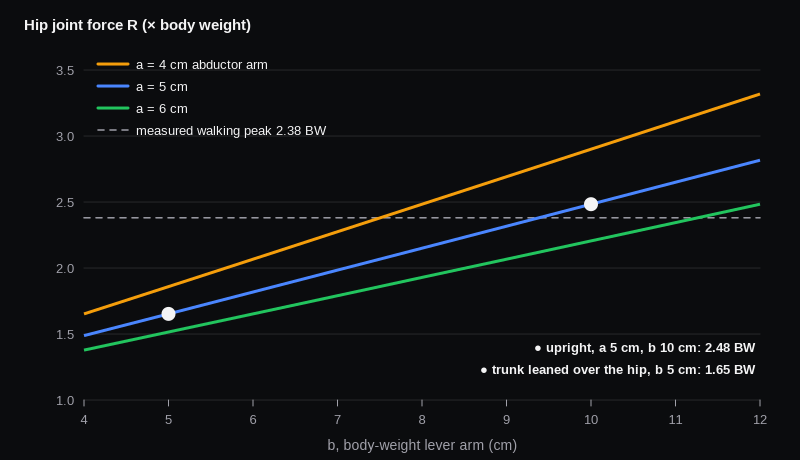
The chart explains a limp you have probably seen. A person with a painful hip leans the trunk over the bad side. That moves the body-weight line to about 5 cm from the joint, and the force drops from 2.48 to 1.65 times body weight, 33 % less. A shorter abductor lever arm of 4 cm, as with a short femoral neck, pushes the force up to 2.90 times body weight. This is why hip implant design pays close attention to femoral neck length and offset.
A master's turns this hand calculation into finite element models of bone and implant, gait-lab motion capture and muscle-force estimation. If FEA is new to you, Skill-Lync's course on the basics of FEA, explicit and implicit is a practical first step before you apply.
What jobs and pay can you expect after a biomechanics master's in the US?
The US Bureau of Labor Statistics reports a median pay of $109,370 for bioengineers and biomedical engineers in May 2025. The field had 23,800 jobs, with 8 % growth projected from 2025 to 2035. Mechanical engineers earned a median of $104,110 across 298,500 jobs, with 11 % projected growth. The mechanical market is 12.5 times larger.
That ratio is the strongest argument for keeping "mechanical" in your degree title if you are unsure. A mechanical MS with biomechanics electives qualifies you for device and implant roles and for the much wider pool of mechanical design and analysis jobs. A biomedical MS signals commitment to health care, which helps for roles close to clinical work and regulation.
After graduation, F-1 students can apply for post-completion Optional Practical Training (OPT). Graduates of programmes on the STEM list can then apply for a 24-month STEM OPT extension with an employer enrolled in E-Verify. The Department of Homeland Security's STEM Designated Degree Program list includes both CIP 14.0501, Bioengineering and Biomedical Engineering, and CIP 14.1901, Mechanical Engineering. Check the CIP code printed on your Form I-20 rather than the programme name.
How should a mechanical graduate in India prepare for a biomechanics master's?
Build three things before you apply: strong mechanics, a simulation skill, and enough biology to read a biomechanics paper.
- Mechanics: revise strength of materials, dynamics and an introduction to continuum mechanics. Admissions committees read your grades in these courses.
- Simulation: finite element analysis is the common language of implant, device and injury work. Skill-Lync's structural analysis course in Ansys Workbench gives you a project to show.
- Biology and materials: Stanford asks for introductory biology for its MSE: Biomechanical Engineering, and BME programmes assume physiology. Skill-Lync's medical technology courses on biomaterials and implants cover the vocabulary.
- A focused statement of purpose: name the labs or concentration you want and explain how your project work leads there.
Not sure whether a mechanical or a biomedical master's suits your profile? Talk to a Skill-Lync counsellor before you shortlist.
Frequently asked questions
Can a mechanical engineer do a master's in biomechanics in the USA?
Yes. A mechanical degree fits biomechanics concentrations inside mechanical engineering MS programmes, such as Columbia's, directly. Stanford's MSE in Biomechanical Engineering has the same admission requirements as its MSME plus introductory biology, which admitted students can make up. Biomedical engineering programmes also admit mechanical graduates but assume some physiology.
Is biomechanics a good career for mechanical engineers?
It suits mechanical engineers who enjoy mechanics, materials and simulation and want to work on implants, prosthetics, sports equipment or medical devices. The specialised market is smaller. BLS counts 23,800 US biomedical engineer jobs against 298,500 mechanical ones, so a mechanical degree with biomechanics electives keeps more doors open.
How much does an MS in biomechanics in the USA cost in rupees?
For one academic year, the five programmes with complete published figures cost between about ₹44 lakh (Delaware, Purdue) and ₹110 lakh (Stanford). That covers tuition, fees and the university's living budget at ₹92.68 per dollar (20 Nov 2026). Two-year programmes roughly double the total, while funded research places can remove tuition.
Is the GRE required for a biomechanics master's in the US?
It depends on the university and changes from year to year. Penn Engineering lists the GRE as optional for master's applicants entering in Fall 2027. For every other programme, check the department's admissions page for your intake year before you book the test. If you have taken it, a good score rarely hurts.
Do biomechanics master's degrees qualify for STEM OPT?
Usually, yes. The DHS STEM list includes CIP 14.0501 (Bioengineering and Biomedical Engineering) and CIP 14.1901 (Mechanical Engineering). That allows a 24-month STEM OPT extension with an employer enrolled in E-Verify. Confirm the CIP code on your I-20, because the code decides eligibility, not the programme name.
Sources and further reading
- Stanford Mechanical Engineering, Biomechanical Engineering degree programs (accessed 21 Nov 2026); Stanford Student Services, 2026-2027 graduate tuition rates; Stanford Financial Aid, graduate student budget 2026-2027.
- Columbia Engineering Bulletin, Mechanical Engineering (MS) and Graduate tuition, fees and payments.
- Purdue Mechanical Engineering, Professional Masters in Sports Engineering; Purdue Bursar, Professional Master's Program Fees 2026-2027.
- University of Michigan BME, Master's MS program; U-M Office of the Provost, Tuition and fees schedule, fall 2026; U-M Office of Budget and Planning, Estimated cost of attendance 2025-26.
- Georgia Tech Catalog, Master of Science in Biomedical Engineering (2026-2027); Georgia Tech Bursar, Fall 2026 graduate tuition and fees; Georgia Tech Financial Aid, Graduate costs 2026-2027.
- University of Pennsylvania, Bioengineering master's concentrations, Bioengineering MSE catalog 2026-27 and Penn Engineering graduate admissions: how to apply.
- UC San Diego, Bioengineering graduate programs catalog and 2026-27 graduate registration fees.
- University of Delaware Graduate College, Biomechanics and Movement Science and Cost of attendance.
- US Bureau of Labor Statistics, Occupational Outlook Handbook: Bioengineers and Biomedical Engineers and Mechanical Engineers (last modified 27 Aug 2026).
- US Department of Homeland Security, STEM Designated Degree Program List and STEM OPT extension overview.
- European Central Bank, euro foreign exchange reference rates, 20 Nov 2026 (USD 1.0990 and INR 101.85 per euro).
- G. Bergmann et al., Hip contact forces and gait patterns from routine activities, Journal of Biomechanics 34 (2001) 859-871.
- D. A. Winter, Biomechanics and Motor Control of Human Movement, 4th edition, Wiley (segment mass fractions); M. Nordin and V. H. Frankel, Basic Biomechanics of the Musculoskeletal System, Wolters Kluwer (single-leg-stance hip model).