Can CFD Get You a Core Mechanical Job in India? Roles, Tests, Projects
An honest answer for mechanical freshers: the CFD job families in India and who hires them (from 240 Skill-Lync CFD placements), what interviews test, which solvers to learn, five benchmark projects with the number each must hit, a worked pipe-flow y+ example, and the limits of a CFD-only plan.
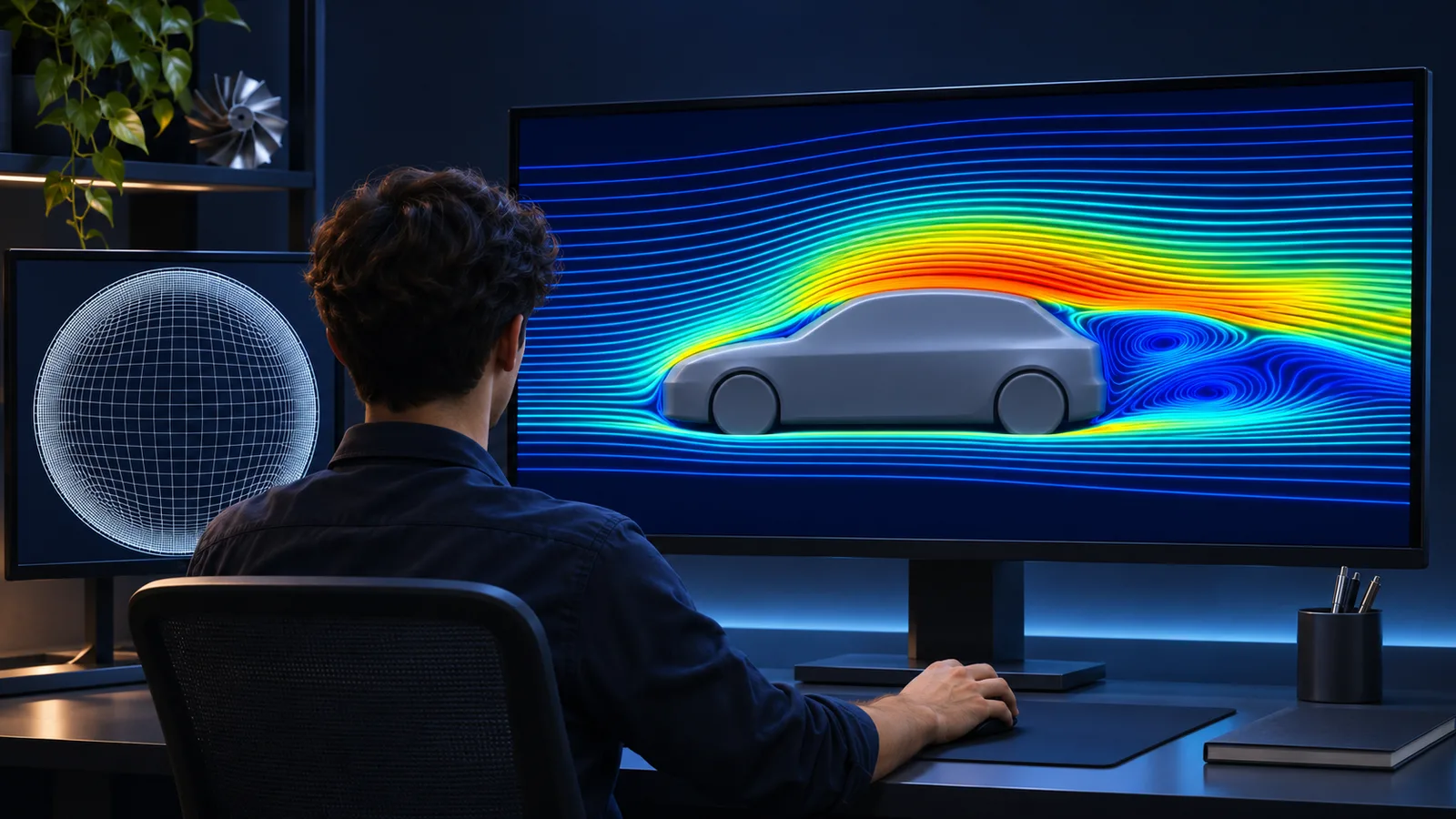
Yes, CFD can get a mechanical engineer a core job in India, but CFD on its own rarely does. CFD (computational fluid dynamics) is one of the few mechanical specialisations with its own fresher job titles. In Skill-Lync's placement records, 240 learners were placed in CFD roles, and half of them carried the title "CFD Engineer". Employers hire people who pair one solver with fluid mechanics and heat transfer, and who can show a result checked against real data.
In short
- Skill-Lync placement records hold 240 CFD placements (snapshot 15 Nov 2026). 122 were titled CFD Engineer, 46 GET or trainee and 10 FEA/CAE Engineer, and 150 of the 240 were recorded as freshers.
- The employers with the most CFD placements in those records are Mechartes and Cyient (9 each), Analyzer CAE and Expleo (8 each), and Alten and Cummins (7 each). Most of the top six are engineering-services or simulation-consulting firms, not vehicle makers.
- CFD job postings seen on Naukri on 16 Nov 2026 named Ansys Fluent, STAR-CCM+, Ansys CFX and OpenFOAM. They asked for thermodynamics, heat transfer and fluid mechanics alongside the tool.
- Interview questions reported on AmbitionBox (re-checked 22 Nov 2026) start with fundamentals: the governing equations, boundary conditions, RANS vs LES vs DNS, and steady vs transient solvers.
- A portfolio project with a number to hit carries more weight than any certificate. Water at 1.5 m/s in a 50 mm pipe should lose 430 Pa per metre (Colebrook). If your CFD gives that, you can defend it in an interview.
This guide is for mechanical engineering students and freshers in India who are deciding whether to specialise in CFD. It covers who hires, what they test, the tools, the projects worth building, and the limits. Salary figures live on two dedicated pages, the CFD engineer salary data page and the CFD engineer salary guide, so this post links to them rather than repeating their tables.
Is CFD a core mechanical job?
Yes. CFD work is core mechanical engineering: it applies fluid mechanics, heat transfer and thermodynamics to real products such as car bodies, pumps, heat exchangers, engines and building ventilation. A CFD engineer predicts flow rates, pressure drops, heat transfer and forces such as lift and drag before anything is built. That is design and analysis work, not IT work.
CFD stands for computational fluid dynamics. The software splits the space around or inside a product into millions of small cells and solves the equations of mass, momentum and energy in each one. The payoff for a company is fewer physical prototypes. A team can test twenty duct shapes on a computer and build only the best two.
The catch is that the job sits inside a larger engineering team. A CFD result is only useful if someone can judge whether it is right, and that judgement comes from the fundamentals you learned in your degree. If you are weighing a core career against a switch to software, our comparison of core vs IT jobs for mechanical engineers sets out the trade-offs.
Which jobs use CFD in India?
CFD is used in seven main job families in India: CFD or CAE analyst at an engineering-services firm, automotive aerodynamics and thermal engineer, engine and combustion engineer, HVAC and building-services analyst, turbomachinery and aerospace aerodynamicist, process and energy engineer, and application or support engineer for simulation software. The title varies more than the work.
The table maps each family to the problems it solves and the evidence we found for it. "Records" means Skill-Lync placement records, snapshot 15 Nov 2026. "Posting" means a listing seen on Naukri on 16 Nov 2026. Postings close and reopen, so treat them as examples of what employers ask for, not a live vacancy list.
| Job family | What you simulate | Evidence: employers and tools |
|---|---|---|
| CFD / CAE analyst, engineering services | Client projects across sectors: cooling, ducts, valves, sprays | Cyient, Expleo, Alten, Hinduja Tech, Tech Mahindra, Tata Technologies (records). Tata Technologies posting: STAR-CCM+, exhaust aftertreatment and spray modelling |
| Automotive aerodynamics and thermal | Drag, underhood airflow, cabin HVAC, battery and lamp cooling | Maruti Suzuki "CAE Engineer / Analyst - CFD" (aerodynamics, 1-5 years); FORVIA HELLA "CFD Engineer" (STAR-CCM+, 1-3 years); Valeo thermal/CFD; BMW TechWorks India (Ansys CFX); RNTBCI (records) |
| Engines and combustion | In-cylinder flow, fuel sprays, combustion, exhaust | Cummins, 7 placements (records); Tata Technologies aftertreatment posting; CONVERGE is built for this work |
| HVAC, buildings, data centres, fire | Room airflow, data-hall cooling, smoke movement | Mechartes, a simulation consultancy for buildings, data centres, power, oil and gas and process plants, 9 placements (records); e-MUG (HVAC, Fluent and OpenFOAM); Jensen Hughes "CFD / Fire and Egress Modeling" |
| Turbomachinery and aerospace | Compressor and turbine blades, wings, intakes | Agile Technology "Turbomachinery Aerodynamics" (Ansys CFX, 2-6 years); Airbus India aerodynamics posting (asked for a master's degree) |
| Process and energy | Reactors, mixing, separators, plant equipment | Mechartes (process plants, oil and gas); NoPo Nanotechnologies, a CFD and simulation engineer role (Fluent, heat transfer) |
| Application or support engineer | Customer cases and solver demos for software users | "Application engineer" and "technical support engineer" titles appear in the CFD records |
Government aerospace and defence labs are a separate route. They recruit scientists and engineers through their own exams and GATE, not through CFD job boards. Our ISRO scientist/engineer and DRDO Scientist B pages cover those routes. For a broader view of the work in each sector, see the CFD engineer career path.
Who hires CFD freshers in India?
In Skill-Lync's records, most CFD hires went to engineering-services and simulation-consulting firms. The top employers were Mechartes and Cyient (9 placements each), Analyzer CAE and Expleo Engineering (8 each), and Alten and Cummins (7 each). Vehicle and engine makers' own centres, Cummins and RNTBCI, account for 7 and 3 placements.
Based on 3,711 Skill-Lync placement records up to 7 Nov 2026 (data snapshot of 15 Nov 2026). This is a starting point; we'll update it as new placements come in. The records are a self-selected sample: learners who reported a placement, not the whole job market. They are mostly starting offers, and most date from 2021 to 2023, so recent years are thin. No employer in the CFD records has 10 placements, so we show counts, not per-company pay.
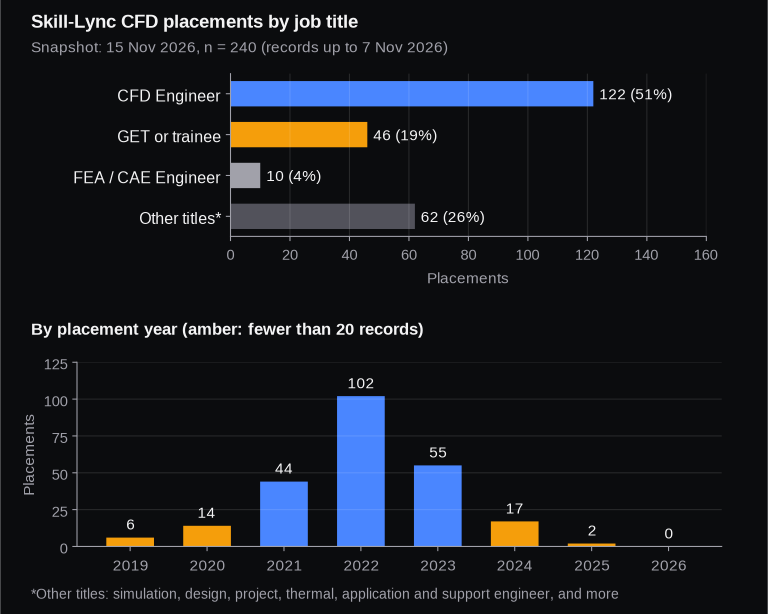
Three things stand out in the data.
- CFD is a real but narrow door. CFD accounts for 240 of 3,711 records, about 6.5%. CAE (structural FEA) has 456, almost twice as many, so CFD plus FEA together opens more doors than either alone.
- Freshers do get in. 150 of the 240 CFD placements were recorded as freshers, 36 as experienced hires and 54 were not marked.
- The title is not always "CFD". About half the hires were called CFD Engineer. The rest came in as GETs, simulation engineers, thermal engineers or application engineers. Search job boards for all of these titles.
Pay is covered elsewhere. In short, the median CFD starting offer in the same snapshot was 3.5 LPA (n = 240), the same as the median across all 3,711 records. CFD is not a shortcut to a higher first salary. The gap opens with experience. The CFD salary data page breaks pay down by title and city, and the CFD salary guide adds third-party data by experience. Individual records are listed on recent placements, and the wider list of companies hiring mechanical engineering freshers is a useful second search.
What do CFD job interviews actually test?
CFD interviews test fluid mechanics first and software second. Questions candidates reported on AmbitionBox include which governing equations CFD solves, the velocity and thermal boundary conditions for a flat plate, RANS vs LES vs DNS, and steady vs transient solvers. Then the interviewer walks through your own project, asking you to justify the mesh, the model and the result.
The reported questions, with the company named where the candidate gave one (AmbitionBox CFD Engineer and CFD Analyst pages, read 16 Nov and re-checked 22 Nov 2026):
- "What governing equations are solved in CFD?" (Caepro Technologies)
- Velocity and thermal boundary conditions for flow over a flat plate and for internal flow (Caepro Technologies)
- "How do you use tools or software related to CFD?" (Tata Technologies)
- The physics behind the turbulence model, and steady-state vs transient solvers (TechnoPro)
- The difference between RANS, LES and DNS (John Deere)
- Explicit vs implicit schemes, asked of a thermal engineer candidate (Pure EV)
The project walk-through follows the order of the work. Interviewers look for whether you can defend each choice, and above all whether you checked the answer.
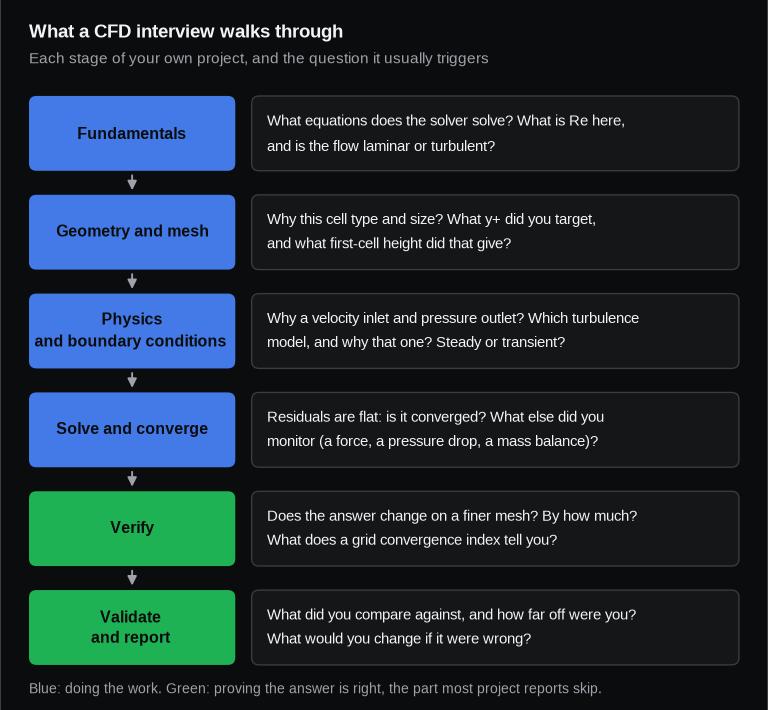
Two terms come up often. Verification asks whether you solved the equations correctly: does the answer stop changing when the mesh gets finer? NASA Glenn's guide to grid convergence recommends Roache's grid convergence index (GCI), a refinement ratio of at least 1.1 between grids, and a safety factor of 1.25 when three or more grids are compared. Validation asks whether you solved the right equations, by comparing with an experiment. ASME's V&V 20 standard sets out how to quantify that comparison for CFD and heat transfer.
For the full question bank with worked answers, see 50 CFD engineer interview questions. The rest of this post is about building the projects that make those answers convincing.
Which CFD software should I learn for jobs in India?
Learn Ansys Fluent or Simcenter STAR-CCM+ first, because those are the tools Indian automotive and thermal postings name most often. Then add OpenFOAM if you want open-source or methods roles, or CONVERGE if you are aiming at engines and combustion. Depth in one solver beats a short tour of four.
| Tool | Who makes it | Where it shows up |
|---|---|---|
| Ansys Fluent (and CFX) | Ansys, part of Synopsys since the acquisition closed on 17 Jul 2025 | The most-listed CFD skill on AmbitionBox's CFD Engineer page. CFX in the BMW TechWorks and turbomachinery postings |
| Simcenter STAR-CCM+ | Siemens | Automotive thermal and aftertreatment postings (FORVIA HELLA, Tata Technologies) |
| OpenFOAM | Open source: OpenCFD (v2606, June 2026) and the OpenFOAM Foundation (v14, July 2026) | Consulting and research roles (e-MUG, Simgrosys postings); free, so ideal for a portfolio |
| CONVERGE | Convergent Science (CONVERGE 6 released in 2026) | Engines, sprays, gas turbines and aftertreatment; autonomous meshing |
| Meshing: ANSA, HyperMesh, ICEM CFD | BETA CAE, Altair, Ansys | HyperMesh and ANSA appear in AmbitionBox's CFD skills list; ICEM CFD in the Valeo and e-MUG tags |
You do not need a paid licence to start. Ansys Student is free for verified students for learning and student projects. Its limits are 1 million cells or nodes for fluids and up to four CPU cores. That is enough for every project in the next section if you use 2D or symmetry where the physics allows. OpenFOAM has no cell limit. Python helps too: postings list it as a skill, and scripts that post-process results or run parameter sweeps are a strong portfolio addition.
Skill-Lync's CFD courses compared page sets out which course teaches which solver, from the Ansys Fluent course to Advanced CFD using OpenFOAM.
What CFD projects should be in my portfolio?
Build four to six projects, each matched against a published number: turbulent pipe flow against the Colebrook friction factor, a backward-facing step against measured reattachment length, a cylinder wake against the Strouhal number, the Ahmed body against wind-tunnel data, a cold plate against an energy balance, and one project from your target sector.
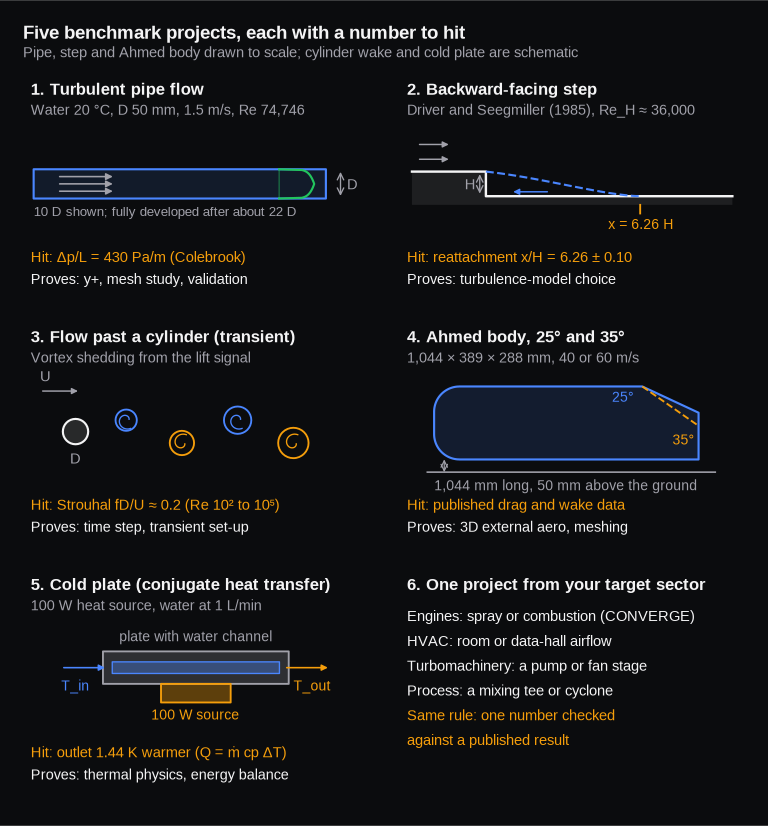
| Project | The number to hit | What it proves to an interviewer |
|---|---|---|
| 1. Turbulent pipe flow | Pressure drop per metre from the Colebrook friction factor (worked below) | Boundary conditions, y+ and first-cell height, a mesh-independence study, a clean validation |
| 2. Backward-facing step | Reattachment at x/H = 6.26 ± 0.10 (Driver and Seegmiller, 1985, Re about 36,000 on step height) | Turbulence-model choice. In NASA's NPARC comparison, k-ε predicted 5.31 (15% short) and SST 6.43 (2.7% long) |
| 3. Flow past a cylinder | Strouhal number close to 0.2 for Re from 10² to 10⁵ | A transient set-up: time step from the Courant number, a lift signal, an FFT |
| 4. Ahmed body, 25° and 35° slants | Drag and wake data from the original tests (Ahmed et al., 1984, 60 m/s) and later measurements at 40 m/s (Lienhart and Becker, 2003) | 3D external aerodynamics, meshing a real body, reading a wake. The two slants sit either side of a drag crisis |
| 5. Cold plate (conjugate heat transfer) | Energy balance: 100 W into water at 1 L/min must warm it by 1.44 K | Thermal physics for EV battery, electronics and data-centre roles |
| 6. A sector project | Whatever the published case gives you | Fit for the job you want: spray combustion for engines, room airflow for HVAC, a pump stage for turbomachinery, a mixing tee for process plants |
Skill-Lync's free tools check the hand numbers for several of these: the pipe flow calculator, the backward-facing step calculator, the flow over a cylinder calculator and the CHT calculator. For the Ahmed body, our walkthrough of flow over an Ahmed body using open-source software is a starting point.
Write each project up the same way: the geometry and conditions, the mesh with its y+, three meshes and the change between them, the comparison with the reference number, and one paragraph on what you would do differently. That last paragraph is often what interviewers remember.
Worked example: the numbers behind project 1
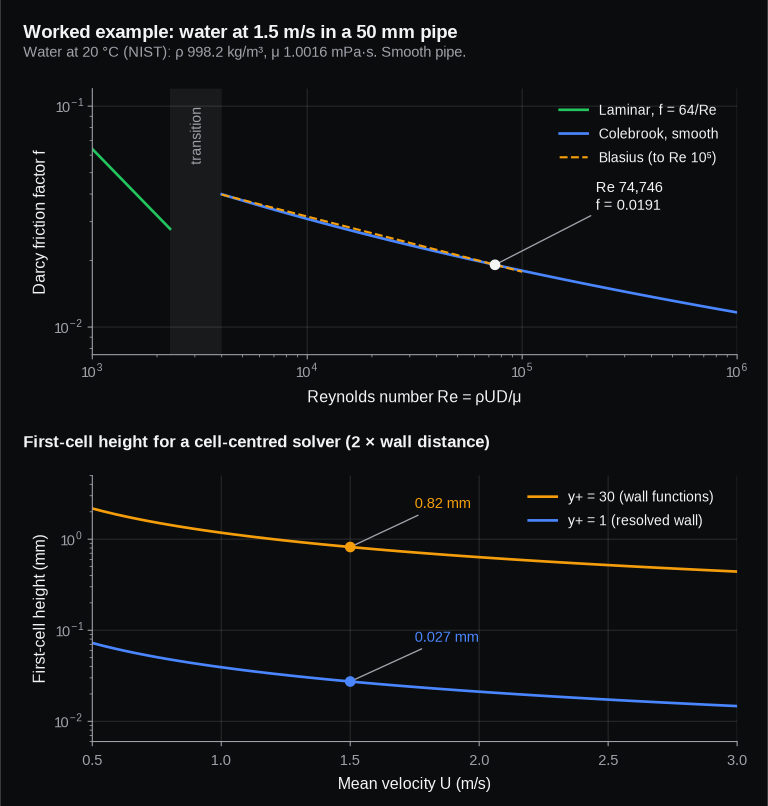
Here is the hand calculation you should do before meshing the pipe, and be ready to repeat in an interview. Water at 20 °C flows at 1.5 m/s through a smooth 50 mm pipe. NIST gives and . Every number below comes from a script kept with this article, and it matches the "Pipe" preset of the y+ calculator exactly.
Step 1: Reynolds number.
That is far above 4,000, so the flow is turbulent and you need a turbulence model.
Step 2: friction factor. For a smooth pipe (roughness ), the Colebrook equation is
Solved numerically it gives . The Blasius formula , valid up to Re 100,000, gives 0.01914, within 0.02%. Two independent correlations agreeing this closely is a good sign the target is solid.
Step 3: the validation target. The Darcy-Weisbach equation turns into a pressure gradient:
That is 4.30 kPa over 10 m of pipe. Read the pressure drop from your CFD over a stretch of fully developed flow and compare it with this number.
Step 4: wall shear and first-cell height. A force balance on the pipe gives the wall shear stress, and from it the friction velocity:
The wall coordinate is , with . For , the first cell centre sits at mm. Fluent, OpenFOAM and STAR-CCM+ store values at cell centres, so the first cell is twice that: 0.027 mm. For wall functions at , the first cell is 0.82 mm.
Step 5: how long a pipe to model. The turbulent entrance length is about m, or 22 diameters. Measure the pressure drop beyond that point, or use periodic boundary conditions to model fully developed flow directly.
Step 6: the inflation layers. With a growth ratio of 1.2, 29 layers starting at 0.027 mm reach the 25 mm pipe radius. Starting at 0.82 mm, 11 layers do. That difference in cell count is why the choice between a resolved wall and wall functions matters in industry.
In an interview, this is the story to tell. Re told you to use a turbulence model. The y+ target set the mesh. The Colebrook number told you whether the answer was right. For the theory behind the y+ bands, read y+ and near-wall treatment in CFD.
Can I get a CFD job with CFD software skills alone?
Rarely. Postings ask for fluid mechanics, heat transfer and thermodynamics alongside the solver. Valeo's thermal CFD listing put "good knowledge in thermodynamics, heat transfer and fluid mechanics" first. Interviewers test the physics before the software, because a solver will happily converge to a wrong answer and only fundamentals catch it.
Here are the honest limits of a CFD-only plan:
- The market is narrow. CFD is about 6.5% of Skill-Lync's placement records, against roughly 12% for CAE (456 of 3,711). Adding FEA, or the thermal and design skills of a broader mechanical role, widens your options a lot.
- Our recent data is thin. 201 of our 240 CFD records date from 2021 to 2023, with only 2 from 2025 and none yet from 2026. They show who hired, not how many CFD jobs are open today.
- Some CFD roles want a postgraduate degree. An Airbus India aerodynamics engineer posting in Bengaluru (closed in July 2026) asked for a master's in aerospace or mechanical engineering and 3-5 years of experience. Aerospace and solver-development roles often sit at that level. Industrial roles are more open: 150 of our 240 CFD placements were recorded as freshers.
- Many first jobs are mixed. A quarter of our CFD hires (62 of 240) had titles like simulation, project or thermal engineer, and 46 started as GETs. Expect to do meshing, CAD clean-up and report writing before you own a case.
What does work is CFD plus fundamentals plus proof. Revise fluid mechanics and heat transfer to GATE level, learn one production solver well, and build three to five validated projects from the list above. A structured route such as Skill-Lync's Post Graduate Program in CFD covers Fluent, OpenFOAM and CONVERGE with project work, but the projects and the physics are what get you hired.
Frequently asked questions
Can a mechanical fresher get a CFD job without an M.Tech?
Yes, for many industrial roles. 150 of the 240 CFD placements in Skill-Lync's records (snapshot 15 Nov 2026) were freshers. The records do not capture degree level, so read that as "freshers do get in", not "no M.Tech needed anywhere". Aerospace aerodynamics roles, such as the Airbus India posting above, often ask for a master's degree.
Is the Ansys student version enough to build a CFD portfolio?
Yes. Ansys Student allows 1 million cells or nodes for fluids and up to four CPU cores, enough for a pipe, a backward-facing step, a 2D cylinder and a cold plate. For a 3D Ahmed body, use a half model on the symmetry plane, or OpenFOAM, which has no cell limit.
Should I learn Fluent or OpenFOAM first?
Learn Fluent (or STAR-CCM+) first if you want automotive, HVAC or services jobs, since those postings name them. Learn OpenFOAM first if you are comfortable with Linux and want research, consulting or methods work. Many engineers end up using both.
Does CFD or FEA have more jobs?
FEA, in our data. Skill-Lync's records hold 456 CAE (FEA) placements against 240 CFD placements in the 15 Nov 2026 snapshot. CFD roles are fewer but less crowded, and engineers who can do both are useful to engineering-services firms.
Which cities have the most CFD jobs in India?
Pune, Bengaluru and Chennai. They have the most CFD engineer salary reports on AmbitionBox (367, 334 and 257 salaries, read 16 Nov 2026). The CFD postings we reviewed on 16 Nov 2026 were in Pune, Gurugram, Chennai, Bengaluru, Hyderabad, Coimbatore and Mumbai. The CFD salary page breaks Skill-Lync offers down by city.
Sources and further reading
- Skill-Lync placement records, snapshot of 15 Nov 2026 (3,711 records up to 7 Nov 2026): domain, job-title and year counts for CFD and CAE, and top hiring companies. Public records: skill-lync.com/recent-placements.
- Naukri, "CFD engineer" job search, naukri.com/cfd-engineer-jobs, seen 16 Nov 2026: postings by Maruti Suzuki, FORVIA HELLA, Valeo, Tata Technologies, BMW TechWorks India, Agile Technology, e-MUG, Simgrosys, Jensen Hughes and NoPo Nanotechnologies.
- AmbitionBox, CFD Engineer and CFD Analyst profiles: reported interview questions and top skills, read 16 Nov 2026, CFD Engineer page re-checked 22 Nov 2026. Thermal Engineer profile for the explicit vs implicit question.
- Mechartes, company website, read 22 Nov 2026: simulation consultancy for buildings, data centres, power, oil and gas, and process plants.
- Airbus India, "Engineer - Aerodynamics" posting, Bengaluru, via Built In, read 22 Nov 2026 (listing removed 3 Jul 2026).
- NASA Glenn Research Center, Examining spatial (grid) convergence: GCI, safety factors, refinement ratio.
- ASME, V&V 20, Standard for Verification and Validation in Computational Fluid Dynamics and Heat Transfer (2009, reaffirmed 2021).
- Ansys, Ansys Student, read 22 Nov 2026: 1 million cell/node fluids limit, four HPC cores, educational use only.
- Synopsys, Synopsys completes acquisition of Ansys, 17 Jul 2025.
- Siemens, Simcenter STAR-CCM+; OpenCFD, OpenFOAM v2606 (26 Jun 2026); OpenFOAM Foundation, OpenFOAM 14 (14 Jul 2026); Convergent Science, CONVERGE 6 release, 1 Jul 2026.
- NIST Chemistry WebBook, thermophysical properties of water at 20 °C and 0.101325 MPa: density, viscosity, cp.
- Wikipedia, Darcy friction factor formulae (Colebrook-White, Blasius valid to Re 100,000), Entrance length (turbulent ) and Strouhal number (close to 0.2 for Re 10² to 10⁵).
- NASA Turbulence Modeling Resource, 2D backward-facing step (Driver and Seegmiller, AIAA Journal 23(2), 1985), and NPARC Alliance, backward-facing step validation: reattachment predictions by model.
- ERCOFTAC Knowledge Base, Ahmed body, AC1-05: dimensions, 60 m/s and 40 m/s experiments, 25° and 35° slants near the drag crisis.