Week 9 - FVM Literature Review
Fintite Volume Method :
1. It is one of the descretization methods to solve the partial differential equations in computer .
2.In Finite volume method we descretise using a volume , The volume might be of any shape .
3. In that volume everything is conserved i.e momentum , Energy , Mass are conserved .
4. In Finite volume volume method we start with the integral form of governing equation , We will apply gauss divergence theorem to descretise the equation .
5. So finally the method of decretising the governing equation by taking a small volume and conserving everything in that small element is called Finite Volume Method.
Differences between FVM and FDM
1.In FDM we decretise using points where as in FVM we descretise using volume
2. FVM equations represents the conservation of property but we loose that thing in FDM.
3. Its difficult to use the FDM method when the mesh is not alligned along x and y direction .
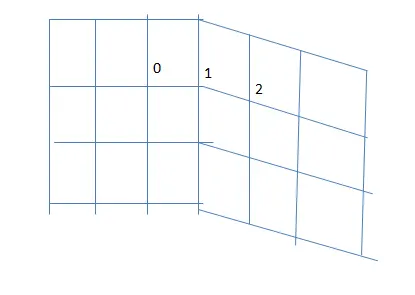
4. Frome the above diagram the points 0,1 are in one plane but the point 2 is another plane .
5. We canot use FDM method for point 2 as it is in another plane this is one of the major disadvantage of the FDM .
Lets take an example
Example of Steady 1D heat conduction in a fin
Lets write the laplace equation required for calculating the temperature profile along the fin .
`alpha*(partial^2T)/(partial x^2)+S =0`---------------eq 1
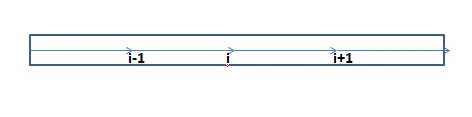
Lets write the descretisation equation for the above equation .
`alpha*(T(i+1)-2*Ti +T(i-1))/dx^2 +s = 0`
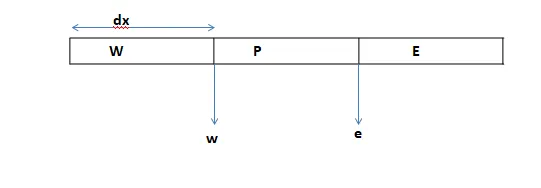
The above diagram shows the three element volumes in which the fin is divided
Eq 1 is valid for all the volumes in the fin so its valid for the small control volume in the element .Lets consider a small volume of dv in the element
So we can write the following equation
`int((partial((alpha*(partialT)/(partialx)))/(partialx)) + S)*dv = 0`
By solving the above equation and by applying the integral limits from w to e we will get the following equation
`alphae*A*(partialT)/(partialx)e-alphaw*A*(partialT)/(partialx) w+S*dv =0`
`alphae` is the thermal conductivity at face e `alphaw` is the thermal conductivity at face w
`(partialT)/(partialx)e` is the gradient of temperature at face e and `(partialT)/(partialx)w` is the gradient of temperature at face w
Now the above equation can be written as
`alphae*A*(Te-Tp)/(dx)-alphaw*A*(Tp-Tw)/(dx)+S*dv =0`
Te is the temperature of the element E and the Tp is the temperature of the element P
Gradient schemes
- we calculated the temperature at face e we used the temperatures of the elements Tp and Te
- this is one the gradient scheme used to calculate the gradient .
- Gradient scheme is something which tells us which points we need to consider and how to structure them to get the gradient at a particular face
we need to know how to do interpolation to get temperature at a particular face . These interpolation methods are interpolation schemes
Flux limiters
- when we are calculating gradients we took the temperature values .
- These temperature values should not exceed limits they need to be bounded to compute the gradient correctly.
- flux limiters are needed to limit the temperature values so that we get the correct temperature gradient .