Week 9 - FVM Literature Review
The Finite Volume Method (FVM) is a discretization method for the approximation of a single or a system of partial differential equatons expressing the conservation, or balance, of one or more quantities. These PDEs are often called conservation laws. FVM uses a volume integral formulation of the problem with a finite partitioning set of volumes to discretize the equations.
|
FDM |
FVM |
|
|
|
|
|
|
|
|
|
|
Interpolation schemes are methods of estimating values of variables at locations other than at nodal points, such as cell faces, for approximation of surface and volume integrals. The figure below shows the neighbouring control volume around the grid point P for a 1D linear heat conduction equation.
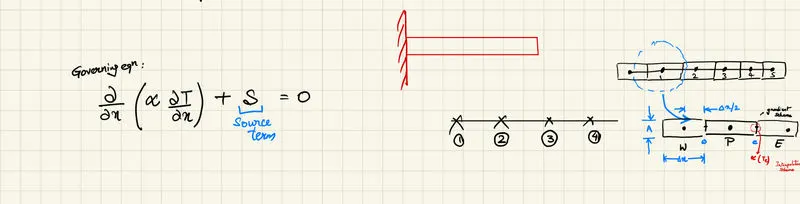
There are different types of interpolation schemes:
- upwind interpolation
- linear interpolation
- quadratic upwind interpolation
- hybrid
- total variation diminising
Flux limiter
For convective fluid flow it has been observed that lower order schemes are usually stable but quite dissipative in nature around points of discontinuity or shocks while the higher order schemes are unstable in nature and show oscillations in the vicinity of discontinuity. Highly accurate and oscillation free schemes are known as High Resolution Schemes.
Flux limiters are used to tune high order and low order schemes in such a way that the resulting scheme gives a high order accuracy in the smooth region of the flow and maintains first order accuracy in the vicinity of shocks and discontinuities, as flux limiter is constrained to be greater than or equal to zero. It assumes a value of 0 near discontinuities and a value of 1 away from them.