Week 9 - FVM Literature Review
Finite Difference Method (FDM)
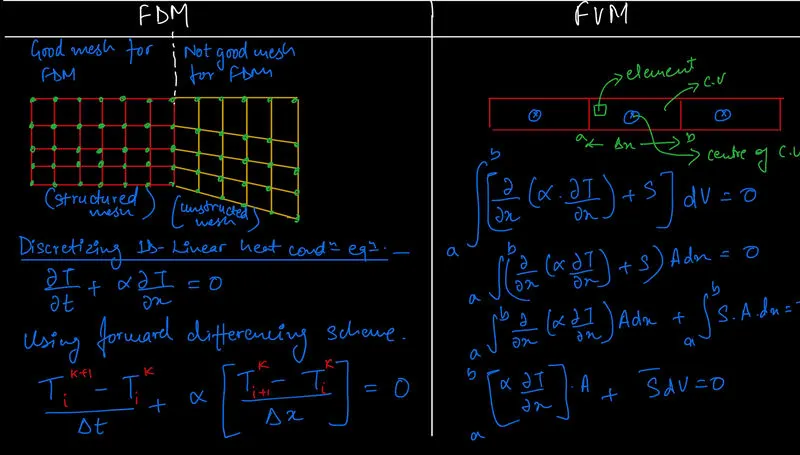
1. Finite difference method uses the concept of discretization of a PDE and solving it at each element's nodes.
2. Truncation error plays a significant effect on the precision & accuracy of the solution.
3. This method is efficient and accurate with only structured mesh. If the mesh is non-uniform then variable transformation terms are to be used which in turn will complicate the problem.
4. We use explicit and implicit methods to solve the discretized equations
5. Space & time loop is to be run for convergence of the solution.
6. Boundary conditions to be specified.
7. Taylor series is used for discretization of the equation
Finite Volume Method (FVM)
1. Control volume becomes more important than an element.
2. Equation is solved at a small element within the control volume & integrated over the entire element.
3. It can handle discontinuities in the system.
4. It uses the divergence theorem concept.
Interpolation schemes
1. Linear Interpolation scheme (forward, backward, central differencing)
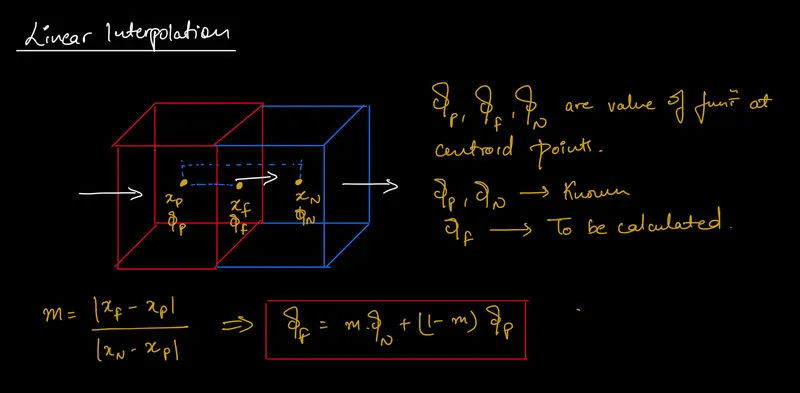
In Linear interpolation, we generally have 3 methods forward differencing, backward differencing, and central differencing. According to the problem, a choice of differencing technique is used.
Let's take an example of Central differencing,
Suppose the red cell is the present cell & the blue cell is the neighboring cell & value of some function (say ϕ) is to be calculated on the common face between two cells.
xp, xn are the centroid points of two cells as all values are calculated at the centroid. xf is the center of the face.
2. Upwind Interpolation
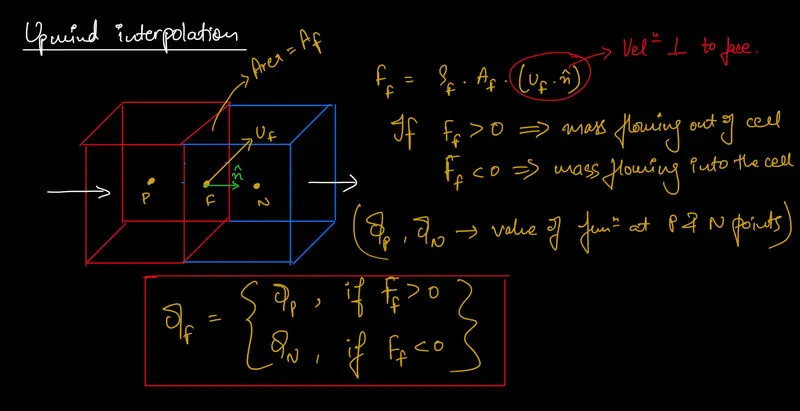
In this, we calculate the mass flux through the face & based on the mass flux value (positive or negative ) we assume the value of our function at the face.
Basically, we assume the upstream function value at the face also.
This interpolation scheme is only first-order accurate. (not very accurate though). But good to generate a stable initial solution.
3. Quadratic Upwind Interpolation for Convective Kinematics (QUICK)
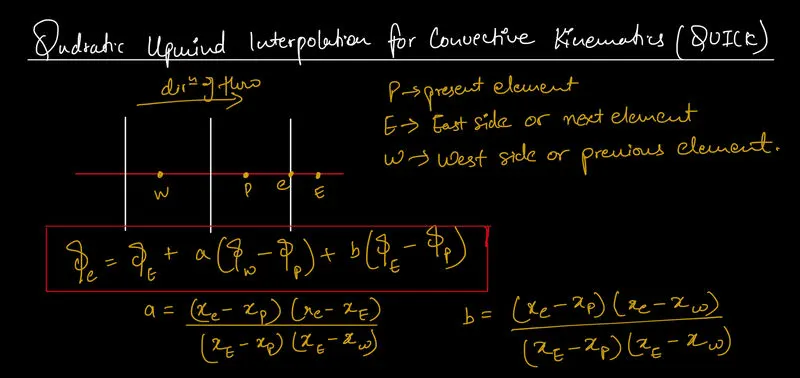
It is more accurate as it uses 3 nodes to calculate the value of the function at the face.
It is 3rd order accurate.
4. Hybrid Interpolation Scheme
It is the mixture of the Upwind differencing scheme(UDS) & Central differencing scheme (CDS).
It contains favorable characteristics of UDS & CDS. It switches to UDS when CDS becomes unstable at high Pe flow.
Concept of flux limiter
In convective flow,
low order schemes --> stable (but dissipative near the discontinuity points)
Higher order schemes --> unstable (also dissipative)
Accurate & oscillations-free schemes are called High-Resolution Schemes.
Therefore, the flux limiter function is used to fine-tune the high & low-order schemes so that we get stable & high accuracy in smooth areas & first order accuracy near the discontinuities areas.