Week 9 - FVM Literature Review
FINITE VOLUME METHOD
finite volume method is the method for reducing the partial differential equation into the algebraic equation by dividing domain into finite sized subdomain through 3 properties conservativeness ,boundness and transportiveness .
step1)divide the domain into finite sized subdomain,each subdomain are represented by the grid point called centroid of the subdomain.
step2)integrate the governing equation over each subdomain.
step3)profile assumption for the dependent variable
- Lets understand the finite volume method with the help of example
general transport equation
`(del (rho*phi))/(delt)+grad*(rho*vecV*phi)=grad*(gammagradphi)+S`
lets suppose the steady with no source term for above equation
`grad*(rho*vecV*phi)=grad*(gammagradphi)`
step 1)integrate over the control volume
`intgrad*(rho*vecV*phi)-intgrad*(gammagradphi)=0`
`int grad (rho*vecV*phi-gamma*gradphi)=0`
here `(rho*vecV*phi-gamma*gradphi)`is denoted by the "J" which is known as the flux
so the equation reduces to
`int grad*vecJ=0`
now applying the divergence theorem to convert the volume integral into the surface integral
`intgrad*vecJ=oint vecJ*hatnds`
Difference between the FDM,FVM and FEM
1)FDM and FEM are the methods which does not involve the physics of the problem but the FVM method include the physics of the problem by 3 proprtities conservatives ,boundness and transportiveness.
2)FDM is the oldest method for numerical solutions of PDEs. On structured grids, the FDM is very simple and effective. It is especially easy to obtain higher-order schemes on regular grids. The disadvantage of the FDM is that certain conservation laws are not enforced unless special care is taken
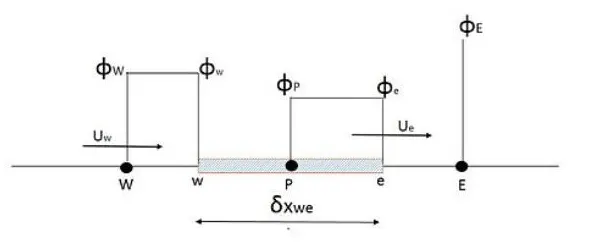
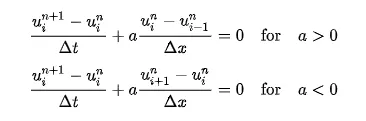
- two data points are considered
- used for convection and diffusion equation
- consider the direction of the flow
- first order accurate in space and time
2)LINEAR UPWIND DIFFERENCE APPROXIMATION SCHEME
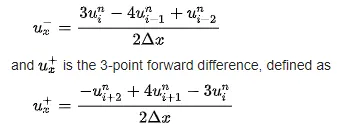
- second order accurate
- more accurate than upwind scheme for the spatial terms
- consider 3 data points instead of 2 in order to accurate finite differential stencil
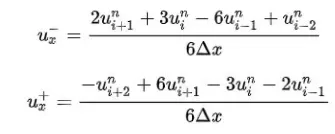
- second order accurate
- introduces slight instabilities in the system due to high gradient
FLUX LIMITERS
flux limiters are used to bound the spatial derivatives to the realistic values for scientific and engineering problems this generally means the physically reliable and meaningful values.
They are used in higher resolution schemes for the problems described by the PDEs and only used when the sharp waves are present.