Week 9 - FVM Literature Review
Finite Volume Method (FVM):
The finite volume method (FVM) is a method for representing and evaluating PDE in the form of algebraic equations. In the finite volume method, volume integrals in a partial differential equation that contain a divergence term are converted to surface integrals, using the divergence theorem. These terms are then evaluated as fluxes at the surfaces of each finite volume. Because the flux entering a given volume is identical to that leaving the adjacent volume, these methods are conservative. Another advantage of the finite volume method is that it is easily formulated to allow for unstructured meshes. "Finite volume" refers to the small volume surrounding each node point on a mesh.
Differences between FDM & FVM
Finite volume methods can be compared and contrasted with the Finite difference method, which approximates derivatives using nodal values, or finite element method, which creates local approximations of a solution using local data, and construct a global approximation by stitching them together. In contrast, a finite volume method evaluates exact expressions for the average value of the solution over some volume and uses this data to construct approximations of the solution within cells.
interpolation schemes:-
- Upwind interpolation scheme
- Linear interpolation scheme
- Quadratic upwind differencing scheme
- Hybrid interpolation scheme.
Upwind interpolation scheme:
This scheme is same as forward differencing scheme. it uses node values at upwind to interpolate the results.
Linear interpolation scheme
This scheme is similar to the central differencing scheme. it approximates the value of variable at control volume face centers by linear interpolation of values at two nearst nodes.
Quadratic upwind differencing scheme:
it approximates the values of variable at control volume face centers by Quadratic interpolation of values at three nearest nodes.
Hybrid interpolation scheme.
This scheme is the combination of Upwind interpolation and linear interpolation scheme
Fluxes:
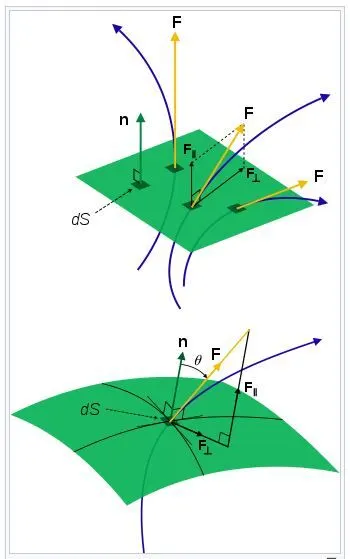
Fluxes describe any effect that appears to pass through a surface or substance. For transport phenomena (exchange of mass, energy, change of momentum, and angular momentum between observed and studied systems), flux is a vector quantity, describing the magnitude and direction of the flow of a substance or property.
Flux limiters
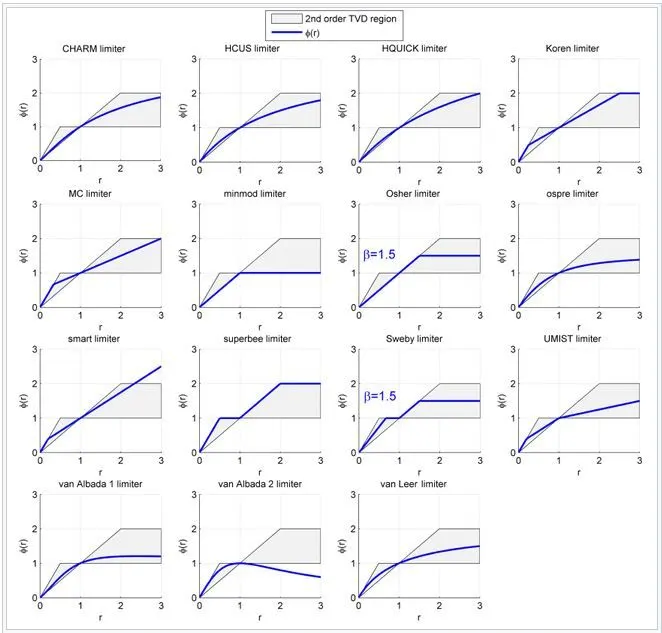
Flux limiters are used in high resolution numerical schemes used to solve problems in science and engineering, particularly fluid dynamics, described in PDE's. They are used to avoid the spurious oscillations that would otherwise occur with high order spatial discretization schemes due to shocks, discontinuities or sharp changes in the solution domain. Use of flux limiters, together with an appropriate high resolution scheme, make the solutions total variation diminishing(TVD) ( property of certain discretization schemes used to solve hyperbolic PDE).
Note that flux limiters are also referred to as slope limiters because they both have the same mathematical form, and both have the effect of limiting the solution gradient near shocks or discontinuities. In general, the term flux limiter is used when the limiter acts on system fluxes, and slope limiter is used when the limiter acts on system states (like pressure, velocity etc.).