Week 9 - FVM Literature Review
finite volume method:
finite volume method is based on the approximate solution of intergral form of governing equations. the problem domine is divied into a set of control volumes. the governing equations are applied to each control volume. In the finite volume method, volume integrals in a partial differential equation that contain a divergence term are converted to surface integrals, using the divergence method.
difference between finite volume and finite difference methods:
in finite difference method, the governing equations are in direct partial difference form. so we can easily discretize them easily by using different schems. where as in finite volume method, the governing equations are in integral form.at first these integral forms are converted into differencial foram and then we are going to discretize them.
finite difference method is simple and this method is applied to simple shapes such as rectangular,square shapes etc,. the simple shapes can be discretized with required number of nodes with equal difference. where as while discretizing complex shapes, the common difference between nodes are not equal. it is very difficult to make that common differenc equal at all nodes. so we are going to use finite volume methods for complex shapes.
neeed of interpolation schems and flux limiters in FVM:
the integral form of equations for a control volume involves both surface and volume intergrals. the approximation of surface and volume intergrals may require values of variable at locations other than computational nodes. the values at the locations are obtained using interpolation schems. thats why we need interpolation schmes in FVM.
there are three interpolation schmes are most commonly used.
1. upwind interpolation scheme
2. linear interpolation scheme
3. quadratic upwind interpolation scheme
flux limiters are used in numerical schemes used to solve the governing equations which are in the form of partial difference equations. Use of flux limiters, together with an appropriate numerical scheme, make the solutions total variable diminishing(total variable diminishing is the property of certain disretization shemes which are used to solve hyperbloic equations.).
1D linear heat conduction equation:
`d/dx (c dt/dx) + S = 0`
where t is temperature
c is the thermal diffusivity
S is the sourse term which represents the heat generated during conduction.
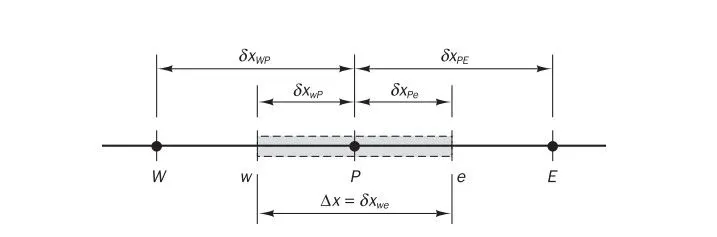
here we is the control volume. P is the centre of control volme where as W and E are the centres of neighbouring control volumes
The key step of the finite volume method is the integration of the governing equation over a control volume to yield a discretised equation at its nodal point P. For the control volume defined above gives
`∫ d/dx(c dt/dx)dV+∫SdV=0`
where A is cross sectional area of control volume, dv is the volume. in order to derive useful form of discretized equations, the diffusion coefficent c and gradient dt/dx are required. to calculate gradiet at control volume faces, appropriate distribution of properties between nodalpoints is used . using simple averaging, one can write
`c_e=(c_E+c_P)/2` `c_w=(c_P+c_W)/2`
using central differencing method , the diffusive flux can be written as
`(dt/dx)_e=(T_E-T_P)/dx``(dt/dx)_w=(T_P-T_W)/dx`
the sourse term may also dependent variable. in such cases the finite volue method approximates the sourse term by means of linear form expressed as
`S ̅ _udV=S_u +S_pt_p`
where S_u is a constant sourse term.
after substituting the gradient values, sourse term and thermal diffusivity values in the above integral equation, we are going to get the below final equation
`(c_e/(dx__PE ) A_e+ c_w/(dx__WP ) A_w-S_p ) t_P=(c_e/(dx__PE ) A_e ) t_E+(c_w/(dx__WP ) A_w ) t_W+S_u`