Week 8 Multi cell Battery Pack
1. AIM
To understand how the weakest cell limits the usable capacity of the battery pack and the solution for it.
2. THEORY
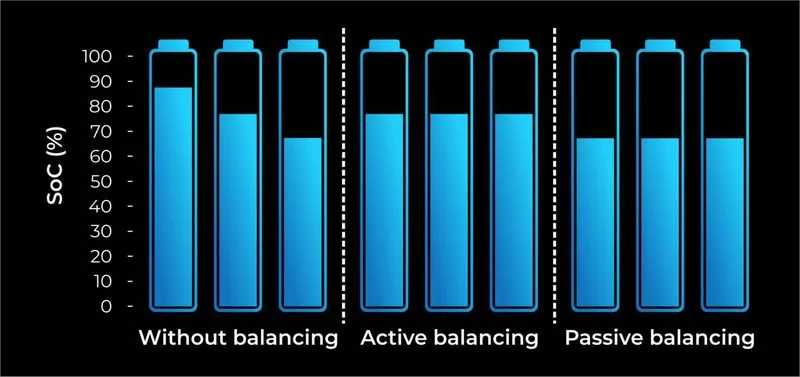 |
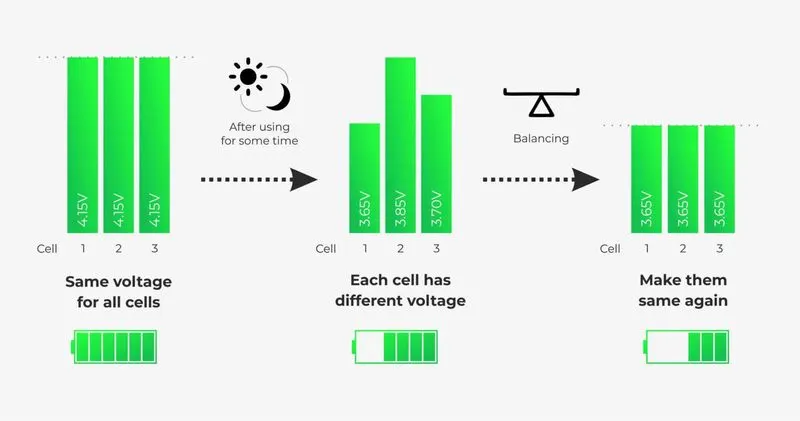
Cell balancing is a technique that improves battery life by maximizing the capacity of a battery pack with multiple cells in series, ensuring that all of its energy is available for use. A cell balancer or regulator is a functionality in a battery management system that performs cell balancing often found in lithium-ion battery packs electric vehicles and ESS applications.
Typically, individual cells of a battery pack have different capacities and are at different SOC levels. Without redistribution, discharging must stop when the cell with the lowest capacity is empty, even though the other cells are still not empty. This limits the energy delivering capability of the battery pack.
During balancing, higher capacity cells undergo a full charge/ discharge cycle. Without cell balancing, the cell of the slowest capacity is a weak point. Cell balancing is one of the core functions of a BMS, along with temperature monitoring, charging, and other features that help maximize the life of a battery pack.
The Need for Cell Balancing
When you need several cells grouped together to power a device, you need to do some sought of balancing. The reason is that battery cells are fragile things that die or get damaged if they are charged or discharged too much. For your cells that have different SoC and you start using them, their voltage starts dropping until the cell with the least amount of energy stored in it reaches the discharge cut-off voltage of the cell.
At that point, if the energy keeps flowing through the cell, it gets damaged beyond repair. Now, if you attempt to charge this group of cells to the correct combined voltage, the healthy cells get overcharged and thus get damaged as they will take the energy that the already dead cell is no longer able to store. Imbalanced lithium-ion cells die the first time you try to use them. This is why balancing is absolutely required.
Other reasons for cell balancing include:
Thermal Runaway
Battery cells, especially lithium cells are very sensitive to overcharging and over-discharging. This leads to thermal runaway when the rate of internal heat generation exceeds the rate at which the heat can be released. By the use of cell balancing, every non-defective cell in the battery pack should be balanced to the same relative capacity as the other non-defective cells. Other than using cell balancing, you can keep the pack cool since heat is one of the primary factors that lead to thermal runaway. This minimizes the retention of heat in the pack. You should maintain the battery environment at room temperature.
Cell Degradation
When a lithium cell is overcharged even slightly above its recommended value the energy capacity, efficiency, and life cycle of the cell reduces. Cell degradation is mainly caused by:
- Mechanical degradation of electrodes or loss of stack pressure in pouch-type cells.
- Growth of solid electrolyte interface (SEI) on the anode. SEI is seen as a cause for capacity loss in most, if not all, graphite-based Li-ion when keeping the charge voltage below 3.92v/cell.
- The formation of electrolyte oxidation (EO) at the cathode may lead to sudden capacity loss.
- Lithium-plating on the surface of the anode generated by high charging rates.
Cell degradation is a serious economic problem that varies according to how the battery is being used.
Incomplete Charging of a Cell Pack
Batteries are charged at a constant current of between 0.5 and 1.0 rate. The battery voltage rises as the charging progresses to peak when fully charged then subsequently falls. Consider three cells with 77 Ah, 77 Ah, and 76 Ah respectively and 100 percent SoC, and all cells are then discharged and their SoC goes down. You can figure out quickly that cell 3 becomes the first to run out of energy since it has the lowest capacity.
When power is put on the cell packs and the same current is flowing through the cells, once again, cell 3 lags behind during charging and may be considered fully charged as the other two cells are fully charged. This means that cell 3 has a low Coulometric Efficiency (CE) due to the cell’s self-heating that results in cell imbalance.
Incomplete Use of Cell Pack Energy
Drawing more current than the battery was designed for or short-circuiting the battery is most likely to cause premature failure of the battery. When discharging the battery pack, the weaker cells discharge faster than the healthy cells whereas they reach the lowest voltage more quickly than other cells. Providing regular rest periods during the operation of the battery allows the chemical transformations in the battery to keep track of the demand for current.
Types of Cell Balancing
 |
Active Cell Balancing
 |
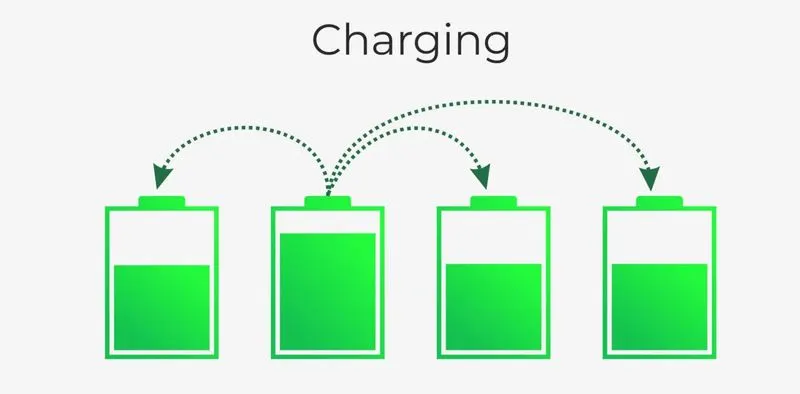 |
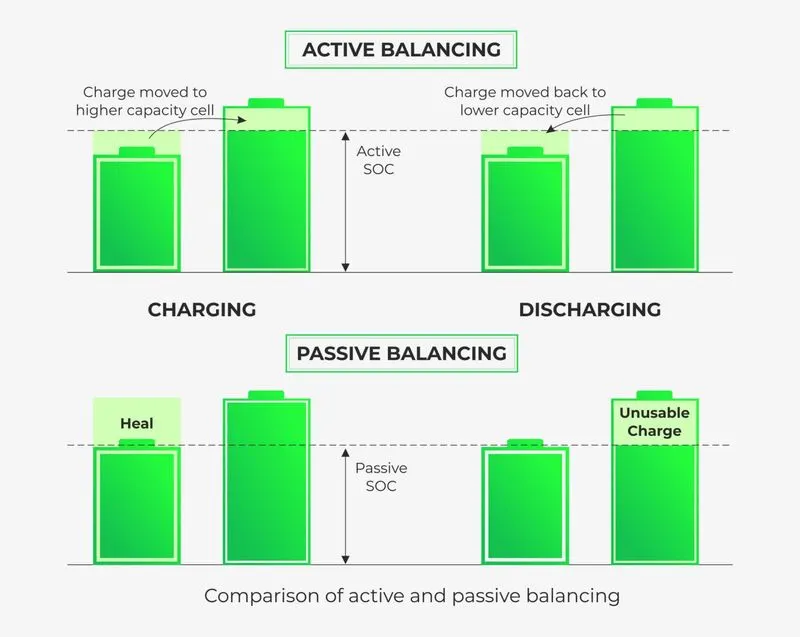
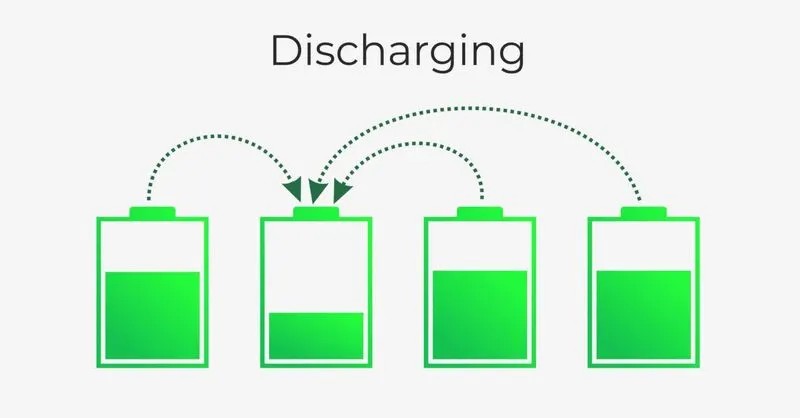
An active cell balancer generally transfers energy from one cell to another. That is from high voltage/ high SoC to a cell with a lower SoC. The purpose of an active balancer is that if you have a pack of cells with lower capacity, you can extend the life or the SoC that you have on the pack by moving energy from one cell in the pack with more energy than the other cell.
Instead of wasting all that energy as heat, an active cell balancer efficiently balances cells with tiny converter circuits that pass energy from the highest voltage cells to the lowest voltage cells. There are two different categories of active cell balancing methods: charge shuttling and energy converters. Charge shuttling is used to actively transport charges from one cell to another to achieve equal cell voltage. Energy converters use transformers and inductors to move energy among the cells of a battery pack.
Other active cells balancing circuits are typically based on capacitors, inductors or transformers, and power electronics interface. These entail:
Based on capacitors
- Single capacitors – this method is simple because it uses a single capacitor regardless of the number of cells connected in the battery. However, this method requires a large number of switches and intelligent control of the switches.
- Multiple capacitors – this method with multiple capacitors connected to each battery transfers unequal cell energy by multiple capacitors. It does not require a voltage sensor or closed-loop control.
Based on inductors or transformers
- Single/ multiple inductors – a cell balancing circuit with a single inductor has a small volume and low cost while multiple inductors have fast balancing speed and decent cell balancing efficiency.
- Single transformer – this method has a fast balancing speed with low magnetic losses.
- Multiple transformers – this cell balancer has a fast equalizing speed. However, it requires an expensive and complex circuit that prevents the transformer from being flooded.
Based on Power Electronics Interface
- Flyback/ forward converter – the energy of a high voltage cell is stored in the transformer. This cell balancer has high reliability.
- Full-bridge converter – this cell balancer has fast equalization speed and high efficiency.
Active balancers are capable of pushing a lot of current from one cell to another.
Advantages
- It improves capacity usage. It performs great when you have different cell capacities in a series.
- It increases energy efficiency. It saves energy instead of burning the excess energy in a cell by transferring the excess energy to a lower energy cell.
- Lifetime extension. It improves the life expectancy of a cell.
- Fast balancing.
Disadvantages
- When you transfer energy from one cell to another, approximately 10-20% of the energy is lost.
- The charge could be transferred only from higher cell to lower cell.
- Although an active cell balancer has high energy efficiency, its control algorithm may be complex and its production cost is expensive because each cell should be connected with an additional power electronics interface.
Passive Cell Balancing
 |
A passive system potentially burns off excess energy from the high cells through a resistive element until the charge matches the lower energy cells in the pack. If you have cells packed in series and you notice that some of the cells have higher energy than the other lower energy cells, you can balance the cells in burning energy of the top cells simply by attaching a resistor to the cells which release the energy into heat thereby equalizing the cell energy of the battery pack.
Initially, you burn off the excess energy until you have balanced cells. Passive cell balancing allows all cells to appear to have the same capacity. There are two different categories of passive cell balancing method: fixed shunting resistor and switching shunting resistor. A fixed shunting resistor circuit is usually connected to the fixed shunting to prevent it from being overcharged. With the help of the resistors, the passive balancing circuit can control the limit value of each cell voltage without damaging the cells. Energy consumed by these resistors for balancing a battery may result in thermal losses in the BMS. This, therefore, proves the fixed shunting resistor method to be an inefficient cell equalizing circuit.
The switch shunting resistor cell balancing circuit is currently the most common method in cell equalizing. This method has a continuous mode and a sensing mode, where the continuous mode all switches are controlled to be turned on or off at the same time, and in the sensing mode, a real-time voltage sensor is required for each cell. This cell balancing circuit consumes high energy through a balancing resistor. This cell balancing circuit is suitable for a battery system that requires a low current when it is charged or discharged.
Advantages
- You should never have to balance a pack that is working perfectly.
- A cell cannot waste energy that it does not have. As soon as the energy bank is full, that is only when the cell has enough energy to balance.
- It allows all cells to have the same SoC.
- It provides a fairly low-cost method for balancing the cells.
- It can correct for long-term mismatch in self-discharge current from cell to cell.
Disadvantages
- Poor thermal management.
- They do not balance during the full SoC. They only balance through the top of each cell at around 95%. This is because if you have different cell capacities, you are forced to burn off the excess energy.
- Its energy transmission efficiency is usually low. Electrical energy is dissipated as heat in the resistors and the circuit also accounts for switching losses. In other words, it results in a high amount of energy loss.
- It does not improve the run-time of a battery-powered system.
3. CONCLUSION
Balancing compensates for the SoC of individual cells, not the capacity imbalance. The good thing about a battery pack’s balance is that if the pack is balanced in the factory, the BMS only needs to handle the balancing current. This makes more sense to build battery packs that are already balanced, to remove the need for a BMS that can perform gross balancing.
To minimize the effects of cell voltage drifts, imbalances must be properly moderated. The objective of any balancing scheme is to allow the battery pack to operate at its expected performance level and extend its useful capacity.