Week 8- Moving zones approach in Fluent
Aim: To understand various models available in Ansys Fluent for modeling moving zones. And also perform a base simulation to understand the fluent workflow for moving reference frame.
The 2 different modeling techniques available for moving zones are:
1. Moving Reference Frame:
Suitable for steady-state analysis.
low computational cost.
The mesh topology will not change.
2. Moving Mesh Method
the Mesh topology will change that is the mesh shape will vary with the motion of the frame.
There is a change in the control volume
Transient simulation is used.
Used for modeling Vortex-induced flows.
Multiple Moving Reference Frame
The interface is the region existing in contact between a stationary frame and a moving frame.
N-S Equations in the stationary frame and rotating frame are solved separately.
Data is transferred from one frame to the other through the interface.
Simulation case-setup & Boundary conditions
- Pressure-based steady-state solver is used to solve the governing equations.
- Viscous model is K-e realizable with enhanced wall treatment.
- Air at standard atmospheric conditions is the working fluid.
- For setting up MRF we have to enable Frame motion and provide a RPM of 250.
- And for the airfoil wall, we define it to be a moving wall, with rotational motion relative to its adjacent cell zone.
Results:
Velocity Contour
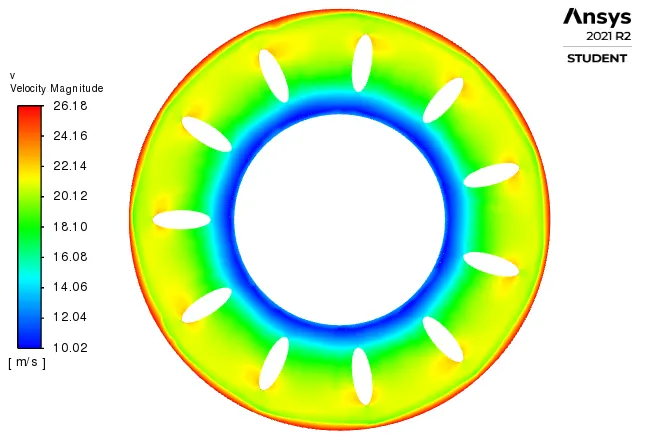
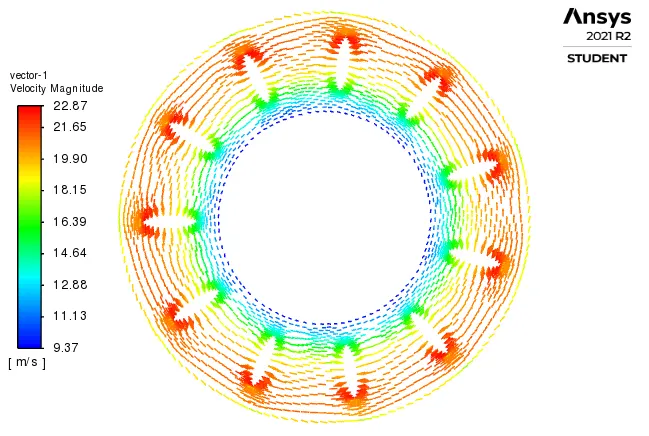
MRF simulation was successfully completed.