Week 2 - Converging diverging nozzle
Aim: To analyze the flow in the CD nozzle.
The domain was created in SpaceClaim, with the model assumed to be axisymmetric.
Case-setup & Boundary Conditions:
Meshing:
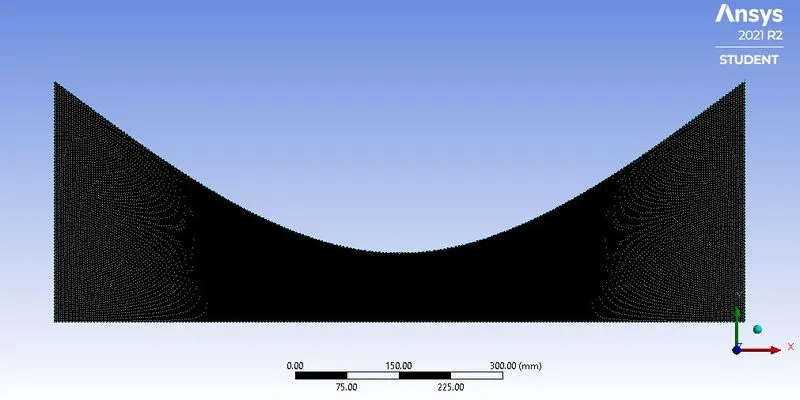
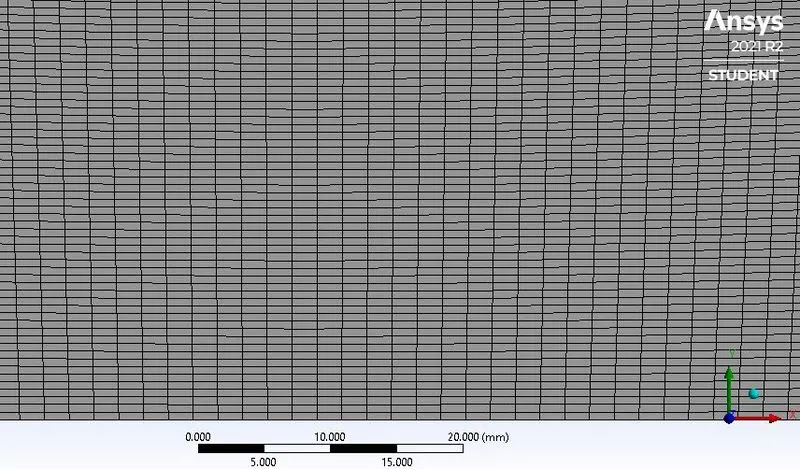
A cell count of 93,625 was made with a global element size of 2mm and also inserting a "face meshing" for the domain to get a structured mesh. Fig provided below illustrates the mesh produced.
A density-based steady-state solver is employed to solve the 2D axisymmetric problem.
The flow is assumed to be "Inviscid" to effectively study the CD nozzle. And also the energy equation is solved to understand the temperature fluctuations.
Air is assumed to behave like ideal gas here.
The boundary conditions provided are:
Pressure Inlet with 101325 Pa & Initial/supersonic gauge pressure is 1e5
Pressure Outlet with 2815 Pa
Operating Pressure : 0 Pa
Standard Initialization from the inlet.
high Mach number compressible flow the pressure changes are larger than in the low Mach number flows so there is no need to worry about roundoff errors which are more significant in the low Mach number flows. ansys normally subtracts the operating pressure from absolute pressure to eliminate the roundoff errors, so operating pressure is set to zero to make gauge pressure and absolute pressure equal.
Results:
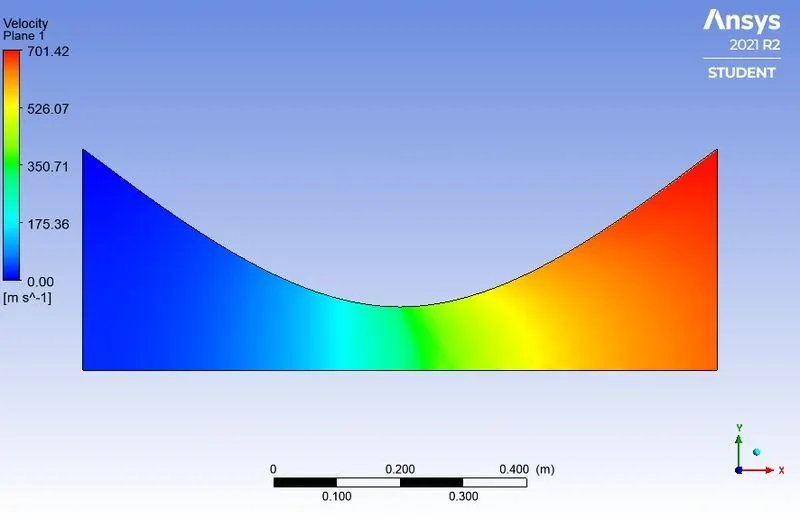
Velocity Variation across the domain
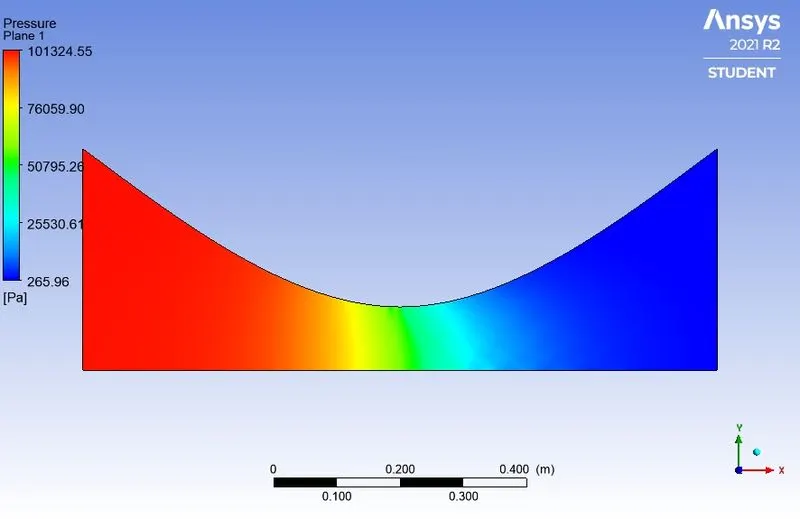
Pressure Variation across the domain
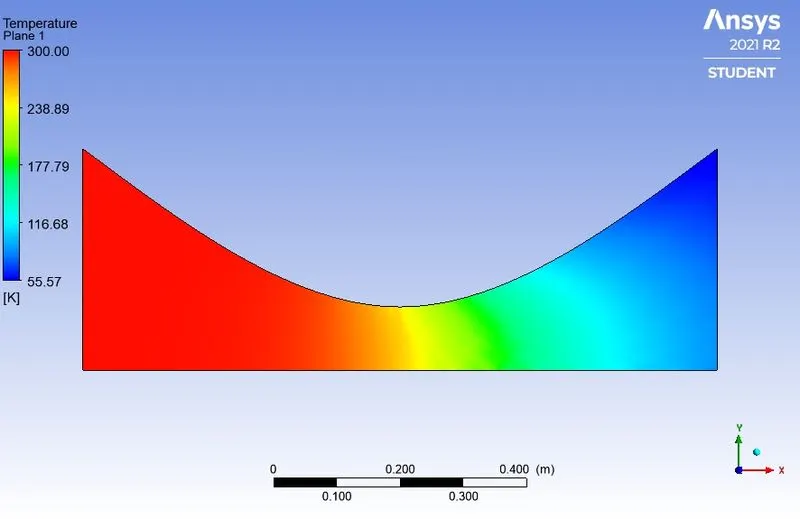
Temperature Variation across the domain
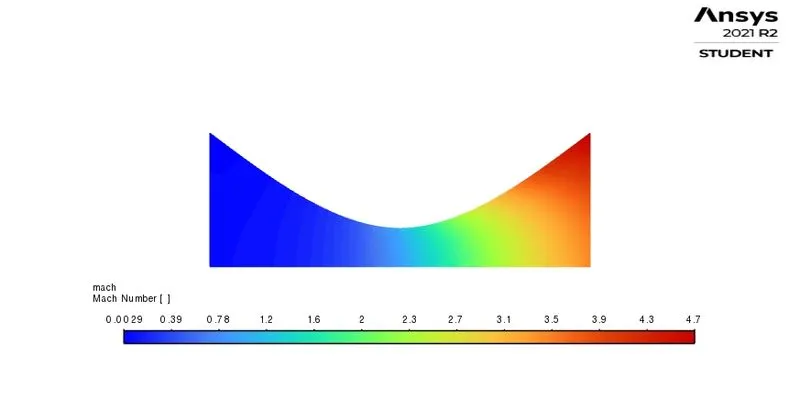
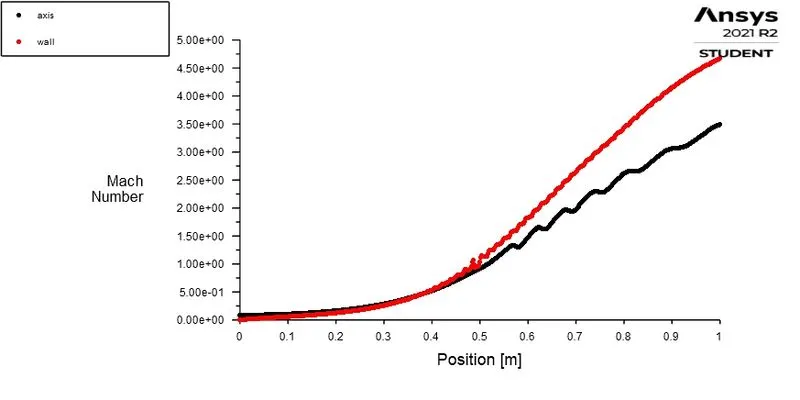
Variation of Mach No along the domain.
The flow can be seen to go into the supersonic regime (1.2 to 5) roughly about 0.6 m from the inlet along the axis of the CD nozzle.
`(dA)/A = (M^2-1)*((dC)/C)`
When the flow is subsonic (M<1) which is the case in the converging region of the nozzle, an increase in the area will decrease the velocity.
Now when the flow is supersonic (M>1) which is the case in the diverging region of the nozzle, an increase in the area will increase the velocity.
Conclusion:
Flow-through the CD nozzle was successfully analyzed.
A theoretical explanation was given for the results observed.