Week 3 - Pitot tube
Aim: To study the working of Pitot tube, And verify the numerical result obtained.
Given Data:
|
Velocity(m/s) |
Gauge Pressure (Pa) |
|
240 |
-2817 |
|
100 |
33287 |
|
62 |
65780 |
Introduction:
A pitot tube is a flow measurement device used to measure fluid flow velocity. The basic pitot tube consists of a tube pointing directly into the fluid flow. As this tube contains fluid, a pressure can be measured; the moving fluid is brought to rest (stagnates) as there is no outlet to allow flow to continue. This pressure is the stagnation pressure of the fluid, also known as the total pressure. The static tube will measure the static pressure of the fluid.
By Bernoulli's principle:
`P_(Stagnation)=P_(static)+P_(dynamic)`
from which we can derive an equation for velocity as :
`v=sqrt((2*(P_(stagnation)-P(static)))/(rho)`
Case Settings & Boundary Conditions:
A pressure-based steady-state solver will be employed here.
The flow is taken to be laminar.
Air with Density = 0.863 & Viscosity of 1.678e-5 is the working fluid.
Velocity Inlet: 62 m/s with initial gauge pressure as 65780
Pressure outlet: 65780
Operating Pressure : 0 Pa
We first perform standard initialization following which have to do FMG initialization.
Run it for 500 iterations.
Results:
Case - 62 m/s & pressure of 65780 Pa
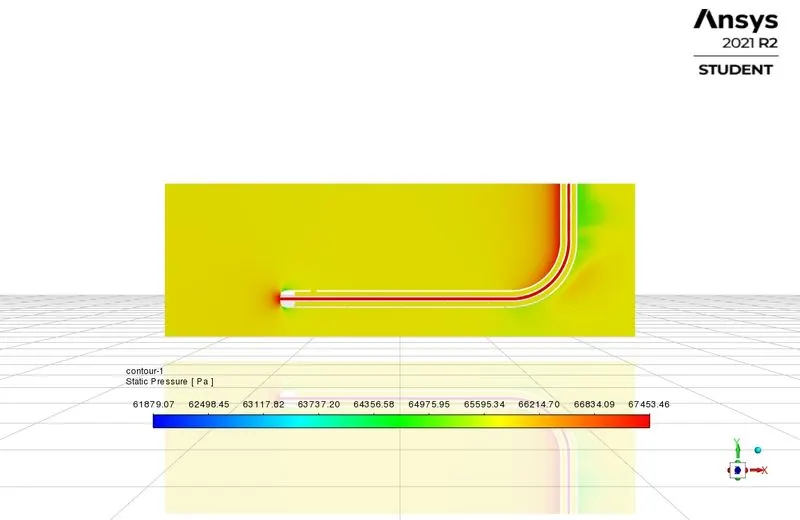
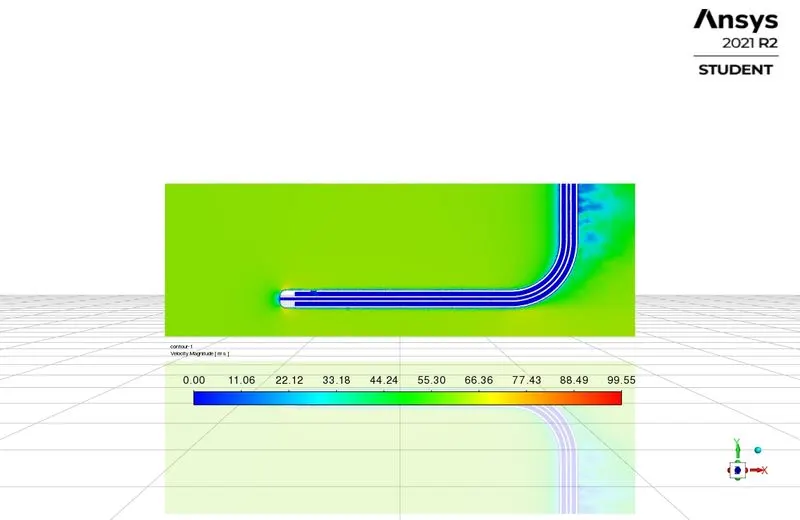
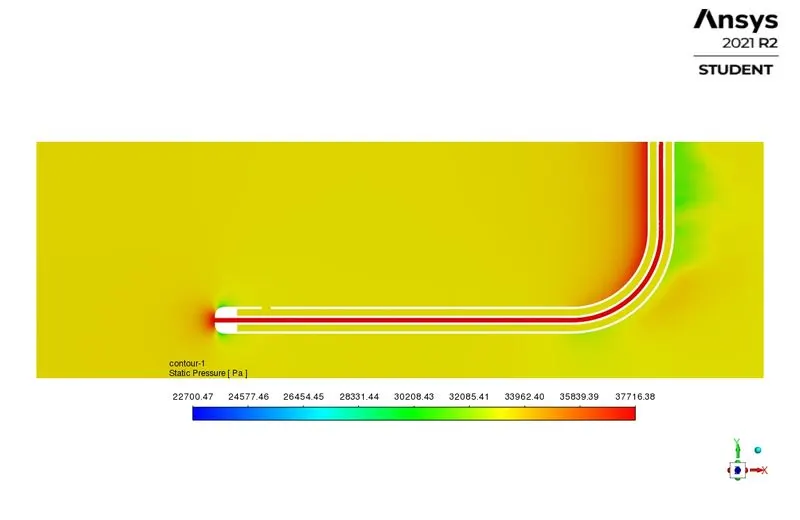
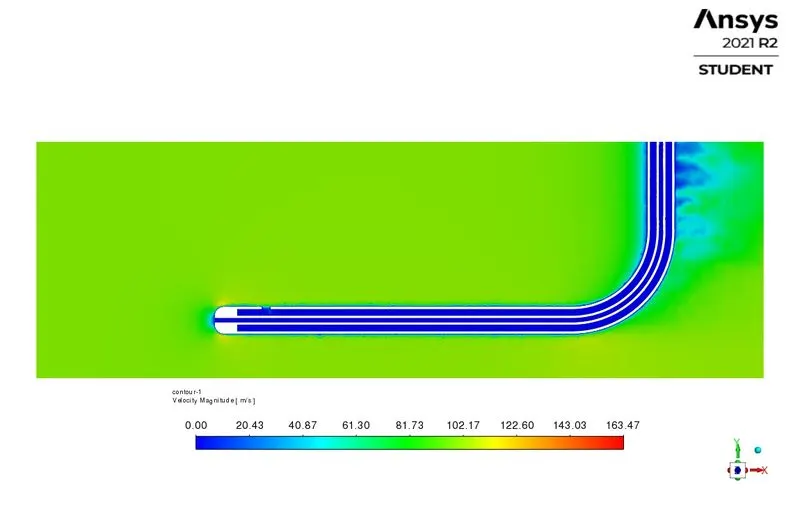
Case - 100 m/s & 33287
Case 240 m/s & -2817
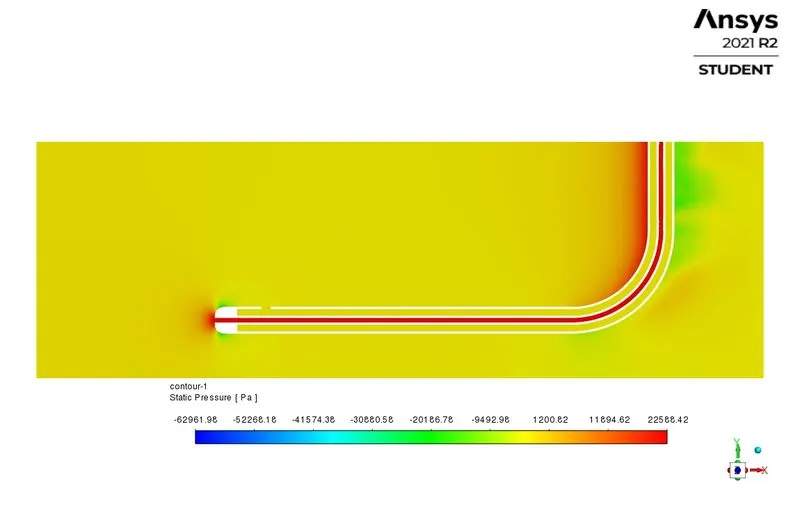
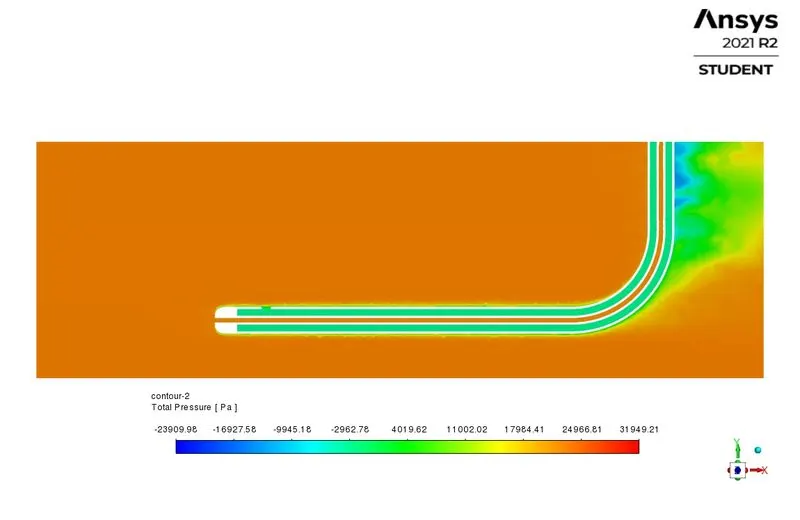
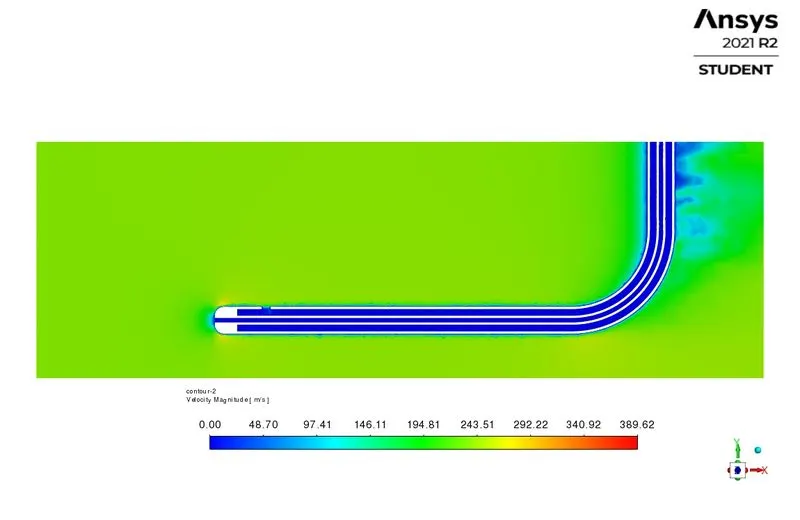
Comparison of Velocity values calculated using Bernoulli's principle with the given values.
| Given_Velocity | 240 | 100 | 62 |
| Stag_Pressure | 22210.083 | 37626.798 | 67451.146 |
| Static Pressure | -2336.2355 | 33333.783 | 65806.972 |
| Density | 0.863 | 0.863 | 0.863 |
|
Calculated_Velocity
|
238.5079077 | 99.74492381 | 61.72818224 |
| % Error | 0.6217051418 | 0.2550761884 | 0.43841575 |
Conclusion:
The results are successfully validated using Bernoulli's principle.