Week - 8 Mass Scaling
Objective:
To perform mass scaling on the given model to reduce the runtime and to compare the runtime with Implicit and Explicit method.
Theory:
Time step:
In FEA time step is the time required for a shock wave to propogate across the smallest element, A run in asingle model simulation starts at time zero and continues till the user defined endtime is reached.
The time step is calculated by:
`delT= (L/C)`
where
L = Smallest element length
`c=sqrt(E/(rho))`
where
E = youngs modulus of the material
`rho`= Density of the material
So it can be understood that the time step is directly dependent on the length of the element and inversely proportional to the speed of sound on the material which is depend on both material and density of the material.so if the material is stiffer ( modulus of elasticity is higer) the speed of sound increases resulting in a lower time step.
- If the length of the element increases the accuracy of the result decreases so the speed of the shock wave should be increased
- This is done by mass scaling option by increasing the time step
- In LS-Dyna time step is controlled by DT2MS option which is available in *CONTROL_TIMESTEP
- The DT2MS can be either positive or negative value, If the value is Negative,mass is added to only those elements whose timestep would be less than TSSF*abs(DT2MS) and If the value is Positive,mass is added or taken away from the elements so that the timestep of every element is same
- In this Simulation negative values of DT2MS is to be used beacuse elements whose value is greater than TSSF*abs(DT2MS) will not reduce the runtime where as elements whose value is less than TSSF*abs(DT2MS) will reduce the runtime to take care of this issue negative value DT2MS is used here.
Procedure:
case setup & Execution:
case 1: Run the model without mass scaling
1. The given Keyword file is imported into LS-PP, the keyword file consists of all important parameters like mat,sec,boundary conditions, control cards and Data base cards
2. To understand the process,the *CONTROL_TIMESTEP card is deleted
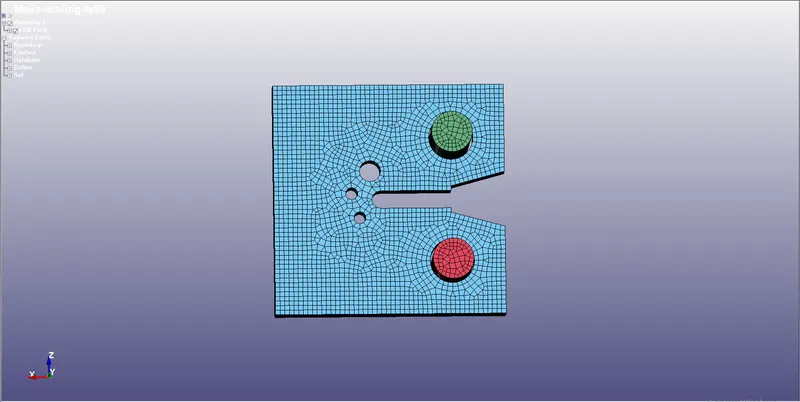
3. The Keyword file is saved in a separate folder and opened in LS-Dyna manager
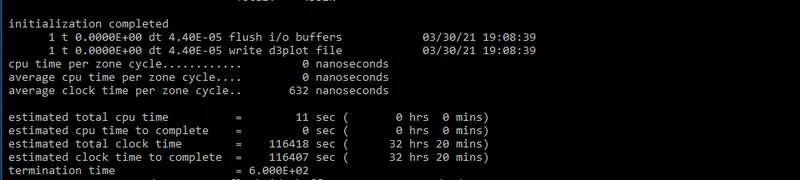
Here we can see that the estimated time to complete this simulation is 32 hrs 20 mins which is significantly higher, to reduce this we need to imply mass scaling
Case 2: With mass scaling
1. *CONTROL_TIMESTEP keyword is added to the model with tssfac=0.9 and DT2MS = -3.500E-05
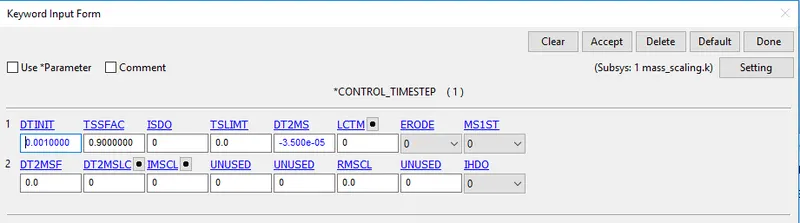
2. The Keyword file is saved in a separate folder and opened in LS-Dyna manager
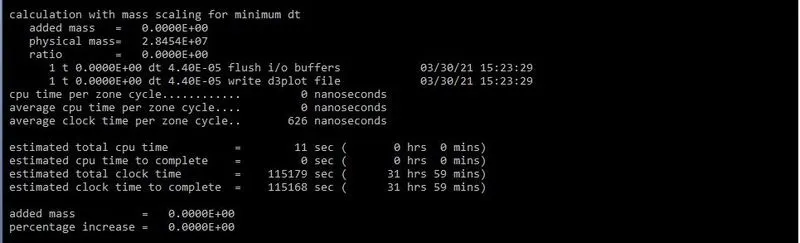
- From the above image it can be seen that the time for computation is decreased from 32 hrs 20 mins to 31 hrs 59 mins, the decrease in computation time is not that significant
- But we can see that there is no mass added with given DT2MS of -3.500E-05 with percentage of mass increase in 0%, this can be changed to changing the values of DT2MS and tssfac
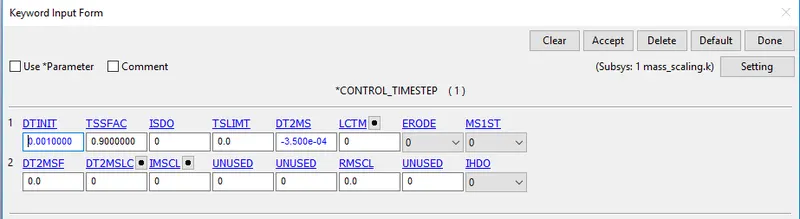
Case 3: Mass scaling with tssfac=0.9 and DT2MS = -3.500E-04
1. *CONTROL_TIMESTEP keyword is added to the model with tssfac=0.9 and DT2MS = -3.500E-04
2. The Keyword file is saved in a separate folder and opened in LS-Dyna manager
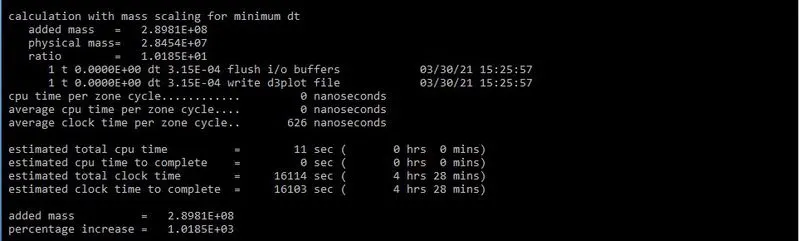
- From the above image it can be seen that the time for computation is decreased from 31 hrs 59 mins to 4 hrs 28 mins, there is considerable decrease in computation time
- However we can see that the mass added with given DT2MS of -3.500E-04 with percentage of mass increase in 1.0185E+03 is 2.8981E+08
- Since the added mass value exceeding the limit, the energy values will vary considerably and accuracy of the results will be compromised so the given mass needs to be reduced.
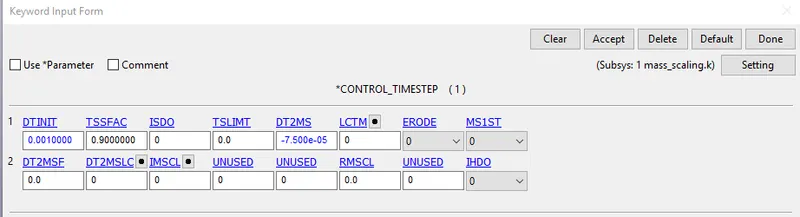
Case 4: Mass scaling with tssfac=0.9 and DT2MS = -7.500E-05
1. *CONTROL_TIMESTEP keyword is added to the model with tssfac=0.9 and DT2MS = -7.500E-05
2. The Keyword file is saved in a separate folder and opened in LS-Dyna manager
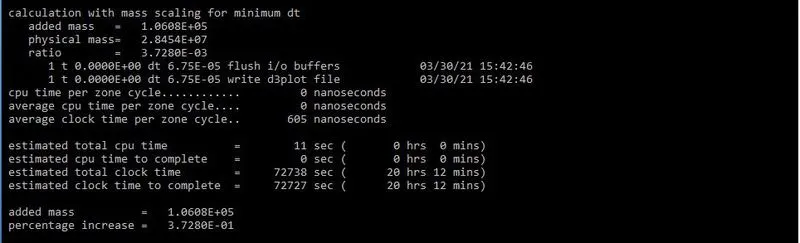
- From the above image it can be seen that the computation time is 20 hrs 12 mins which is higher than that of the previous case
- However we can see that the mass added with given DT2MS of -7.500E-05 with percentage of mass increase in 3.728E-01 (i.e., is 0.3%) is 1.0608E+05
- Since it is not the recommended value further mass can be added.
Case 5: Mass scaling with tssfac=0.9 and DT2MS = -8.500E-05
1. *CONTROL_TIMESTEP keyword is added to the model with tssfac=0.9 and DT2MS = -8.500E-05
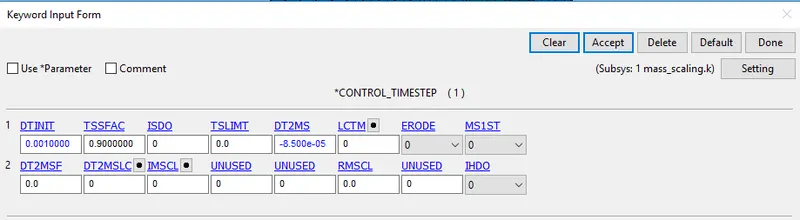
2. The Keyword file is saved in a separate folder and opened in LS-Dyna manager
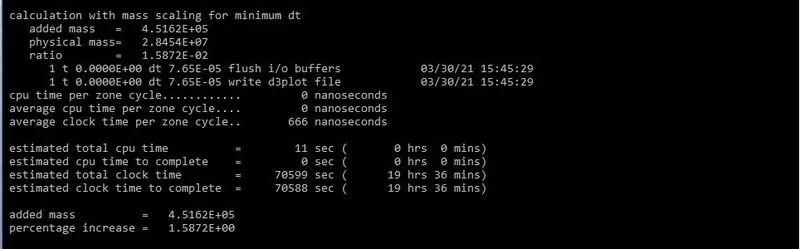
- From the above image it can be seen that the computation time is 19 hrs 36 mins which is lesser than the previous case
- However we can see that the mass added with given DT2MS of -8.500E-05 with percentage of mass increase in 1.5872E+00 (i.e., is 1.5%) is 4.51628E+05
- Since it is not the recommended value further mass can be added.
Case 6: Mass scaling with tssfac=0.9 and DT2MS = -9.753E-05
1. *CONTROL_TIMESTEP keyword is added to the model with tssfac=0.9 and DT2MS = -9.753E-05
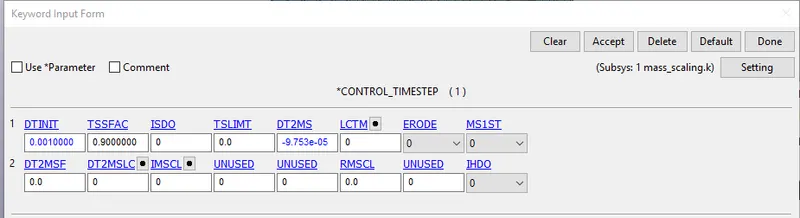
2. The Keyword file is saved in a separate folder and opened in LS-Dyna manager
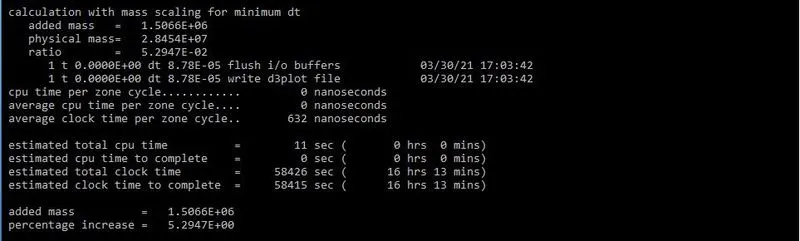
- From the above image it can be seen that the computation time is 16 hrs 13 mins which is lesser than the previous case
- However we can see that the mass added with given DT2MS of -9.753E-05 with percentage of mass increase in 5.2947E+00 (i.e., is 5.29%) is 1.5066E+06
- Since it is not the recommended value further mass can be added.
Case 7: Mass scaling with tssfac=0.9 and DT2MS = -1.025E-04
1. *CONTROL_TIMESTEP keyword is added to the model with tssfac=0.9 and DT2MS = -1.025E-04
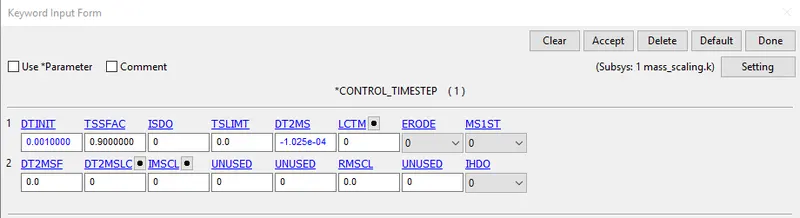
2. The Keyword file is saved in a separate folder and opened in LS-Dyna manager
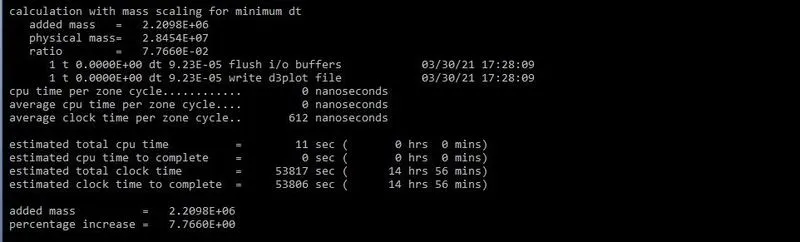
- From the above image it can be seen that the computation time is 14 hrs 56 mins which is lesser than the previous case
- However we can see that the mass added with given DT2MS of -1.025E-04 with percentage of mass increase in 7.7660E+00 (i.e., is 7.76%) is 2.2098E+06
- Since it is not the recommended value further mass can be added.
Case 8: Mass scaling with tssfac=0.9 and DT2MS = -1.030E-04
1. *CONTROL_TIMESTEP keyword is added to the model with tssfac=0.9 and DT2MS = -1.030E-04
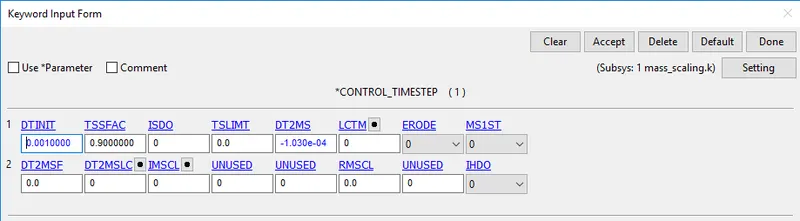
2. The Keyword file is saved in a separate folder and opened in LS-Dyna manager
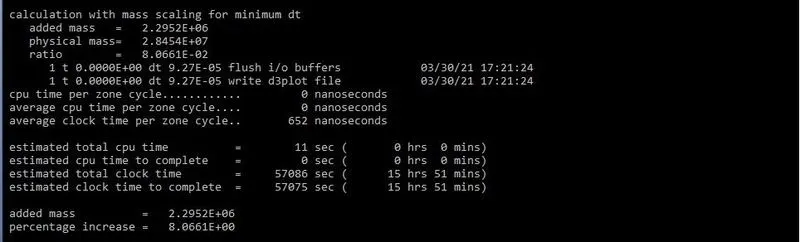
- From the above image it can be seen that the computation time is 15 hrs 51 mins which is somewhat higher than the previous case
- However we can see that the mass added with given DT2MS of -1.030E-04 with percentage of mass increase in 8.0661E+00 (i.e., is 8.06%) is 2.2952E+06
- Here the recommended percentage of mass is achieved but to see further DT2MS value is reduced to 0.001 to see the results
Case 9: Mass scaling with tssfac=0.9 and DT2MS = -1.029E-04
1. *CONTROL_TIMESTEP keyword is added to the model with tssfac=0.9 and DT2MS = -1.029E-04
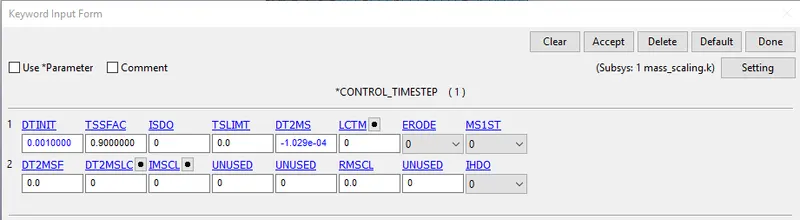
2. The Keyword file is saved in a separate folder and opened in LS-Dyna manager
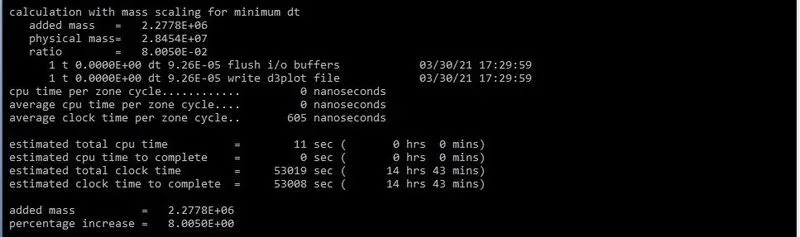
- From the above image it can be seen that the computation time is 14 hrs 43 mins which is somewhat lesser than the previous case
- However we can see that the mass added with given DT2MS of -1.029E-04 with percentage of mass increase in 8.0050E+00 (i.e., is 8.00%) is 2.2778E+06
- In this case the accurate result is achieved with the added mass percentage of 8%.
The mass sacling can be done by altering the TSSFAC values too, The TSSFAC values will generally range between 0.5 to 0.9
| DT2MS | Mass Percentage | Computation time |
| -3.500E-05 | 0 | 31 hrs 59 mins |
| -3.500E-04 | 101.8 | 4 hrs 28 mins |
| -7.500E-05 | 0.372 | 20 hrs 12 mins |
| -8.500E-05 | 1.5872 | 19 hrs 36 mins |
| -9.753E-05 | 5.297 | 16 hrs 13 mins |
| -1.025E-04 | 7.766 | 14 hrs 56 mins |
| -1.030E-04 | 8.066 | 15 hrs 51 mins |
| -1.029E-04 | 8.005 | 14 hrs 43 mins |
The computation time shown by the solver may not be true since it sometimes finish the problem within the predicted time or it may takes more than that.
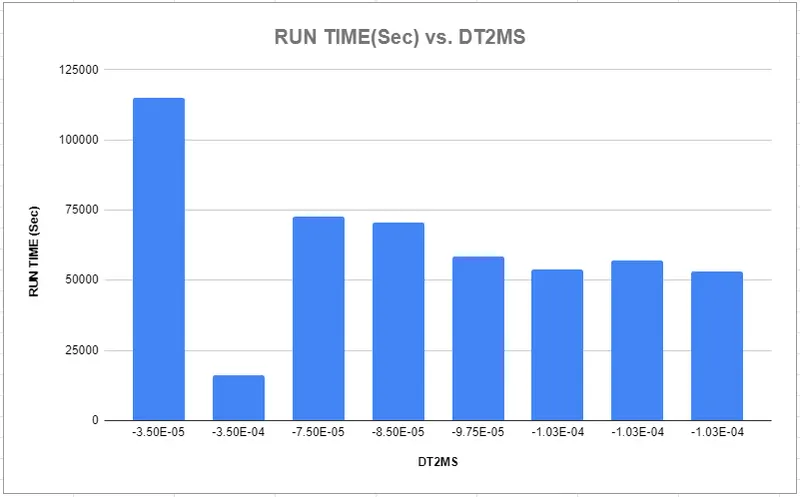
From the above chart it can be understood that time decreases when mass is added, For the scale factor of 0.9 the optimum value of DT2MS is -1.03E-04 for a steady simulation
since the percentage of mass added is 8%
MASS SCALING FOR IMPLICIT SOLUTIONS:
1. The given keyword is imported into LS-PP
2. The keyword file consists of all the imporatant parameters like Mat,Section.Boundary conditions, Prescribed motion set with control cards and Database cards
3. To Make the solver function into Implicit the following cards are added to the keyword.
In LS prepost generally the solver used is Explicit, to perform in Implicit solver the following keywords are needed to be defined to switch from implicit to explicit
i. Keyword manager `rarr`All`rarr` control `rarr` Implicit_Auto
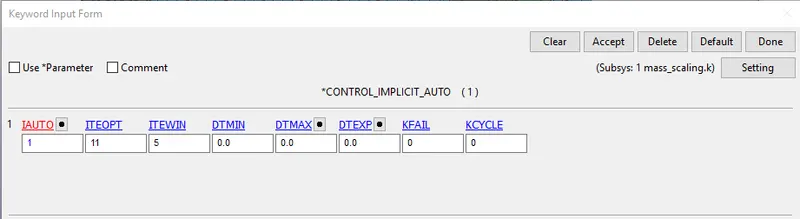
CONTROL_IMPLICIT_AUTO card is used for automatic time step control during implicit analysis. Input value for Automatic time step control flag = IAUTO = 1.
ii.Keyword manager `rarr`All`rarr` control `rarr` Implicit_General
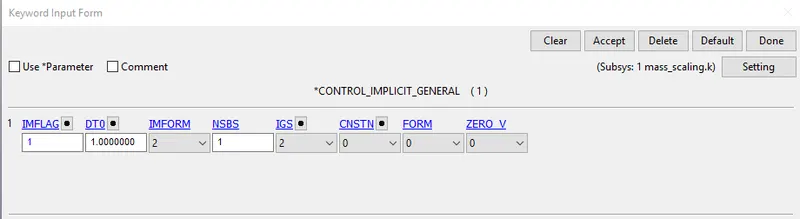
- CONTROL_IMPLICIT_GENERAL card is used to activate implicit analysis and define associated control parameters. This keyword is required for all implicit analyses.
- The input value for IMFLAG=Implicit/Explicit switching flag = 1 (implicit analysis)
- DT0=Initial time step size for implicit analysis = 1.00.
iii.Keyword manager `rarr`All`rarr` control `rarr` Implicit_Solution
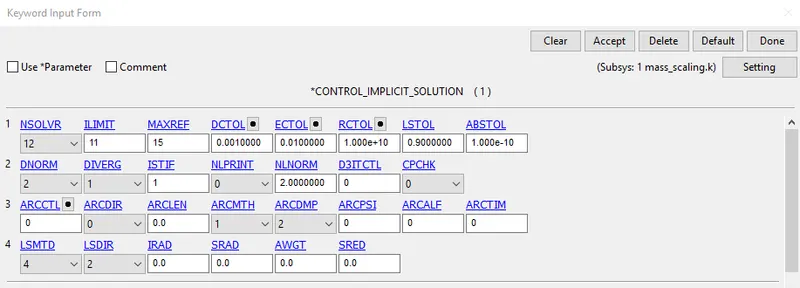
CONTROL_IMPLICIT_SOLUTION card is used to specify whether a linear or nonlinear solution is desired. The default values are set as it is in the card.
iv.Keyword manager `rarr`All`rarr` control `rarr` Implicit_Solver
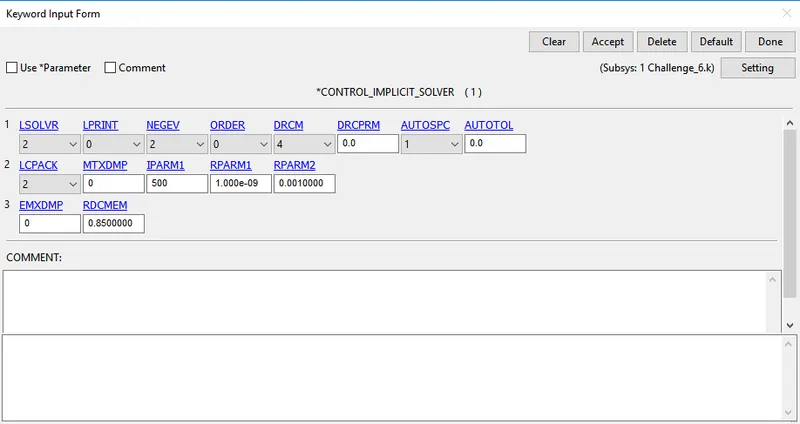
CONTROL_IMPLICIT_SOLVER card is used for implicit calculation.
*CONTROL_TIMESTEP keyword is added to the model with tssfac=0.9 and DT2MS = -1.029E-04 which is value in which stable solution is achieved with a percentage of added mass is 8% achieved.
The Keyword file is saved in a separate folder and opened in LS-Dyna manager
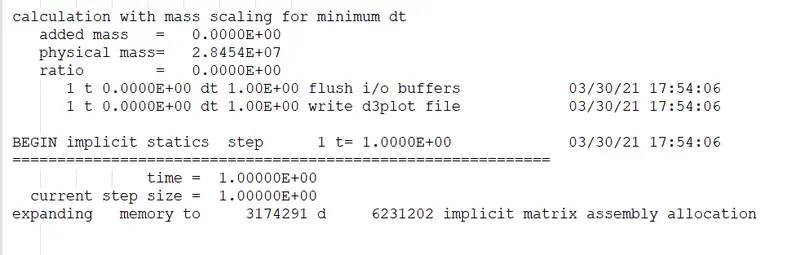

- This can be seen in the above image that there is no mass added during the run, even though we added the *CONTROL_TIMESTEP card
- so it can be concluded that the factors like "tssfac" and "DT2MS" does not have any contol over the runtime implicit solution.
- Also it is noted that the runtime of Implicit differs significantly when compared to Explicit.
Conclusion:
- The objective of mass scaling is done on the given model is done by adjusting the values of DT2MS and TSSFAC by trail and error.
- by considering the hard limit on mass scaling to be 8% which is achieved through the optimized value of DT2MS = -1.029E-04 and TSSFAC of 0.9 with the lowest possible runtime of 14 hrs 57 mins.
- The values of DT2MS and TSSFAC does not affect the run time of implicit solution.