Geometric Topology, Mid surface Extraction and Meshing of a Bottle cap model using ANSA
Geometric Topology, Mid surface Extraction and Meshing of a Bottle cap model using ANSA
Objective:
To Perform the geometric topology to the given model and extract the midsurface to generate 2D Meshing for the given bottle cap model according to the given element quality criteria and assign thickness to the shell elements using ANSA.
|
Sno. |
Quality criteria |
Value |
|
1. |
Total length |
1 |
|
2. |
Minimum length |
0.5 |
|
3. |
Maximum length |
3 |
|
4. |
Aspect |
3 |
|
5. |
Warpage |
15 |
|
6. |
Skewness |
45 |
|
7. |
Jacobian |
0.7 |
|
8. |
Minimum quad angle |
45 |
|
9. |
Maximum quad angle |
135 |
|
10. |
Minimum tria angle |
30 |
|
11. |
Maximum tria angle |
120 |
|
12. |
Tria percentage |
15 |
Procedure:
Geometric topology:
1.The given part is separated into two components which are kept in separate using the lock view.
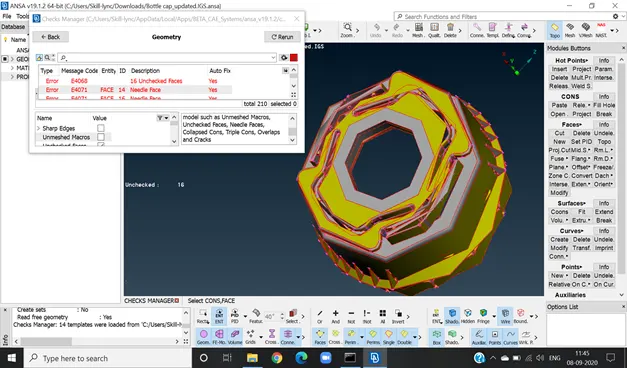
2.The separated component is checked for geometrical errors using the checks manager.
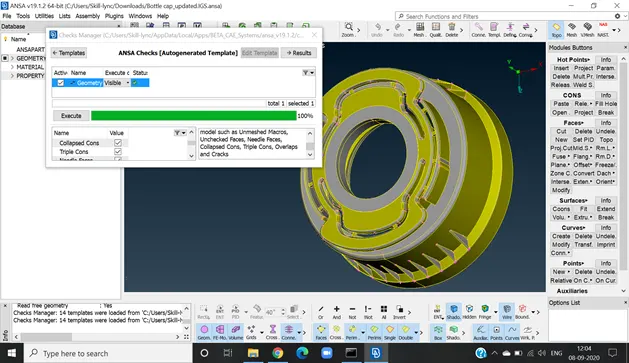
3.The Errors which are displayed is cleared by using the auto fix option in checks geometry and by also using the tools available in hot points, cons, faces and surface.
Geometric errors before topology:
Model without geometric errors:
Mid surface Extraction:
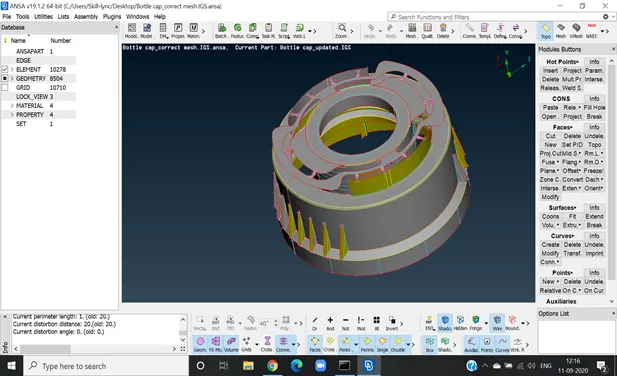
The given model is complex and has variable thickness, hence different mid surface extraction methods is used:
1.OFFSET method: The offset option available in FACES module is used for extracting the midsurface of the outer circular surface.
2.SINGLE-MIDDLE method: The single middle option available in FACES module is used for extracting the mid surface of ribs.
3.MULTI-MIDDLE: The multi middle option available in FACES module is used for extracting the midsurface of small ribs and supporting structures which are available in the component.
The Extracted Mid surface is as follows:
ASSIGNING THICKNESS:
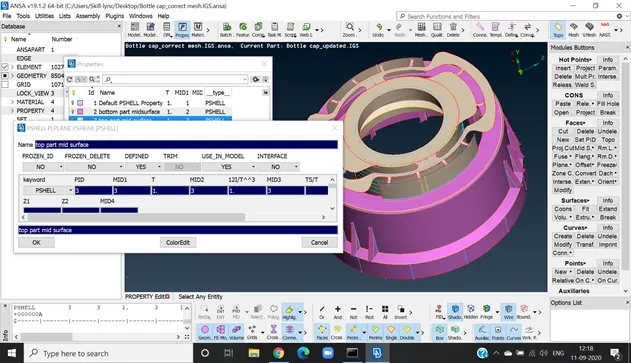
The thickness to the extracted midsurface is assigned in the Properties tab, the created midsurace is selected and renamed according to their names, the thickness values of both the part are entered and their type is chosen as PSHELL. The thickness is applied successfully.
Mid Surface with thickness assigned:
MESHING:
1.Once again geometric check is performed using the checks manager.
2.The given quality criteria and mesh parameters values are entered.
3.Mesh is generated using the batch mesh option.
4.The component is checked for quality criteria which is achieved by using various tools available in the modules like Cut, join, Num +/-, Reconstruct, Smooth etc.,
5.Smooth mesh flow is achieved.
Advantages of Batch mesh:
- Batch mesh generation is a well organised way of meshing complex components.
- The mesh flow in batch mesh is perfect.
- Batch meshing is a fast process.
- Feature capturing is perfectly done in batch meshing.
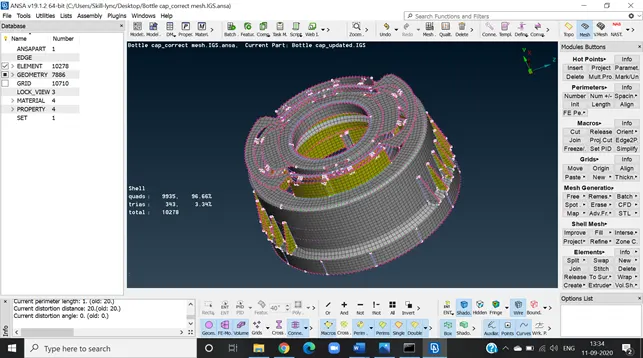
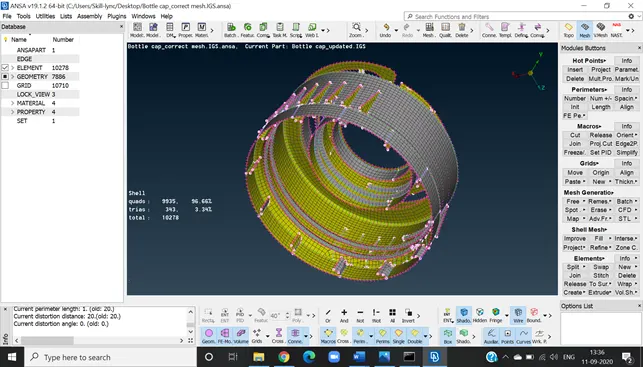
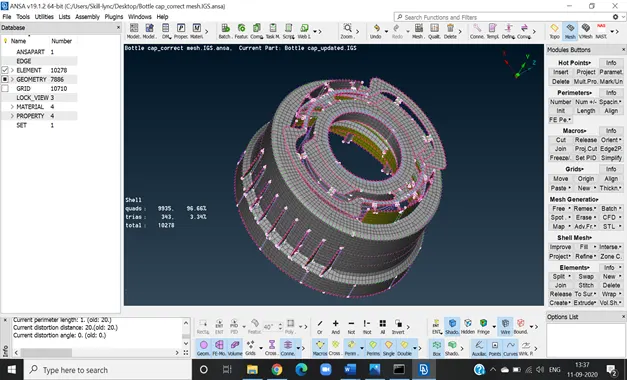
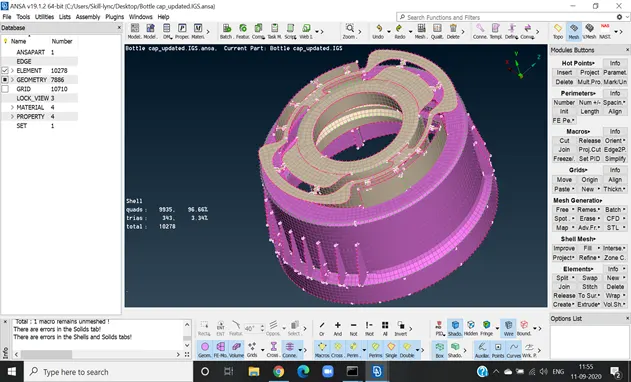
Meshed model of the bottle cap component is as follows:
LEARNING OUTCOMES:
1.Learnt about the various tools of ANSA.
2.Able to clear the geometrical errors in the given model
3.Able to extract the mid surface both manually and through the midsurface and middle option. and assign the thickness to the extracted surfaces.
4.Able to attain a Smooth mesh of the given component to clear the quality criteria.
Conclusion:
The given Bottle cap Imported into ANSA , the geometrical errors are fixed and checked then the midsurface is extracted and assigned thickness finally the midsurface is meshed successfully by clearing the quality criteria.