Week - 8 Mass Scaling
Challenge 8 - Mass Scaling
Objective
- Study the effects of DT2MS and TSSFAC parameters on the computational time to perform a explicit simulation
- Compare the computational time of the same simulation using a implicit solution scheme
Background
In the context of Finite Element Analysis (FEA) and explicit simulations, mass scaling is a powerful technique which allows to accelerate the simulation process by artificially increasing the mass of certain elements to allow for a bigger time step. Mathematically, this can be explained by considering the critical time step (t_crit), which determines the maximum time increment allowed for a accurate simulation results:

The above formula uses the characteristic length of the smallest element in the model, and the elastic wave speed of the material, which is a function of the density and the young's modulus:
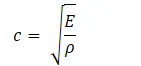
Therefore, we can observe how by increasing the density or "adding mass" to the model we can decrease the elastic wave speed and increase our critical time step.
However, the use of mass scale introduces several considerations that must be taken into account to ensure the reliability of the simulation:
- As the total mass in the model changes, the dynamic and inertial response will also change
- Artificial kinetic energy will also get introduced in the model, therefore, energy conservation in the model may not be achieved
- If the time step increase is very large, it may arise numerical instabilities when solving the model
Procedure
In order to study the effects of mass scaling in the computational time, we will analyze the following case:
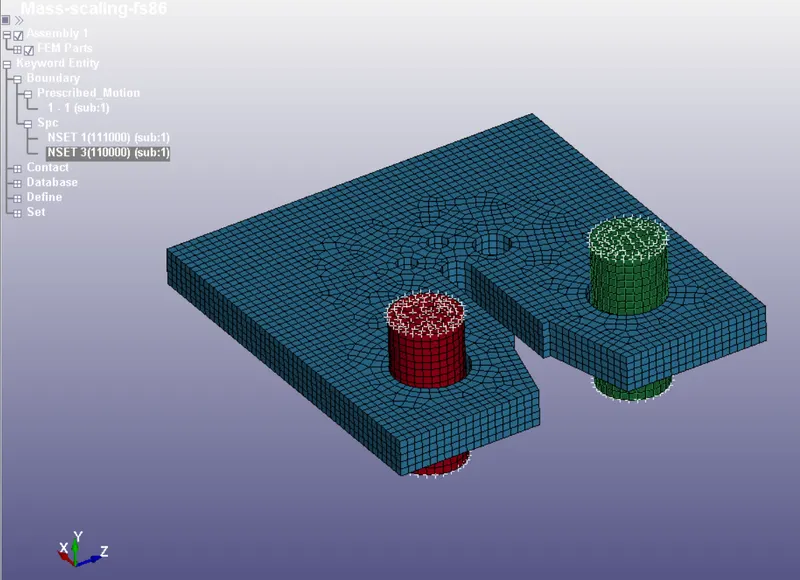
In this fully build model deck, the green pin is pulled outwards in the Y direction while the other pin is fixed in its translational degrees of freedom. An Automatic contact definition is set between the surface of the pin and the block.
By using the Keyword manager, we can observe the default time step configuration in the model:
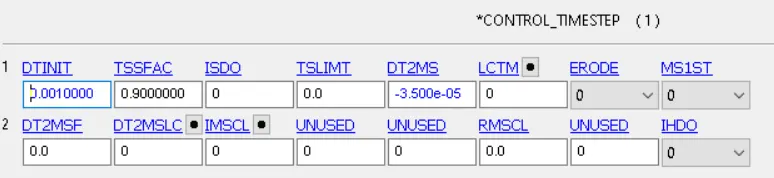

Before running the simulation, we must ensure that this predefined time step is lower or equal to the critical time step to ensure proper results.
The critical time step for this simulation can be obtained using the characteristic length of the smallest element and the material properties as:
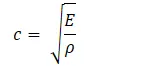
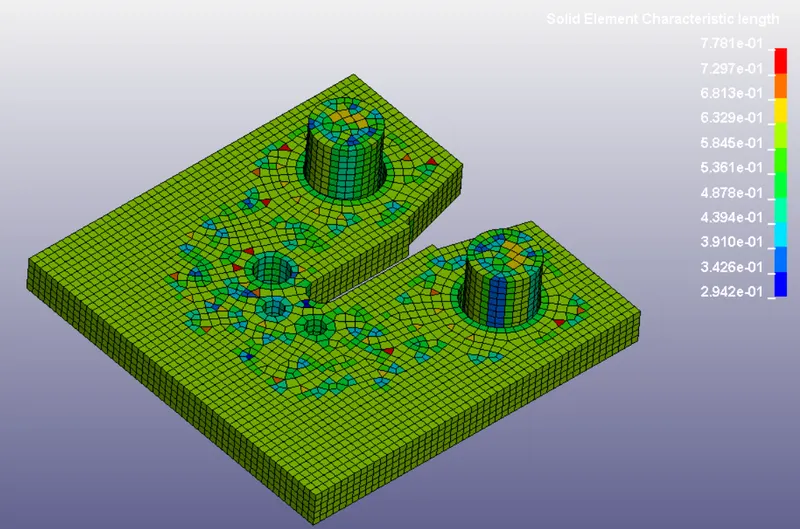
Both of this properties can be obtained with the information already defined in the model. In terms of characteristic length we get:
In terms of material properties we have:
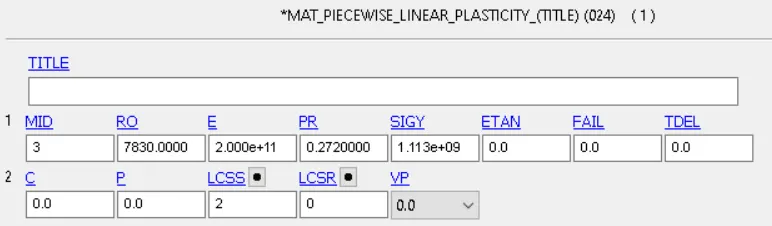
Although we have no title for the material, just by looking at the values we can assume this material is common steel and the unit system is given as Kg, m, s. Thus:
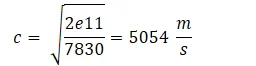

Since the predefined time step is smaller than our critical time step we can proceed to make a first run on the simulation
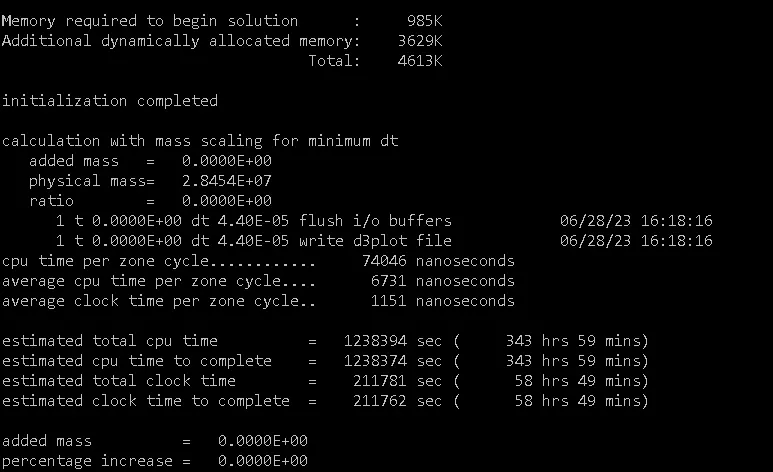
As observed on the previous figure, the estimated time to complete the simulation is 58 hours and 49 minutes and there is no mass scaling in this run.
If we use the notepad to quickly modify the .k file we can change the value of the DT2MS parameter, which, activates mass scaling when the time step is lower than the set value.

If we double the value of the DT2MS parameter (-7e-5) we get:
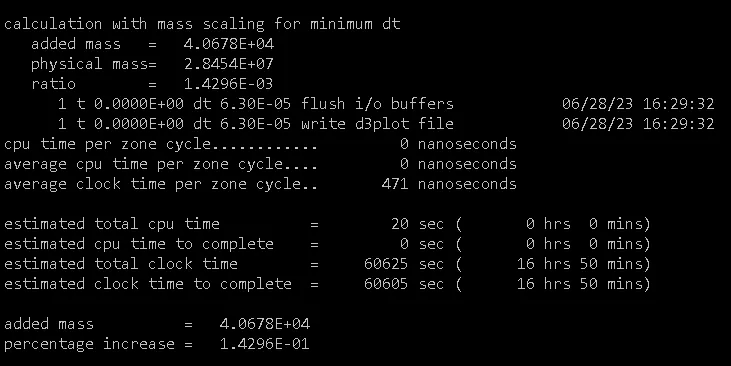
From the previous figure we can observe that this change triggers a 0.142% mass increase in the model, which is really small, and increases computational time almost 4 times. For this particular exercise, we will keep increasing the DT2MS parameter until we achieve an 8% mass percentage increase. The summary of these runs can be observed in the following graphs:
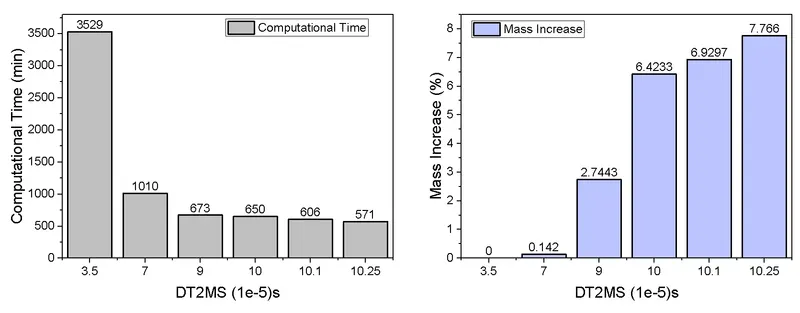
As observed, both the computational time decrease and percentage of increased mass do not follow a linear trend, therefore, is very important to do multiple runs until perfectly dialing the DT2MS parameter. In terms of efficiency and reliability, the 9e-5 time step seems to be the most adequate
The next step is to evaluate the effect of the TSSFAC parameter. Basically this number is a factor that multiplies the DT2MS value to ensure numerical stability, the default value in Ls-PrePost is 0.9
To see the effects of this parameter in the simulation time, we will vary this parameter from 0.9 to 0.5 using the 9e-5 time step

The summary of the results can be observed in the next figure:
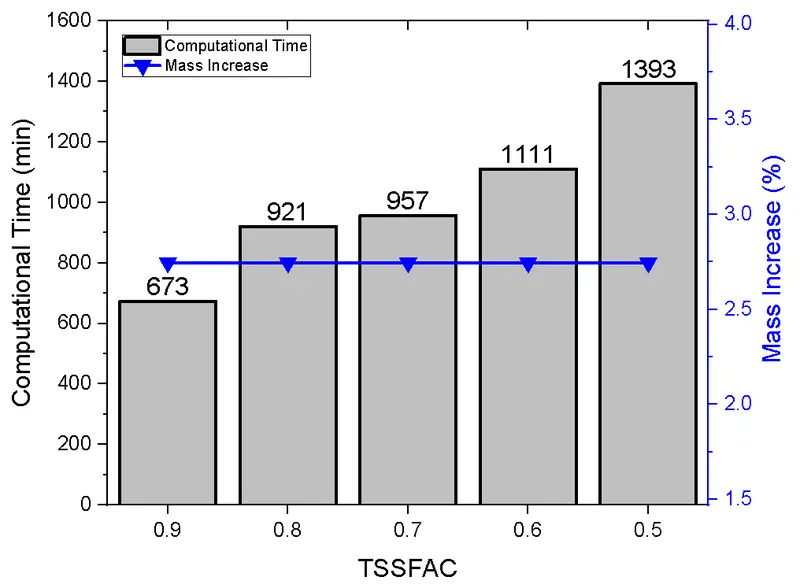
It can be observed that the mass increase in the model remains the same regardless of the TSSFAC parameter, yet, computational time is greatly affected by reducing this parameter.
The only comparison left is to use and implicit solution scheme, which, for this problem makes more sense since the termination time is larger than 100,000 critical time steps. To do so, we must include a few keywords such as:
- Control Implicit General --> Activates the implicit solution scheme

- Control Implicit Auto --> Allows for automatic time step modification

- Control Implicit Solution --> Activates the non-linear solver
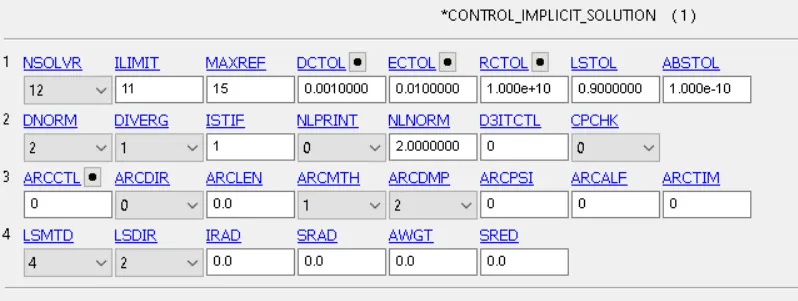
- Control Implicit Solver --> Activates the linear solver
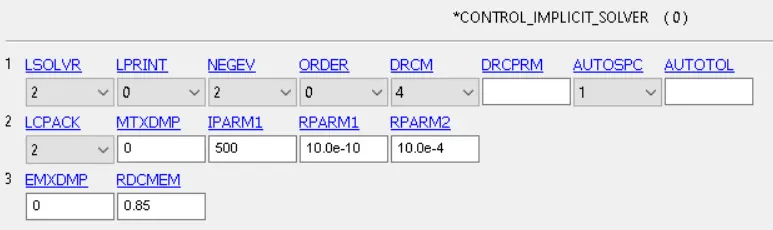
After running the solution we can observe that the computational time was only 42 seconds, with most of the time steps requiring only 2 iterations to solve

Conclusions
- Adjusting the DT2MS parameter can greatly reduce computational time without compromising the accuracy of the results as long as the percentage mass increase is kept below 5%
- Adjusting the TSSFAC doesn’t have any impact in the mass scaling adjustment of a simulation, yet, it greatly increases computational time to obtain a numerically stable solution
- A implicit solution scheme is favored when the termination time is above 100,000 critical time steps