Week 8: Literature review - RANS derivation and analysis
AIM: Literature study on RANS derivation and analysis for Reynolds stress.
OBJECTIVE:
- Discuss on the term Reynolds stress.
- Discuss on turbulent viscosity and how is it different from molecular viscosity.
RANS MODELLING:
The RANS approach decomposes flow variables (e.g. velocity) into mean and fluctuating terms.
`u_i=baru_i+u_i'` i.e, instantaneous velocity= mean velocity(we are solving for) + fluctuating velocity( we are going for modelling).
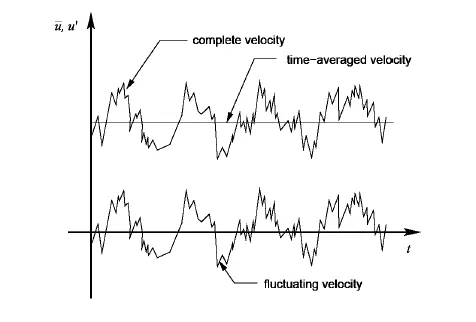
Now, inserting the above equation into the NS equation and averaging the result yields the RANS equation.
Governing equation for the boundary layer:
`(delu)/(delx)+(delv)/(dely)=0` continuity equation
`rho((delu)/(delt)+u(delu)/(delx)+v(delu)/dely)=-(delp)/(delx)+mu((del^2u)/(dely^2)+(del^2u)/(delx^2))`
momentum equation
- If we take origina; N.S equation and solve it over small time scale and if we have large number of computational cell, then we do not need turbulence model.
- So, wit the help of turbulence model we can capture the effect of turbulence with coarser grid and larger time step.
- Hence,we are taking the governing equation and integrating over a time that is much larger than turbulent time scale ,this is called averaging.
now , Reynolds decomposition follows:
`u(x,y,z,t)=baru(x,y,z)+u'(x,y,z,t)` similarly for V and W velocity components.
lets apply decomposition to continuity equation:
`del/(delx)(baru+u')+del/(dely)(barv+v')=0`
`1/t_iint_0^(t_i)(del/(delx)(baru+u')dt+1/t_iint_0^(t_i)del/(dely)(barv+v')dt=0`
`1/t_iintdel/(delx)barudt+1/t_iintdel/(delx)u'dt+1/t_iintdel/(dely)barvdt+1/t_iintdel/(dely)v'dt=0`
`1/t_iintdel/(delx)barudt+1/t_iintdel/(dely)barvdt=0`
`del/(delx)baru*(1/t_i)int_0^(t_i)dt+del/(dely)barv*(1/t_i)int_0^(t_i)dt=0`
`del/(delx)baru((t_i-0)/t_i)+del/(dely)barv((t_i-0)/(t_i))=0`
`del/(delx)baru+del/(dely)barv=0` time averaging velocity component satisfies the continuity equation.
Now momentum equation:
`rho{(delu)/(delt)+u*(delu)/(delx)+v*(delu)/(dely)}=-(delP)/(delx)+mu*(del^2u)/(dely^2)`
`(delu)/(delt)+u*(delu)/(delx)+v*(delu)/(dely)=(-delp)/(delx)+(mu/rho)*((del^2u)/(dely^2))`
`(delu)/(delt)+u*(delu)/(delx)+v*(delu)/(dely)+u((delu)/(delx)+(delv)/(dely))=(1/rho)(-delP)/(delx)+nu(del^2u)/(dely^2`
In this equation x component of velocity is multiplied by continuity equation.
Now rearranging the terms we get,
`(delu)/(delt)+u*(delu)/(delx)+v*(delu)/(dely)+u*(delu)/(delx)+u*(delv)/(dely)=-(1/rho)(delP)/(delx)+nu*(del^2u)/(dely^2)`
`(delu)/(delt)+((delu^2)/(delx))+del/(dely)(u*v)=-(1/rho)*(delp)/(delx)+nu(del^2u)/(dely^2)`
Now Reynolds decomposition follows:
`u=baru+u'`
`1/t_i*int_0^(t_i)(del/(delt)(baru+u')dt)+del/(dely)(baru+u')(barv+v')dt+del/(delx)(baru+u')^2dt=1/(t_i)int_0^(t_i){-del/(rhodelx)(barP+P')dt}+nudel^2/(dely^2)(baru+u')dt`
`1/(t_i)(int_0^(t_i)(delbaru)/(delt)dt+(delu')/(delt)dt+(delbaru^2)/(delx)dt+(delu'^2)/(delx)dt+(del((2*baru*u')/(delx))dt+(del)/(dely)(barubarv)dt+(del)/(dely)(baruv')dt+(del)/(dely)(u'barv)dt+(del)/(dely)(u'v')dt=1/(t_i)int_0^(t_i)(-1/(rho)*(delbarP)/(delx)dt-(1/rho)*(delP')/(delx)dt` +`nu(del^2baru)/(dely^2)dt+nu(del^2u')/(dely^2dt`
`(delbaru)/(delt)+(delbaru^2)/(delx)+(del)/(dely)(baru*barv)=-(1/rho)*(delbarP)/(delx)+nu*(del^2baru)/(dely^2)-(1/t_i)int_0^(t_i)(del)/(delx)(u'^2dt)-(1/t_i)int_0^(t_i)(del)/(dely)(u'v')dt`
since the velocity gradient in'x' direction is lower as compared to 'y' direction so, `1/(t_i)int_0^(t_i)(del)/(delx)(u')^(2)dt` tends to zero.
Therfore, `(delbaru)/(delt)+(delbaru^2)/(delx)+(delbarubarv)/(dely)=-1/(rho)(delbarP)/(delx)+nu*(del^2baru)/(dely^2)-(1/t_i)int_0^(t_i)(del(u'v'))/(dely)dt`
= `-(1/rho)*(delbarP)/(delx)+(1/rho)(del)/(dely)[nu*(delbaru)/(dely)-rho/t_iint_0^(t-i)(u'v')dt]`
pressure term Momentum diffusion
- The left hand side denotes the inertial term calculated based on average quantity.
- The right hand side denotes momentum diffusion i.e, combination of molecular viscosity(first term) and turbulent viscosity(2nd term).
- Turbulance modelling is all about capturing the time integral of (u'v')dt i.e, Reynolds stress.
In the viscous sub-layer the viscous term is much much greater than the inertial term and assuming insignificant pressure drop, dp/dx->0
we have the equation : `-1/(rho)*(delbarP)/(delx)+(1/rho)(del)/(dely)[nu*(delbaru)/(dely)-rho/t_iint_0^(t_i)(u'v')dt]`
`mu*(delbaru)/(dely)-rho/(t_i)int_0^(t_i)(u'v')dt=const.`
inside viscous sub-layer molecular viscosity dominates
- Whenwe are in outside the viscous sub-layer, generally turbulent viscosity dominates. so Reynolds stress is `tau_s` equal to
`tau_s=-rho/t_iint_0^(t_i)(u'v')dt` approx
- Generally the turbulent transfer of momentum by eddies giving rise to an internal fluid friction but taking place inmuch larger scale.
- Wheras the molecular viscosity is the transfer of momentum (motion) by random motions of individual molecules not moving together.