Week 8 - Challenge 1 - Draft Analysis on a Fan Cover
Draft Analysis for Fan Cover Process:
1.The first step in creating the tooling axis is making sure the Class A surface is well connected.
Since the provided Class A surface was not one part I used the Join operation to join all the different surfaces.
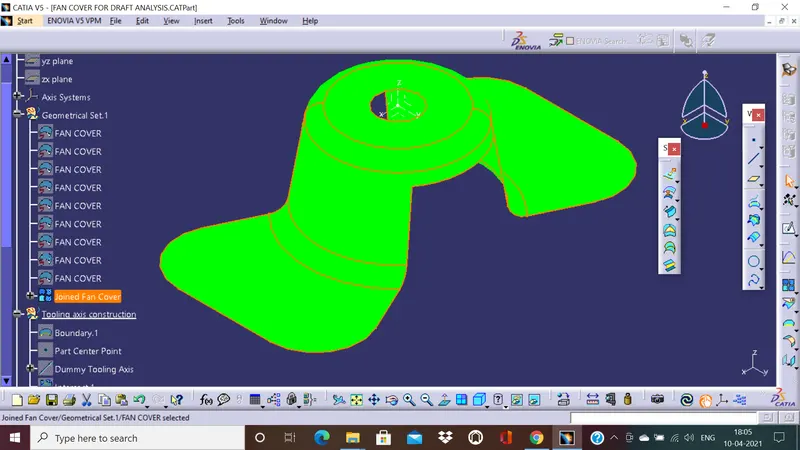
2.I then inserted a new geometry to create the "Tooling axis construction" geometry set.
3.Next I created a Boundary from the joined operation and using the boundary I created a point from the center hole and used the point as the Part Center point. Since the part is symmetric it was easy to locate a point that would equally divide the part.
4.The objective of selecting a tooling axis is to reduce the need for a side core and for performing draft analysis in the direction of the tooling axis. By using the Part center point a new axis system is created.
5.X-Y-Z directions are checked for smooth ejection of the part from the molds. The center hole and side cuts on the fan cover do not allow for smooth ejection in the X and Y directions. Hence the Z-axis is chosen as the ideal direction of movement for the molds.
6.A dummy line along the Z-axis is created for visualization of the estimated tooling axis.
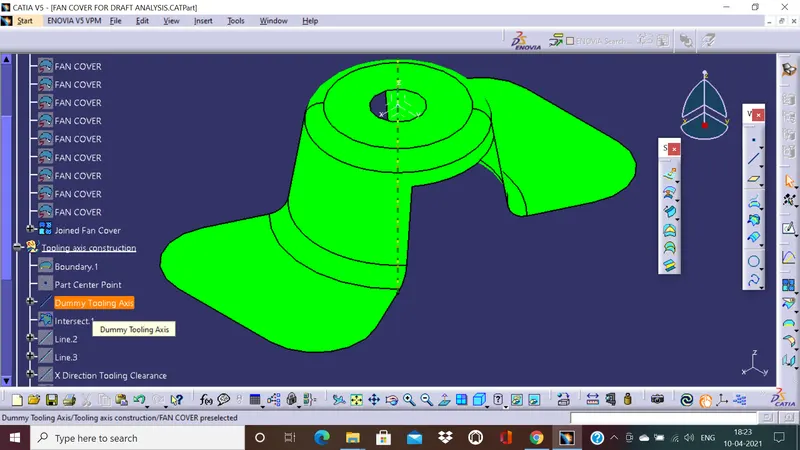
7. Using the Intersect operation, the joined fan cover and ZX plane intersect to form the projected geometry on the ZX plane.
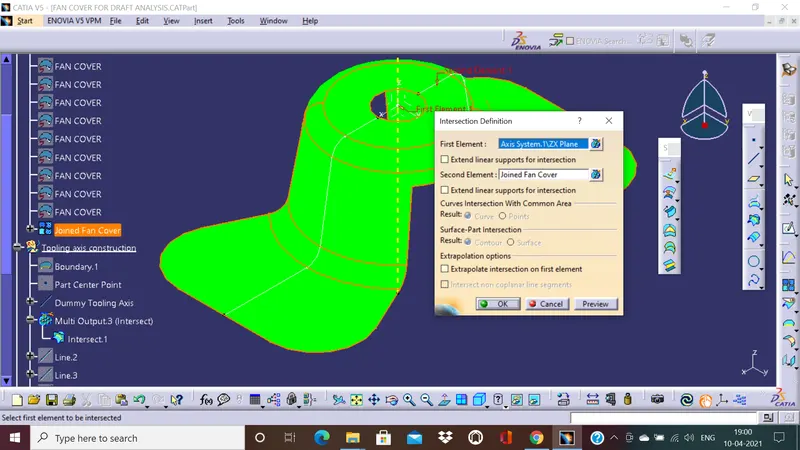
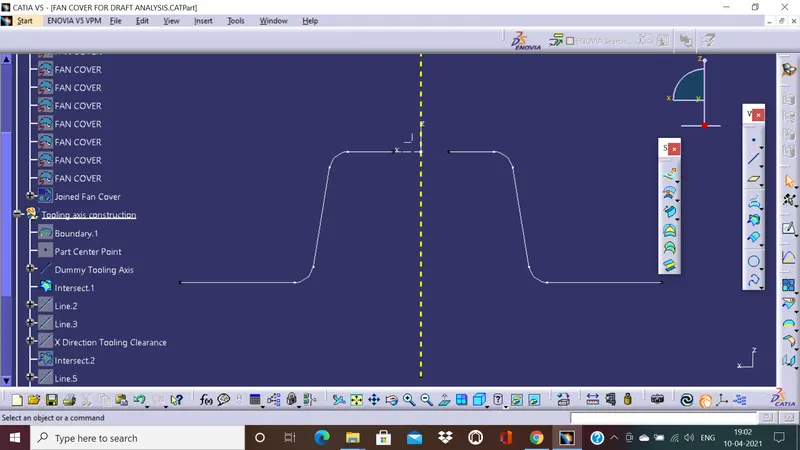
8: Now we inspect the line elements formed and use point-point line type to extend the points that form lines that are almost parallel to the dummy axis line. Two such lines exist and they will be used to create extended new lines.
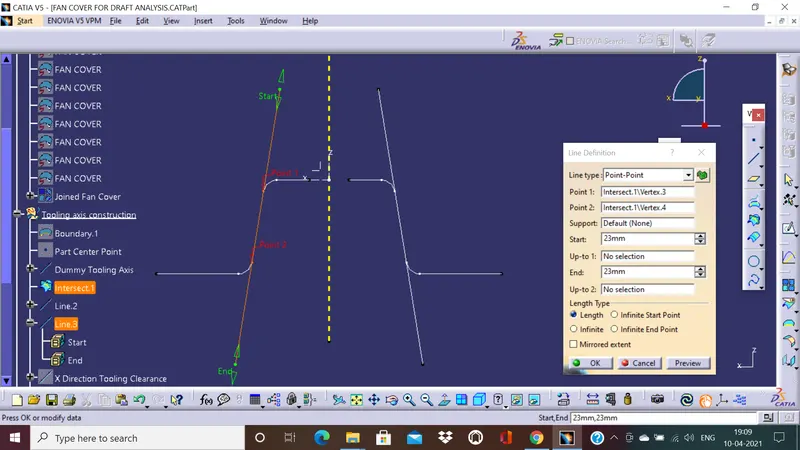
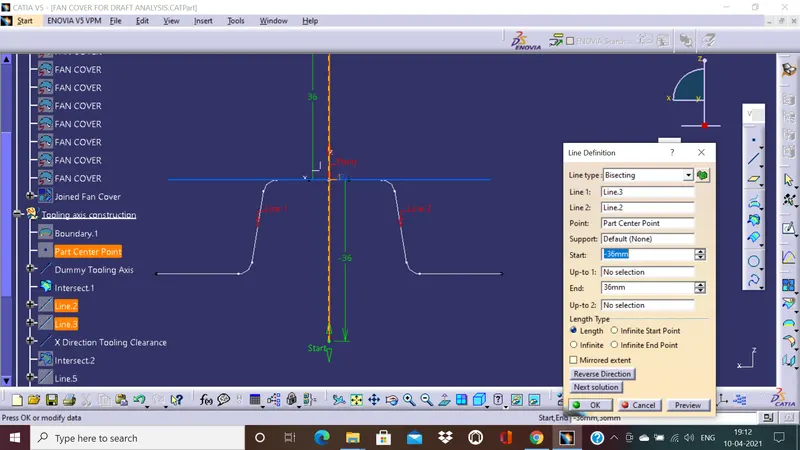
9: Now we bisect the two formed lines using the Part center point to form the X-Direction tooling axis line.
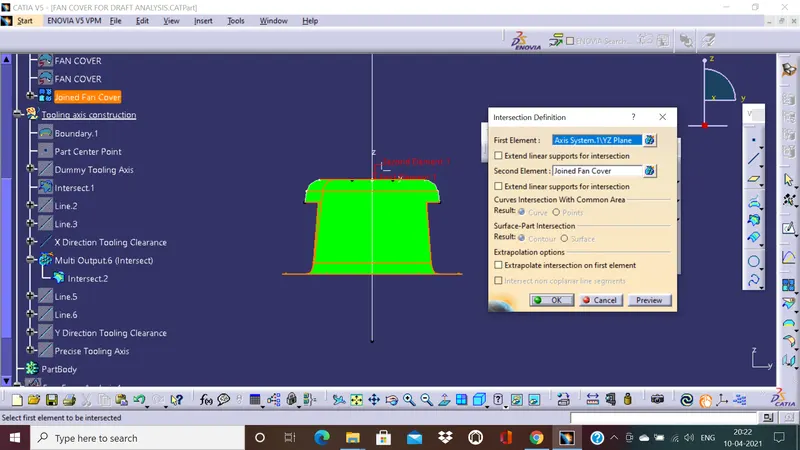
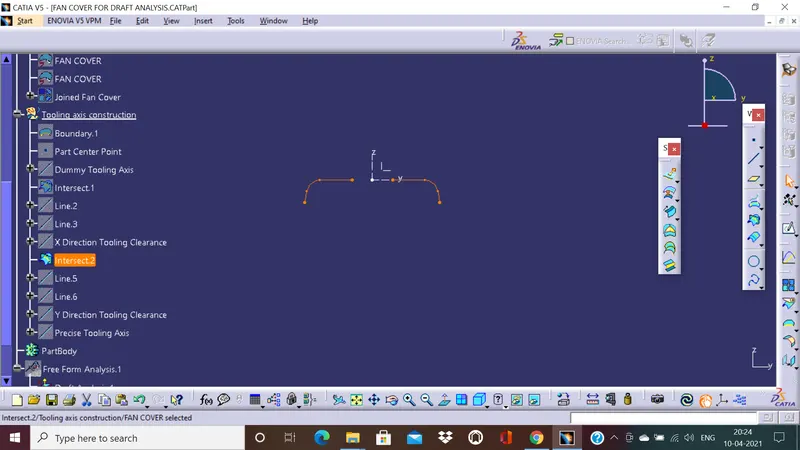
10: We repeat steps 7 to 9 to create the Y-Direction tooling clearing-axis line. For the Y direction we use the YZ plane for intersection with the joined fan cover.
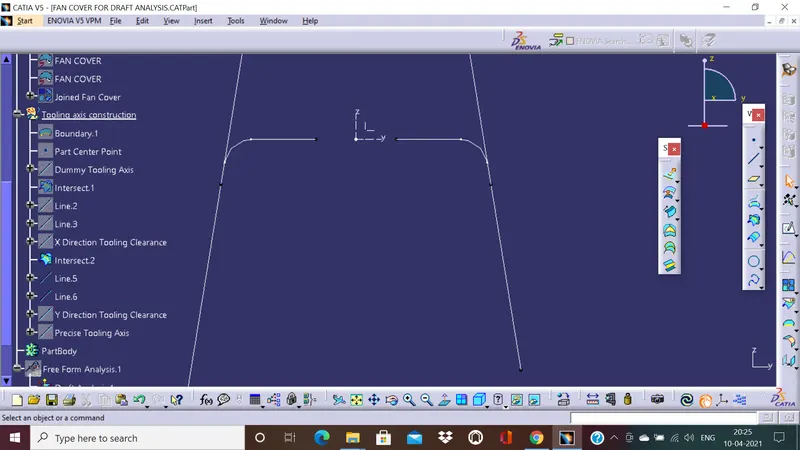
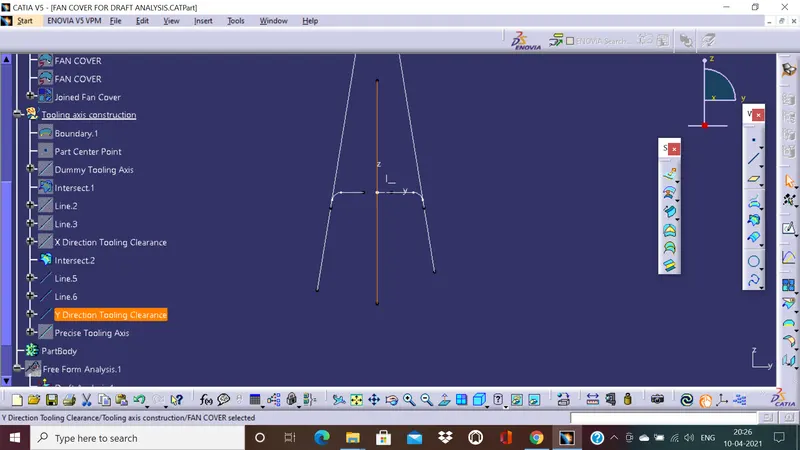
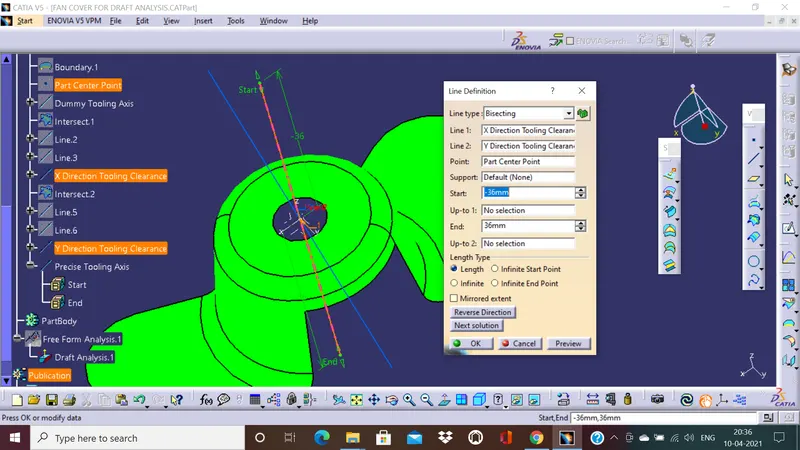
9: Now we are in a position to form the precise tooling axis. Bisecting the X and Y Direction tooling clearance lines, we form the Precise tooling axis of the part. The part center point is also used to locate the line.
Draft analyses:
The joined fan cover and the tooling axis are published. The viewing mode is set to customize and the shading is switched to materials
We go to draft feature analysis and lock the compass on the Precise tooling axis. We can then check for interference according to the limits we set.
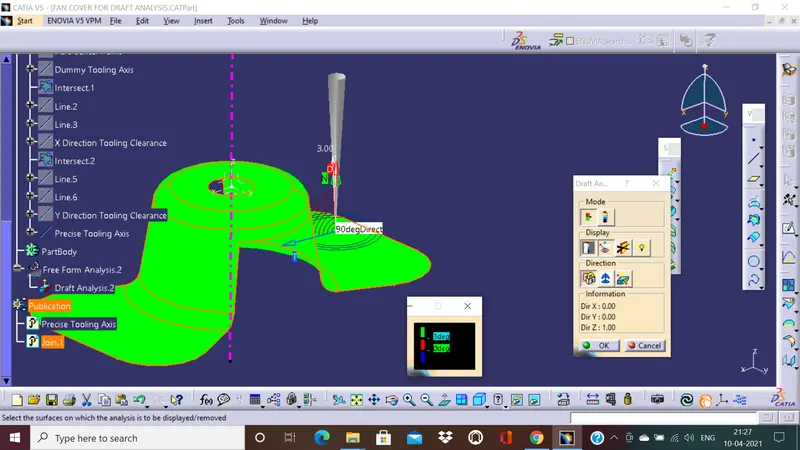
Using Full draft mode we see the color codes of the analysis.
From the color table we see the draft angle range as follows:
0 to 3 degrees - Green color; 0 to -3 degrees - Yellow color
3 to 20 degrees - Cyan color; -3 to -20 degrees - Blue color
20 to 90 degrees - Red color; -20 to -90 degrees - Red color
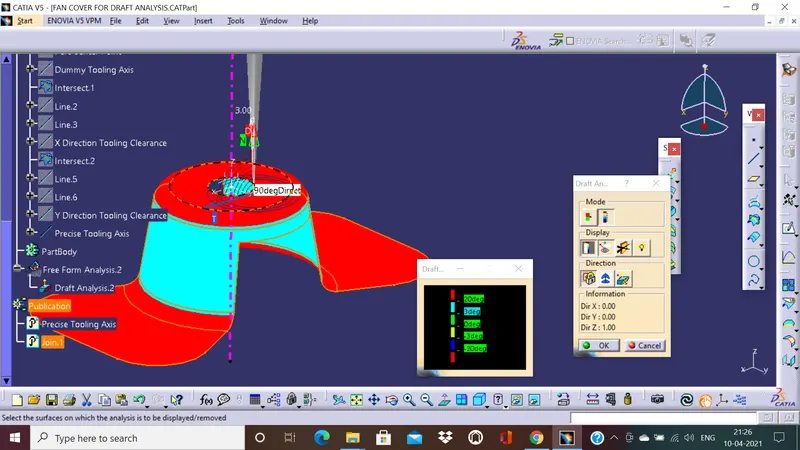
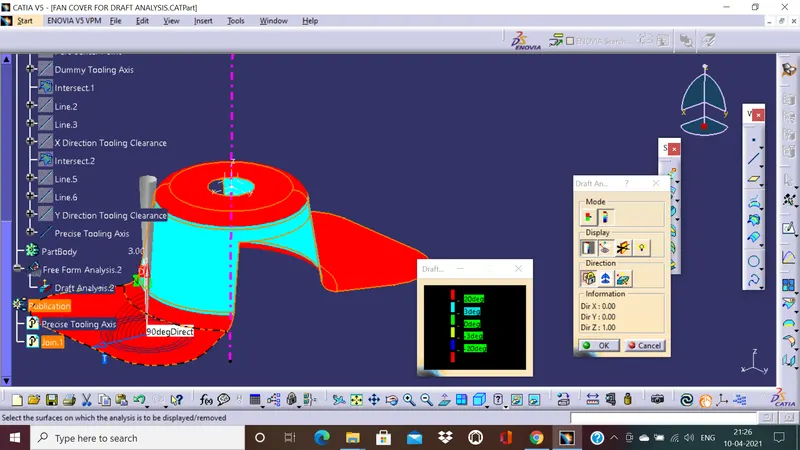
At the top and bottom flat faces, the draft angle is 90 degrees depicted in red color.
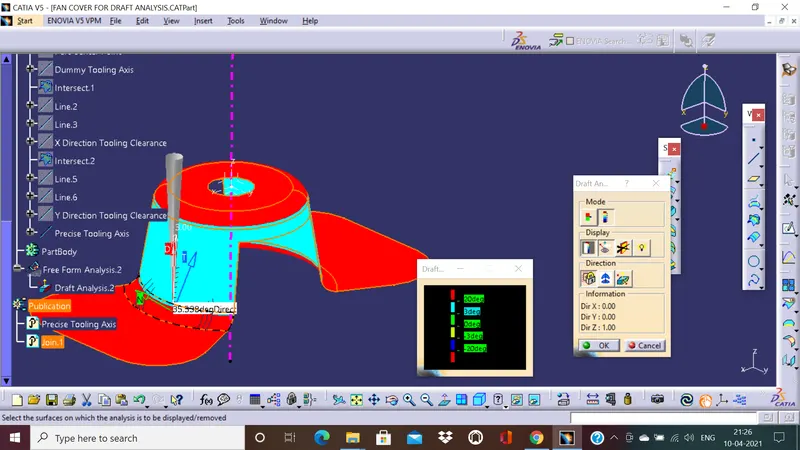
Near the fillet, the draft angle is at the 35 to 50 degrees angle range and still in red color.
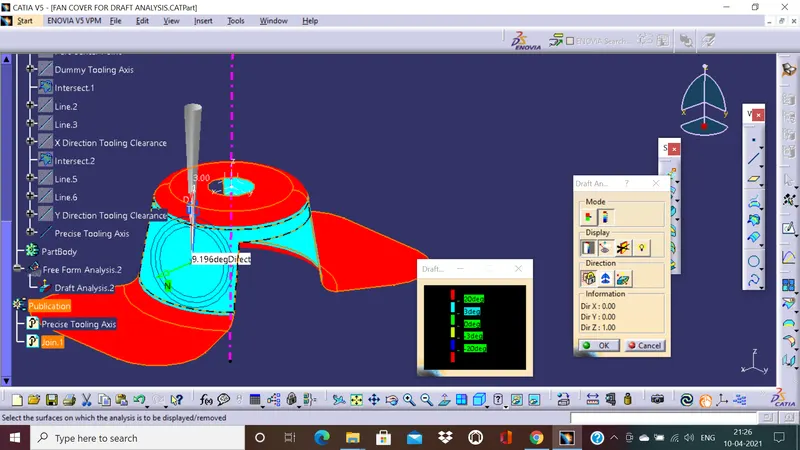
At the surface pointed out by the running point, the draft angle is 9.196 ~ 9 degrees, and therefore it is in the cyan color.
This was the only surface where the draft angle was the least, however, it is much more than 3 degrees so we can say the part can be molded.
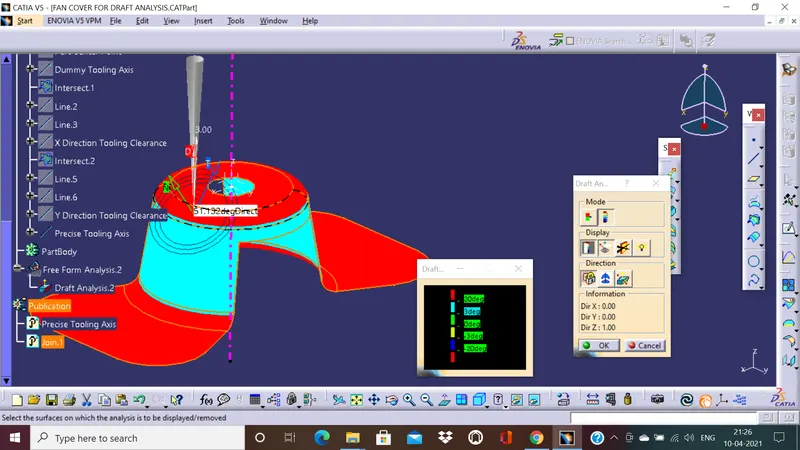
The top fillet draft angle is between 50 and 55 degrees so there should be no issues here.
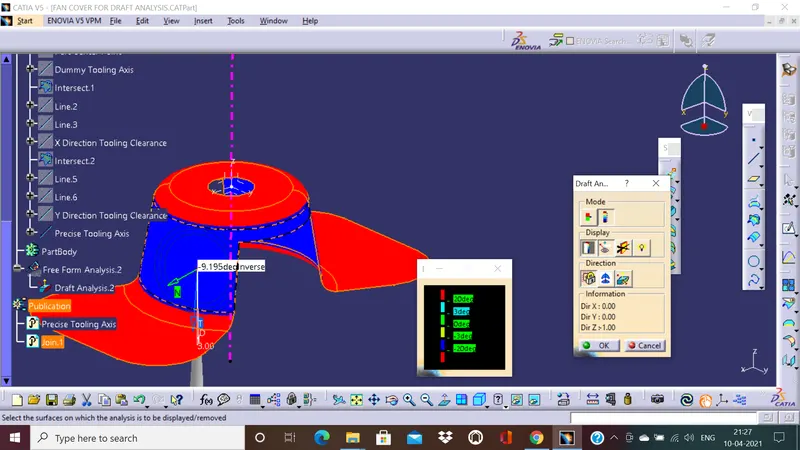
If we reverse the draft direction, we get the same results but in the negative degrees. This is shown in the screenshot below.
Different views of the part all clearing the 3-degree minimum draft angle.
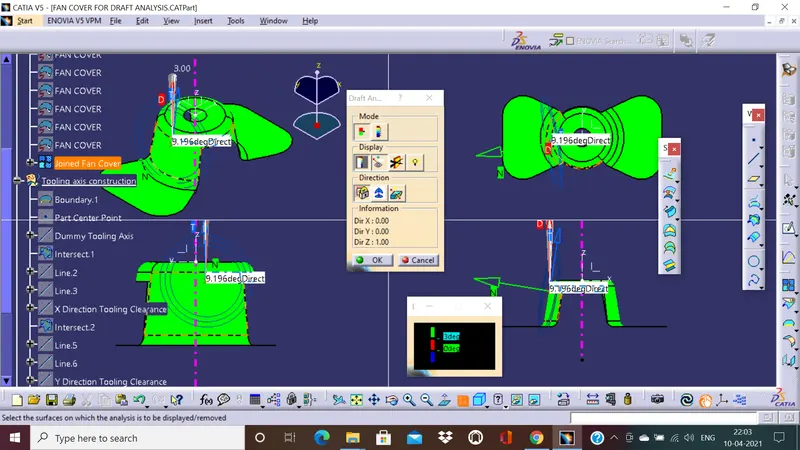
For this analysis, I have set the minimum draft angle to 3 degrees from the tooling axis. The minimum draft angle recorded on the part is around 9 degrees, so it has cleared the requirement.
It can therefore be manufactured using molds that use the same axis as the tooling axis created while designing the part.
Please see the attached cat part in the zipped file.
Thank you.