Week 8 - Challenge 1 - Draft Analysis on a Fan Cover
AIM:
To Create the tooling axis for the given Fan cover model meeting the requirements of the draft angle and perform the Draft analysis on the model of Class-A surface.
Objective:
If you're designing a product that will be manufactured using injection molding, use the Draft Analysis tool to analyze the draft angle. This allows you to verify whether the product will be easily removed from the mold, or if you will need to correct the draft to facilitate mold release.
1. What is a draft angle.?
When designing a product to be injection molded, the sides of the object should not be parallel to the pull direction (the direction in which the mold is pulled away from the object). Rather, any parallel sides need to be angled slightly so that the mold can be pulled away from the object easily, without deformation or damage. This slight angle is called draft. The deeper the mold, the more draft needed.
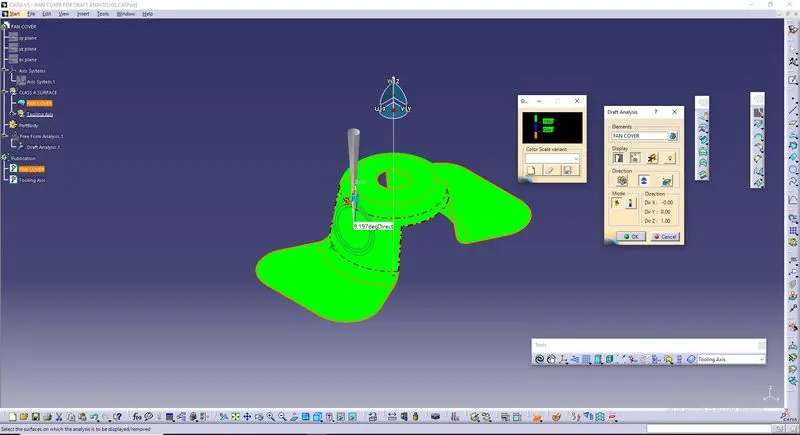
2. What is Draft Analyis.?
The Draft Analysis command enables you to detect if the part you drafted will be easily removed. This type of analysis is performed based on color ranges identifying zones on the analyzed element where the deviation from the draft direction at any point, corresponds to specified values.
3. Tooling Axis:
Tooling Axis is the direction in which the mold opens and closes. Part drafts are given along that axis.
4. Class-A Surface:
In automotive design, a class A surface is any of a set of freedom surfaces of high efficiency and quality. Although, strictly, it is nothing more than saying the surfaces have curvature and tangency alignment – to ideal aesthetical reflection quality, many people interpret class A surfaces to have curvature continuity to one another.
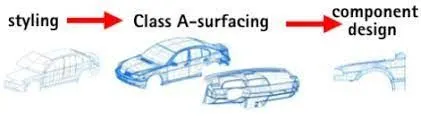
Procedure of the Draft Analysis On Fan Cover:
Step.1:- Design check on Class-A Surface
- After receiving the Class A surface for the fan cover checks for the connectivity of the surfaces on it. use join operation, boundary operation and disassemble. the check is over if any discontinuities do not arise. Delete the operations after the check.
Step.2:- Determine the Tooling Axis:
- Create a Dummy Tooling axis along the best possible direction as per the Class A as shown in Figure. In this case I have chosen the Z-axis dummy as it doesn't interfere with any slots or holes.
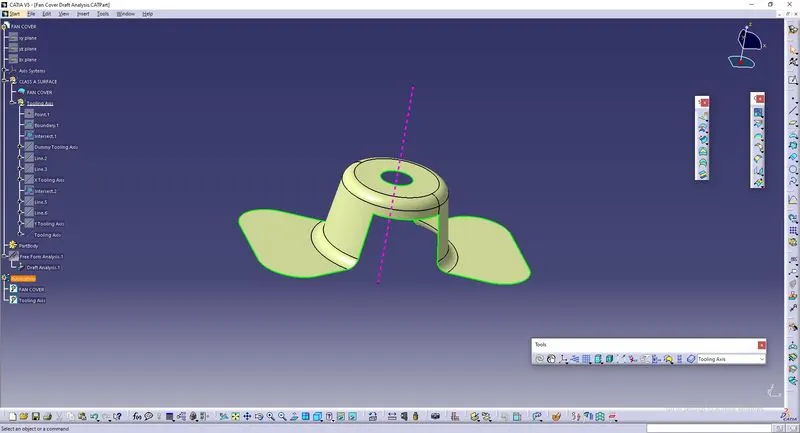
Fig:Dummy Tooling Axis on Class A of Fan Covere
- Create an axis system in this line and a suitable point as shown in the figure.
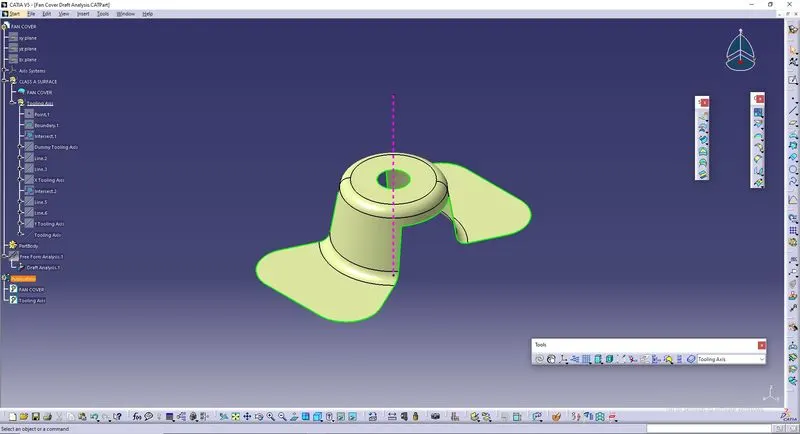
Fig:Axis System on Class A of Fan cover
- Create an intersection between the two planes and the Class A surface i.e.The XZ and YZ plane intersect with the fan cover as shown in the figures below.
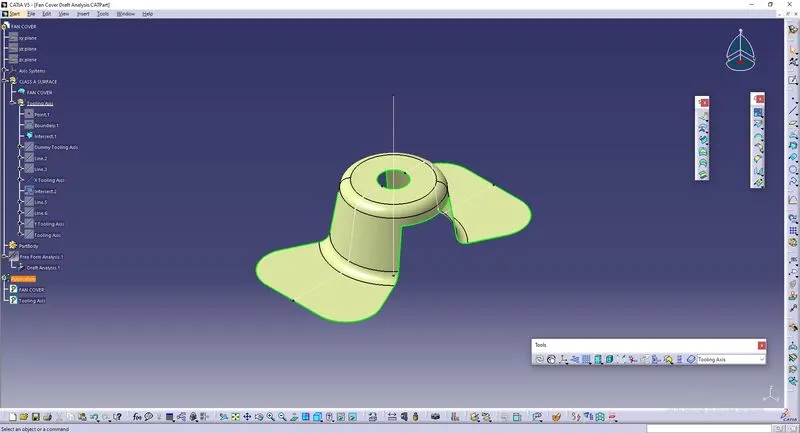
Fig: Intersection of XZ plane With Class A of Fan Cover
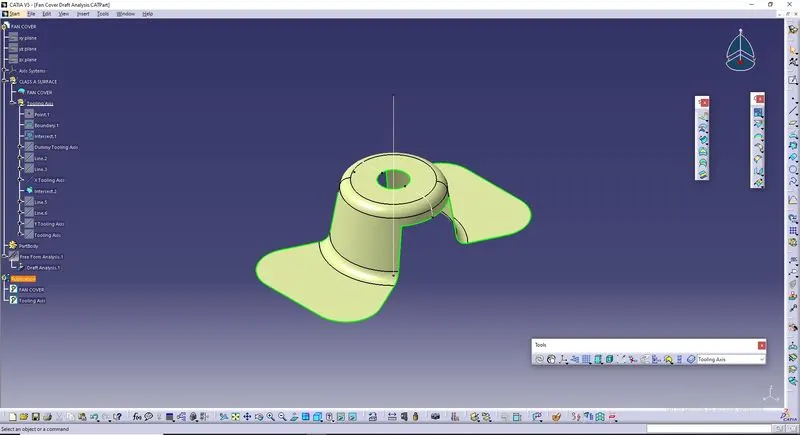
Fig: Intersection of YZ plane With Class A of Fan Cover
- Create extended lines for the faces which may create problems in terms of draft angles. In this Case the lines are created for each intersection as shown in below figures.
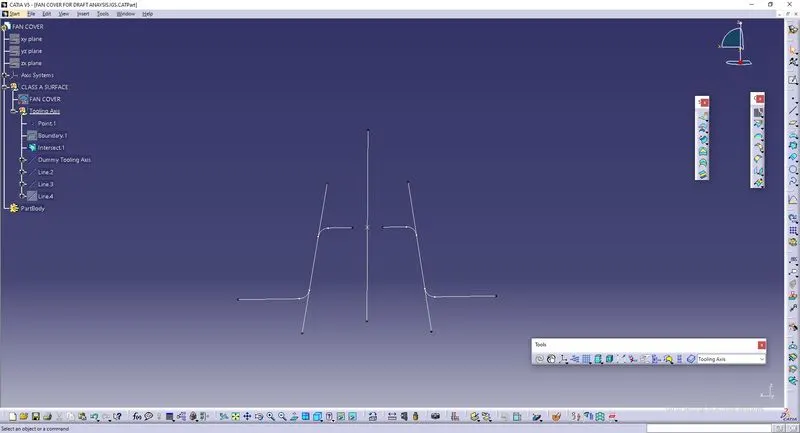
Fig: Extended Lines For Faces On XZ Plane
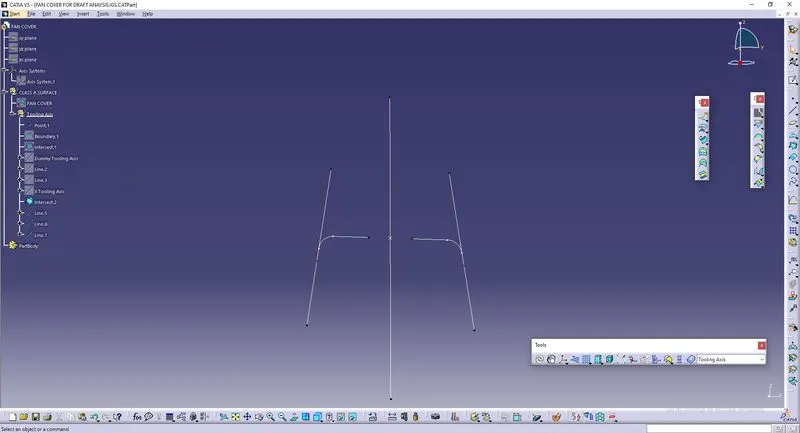
Fig: Extended Lines For Faces On YZ Plane
- Create a bisecting line for the extended line along the center point on both the planes and name it as tool clearing X and tool clearing Y as shown in below figures.
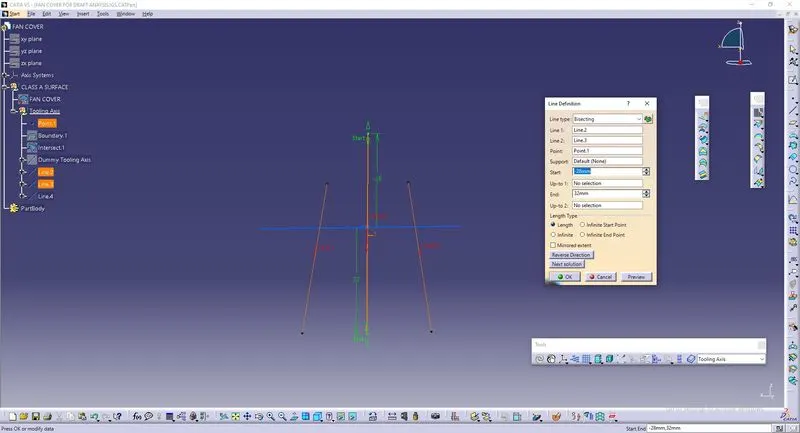
Fig: Tool Clearing For X
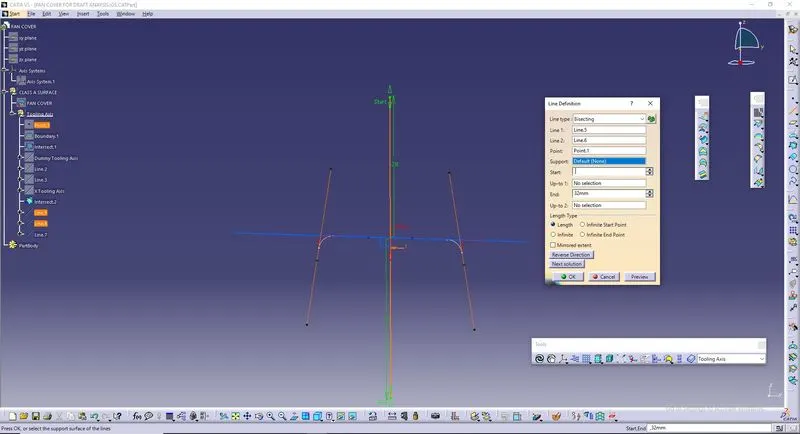
Fig: Tool Clearing For Y
- Create a bisecting line between tool clearing for X and Tool Clearing for Y along The Center Point. This is the main Tooling Axis Required. Name it as Tooling axis and publish it using--publication.
Fig: Tooling Axis and its Publication.
Step.3:- Performing Draft Analysis:
- Change the view mode customization to material mode as shown in figure.
Fig:Material Mode.
- Go to INSERT---ANALYSIS---FEATURE DRAFT ANALYSIS and move the compass to the tooling axis. Change the range to 3degrees. Apply the settings as shown in figure.
Fig: Draft Analysis on fan Cover
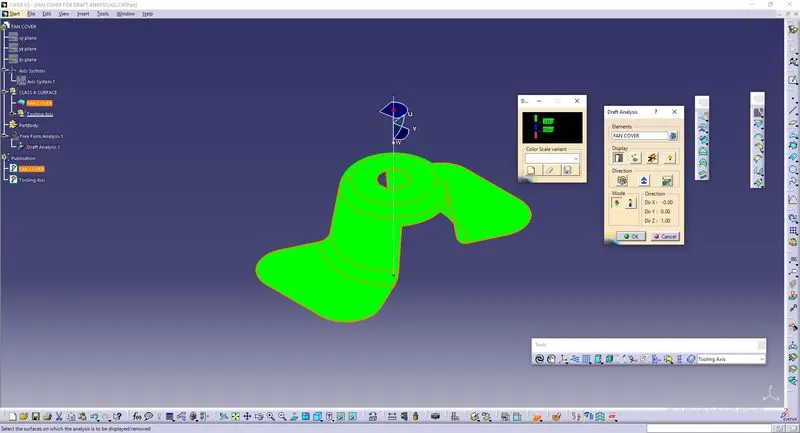
- Screenshots of the model with the proper color code of the draft angle in various orientations (Isometric, Front, Side, and Top View)
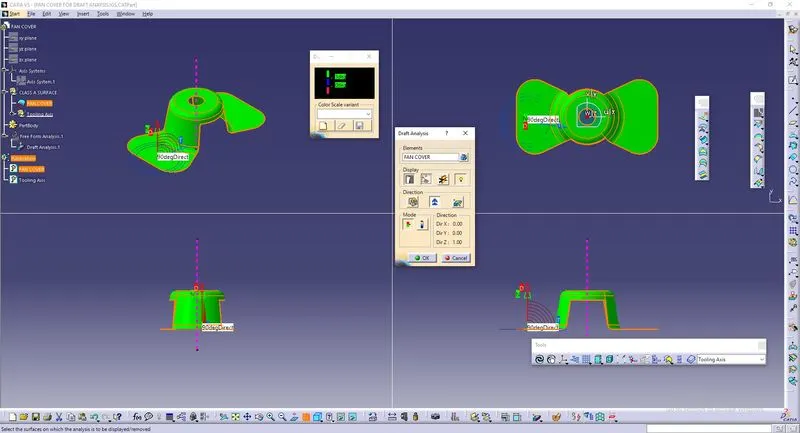
CONCLUSION:- Green colour indicated the draft angles are all having permissible values and the draft analysis status for the fan cover is passed.