Week 7 State of charge estimation
1.Simulate the 3 test cases from harness dashboard and write a detailed report on the results
2.What is coulomb counting? Refer to the above model and explain how BMS implements coulomb counting for SOC estimation ?
to simulate the 3 test conditions from harness dashboard and to explain how BMS implements coulomb counting is as given below:
1: Simulate the 3 test cases from harness dashboard and write a detailed report on the results.
The Closed Loop Harness Dashboard model by Mathworks is as shown below.
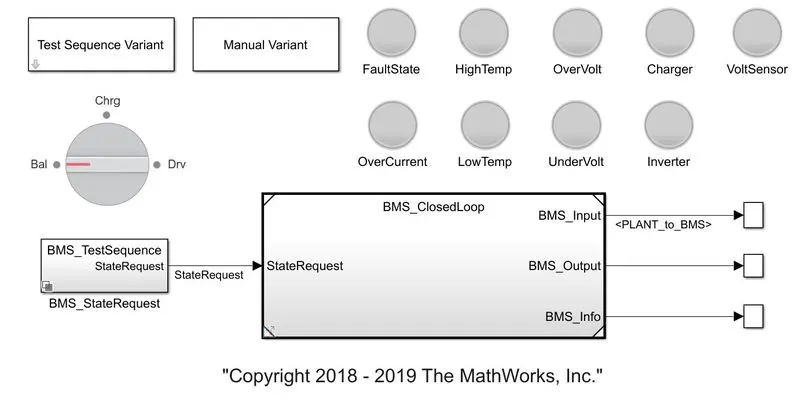
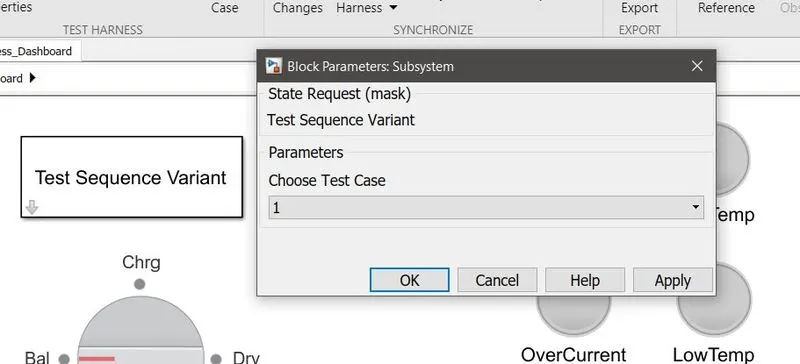
To select one of the 3 test conditions, it can be selected via the Test Sequence Variant block which allows you to select which test needs to be simulated. The first variant was selected initially for the simulation which can be seen below.
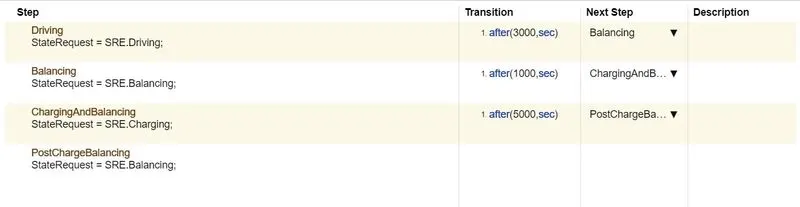
As we look at the test variant as shown below, it states that at the start of the simulation the model will be in the driving condition, thereafter, after 3000 seconds it will be in balancing mode, after 1000 seconds it will be in charging and balancing mode and after 5000 seconds it will be in post charge balancing mode.
After simulating the model for 20000 seconds as given default.
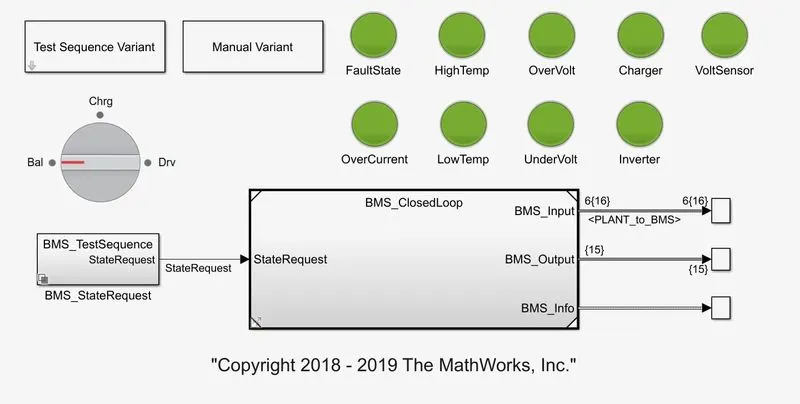
Here we can see all the lights have turned green as there is no fault or errors in the model.
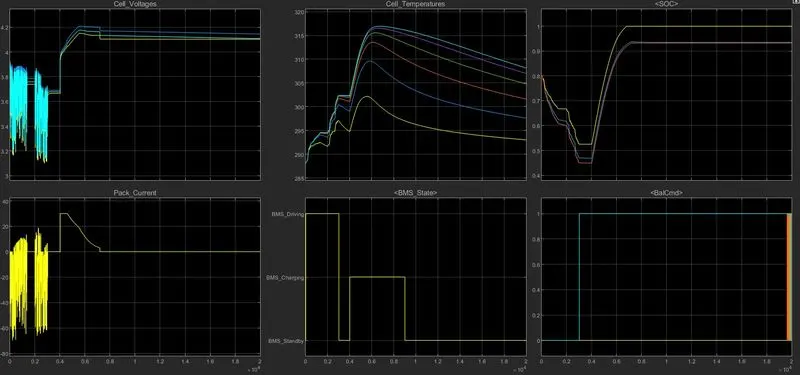
It can be observed from the plot that the vehicle is initially in the driving state and charging was done till 90%. After the charging mode it reaches to the standby mode which can be seen from the BMS state plot. From the Cell temperatures plot it is observed that the battery temperature rises in driving and charging. The battery voltage was increased to 4.2 V while charging. The current plot shows the current value supplied to the vehicle while driving. The SOC was observed to be decreased around 50% in driving condition, which increased while charging.
Coming to the second variant condition to simulate.
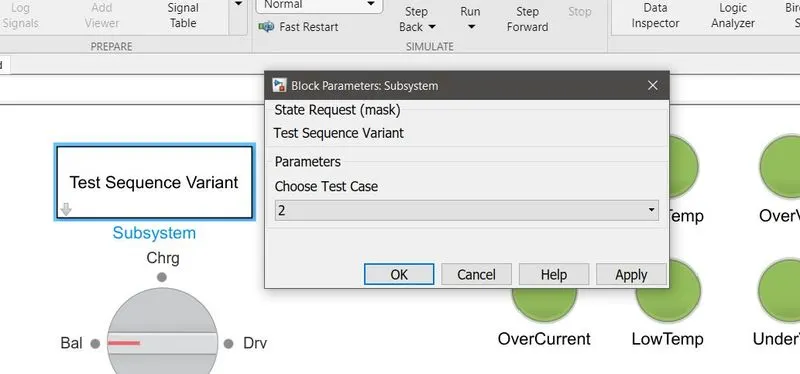
The second variant simulates the below shown conditions.
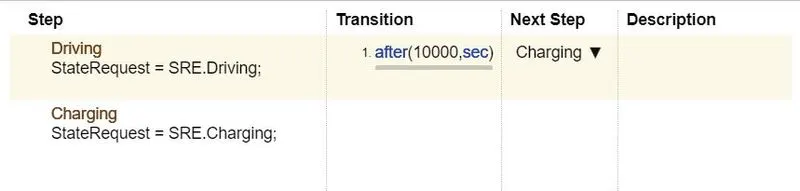
Initially it is the driving condition and after 10000 seconds there is charging condition.
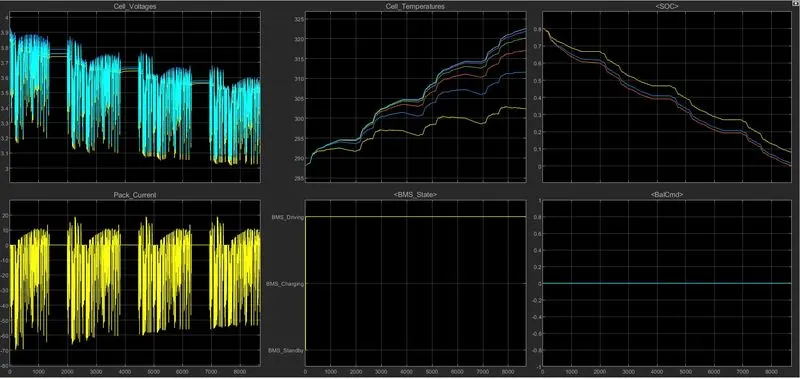
It was observed from the plot that the battery discharges completely in 8692 seconds and the vehicle does not go forward and the charging state was not achieved at 10000 seconds. Hence the vehicle comes to standby condition and simulation stops midway.
Coming to the third condition.
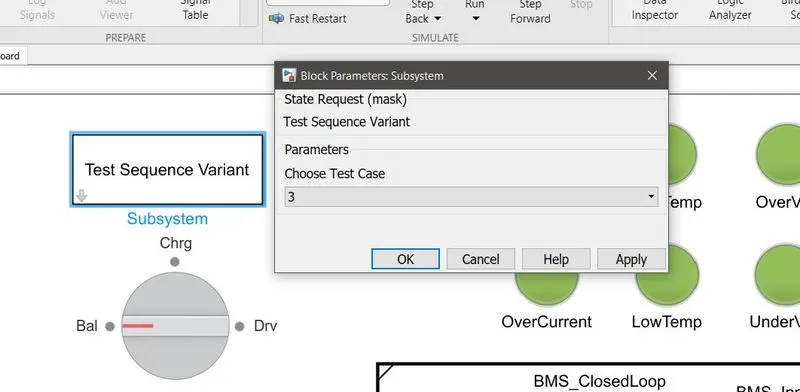
Looking at the condition below for third variant of the simulation. It is just the continuous charging condition from the start till the end of 20000 seconds of simulation.

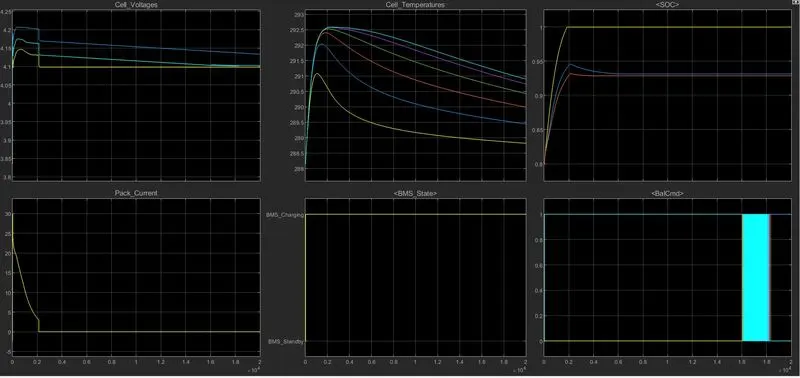
Looking at the plot it can be seen that the battery starts charging and the SOC starts increasing from beginning to around 2000 seconds and stays stable at 100% continuously from 2000 seconds until 20000 seconds. The peak current plot drops from 0 to 2000 seconds and stays constant as the charge is not used anywhere as the driving is not present.
From the above simulated 3 variants of the simulation carried out it was observed that,
- In the first simulation all three conditions were simulated such as driving charging and the stable state hence the charging and discharging were observed and in the end the constant 100% SOC was observed because of the standby state of the vehicle.
- In the second simulation it was just the discharging as the SOC dropped to 0% in the driving state within 8600 seconds and the charging state was not achieved at 10000 seconds.
- In the third simulation, only charging was observed for the first 2000 seconds and the SOC remained at 100% constant for the next 18000 seconds.
2:-What is coulomb counting? Refer to the above model and explain how BMS implements coulomb counting for SOC estimation ?
coulomb counting:-
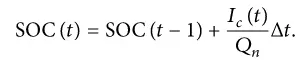
The Coulomb counting method measures the discharging current of a battery and integrates the discharging current over time in order to estimate SOC . Coulomb counting method is done to estimate the , which is estimated from the discharging current, , and previously estimated SOC values, . SOC is calculated by the following equation:

But there are several factors that affect the accuracy of Coulomb counting method including temperature, battery history, discharge current, and cycle life.
As the name suggests, this method is aimed at calculating coulombs or the quantity of electric charge, which is derived from current multiplied by the time necessary for the charge to flow. To measure the remaining capacity or SOC of a battery, you can add coulombs to the initial capacity in case of charging or take them away when you discharge the battery.
Current integration is a widespread method, but its accuracy depends on some factors. First off, you should know the correct measure of the initial SOC that serves as a reference point. You can get this by fully charging or discharging a battery. So if you want to use this technique, you need to allow for regular resetting of the battery SOC to 100% in your BMS design.
Another important condition for the accurate state-of-charge estimation with coulomb counting is the correct current measurement. You can achieve this by increasing the amplitude and time resolution of an analog-to-digital converter (ADC) in your current sensor. However, this can add to the sensor’s cost, so in most cases, BMS designers use inexpensive ADCs with 14- and 16-bit resolution and average measured data afterwards. Then, engineers process data by applying more advanced estimators, such as Kalman filtering or neural networks.
If you’re able to provide the conditions necessary for the efficient use of the current integration method, you can reach high accuracy in your SOC calculation. But this practice will not be reliable if you cannot regularly charge or discharge the battery to the full or if the current value is incorrect.
Coulomb counting is a widespread method that can help you reach high accuracy in the SOC calculation provided that you’re able to fully charge or discharge the battery and correctly measure the current.

The application of a single SOC estimation approach is rarely found in present-day battery management systems. To improve your calculations, you can put different techniques together using so-called hybrid methods. For example, combined with fuzzy logic or Kalman filtering, coulomb counting can better measure accuracy than the current integration method alone.
Present-day battery management systems rarely apply a single SOC estimation method. Putting different techniques together can improve your calculations and increase measuring accuracy
Modified Coulomb Counting Method
To improve the Coulomb counting method, a new technique called modified Coulomb counting method is proposed. The modified Coulomb counting method uses the corrected current to improve the accuracy of estimation.
The corrected current is the function of discharging current. There is a quadratic relationship between the corrected current and discharging current of battery. By practice of experimental data, corrected current is calculated by the following form:

where k2,k1andk0">k2,k1and k0 are constant values obtained from the practice experimental data.
In modified Coulomb counting method, SOC is calculated by the following equation:
The experimental results show that the accuracy of the modified Coulomb counting method is superior to the conventional Coulomb counting method.
But there are several factors that affect the accuracy of Coulomb counting method including temperature, battery history, discharge current, and cycle life .
For example we can look into the project file we downloaded. A BMS system in the file is represented below.
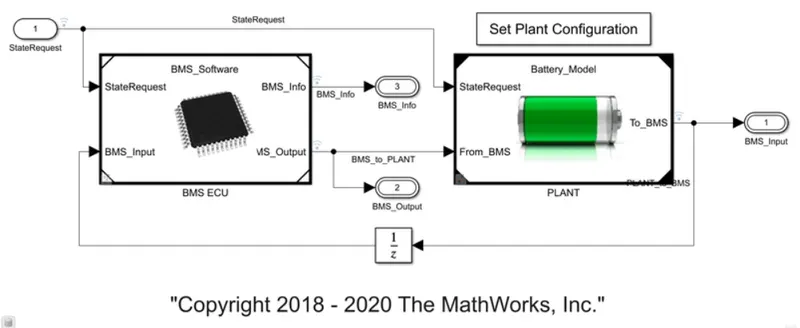
BMS algorithm models , protects , reports the measurement from battery pack.
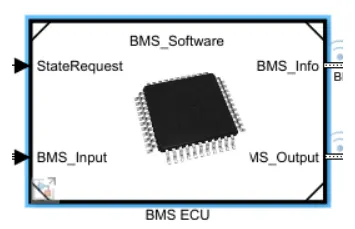
By Clicking on the BMS ECU we get the Subsystem
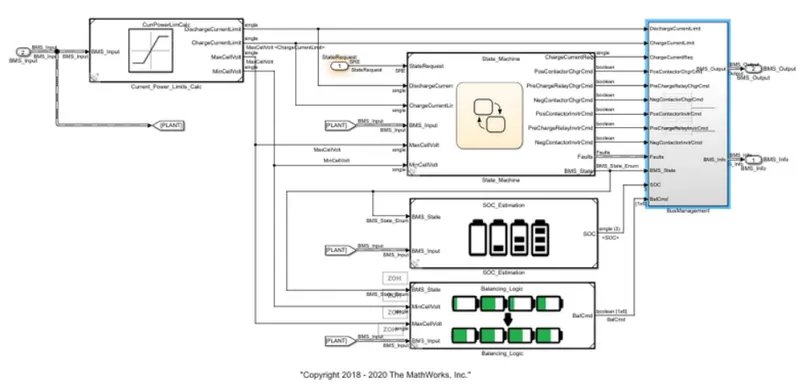
By clicking on the SOC estimation block we get
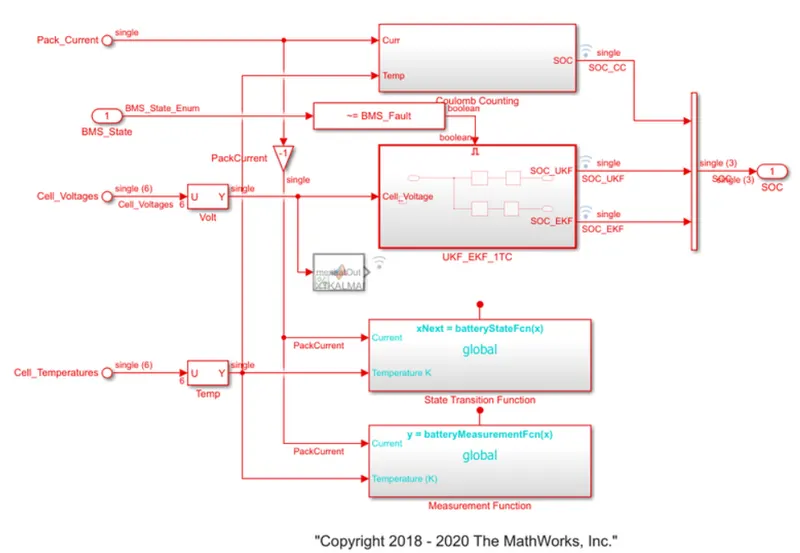
From above figure we observe the Coulomb Counting block.
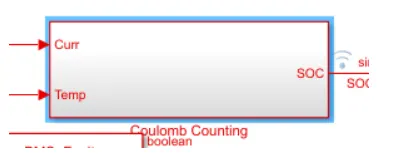
A subsystem opens when we click on the Coulomb Counting
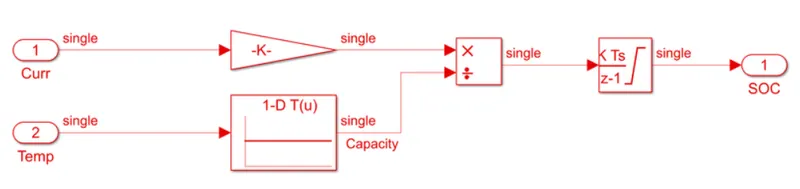
- This system does the estimation by coulomb counting equation mentioned above.
- Advantage of coulomb counting method is its simplicity and low computational cost.
- Temperature and current from the battery is given as inputs.
- Current signal is given to a gain block and temperature is given to capacity since it varies according to temperature.
Conclusion
These methods have good performances at fixed discharging current condition, while others perform better in varied discharging current condition. It is difficult to evaluate the performance of various methods, as the existing applications were in different discharging condition and different size of battery. The developments of various SOC estimate methods are expected to be valuable in battery applications such as BMS in hybrid electric vehicles. Based on the development history of SOC estimation, the future development directions of SOC estimating are proposed in the end