Project - Analysis of a practical automotive wiring circuit
1 .Identify each of the major elements in the above automotive wiring diagram.
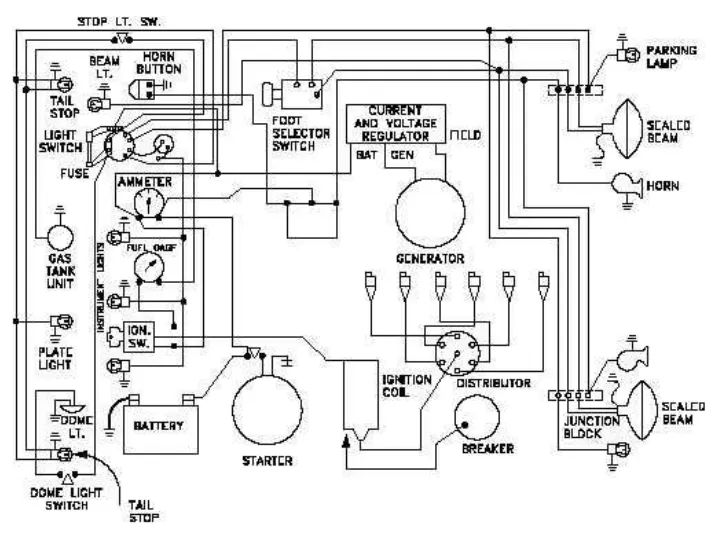
The major element in the above wiring circuit diagram are
- Generator
- Battery
- Starter
- Breaker
- Distributor
- Junction block
- Fuse
- Ammeter
- Horn Button
Foot Selector Switch.
2. Explain the purpose and working of any three elements briefly.
Battery-
purpose-Batteries are small essential components to operate many devices. It is one of the key components in our day-to-day life. Some batteries are rechargeable batteries and are used in each and every sector. Below are some of the applications of batteries.
- Automotive
- House
- Health Instruments
- Medical
- Logistics and construction
- Firefighting and Emergency
- Military
Electric Vehicle Battery is commonly used in vehicles. This battery is used to power the electric motors of electric vehicles. The batteries of electric vehicles are usually rechargeable. Generally, lithium-ion batteries are used in electric vehicles.
working-
- A battery is a device that stores chemical energy and converts it to electrical energy.
- The chemical reactions in a battery involve the flow of electrons from one material(electrode) to another, through an external circuit.
- The flow of electrons provides an electric current that can be used to do work.
- To balance the flow of electrons, charged ions also flow through an electrolyte solution that is in contact with both electrodes.
- Different electrodes and electrolytes produce different chemical reactions that affect how the battery works, how much energy it can store and its voltage.
Ammeter:
Ammeter, instrument for measuring either direct (DC) or alternating (AC) electric current in amperes. An ammeter can measure a wide range of current values because at high values only a small portion of the current is directed through the meter mechanism; a shunt in parallel with the meter carries the major portion.
Working
Digital ammeter designs use a shunt resistor to produce a calibrated voltage proportional to the current flowing. This voltage is then measured by a digital voltmeter, through use of an analog-to-digital converter (ADC); the digital display is calibrated to display the current through the shunt.
Generator-
Generator is also called a dynamo, it converts mechanical energy into electricity for transmission and distribution over power lines to domestic, commercial, and industrial customers. Generators also produce the electrical power required for
- automobiles
- aircraft
- ships
- trains
Working-
Generators don’t actually create electricity. Instead, they convert mechanical or chemical energy into electrical energy. They do this by capturing the power of motion and turning it into electrical energy by forcing electrons from the external source through an electrical circuit. A generator is essentially an electric motor working in reverse.
Some electrical generators, such as those at Hoover Dam, for example, are huge and provide enormous amounts of energy by transferring the power created by water turning turbines into electricity. Residential and commercial generators however are much smaller and rely on more traditional fuel sources like diesel, gas, and propane to create mechanical power that can then be forced into a circuit and induce an electrical current.
Fuse-
purpose-
The fuse breaks the circuit if a fault in an appliance causes too much current to flow. This protects the wiring and the appliance if something goes wrong. The fuse contains a piece of wire that melts easily. If the current going through the fuse is too great the wire heats up until it melts and breaks the circuit
- Acts as a barrier between the electric circuit and the human body
- Prevents device failure due to faulty circuit operation
- The fuse prevents short circuits
- Prevents overload and blackouts
- Prevents damage that is caused due to mismatched loads
The markings on the fuse carry information such as the Ampere rating, voltage rating, and interruption rating.
Working-
The fuses work on the principle of the heating effect of the current. It’s made up of thin strip or strand of metallic wire with noncombustible material. This is connected between the ends of the terminals. Fuse is always connected in series with the electrical circuit.
When the excessive current or heat is generated due to heavy current flows in the circuit, the fuse melts down due to the low melting point of the element and it opens the circuit. The fuse can be made up of the element like zinc, copper, silver &aluminum. They also act as a circuit breaker which is used to break the circuit when the sudden fault occurs in the circuit. This is not only a protector but it is also used as a safety measure to prevent humans from hazards. So this is how the fuse operates.
3. If the total load is 10A from battery, what should be the fuse rating?
Given data: load = 10A
power = voltage x current
(for typical car battery voltage is 12V)
power = 12 x 10 = 120 Watts
fuse rating is 25% more than actual power rating
power for fuse rating = 120 x 1.25 = 150Watts
I = P/V = 150/12 = 12.5A
I = 12.5A
4. If 500W is the load, what is the voltage and capacity of battery you recommend?
Power = Voltage x current
( for recommended voltage is 12V)
500 = 12 x current
current = 500/12 =41.67A
capacity = current x time
capacity = 41.67 x 1 hr = 41.67 Ah
capacity of battery = 41.67 Ah
5.Identify any two elements which are connected parallel to each other. Why they are connected in parallel?
- Generator
- Current and voltage
Asper the above image Generator with current voltage and regulaterare connected in parallelif two are more components are connected in parallelthe have the same differential of potential voltage across their ends.
6. Identify any two elements which are connected in series. Why they are connected in series?
- Battery
- Starter
as per the above image battery and starter are in series to each other because same current flows throw them.