Week 7 State of charge estimation
1. AIM
- What is coulomb counting?
- How BMS implements coulomb counting for SOC estimation?
2. THEORY
State of Charge (SoC) Definition and Estimation
The SOC is one of the most important parameters for batteries, but its definition presents many different issues. In general, the SOC of a battery is defined as the ratio of its current capacity (`Q(t)`) to the nominal capacity (`Q_n`). The nominal capacity is given by the manufacturer and represents the maximum amount of charge that can be stored in the battery. The SOC can be defined as follows:
`SoC(t)=(Q(t))/(Q_n)`
The various mathematical methods of estimation are classified according to methodology as follows:
|
Direct measurement |
this method uses physical battery properties, such as the voltage and impedance of the battery. |
| Book-keeping estimation |
this method uses discharging current as of the input and integrates the discharging current over time to calculate the SOC. |
|
Adaptive systems |
the adaptive systems are self-designing and can automatically adjust the SOC for different discharging conditions. Various new adaptive systems for SOC estimation have been developed. |
|
Hybrid methods |
the hybrid models benefit from the advantages of each SOC estimation method and allow a globally optimal estimation performance. The literature shows that the hybrid methods generally produce a good estimation of SOC, compared to individual methods. |
The determination of battery SOC is always an essential part of a BMS. The accurate and reliable estimation of battery SOC can provide a necessary assessment factor for vehicle energy management and optimal design of the control system. Therefore, a larger number of methods have been proposed for estimating battery SoC in real-time. For comparing these methods in more detail, we have classified them into four groups as follows:
| Categories | Mathematical methods |
| Direct measurement | (i) Open circuit voltage method |
| (ii) Terminal voltage method | |
| (iii) Impedance method | |
| (iv) Impedance spectroscopy method | |
| Book-keeping estimation | (i) Coulomb counting method |
| (ii) Modified Coulomb counting method | |
| Adaptive systems | (i) BP neural network |
| (ii) RBF neural network | |
| (iii) Support vector machine | |
| (iv) Fuzzy neural network | |
| (v) Kalman filter | |
| Hybrid methods | (i) Coulomb counting and EMF combination |
| (ii) Coulomb counting and Kalman filter combination | |
| (iii) Per-unit system and EKF combination |
Coulomb Counting Method
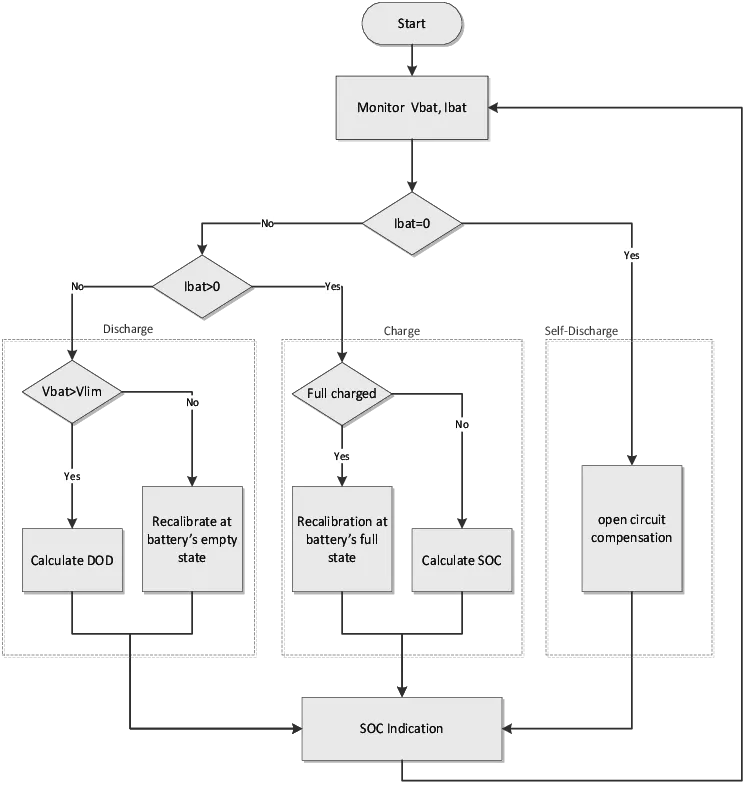
The Coulomb counting method measures the discharging current of a battery and integrates the discharging current over time in order to estimate SOC. Coulomb counting method is done to estimate the `SoC(t)`, which is estimated from the discharging current, `I(t)`, and previously estimated SOC values, `SoC(t-1)`. SOC is calculated by the following equation:
`SoC(t)=SoC(t-1)+(I(t))/(Q_n)Deltat`
But there are several factors that affect the accuracy of the Coulomb counting method including temperature, battery history, discharge current, and cycle life.
Flowchart of Coulumb Counting Method
 |
The general model of SoC estimation
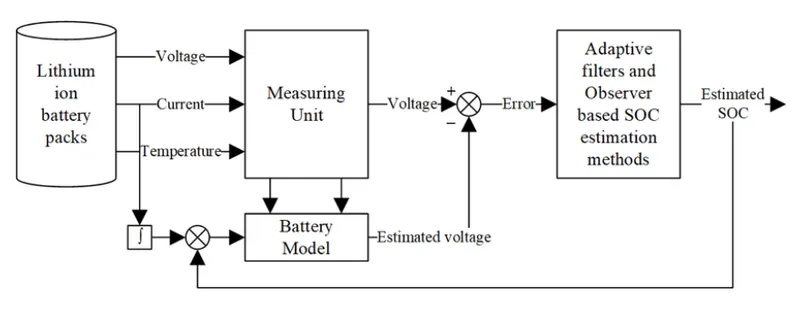 |
The above is a generalized form of how a BMS works for SOC estimation. Depending on the method used for SOC estimation various parameters are taken as input by the BMS. These parameters are used further to calculate the SOC using various relations as per the method and SOC is given at the output. In our case temperature is not needed since the Coulomb counting method is independent of the working temperature of the battery.
Here is an example of a robust SoC estimation framework
 |
3. LEARNING OUTCOME
We learned what is SoC, the different methods for estimation of SoC, and what exactly is the Coulumb Counting Method.