Week 7 State of charge estimation
Aim:- Study on Estimation of State of Charge(SOC) and Battery Management System(BMS) Implements Coulomb Counting for SOC .
Q- 1]Simulate the 3 test cases from harness dashboard and write a detailed report on the results
Ans:-
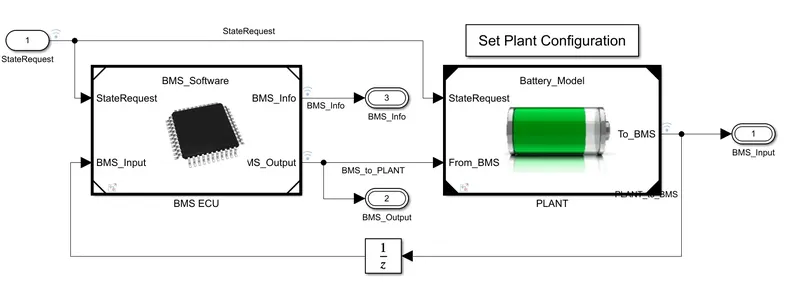
The below model shown the of BMS Closed Loop:-
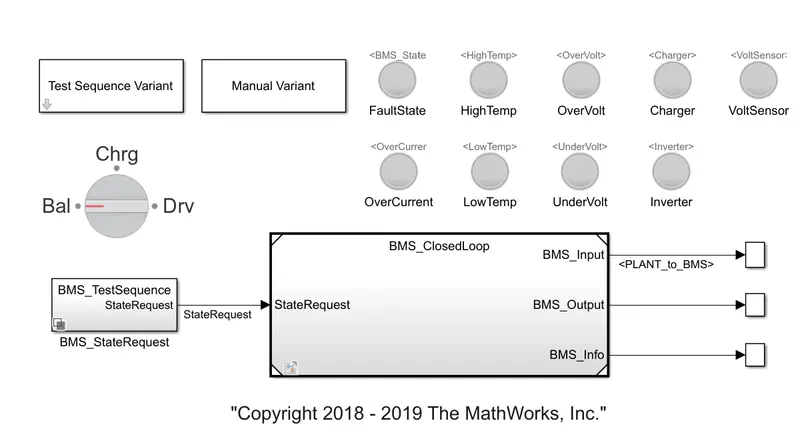
Simulate the 3 test cases from harness dashboard model shown as below:-
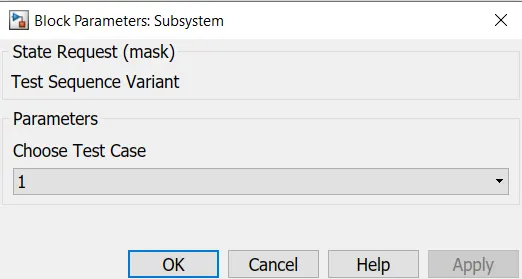
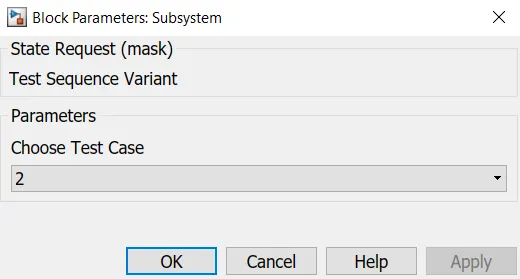
We have click on the Test Sequence Variant. I see 3 Test Case.we can see in the below parameter block:-
We have run the Simulation for First Variant Condition:-
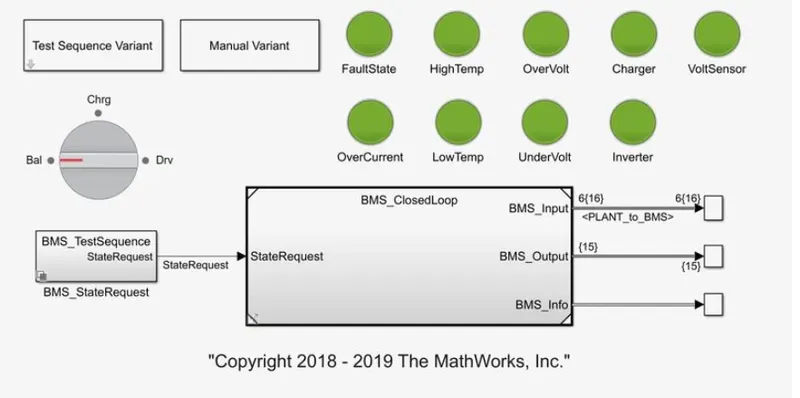
Result:-
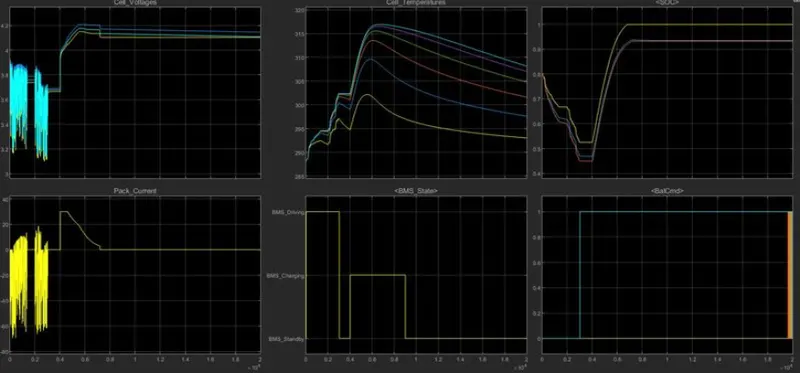
- We can be Observed from the above graph, The Vehicle is Initially in the Driveing State and Charging was done 0.9. After the charging mode it reached the standly mode which can be from BMS state graph.The Battery temp increses in driving and charging.The Battery voltage was increases to 4.2 V. The current graph shown the Current value supplied to the vehicle driving. the State of Charge(SOC) to be Decreased around 0.5.
Simulate for Second test:-
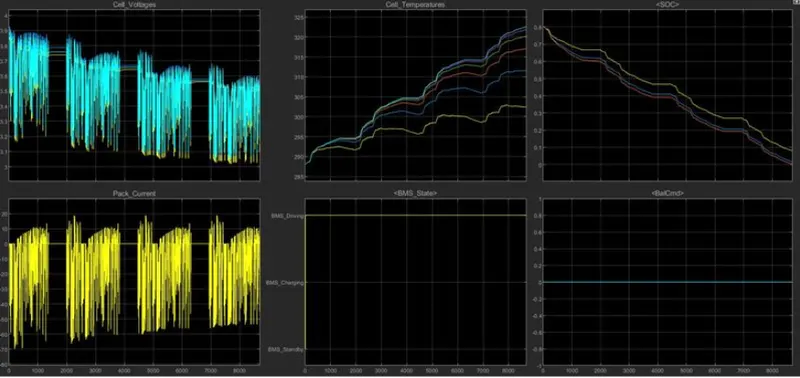
- Observed from above graph, in the graph the battery discharge completely in 8692 Sec & The vehicle does not go to forward.
Simulate for Third test:-
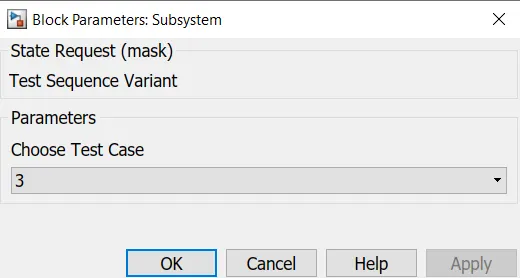
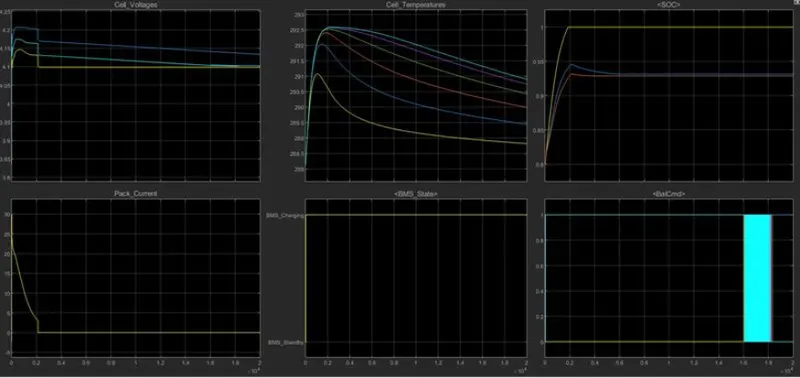
- Observed form above graph, That the Battery start Charging & the State of Charge (SOC) starts increasing from beginning to around 20000 Sec & the stays stable at 100% continuously from 2000 Sec until 20000 Sec. and the peak current drops from 0 to 2000 sec.
Q- 2] What is coulomb counting? Refer to the above model and explain how BMS implements coulomb counting for SOC estimation ?
Ans:-
Coulomb Counting:-
- Coulomb counting is a technique used to track the State of Charge of a battery pack. It works by integrating the active flowing current (measured in amps) over time to derive the total sum of energy entering or leaving the battery pack. This produces a capacity that is typically measured in Amp-hours.
- We will detail here the two most common and simplest methods to estimate the state of charge of a battery :- voltage method or Open Circuit Voltage (OCV) and coulomb counting method.
Different SOC Estimation Methode as are following:-
1] Coulomb Counting Method.
2] Voltage Methode.
3] Kalman Filter Methode.
Coulomb Counting Method:-
- The Coulomb counting method measures the discharging current of a battery and integrates the dischargingcurrent over time in order to estimate SOC [12]. Coulomb counting method is done to estimate the SOC(𝑡), which isestimated fromthe dischargingcurrent, 𝐼(𝑡), and previously estimated SOC values, SOC(𝑡 −1). SOC is calculated by the following equation:-
SOC (𝑡) = SOC (𝑡 − 1) +𝐼 (𝑡)𝑛Δ𝑡.
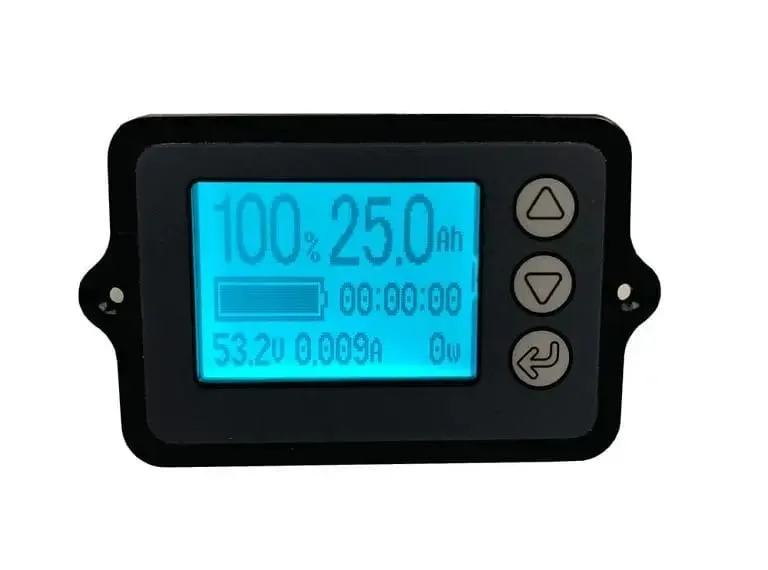
- But there are several factors that affect the accuracy of Coulomb counting method including temperature, battery history, discharge current, and cycle life [1, 12].
- To improve the Coulomb counting method, a new technique called modified Coulomb counting method is proposed. The modified Coulomb counting method uses the corrected current to improve the accuracy of estimation. The corrected current is the function of discharging current. There is a quadratic relationship between the corrected current and discharging current of battery. By practice of experimental data, corrected current is calculated by the following form:-
𝐼 (𝑡) = 𝑘2(𝑡)2 + 𝑘1𝐼 (𝑡) + 𝑘0
- where 𝑘2, 𝑘1 and 𝑘0 are constant values obtained from the practice experimental data. In modified Coulomb counting method, SOC is calculated by the following equation:-
SOC(𝑡) = SOC(𝑡 − 1) +𝐼c (𝑡)𝑄nΔ𝑡. - The experimental results show that the accuracy of the modified Coulomb counting method is superior to the conventional Coulomb counting method [1].
State of Charge (SOC) and Estimation:-
- The determination of battery SOC is always an essential part of a BMS. The accurate and reliable estimation of battery SOC can provide a necessary assessment factor for vehicle energy management and optimal design of the control system. Therefore, a larger number of methods have been proposed for estimating battery SoC in real-time.
- The State of charge (SOC) is a measurement of the amount of energy available in a battery at a specific point in time expressed as a percentage. For example, the SOC reading for a computer might read 95% full or 10%.
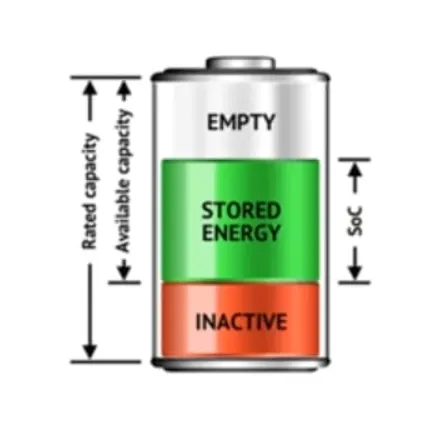
- The SOC provides the user with information of how much longer the battery can perform before it needs to be charged or replaced. Understanding the state of charge in important because understanding the remaining capacity of a battery can help make a control strategy.
- Essentially, the SOC acts like a fuel gauge in a car. It informs the the users of how much longer they can operate the device or machine before it runs out of energy and can no longer perform.
- The battery is one of the most attractive energy storage systems because of its high efficiency and low pollution. There are several kinds of batteries currently being used in industry: lead-acid battery, Ni-MH battery, Ni-Cd battery, and Li-ion battery. The battery has the advantages of high working cell voltage, low pollution, low self-discharge rate, and high power density. Batteries are used commonly for portable utilities, hybrid electric vehicles, and industrial applications.
- SOC estimation is a fundamental challenge for battery use. The SOC of a battery, which is used to describe its remaining capacity, is a very important parameter for a control strategy . As the SOC is an important parameter, which reflects the battery performance, so accurate estimation of the SOC can not only protect battery, prevent overdischarge, and improve the battery life but also allow the application to make rational control strategies to save energy. However, a battery is a chemical energy storage source, and this chemical energy cannot be directly accessed. This issue makes the estimation of the SOC of a battery difficult . Accurate estimation of the SOC remains very complex and is difficult to implement, because battery models are limited and there are parametric uncertainties . Many examples of poor accuracy and reliability of the estimation of the SOC are found in practice.
- The SOC is one of the most important parameters for batteries, but its definition presents many different issues . In general, the SOC of a battery is defined as the ratio of its current capacity (Qt) to the nominal capacity (Qn). The nominal capacity is given by the manufacturer and represents the maximum amount of charge that can be stored in the battery. The SOC can be defined as follows:-
`SOC(t)=(Qt)/(Qn)`
- There are several ways to get Lithium-Ion State of Charge (SoC) measurement or Depth of Discharge (DoD) for a lithium battery. Some methods are quite complicated to implement and require complex equipment (impedance spectroscopy or hydrometer gauge for lead acid batteries).
The Below Model shown the of BMS Closed Loop model,When seen inside the BMS ECU:-
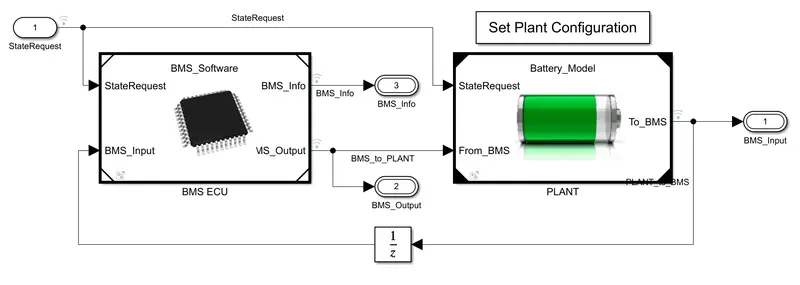
Click on BMS ECU block and Shown below System:-
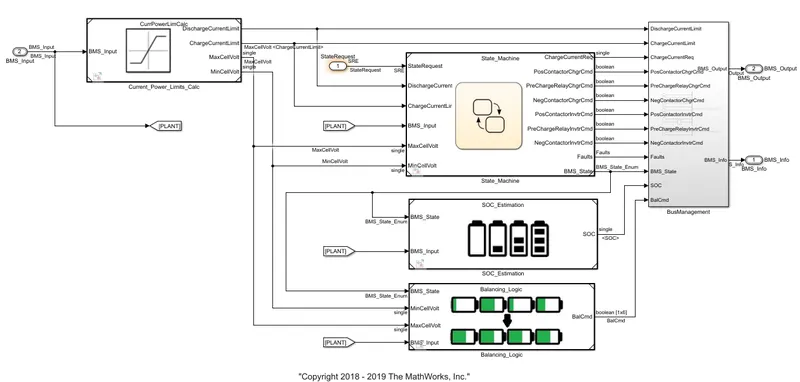
Click on SOC Estimation block Shown below Subsystem in this block:-
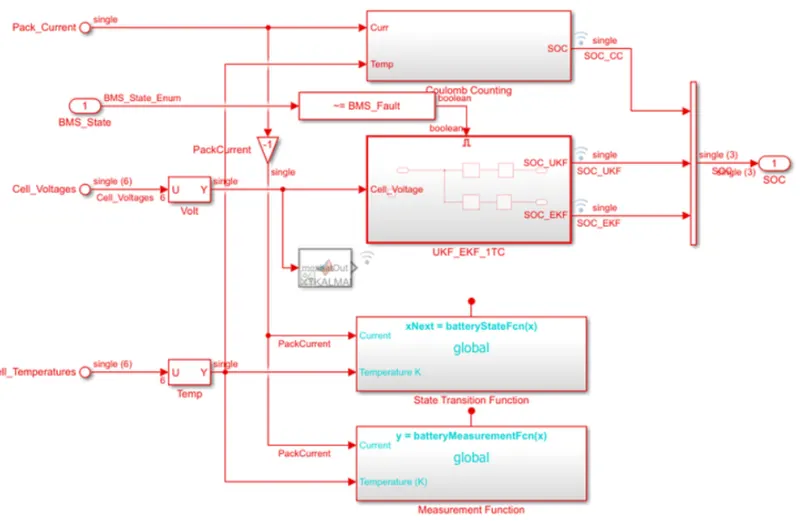
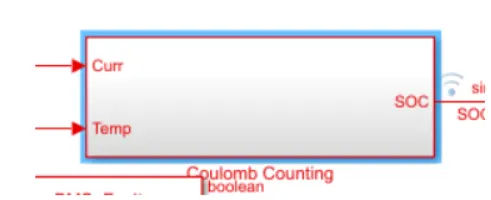
We have click on coulomb counting block we can see in below subststem:-
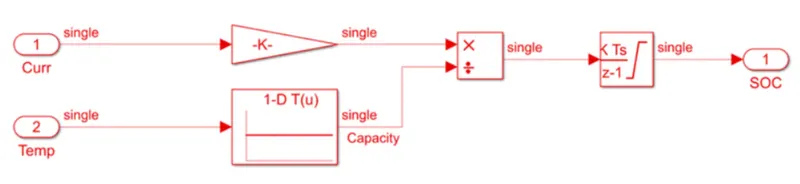
- Coulomb-counting based algorithms are often used as a core technology for battery SOC estimation in BMS. They express the SOC as the ratio of available capacity to the nominal one. The remaining capacity in a battery can be calculated by measuring the current flow rate (charging/discharging) and integrating it over the time interval `Deltatau` .
- The common equation to calculate the SOC is given byEq. (1), where the SOC0 represents the initial SOC, `Ibat`represents the current across the battery and, `Qrated` is the nominal capacity of the battery.
`SOC=SOCo +(int_(t0)^(t0+tau)*Ibat*(Deltatau))/(Qrated)*100` ............(1)
- The initial SOC estimation. Several researchers have reported these limitations and have proposed some solutions to solve them. For example, to avoid cumulative errors, a coefficent of Coulombic efficiency was added to the Eq. (1). In the same vein, the accuracy of the initial SOC affects severely the estimated SOC since `SOCo`is an additive term according to the definition in Eq. (1). Subsequently, we need to estimate `SOCo` with rigor and make the access to the initial SOC easier, for that the OCV-SOC model is generally used; because knowing the OCV value leads to having the instantaneous SOC owing to a well-known mapping between OCV and SOC. For this reason, the OCV-SOC model is idely utilized in a lot of works for battery characterization and monitoring.
- An efficient Coulomb-counting algorithm of a SOC estimation for Li-ion batteries within a hardware platform based on microcontroller which can be used as a real-time tool for multimedia applications. The
accuracy of this algorithm is guaranteed by using a piecewise SOC-OCV model to identify the intial SOC, a periodical recalibration to overcome cumulative errors due to an eventual inaccuracy of sensors and a temperature monitoring using an adaptive coefficient.
Proposed method for SOC estimation:-
- Coulomb-counting is based on exploiting the Eq. (1) by quantifying the charge delivered by the battery through sensing its input and output current [7,37]. Yet, there are some inefficiencies when using this method. First of all, the access to the initial SOC is not guaranteed. Secondly, self-discharge may distort the real SOC value after a long storage period and finally the reference capacity `Qrated` must be
updated in terms of battery ageing. Furthermore an SOC estimation is performed at varying ambient temperature which should be taken into account. - The literature shows enhanced Coulomb-counting algorithms which allow the determination of the initial SOC using the SOC-OCV curve, takes into account self-discharge losses and performs a recalibration at fully and empty stages. Figure 1 gives the flowchart of the propopsed algorithm used to manage the battery monitoring by switching from a battery operating mode to another in accordance with transition conditions.
- The estimation of the SOC of a Li-ion battery by the developed method is based on monitoring the voltage `Vbat` the current `Ibat` and the temperature T°. The operation mode of the battery is recognized by the direction of the current through the battery system. When the battery is in an open circuit mode, `Ibat=0`, a compensation of self-discharge losses will be considered. The information needed to perform the monitoring are the measurement of the battery voltage and the current flowing through it. Coulomb counter is used to track the SOC when battery is charging, discharging and self-discharging. The amount of charges in an operating period is obtained by a temporal integration of a measured charging/discharging current `Ibat` as expressed in Eq. (2).
`DeltaQ=int_t^(t+tau)*Ibat*dt` .......(2)
- This variation that will be used in Eq. (2) will be negative if the battery is in discharge and will be positive if in charge.
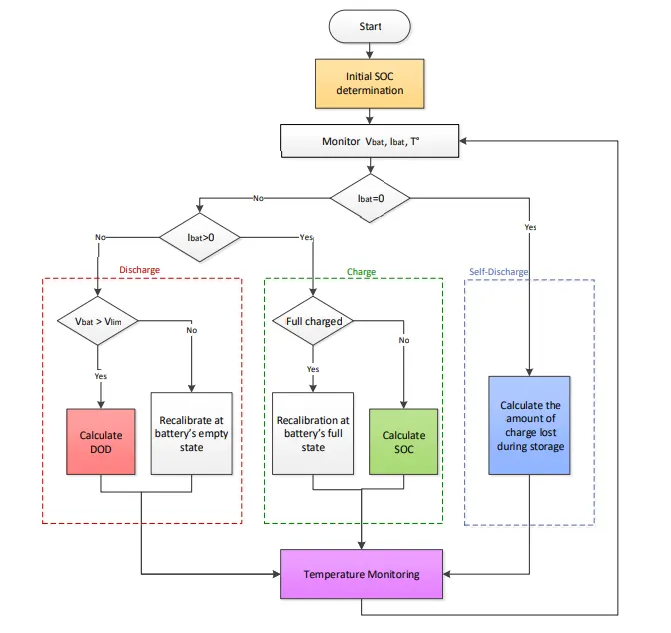
Fig(2) :- Flowchart of the proposed algorithm.
Charge Mode:-
- The typical charge procedure of a Li-ion battery consists of constant-current constant voltage (CC-CV) process . The Coulomb counter is presented by Qgained as expressed in Eq.(3), which represents the quantity of charge accumulated during an operating period equal to τ.
`Qg(t+tau)=Qg(t)+DeltaQ` ......(3)
- Where, Qg = Qgained
- Thus, the variation of the state of charge gained in this same operating period is obtained by the Eq. (4)
`DeltaSOC(t+tau)=(Qg(t+tau))/(Qrated)*100` .......(4)
- By accumulating the previous state of charge indication and the obtained one, we can have the instantaneous value of SOC as expressed in (5).
`SOC(t+tau)=SOC(t)+DeltaSOC(t+tau)` ........(5)
- Knowing the relationship indicated in Eq. (6) the value of DOD is updated in every charging operation in order to get it back in every switching to discharging mode.
`SOC(t)+DOD(t)=100%` .......(6)
Discharge mode:-
- When the current `Ibat` is negative, then the battery is in the discharging mode. In this mode, the Coulomb counter is presented by `Qlost` , which represents the amount of charges losses in the operating period τ as expressed in Eq. (7).
`Qbat(t+tau)=Qlost(t)+DeltaQ` .......(7)
- The value of DOD is calculated according to Eq. (8).
`DOD(t+tau)=DOD(t)+DeltaDOD(t+tau)` ......(8)
- Where,
`DeltaDOD(t+tau)=(Qlost(t+tau))/(Qrated)*100`
Self-Discharge Mode:-
- At the battery storage periods, considering that Li-ion batteries reach 5% rate of self-discharge per month [2], the amount of charge losses per hour is calculated; this amount is designed by the constant,
`q (per)/(hour)` . Then, the quantity of charge dissipated in this phase Qoc is calculated by Eq. (9), representing the cumulative losses during the storage hours.
`Qoc(h+1)=Qoc(h)+q (per)/(hour)` ......(9)
- where,
h is the hour of storage - This value will be added to the amount of charges lost Qlost during discharge mode and subtracted from the amount of charge accumulated Qgained in the charge mode as expressed in Eq. (10)
`Qlost=Qlost+Qoc`
`Qt = Qt-Qoc` .....(10)
- This compensation of self-discharging loss is made at each open circuit period and before switching to another operating battery’s mode.
References link:-
- https://in.mathworks.com/matlabcentral/fileexchange/72865-design-and-test-lithium-ion-battery-management-algorithms