Week 7-Long Piston With Cam
Objective:
The objective of this challenge is to understand how to perform a transient analysis and to study the movement of a cam follower with rotation of a barrel cam.
This challenge consists of three cases in which the contact friction is varied from frictionless to friction coefficient value 0.1 and finaliction coefficient value 0.2. The results expected from this simulation are equivalent stresses in the model, equivalent strain in the model and directional deformation in the follower to understand the movement in the follower. Finally, a comparison has to be made between the three cases and the difference between the results have to be explained.
Preprocessing for the analysis:
1. Geometry Creation
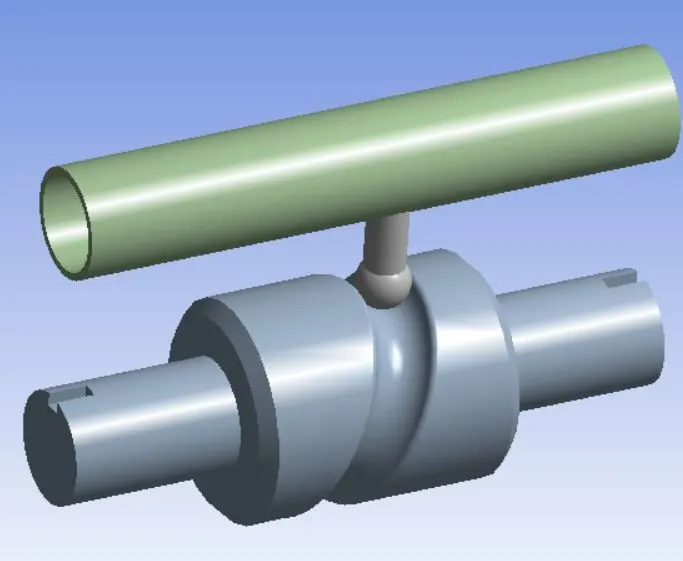
The model required for this challenge was obtained from the one given in the problem. The model is checked in modeler or spaceclaim for any irregularities in the model.
Upn opening the model tab in project workbench, the geometry is renamed with approriate names. The barrel and the cam are considered as rigid bodies since we are not studying the effect of motion on these two bodies. The follower is assigned structural steel material.
2. Connections
There are 2 connections in this challenge viz. i. The connection between follower and barrel and ii. the connection between follower and cam. In both these contacts, the follower is considered as contact body and the cam and the barrel are considered target bodies. There are 3 cases to be considered when it comes to type of contact as mentioned in the problem statement.
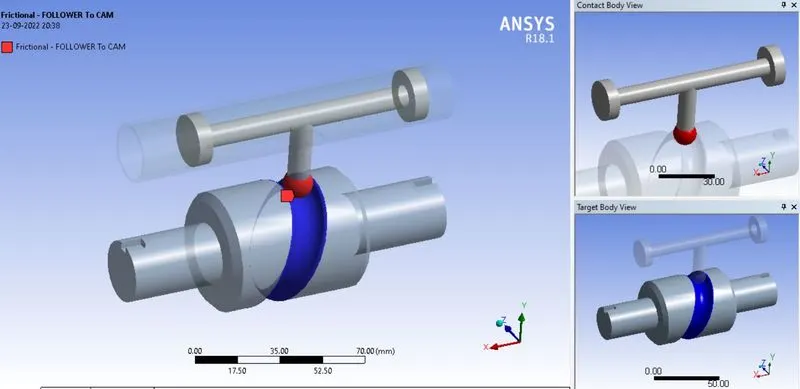
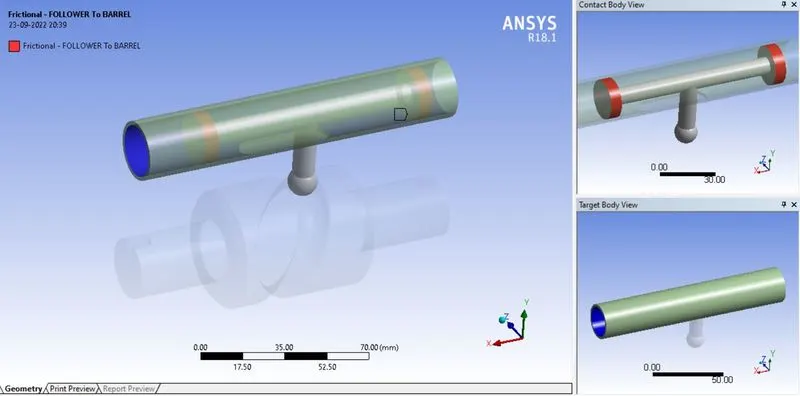
To accomodate these three cases, a parametric analysis was performed on this model. For the frictionless case, the friction coefficient is kept as 0 and updated as 0.1 and 0.2 for cases 2 & 3 respectively.
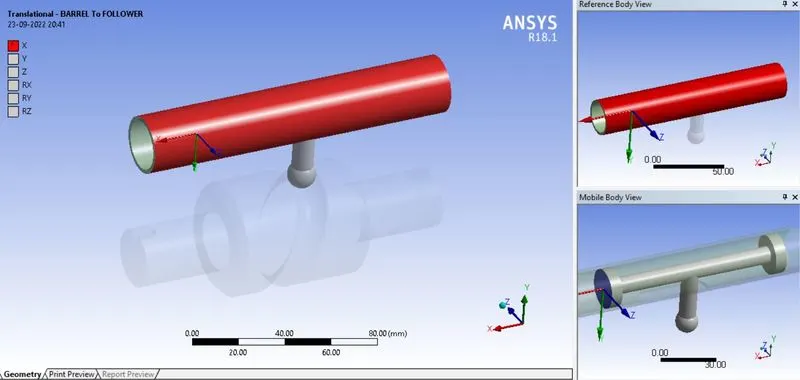
Apart from the 2 contacts there were 3 joints also created to simulate movement in the model.
- Ground to barrel fixed joint: The barrel movement was fixed in all directions in order to restrict its motion and provide stable results on the movement of follower.
- Ground to cam revolute joint: The cam was given a rotaional degree of freedom to simulate rotation that results in translational movement of follower.
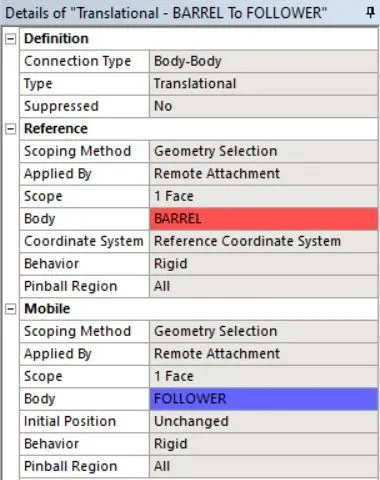
- Barrel to follower translational joint: The follower was given linear degree of freedom with respect to the barrel to simulate the linear motion of follower corresponding to rotation of cam.
3. Meshing
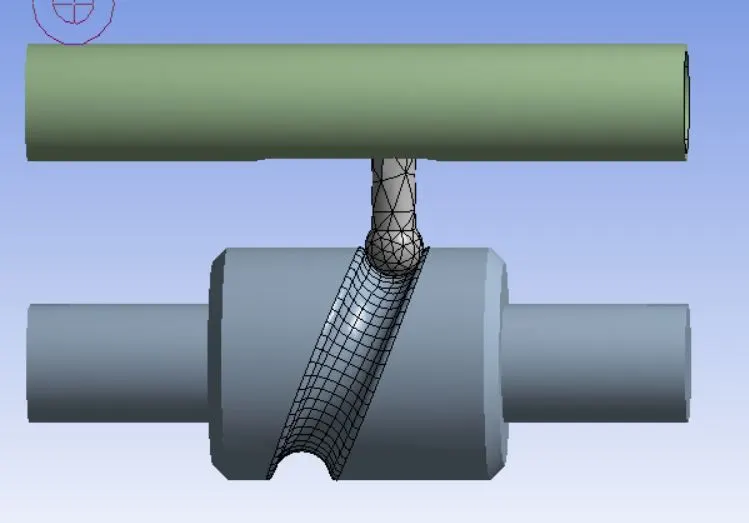
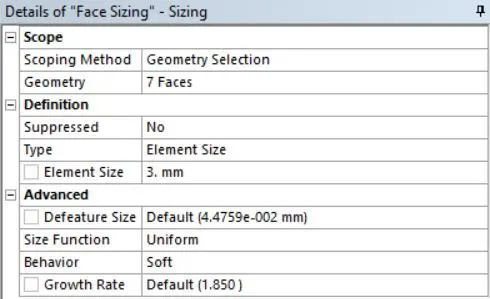
Since the cam and the barrel are considered as rigid bodies the automatic mesh does not mesh these bodies. The surfaces of cam that are in contact with the follower are selected along with the surface of follower in contact woth the cam and given an element sizing of 3 mm.
The model was the subjected to an automatic mesh while keeping adaptive mesh off.
4. Analysis settings
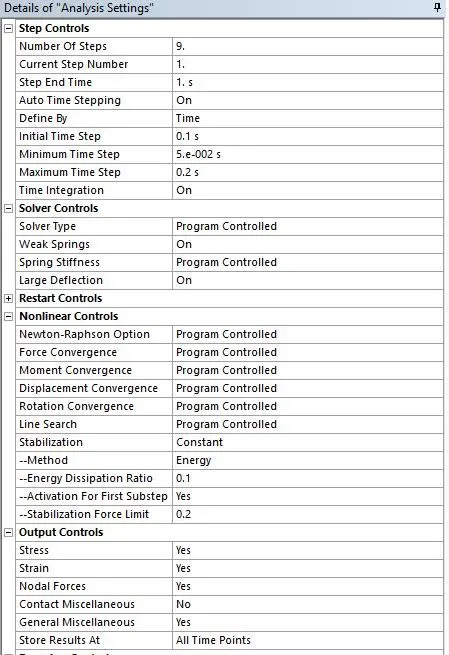
This analysis was solved in 9 steps. The first step was given an initiation time step of 0.1 s, with a max. and min. time step of 0.2 s and 0.05 s respectively. Auto timestepping was kept ON along with weak springs and large deflection. Stabilization effect was changed to 'contant' and the energy dissipation factor was assumed to be 0.1. All outputs other than contact miscellaneous were switched to 'yes'
For steps 2-9, both Auto timestepping and carry over timestep were turned ON while giving a max. and min. time step of 0.03 s and 0.05 s respectively. Rest of the properties were similar to timestep-1 i.e., Weak springs stiffness and large deflections were allowed to be ON. Stabilization effect was changed to 'contant' and the energy dissipation factor was assumed to be 0.1. All outputs other than contact miscellaneous were switched to 'yes'
The analysis setup properties are shown below,
5. Loads and Boundary conditions
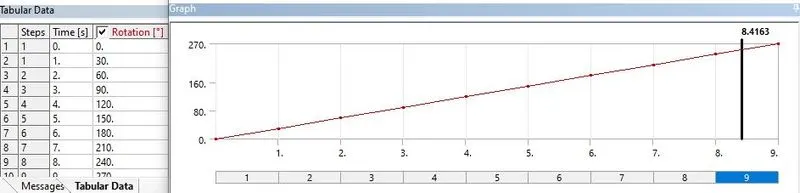
Only one joint load was considered in this analysis to give rotary motion to the cam. The cam was given 30 deg. roations in 9 steps with a total angular displacement of 270 deg with respect to z-axis. This motion can be increased further to 360 deg if we consider an angular displacement of 45 deg.
Solution and psotprocessing:
Three reults were required form the challenge i.e. Equivalent Stress, Directional Deformation and Equivalent Elastic Strain for the follower and the same have been given here
1. Equivalent Stress:
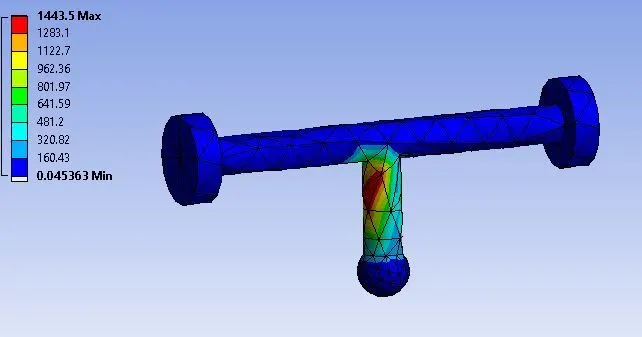
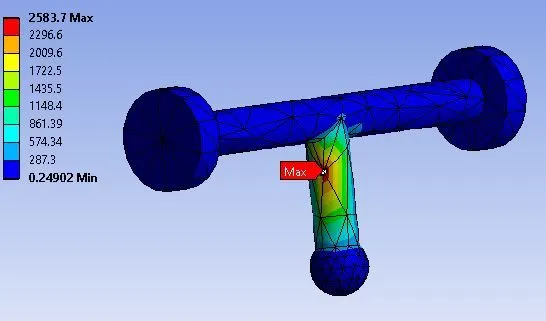
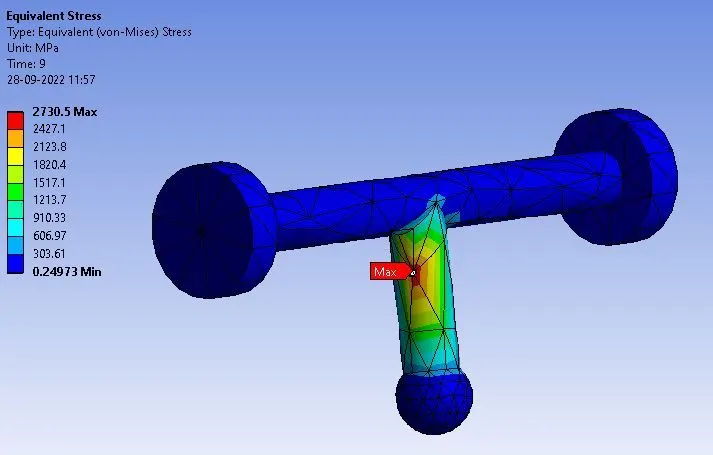
There is a clear trend of increase in stress as we increase the coefficent of friction from 0 to 0.2. The First case i.e. frictionless model shows an equivalent max stress of 1443 MPa which when friction is introduced with factor 0.2 rises significantly to 2583.7 MPa. Another evidence to support this hypothesis is as we increase coefficient of friction from 0.1 to 0.2, the stress in the model rises further from 2583.7 MPa to 2730.5 MPa.
2. Equivalent strain
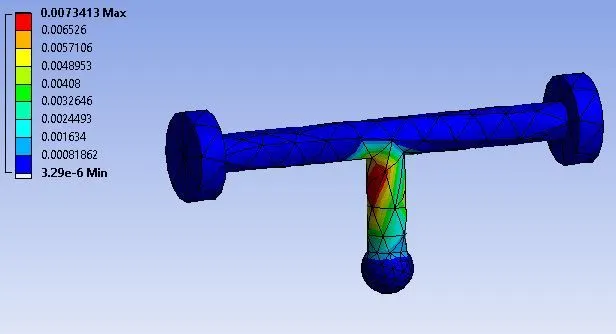
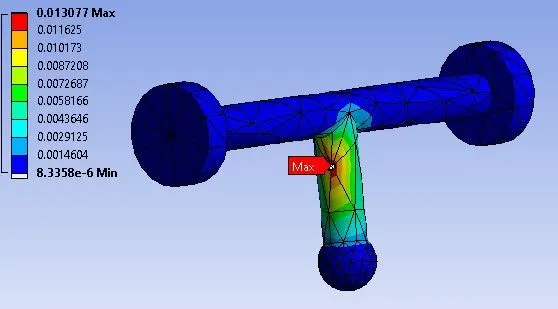
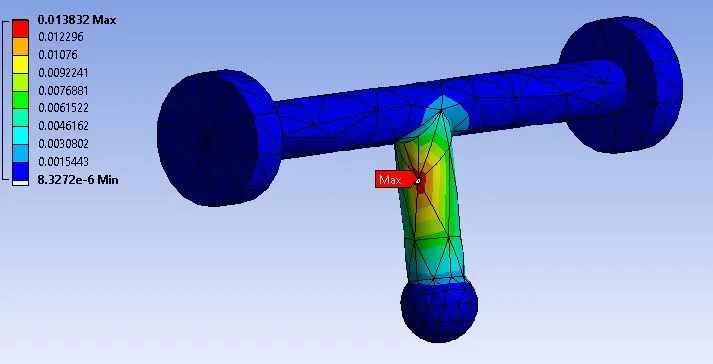
It can be observed that expectedly, the location of max stress and max strain are the same in all models. It is because the location near the joint experiences max stress similar to a cantilever beam. Also, the trend of increase in strain with increase in coefficient of friction similar to the one observed for stress can also be observed in here.
3. Directional Deformation
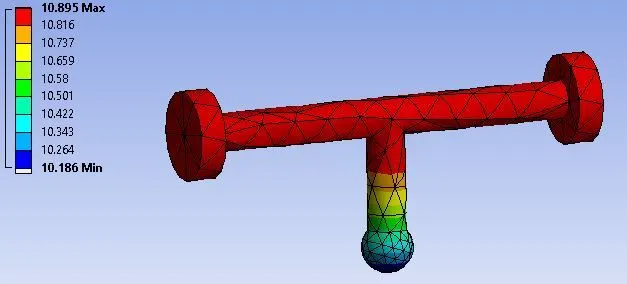
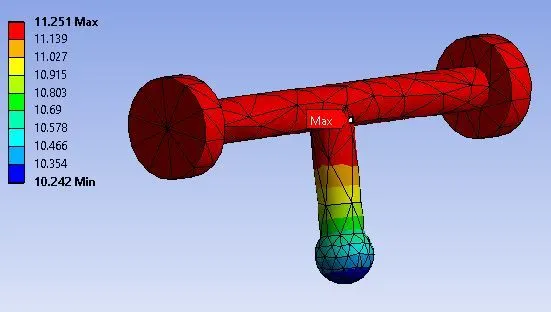
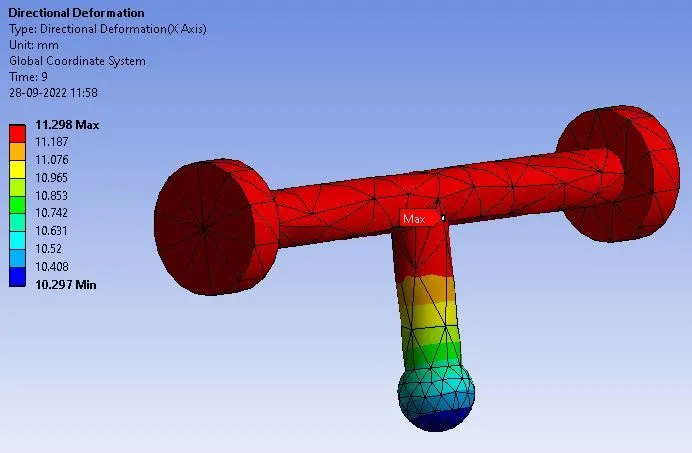
Here deflection is similar on account of the simulation tracing the movement of the body. It can however, be observed that deflection is more in the arm of the follower in contqact with the cam since it onlly traces the outline of the slot in the cam.
Results:
| Results | Max. Equivalent stress (MPa) | Max. Equivalent strain | Directional deformation (mm) |
| Frictionless model | 1443.5 | 0.0073 | 10.895 |
| Coeffiction of friction 0.1 | 2583.7 | 0.013 | 11.251 |
| Coeffiction of friction 0.2 | 2730.5 | 0.0138 | 11.298 |
- It has been observed that with increase in coefficient of friction, the stress is increasing.
- This happens because in absense of frcition there is less resisitance to the motion of the follower.
- However, with the introduction of friciton there is added resistance to the omvement of the follower with the rotation of cam.
- This also results in increased strain on the model.
- As the friction coefficient increses, so does the resistance to motion thereby straining the model and increasing stress even further.