LS DYNA Project 1: Simulation of the impact of a pedestrian's head on the hood of a car using LS-DYNA
AIM: To simulate the crash of a pedestrian's head on the hood of a car and to discuss the Stress-Strain results obtained using LS-PrePost and LS-DYNA.
PROCEDURE:
Initially, before simulating a headform of a child onto the hood, simple impact tests are done as a prelude. A simple sphere is modelled in LS-PrePost by using Solid => Sphere. A sphere of required dimensions is constructed and meshed. A rigid wall is constructed by going to Model and Part => Keyword Manager => Rigid Wall => Geometric_Flat_Display. The rigid wall properties are given below:
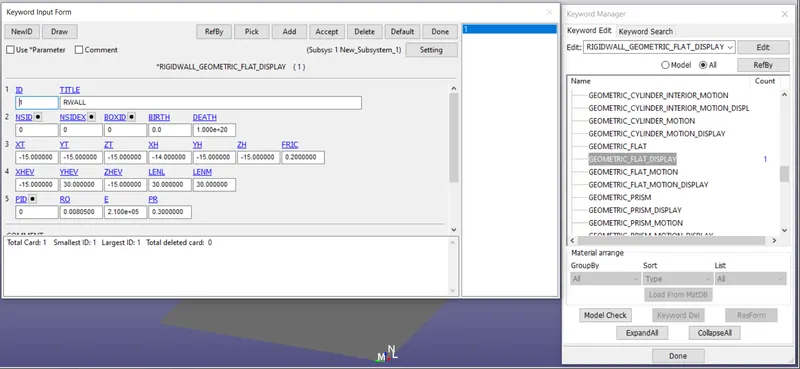
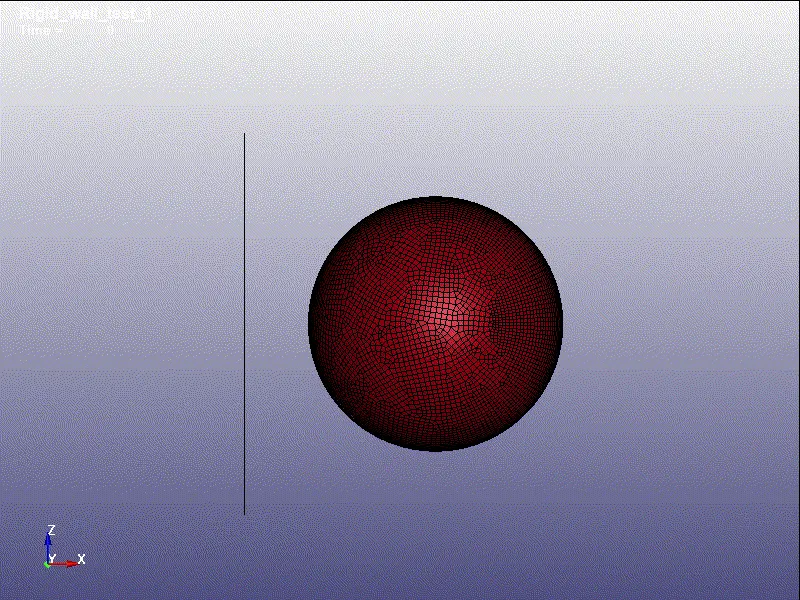
The setup is shown below:
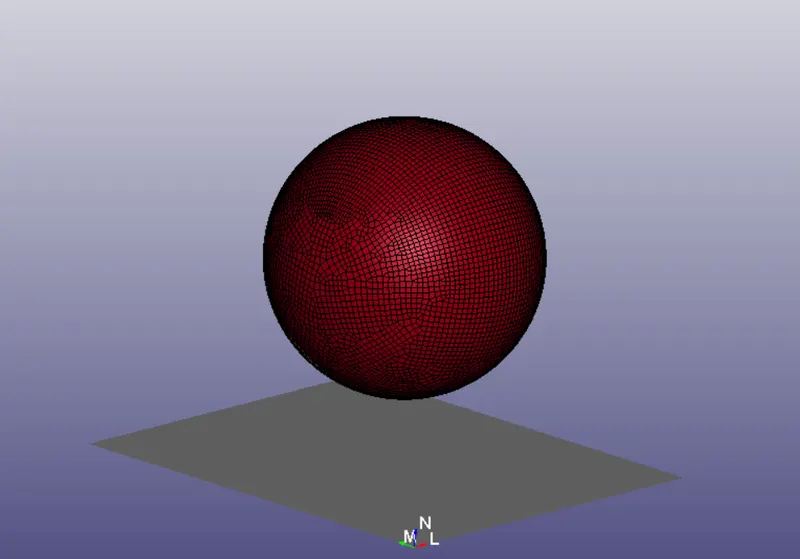
The sphere is given a downward initial velocity of 40 kmph which upon conversion to [g mm ms] system gives 11.11 mm/ms. The material properties given to the sphere are shown below:
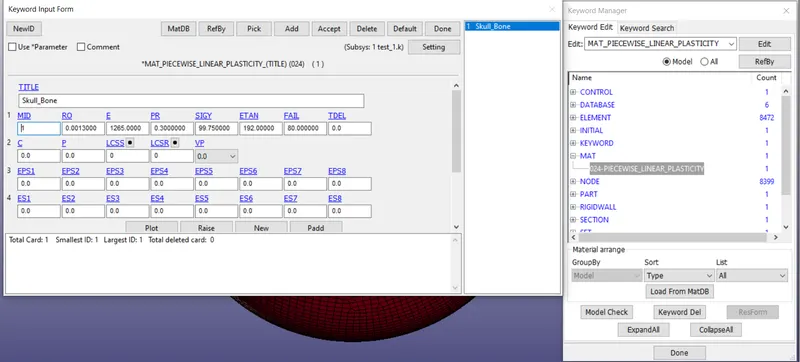
Note: Only the first simulation used [g mm ms] system. The other two simulations use [kg mm ms] system.
The section properties of the sphere are given below:
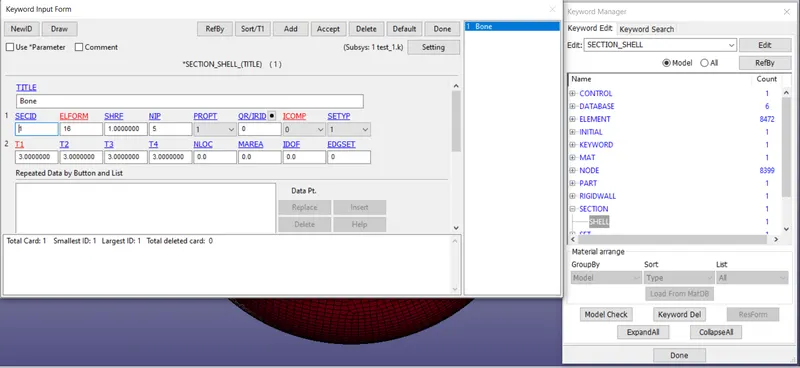
ELFORM =16 is given and the sphere is hollow sphere with 3 mm thickness. Material properties are given in accordance with literature review of the skull.
The results obtained include the Von-Mises stress contour given below:
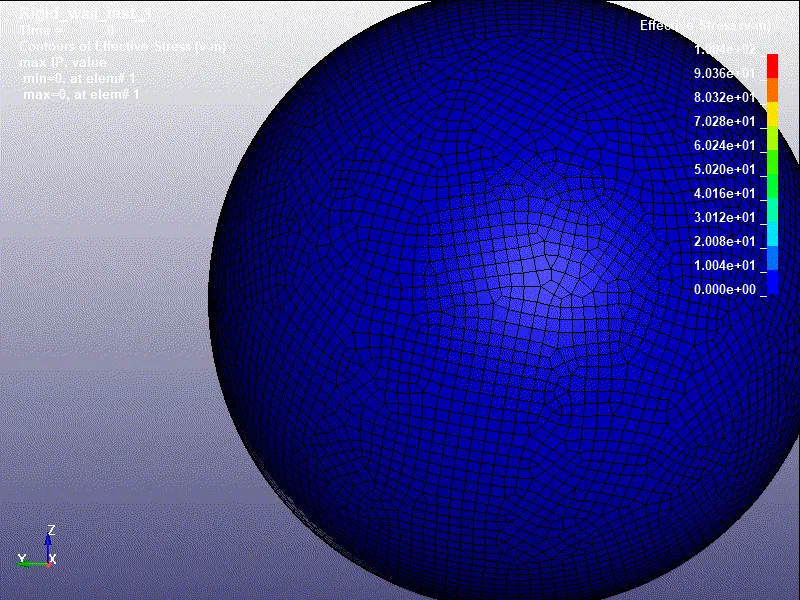
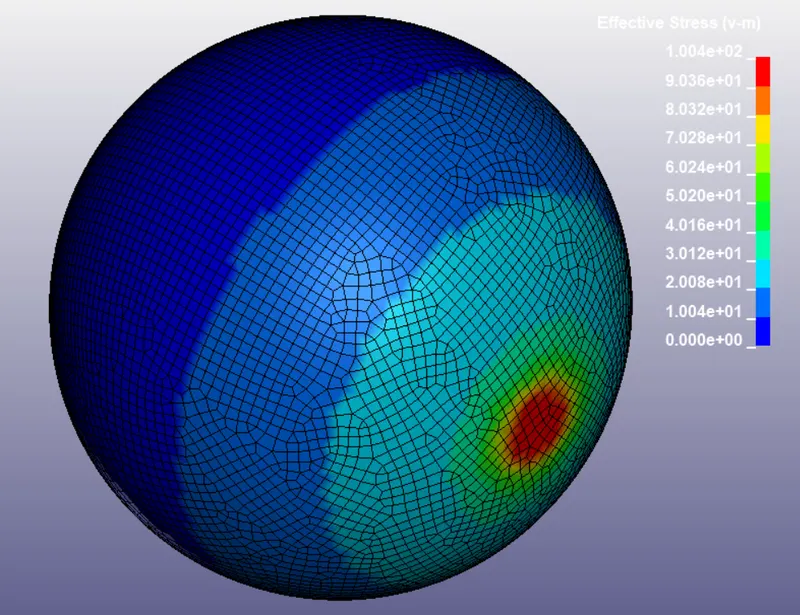
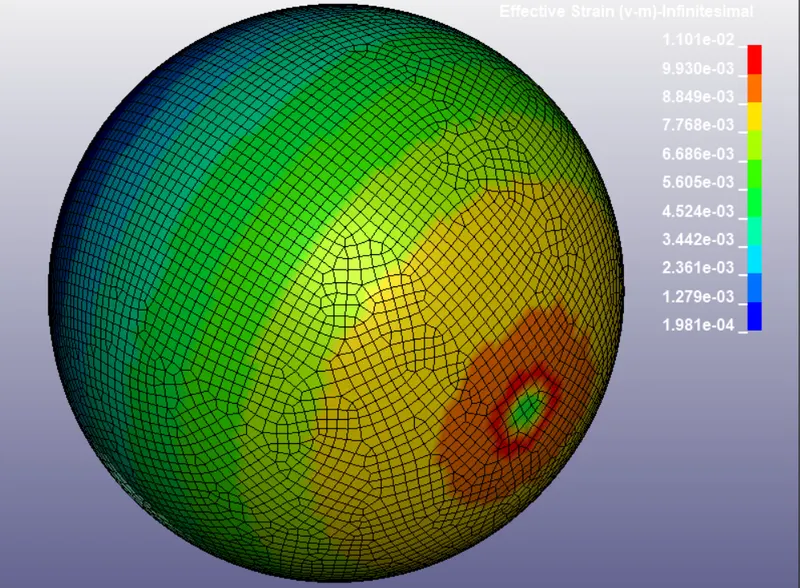
Effective strain contour:
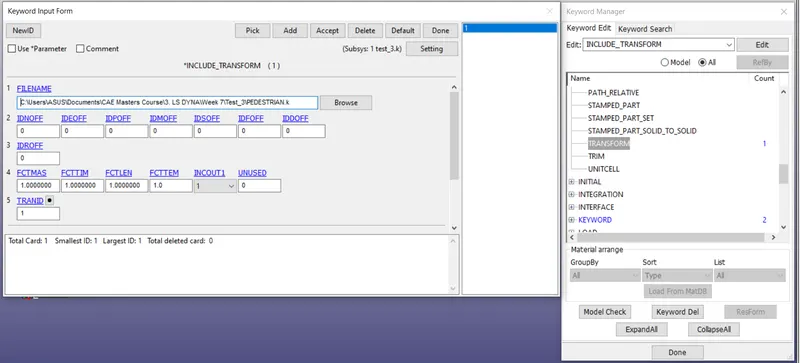
The next step is to replace the simple sphere with a headform which is used in industrial trials as well. This headform can be imported into LS_PrePost by going to keyword manager and going to INCLUDE => Transform.
For this, a transformation has to be defined. This can be done by going to Define => Transformation in the Keyword manager.
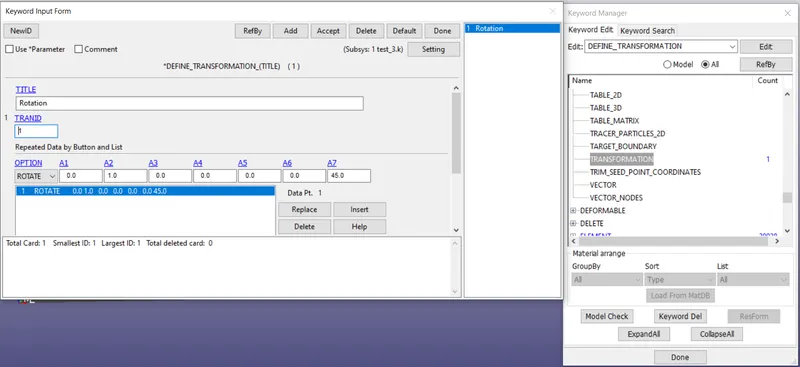
The transformation was defined such that the headform rotates in y-axis by 45 degrees. The include function is shown below:
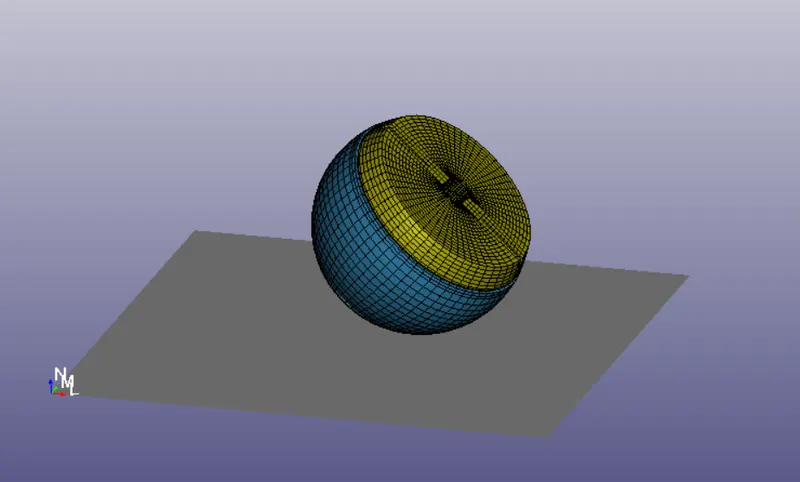
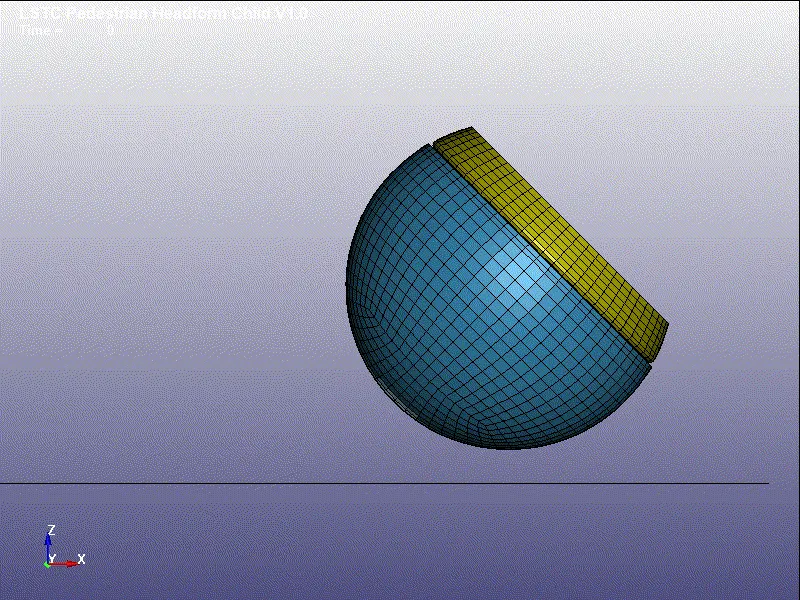
A rigid wall is constructed below the headform in a similar way as that for the previous case. The setup is shown below:
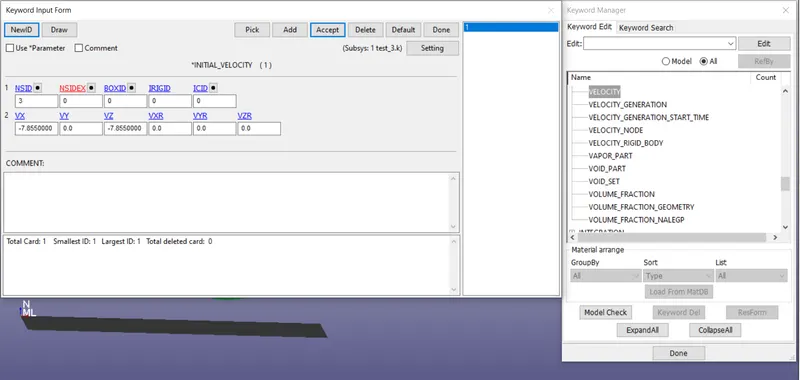
Instead of giving a downward velocity of 40 kmph like the previous case, in this case the resultant velocity is 40 kmph as a result of downward x and z velocities both being 28.28 kmph which upon conversion to [kg mm ms] system goes to 7.855 mm/ms.
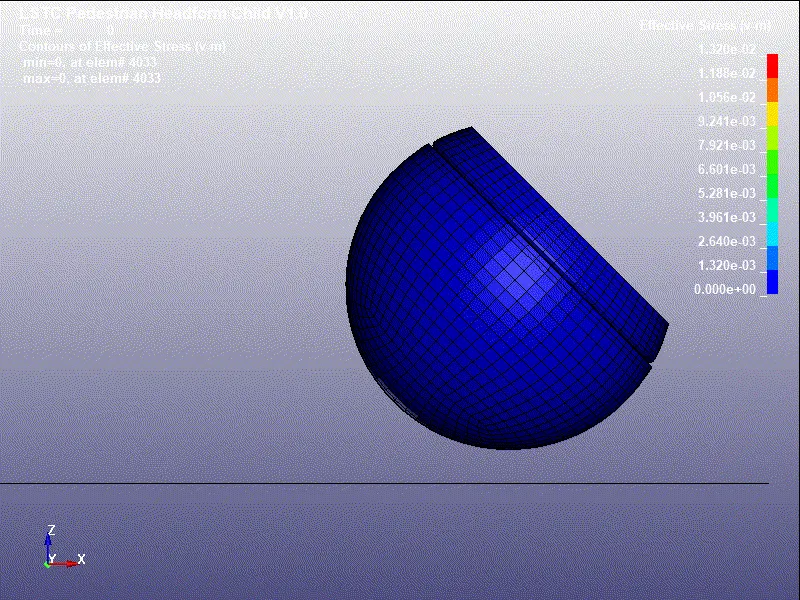
The contact between the skin and rigid structure of the headform are already predefined as are the material and section properties of the headform. The outer part of the headform is given as a hyperelastic Ogden Rubber material whereas the inner part is given a rigid material. This is to simulate the outer skin and the skull respectively. These are kept as they are and not changed in the present simulation. The results are shown below:
The Von-Mises stress contour:
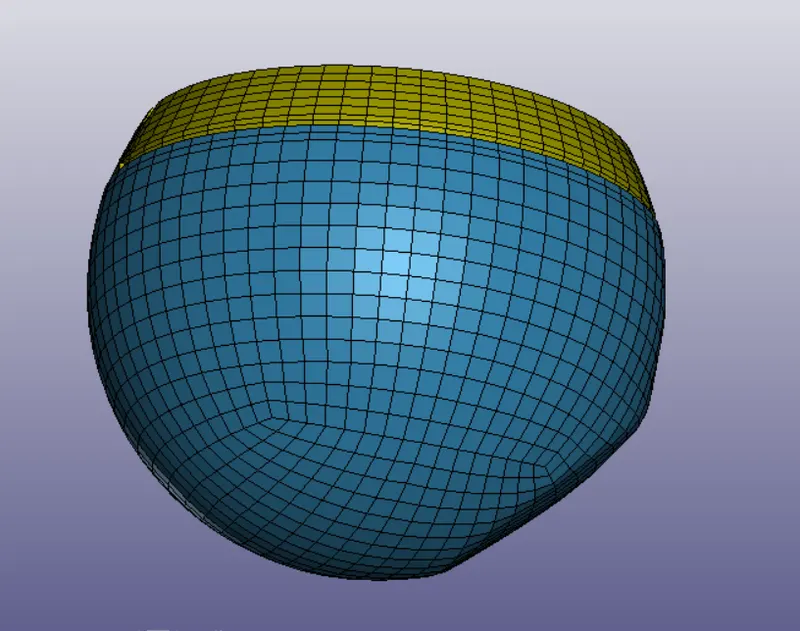
The dent of the headform can be seen below:
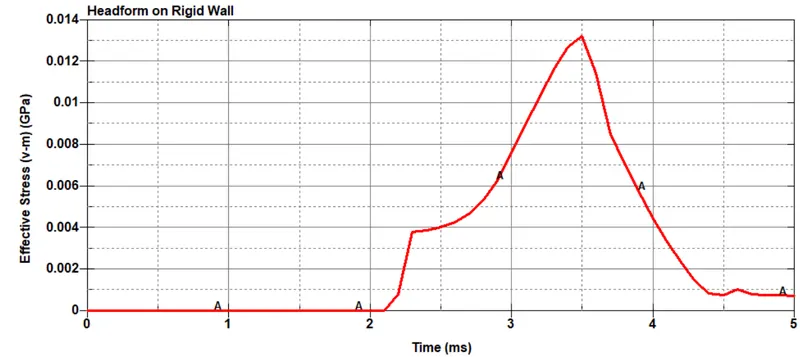
Variation of stress with time is given below:
Variation of strain with time is given below:
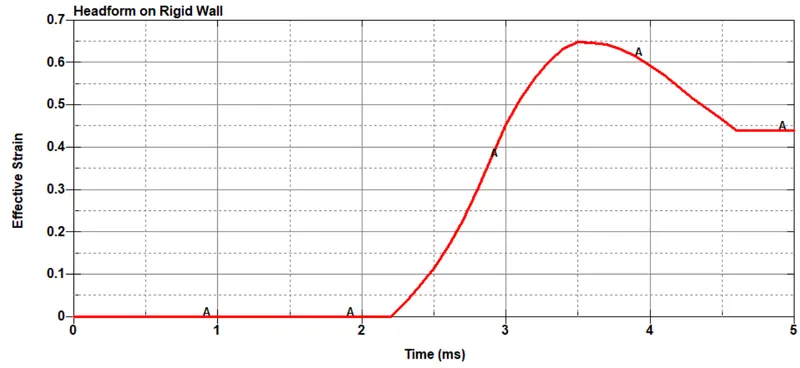
The data from these two graphs was used to create a stress-strain diagram as shown below:
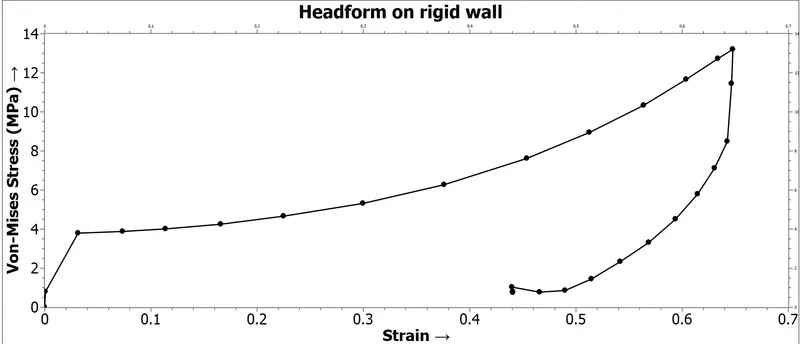
From the graph, it can be easily observed that following a small linear region, the non-linear region starts. The material due to being a hyperelastic rubber material is able to withstand large strains without undergoing fracture. Upon release of stress after impact, a lot of the strain is seen to already recover. It is to be noted that this recovery in strain takes place within 3 seconds post-impact and could progress further had a larger simulation time been given. A strain up to 0.65 is seen with a maximum stress of 13.2 MPa.
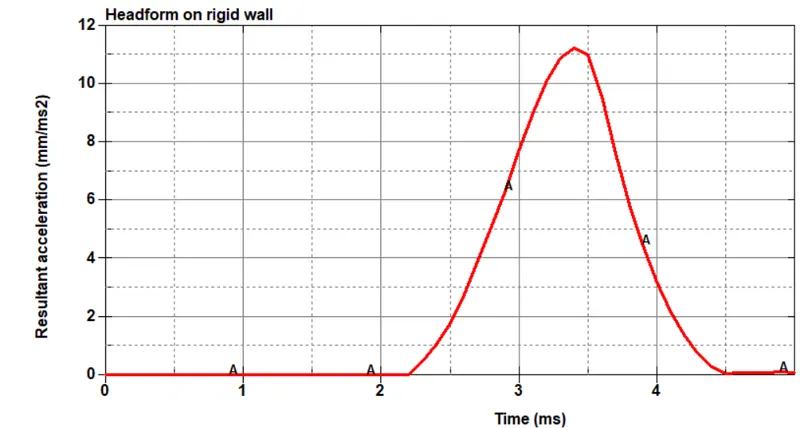
The acceleration curve vs time is given below:
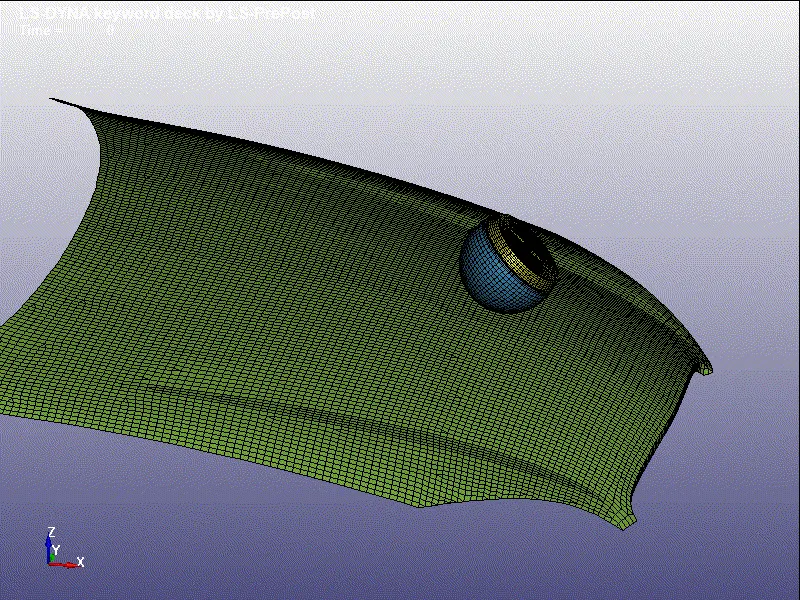
The final part of the simulation includes replacing the rigid wall with the mesh of an actual hood. In the present case, a 5mm thick hood was selected. This hood can be imported into the simulation in Keyword manager by going to Include => Include. The setup for the final case can be seen below:
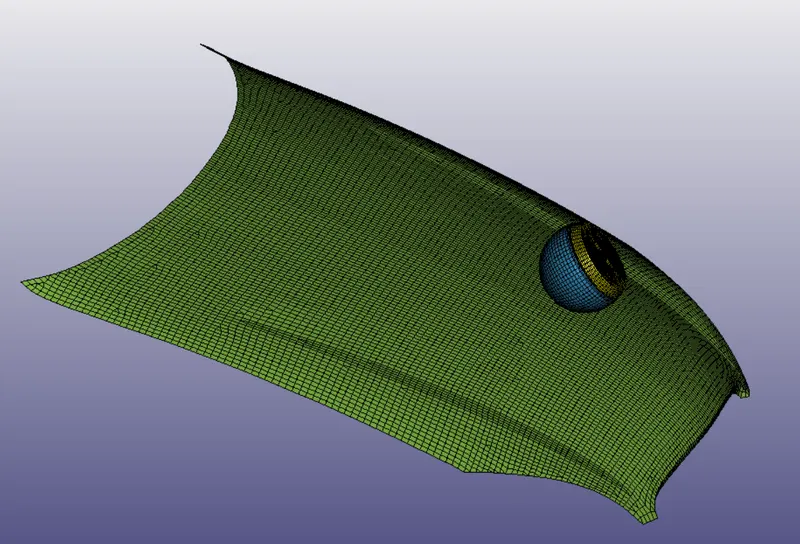
The velocity of the head is same as in the previous simulation. The downward x and z velocities are given as 28.28 kmph which gives resultant velocity of 40 kmph. This upon conversion to [kg mm ms] system gives 7.855 mm/ms velocity.
The material property for hood was given as Aluminium and 5mm thickness shell section was assigned to it. The material properties were assigned in keyword manager by going to MAT => 024-Piecewise_Linear_Plasticity. The shell was given element formulation of ELFORM = 16 with 5 integration points across the thickness.
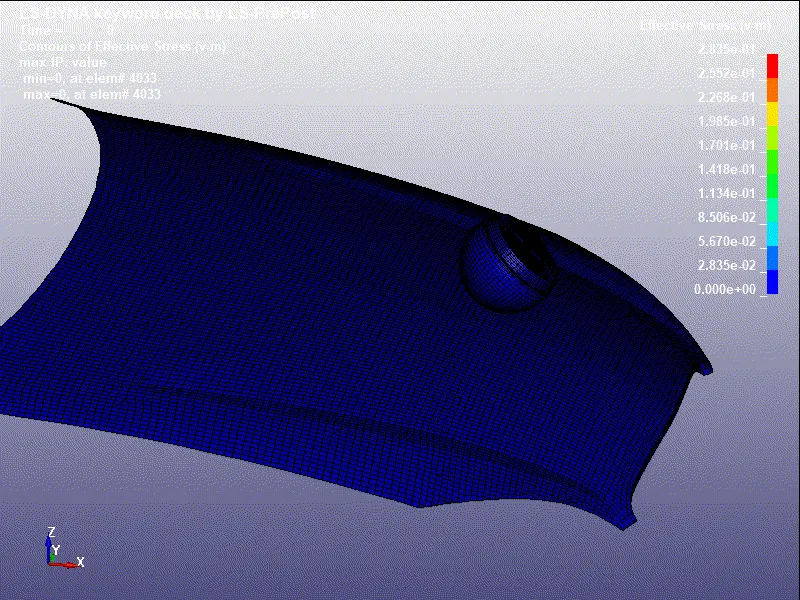
The results are shown below:
Von-Mises stress contour:
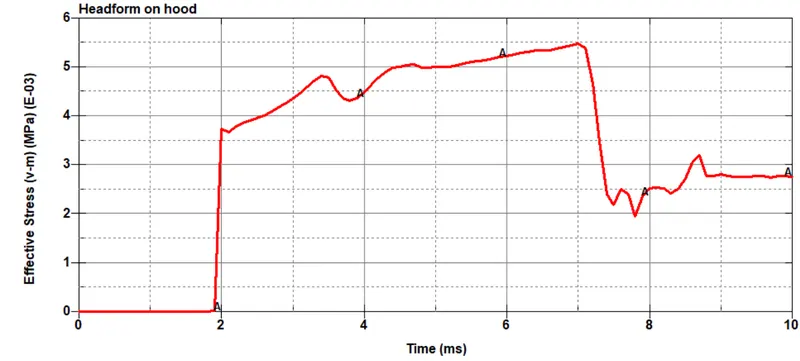
Stress vs time graph:
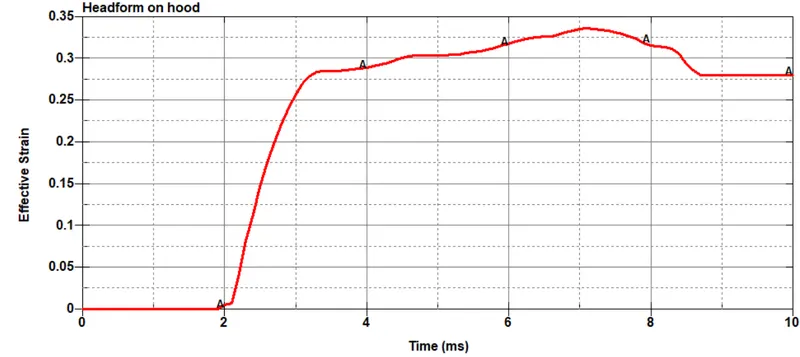
Strain vs time graph:
Using the data from the two graphs, stress-strain graph was obtained as given below:
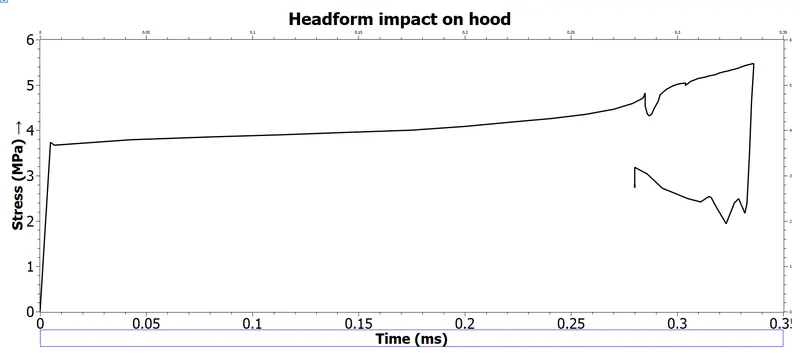
The maximum stress is 5.5 MPa and maximum strain 0.335.
Acceleration vs time graph:
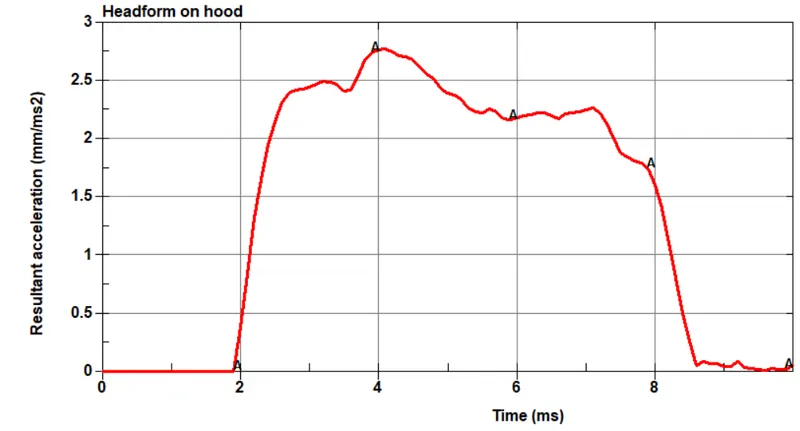
The results from the impact upon a hood vs impact upon a rigid wall can be summarized in the below table:
|
Property |
Rigid Wall |
Hood |
|
Max Von-Mises Stress |
13.2 MPa |
5.5 MPa |
|
Max strain |
0.65 |
0.335 |
|
Maximum Acceleration |
11.2 mm/ms2 |
2.76 mm/ms2 |
As can be easily observed, the stress upon impact when using a hood is more than halved and the strain is also almost half. This can lead to a much lower impact on the head and lead to a much lower HIC value. Therefore, the hood material is often made very weak when compared to the rest of the body, which may seem counter-intuitive at the beginning. But it is necessary to lower the impact on the head of a passenger when a car accident takes place. The lower strength of the hood can prevent a concussion or in worst-case scenarios, death.
The other important feature that needs to be taken into account is acceleration. A high value of acceleration can cause a jerk on the neck muscles and lead to neurological damage if the value is too high. The rigid wall impact caused a maximum acceleration of 11.2 mm / `ms^2` which is only 2.76 mm / `ms^2` in case of impact with the hood. This is another example of how a low strength material can cause the car to be much safer.
CONCLUSION: The simulation of impact of pedestrian onto a rigid wall and the hood of a car were simulated and the results were discussed quantitatively.