Week 7 Challenge
In this Simulink model we need to develop a model of vehicle which is able to calculate all the tracctive forces acting on the vehicle and the power required to overcome this all the resistive forces acting on it and propel the vehicle as per the reference speed given.
We know that there are three major resistive forces acting on the vehicle they are rolling resistance , aerodynamic drag and grade resistance.
We will look one by one all the forces acting on it and know what they actually mean:-
Rolling resistance :-
Rolling resistance is the friction or the forces resisting the motion of a circular object that’s rolling on a surface.
The formula to calculate the rolling resistance is :-
`Fp=M*g*u*cos∝`
Fp = rolling resistance
M= mass of vehicle
g = gravitational acceleration
Aerodynamic Drag:-
The aerodynamic drag is directly proportional to the speed of the vehicle. Along with the speed of the vehicle the aerodynamic drag also depends on the frontal area or the frontal shape of the vehicle. The vehicle when moving forward , leaves behind on the area of low pressure. As per the physics , air flows from high pressure area to the low pressure area thus increasing the aerodynamic resistance.
The formula for aerodynamic drag is :-
`Fa=1/2*δ*Af*Cd*v^2`
Fa= Aerodynamic resistance
Af = frontal area
V= velocity of vehicle
Grade resistance =
When a car is going uphill , it experiences an additional resistance component which is due to the grade of the road and is called the grade resistance, but when going downhill , it helps in the motion of the vehicle. The amount of grade resistance or assistance depends on the mass of the vehicle denoted as M and is given as :-
`Mg=M*g*sinα`
Mg =grade resistance
M= mass of vehicle
g = gravitational acceleration
By considering all the above resistive forces the Simulink model is been developed by using all the necessary blocks and the , here first the mathematical model is been created for calculating all the 3 resistive forces then this are summed up as total resistance and this is been divided with the tractive force ,
We know that F=ma
If we want to calculate the acceleration then the formula will be as follow :-
a =F/m
if we integrate the acceleration then we get the velocity.
Here in this model we desired to get the velocity as the output which is bee fulfilled.
The model for vehicle dynamics looks as follow :-
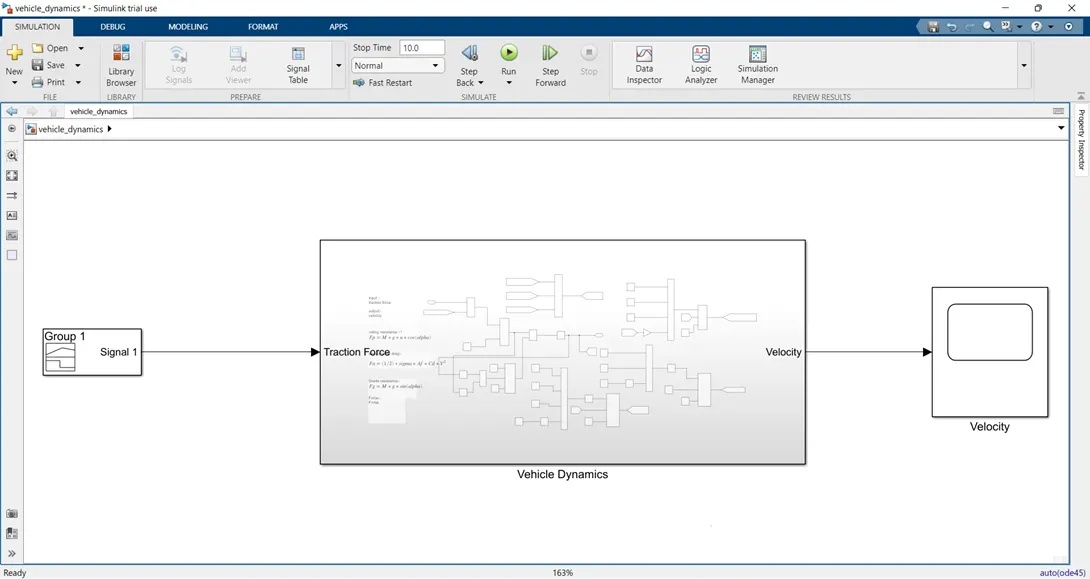
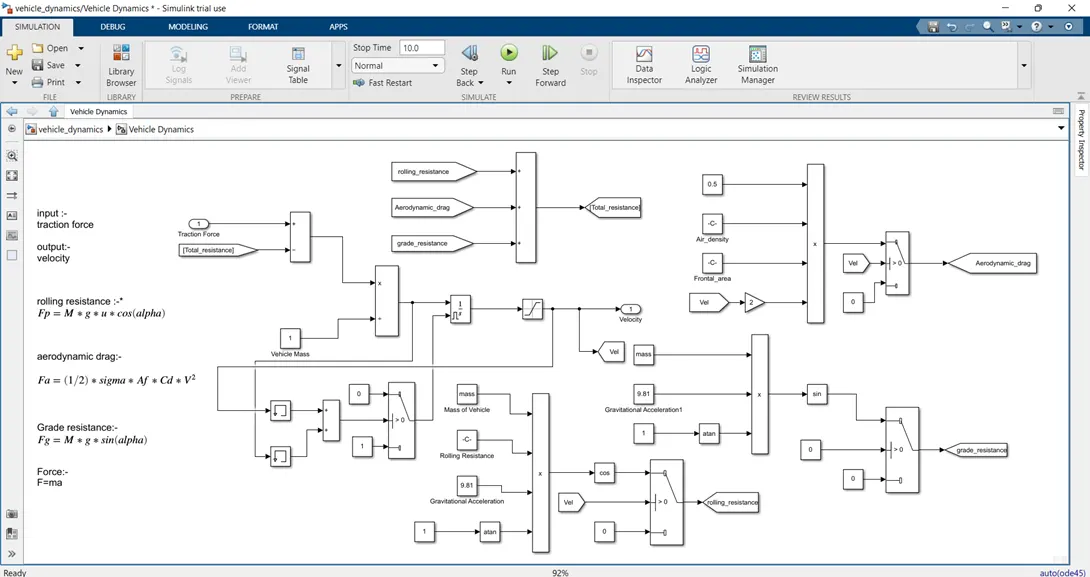
The mass of the vehicle is taken as 2000kg
Frontal area as 2 m^s
Rolling resistance coefficient as 0.15
Air density as 0.019
This variables were created in the workspace.
The model is been developed as shown above and the signal builder block is been used to given the driving command to the vehicle and the scope is used to observe the velocity of the vehicle.
In the above model the saturation blocks are been used to saturate the output in the desired range and even the logic is been created with the help of switch blocks to add the resistances only when the vehicle is in motion or actually the forces are acting on the vehicle at that that time only.