Week 7 Challenge
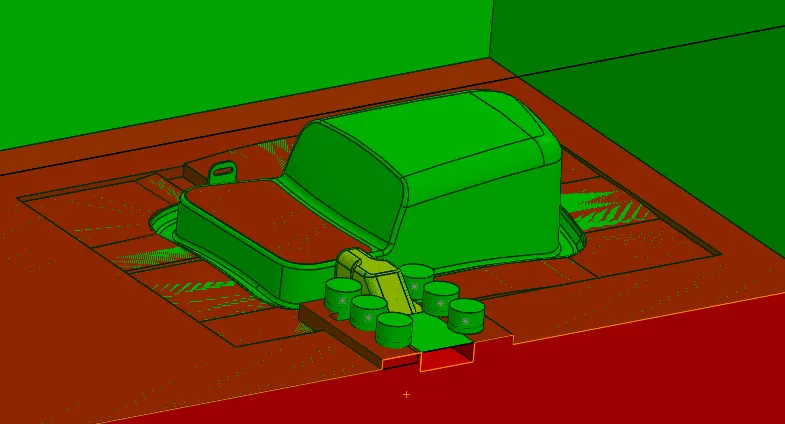
Aim: To create 2 sliders for the 2 undercuts present in the model
Undercuts: Any indentation or protrusion that prevents a part from being ejected from a mold is known as an undercut. It is a quality that the cavity and core by themselves are unable to capture. Because it is die-locked, the part cannot be ejected from the cavity.
- Undercuts are provided by employing Sliders.
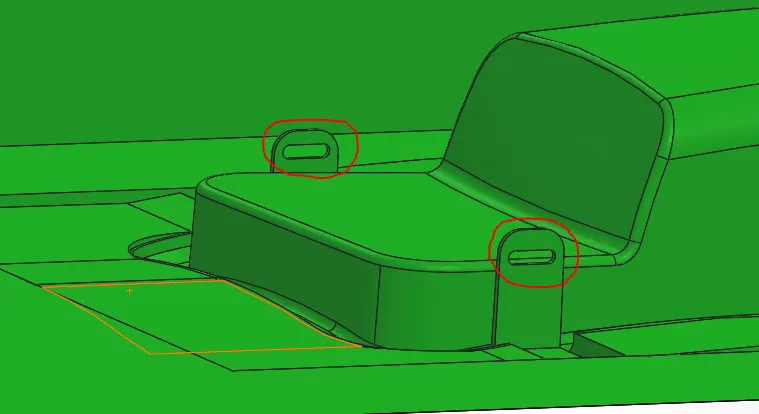
Undercuts in the model
Sliders: An action device may be necessary in the mold for a product design that has elements that are below but parallel to the principal parting line of the mold. This requires a technique for removing a portion of the mold so that the product can be ejected. When an entire portion needs to move, such a section is referred as a slide since it is said to "slide" out of the way.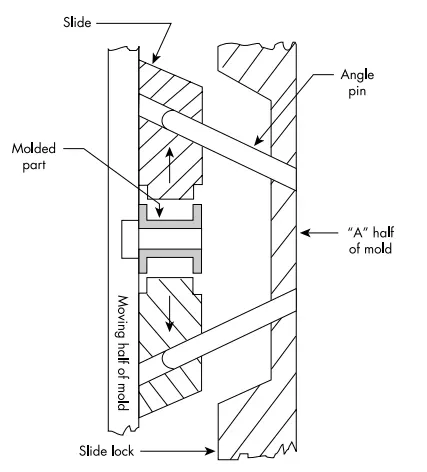
- When the slide is in the forward position, it shuts off against the rest of the cavity set and creates a sealing area to contain the incoming molten plastic.
- When the slide is in the back position, the face is moved out of the way so it will not interfere with the ejection of the molded part from the mold.
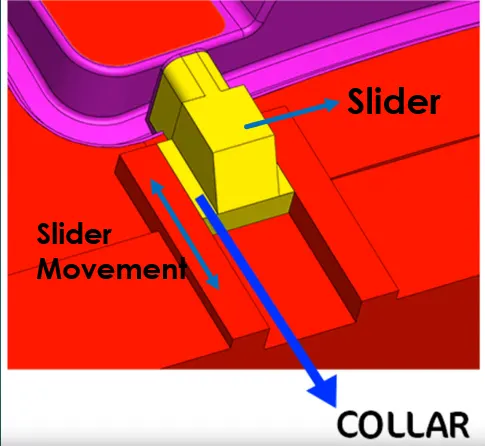
- The slide can be activated by various means including angled pins, hydraulic cylinders, and rack-and-pinion devices.
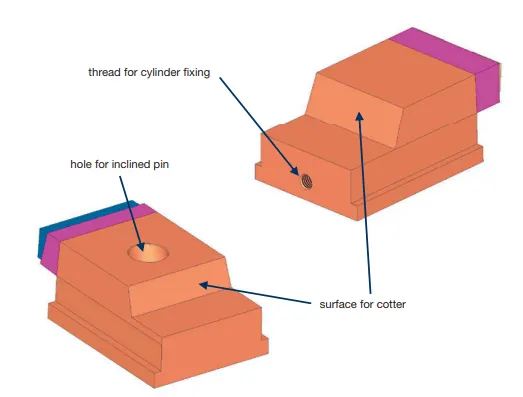
- A stop is added to the area at the rear of the slide travel to ensure the slide cannot move beyond the intended rearward travel.
- However, due to the side forces from the injection pressure used in the molding process, the slide actions are pushed slightly away from the cavity sections. This causes flash and dimensional discrepancies to occur on the molded part. To overcome those side forces, locking mechanisms are usually incorporated.
Inclined Pin Slides: The inclined pin enters the holes of the slide. The mold closes. Through the sloping surface of the inclined pin the inner side of the pin pushes the slide in the mold in a resulting movement. When the mold opens, the pin’s outer side pulls the slide out from the mold. The inclined pin pulls until it is out of the slide again. This way is not random but is the calculated distance that the slide must move. It locks at this position so that the pin meets the hole again during the next closing.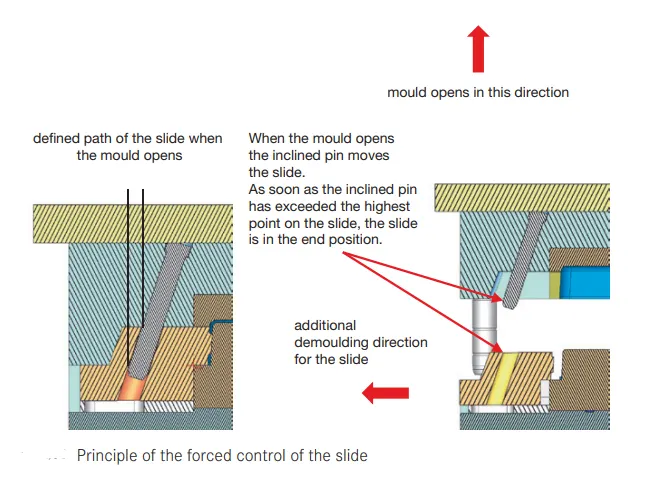
Hydraulic Cylinder actuated Slide: After the inclined pin, the cylinder is the second type of movement of a slide. Hydraulic oil is used as operating medium for the cylinder. The pneumatic pressure is not sufficient for the movement. Oil is not compressed; the power of a hydraulic cylinder is much higher than with air. Despite its power, the hydraulic cylinder is used only to move the slide. For locking the mould, also in moulds with cylinders, a cotter is used. On the hydraulic cylinder or the slides, switches should be built on to monitor the position of the slide in the mould, both in the closed mould and at its end position in the open mould.
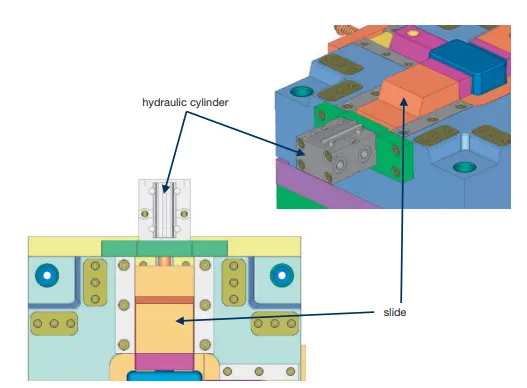
- Cavity Blcok With Slider
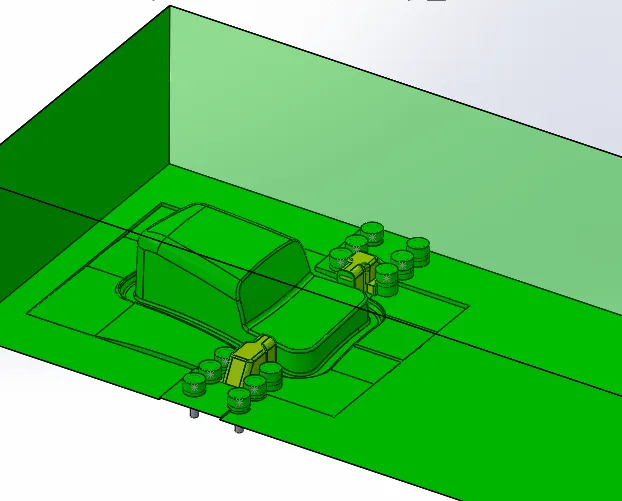
- Core Block With Slider
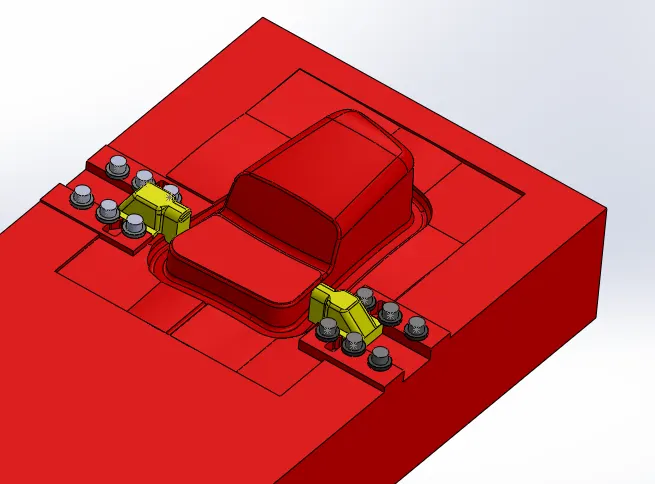
- Assembly