Week 7 Challenge
Aim: To elaborate and explain theoretical questions on Pile and Well Foundations:
For Pile Foundation
- To elaborate on how to fix number of piles in the deep foundations in a flyover in Delhi, listing all the loads acting on it and making all the combinations as per IRC 6.
- To explain what are the different factors that can impact the number of piles and its depth.
- To explain how it is different in wall type abutment and pier (free and fixed).
For Well Foundation
- To elaborate on how to fix the diameter of well in the deep foundation in a river bridge in Delhi, listing all the loads acting on it and making all the combinations as per IRC 6.
- To explain the different factors that can impact the diameter of well and its depth.
- To explain how it is different in wall type abutment , fixed and free pier.
Additional Application based questions:
- What is free standing length in a pile system and how to determine this? Also list all the applicable code clauses from IRC and IS codes.
- What will be the impact of free-standing length on the full length of the pile?
- Roughly determine no. of piles on abutment of height 5 m and width of 12 m.
- Vertical capacity – 250 tonnes
- Horizontal capacity-35 tonnes
- List out failures in deep foundations and their remedies as per the codal provisions.
What all construction parameters need to be taken care of before planning a deep foundation
Question 1:
How to fix number of piles in the deep foundation?
Answer :- Piles are the structural component which comes under the deep foundation. The function of the pile is to transmit a load of a structure to competent sub-surface strata by the resistance developed from bearing at the toe or skin friction along the surface of both. Piles also carry uplift pressure and lateral load.
No of piles that are required in deep foundation is calculated by using the below formula,
Number of piles = Safe bearing capacity of soil/pile capacity.
Where,
Safe bearing cpacity (SBC) which is carrying maximum pressure that soil can carry safely without risk of shear failure and it is calculated after geotechnical investigations.
Lateral load capacity of a single pile depends on the soil reaction developed and the structural capacity of the shaft under bending. Pile capacity depends also on soil property and other factor like type of soil present in that loacation (All the important consideration for finding pile capacity is referred from IS 2911 code).
Following are the loads which acts on the structure.
- Dead load
- SIDL
- Vehicular Live Load.
- Breaking Force.
- Live Load surcharge.
- Earth pressure (In abutment)
- Water Current Load.
- Wind Load.
- Temperature Load.
- Earth quake load.
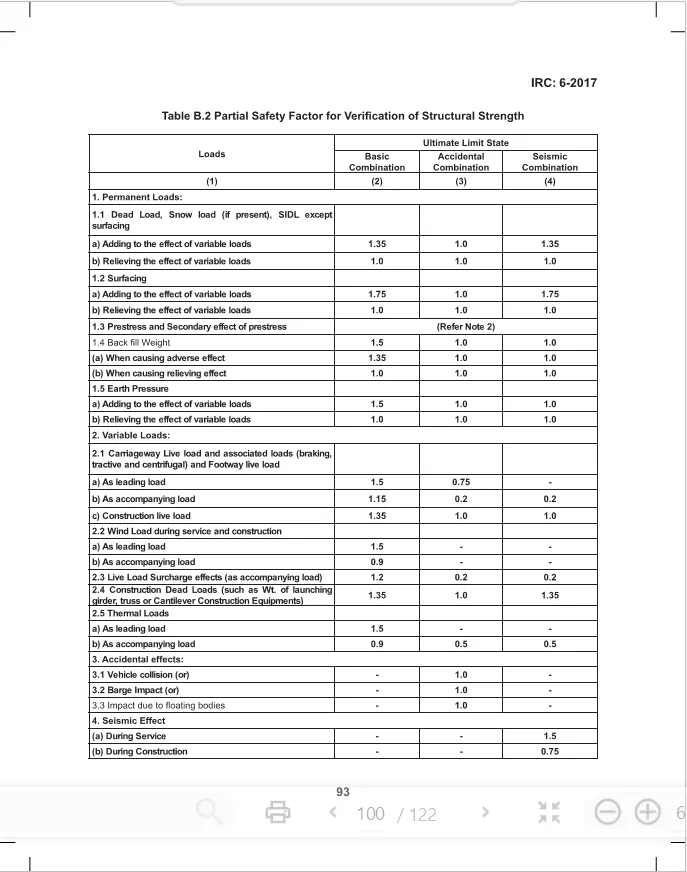
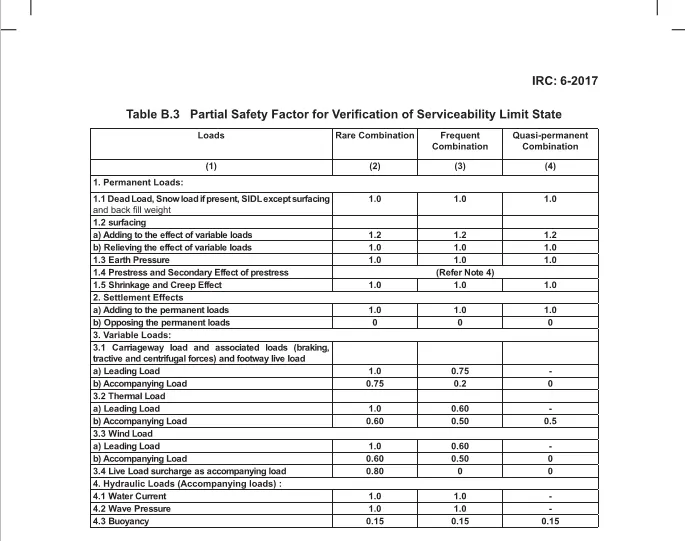
And all the load combination done using ULS and SLS method referring from IRC 6.
ULS combination
SLS Rare & Combination
Following are the factors which impact the number of piles and its depth:
- Safe bearing capacity of soil and and pile capacity.
- Property of soil in that location.
- Spacing in piles and diameter of piles.
- Settlement occurs in pile group.
- Load from superstructure.
- Material availabe on site.
For the abutment, overturing factor is considered due to earth pressure load which is why number of piles required is more as compared to pier.
Question 2:
How to fix the diameter of well in the deep foundation in a river bridge in Delhi, listing all the loads acting on it and making all the combinations as per IRC 6.
What are the different factors that can impact the diameter of well and its depth.
How it is different in wall type abutment , fixed and free pier.
Answer :- Well foundation is a type of deep foundation which is generally provided below the water level for bridges. There are several factors which decide the diameter of well foundation in river bridges such as property of soil, mean velocity of water flowing in the river, base pressure, uplift pressure etc. Several limiting value is given in the code such as minimum dimension of dredge-hole shall not be less than 3 M, and external diameter of singular circular not exceeds 12 M.
Following are the loads which acts on the structure.
- Dead load
- SIDL
- Vehicular Live Load.
- Breaking Force.
- Live Load surcharge.
- Earth pressure (In abutment)
- Water Current Load.
- Wind Load.
- Temperature Load.
- Earth quake load.
And all the load combination done using ULS and SLS method referring from IRC 6.
ULS combination
SLS Rare & Combination
Following are the factors which impacts the diameter of well and its depth.
- Property of soil.
- Sinking process.
- While sinking whole well inside the ground it may be tilt, that measures we may be take.
- Depth of water.
- Scouring zone.
Question 3:
What is free standing length in a pile system and how to determine this?
Also list all the applicable code clauses from IRC and IS codes.
Answer :- The length of piles which comes under scour depth and liquification zone is known as free standing length in pile system. Piles under scouring and liquification is an important criteria considered for designing the pile foundation. For free standing length, we have to take different criteria like providing Liner in that length.
Codes which are used to design and contruct pile are IRC 78, IS 2911
Important clauses we is use in the Code are:
In IRC 78: Clause no 703 (discharge and depth of scouring for foundation desing) is used to find free standing length in pile system.
Clause no 706 for loads, forces, stability and stress in foundation design.
Clause no 708 for detail about well foundation.
Clause no 709 for detail about Pile foundation.
IS 2911 code is all about pile foundation design and construction.
Question 4:
What will be the impact of free-standing length on the full length of the pile?
Roughly determine no. of piles on abutment of height 5 m and width of 12 m.
Vertical capacity – 250 tonnes
Horizontal capacity-35 tonnes
Answer :- If the free standing length is increased then the height of piles will also increase. We have to provide height of pile including free standing length. Pile surface may be exposed to open surface due to which economy cost of pile also increases and environment impact also occurs on the pile. For that, we have to maintain the structure regularly.
Given data :-
- Height of abutment = 5 M
- Wight of abutment = 12 M
- Vertical capacity = 250 tonnes
- Horizonatal capacity = 35 tones
To Calculate No of pile required in foundation.
Assuming total load from the structure is 3500 T
So,
= Total load from structure / Veritical capacity.
= 3500 / 250
= 14 Nos of pile required.
Total piles required in foundation is 14 Nos
Question 4:
List out failures in deep foundations and their remedies as per the codal provisions.
What all construction parameters need to be taken care of before planning a deep foundation.
Answer :-
Following are failure in deep foundation and there remedies.
- Unequal settlement of the sub-soil
- Horizontal movement of the soil adjoining the structure.
- Tilt and tolerance failure.
- Lateral pressure tending to over- turn the structure
- lateral escape of the soil below the foundation
- Rcc failure.
- Buckling of piles.
- Breaking of piles.
- Tension failure of concrete pile for lack of reinforcemen.
- Disintegration of concrete due to poor quality of concrete or reactive aggregate.
Remedies to prevent failure of pile foundation:
- Early repair such as encasement or replacement
- Removal of partial load
- Underpinning
Construction parameter use in deep foundation.
- Protective works i.e. cofferdam, sheet pilling to be done around the foundation.
- Site clearence adn boring shall be done as per indian standerd.
- Lowering the steel cages after clearing.
- Casting the piles by pouring wet concrete.
- Bottom plug sink & top plugging in case of well.