Week 6 - CHT Analysis on a Graphics card
Graphic Card
Aim: To perform a steady-state conjugate heat transfer analysis on a model of a graphics card.
Objectives:
- Running the simulation for at least 3 velocities and discuss the results.
- Running simulation for coarse and fine mesh
- Finding maximum temperature and heat transfer coefficient attained by the processor.
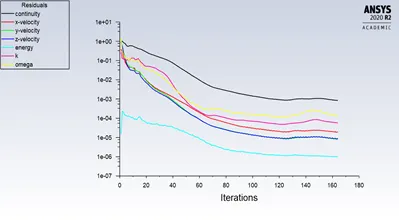
- Proving that the simulation has achieved convergence
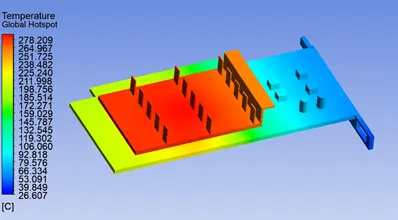
- Identifying potential hotspots on the model.
Theory: The Conjugate Heat Transfer (CHT) analysis consists of simulation of heat transfer between solid and fluid domains by exchanging thermal energy at the interfaces between them.
Application: Simulation of heat exchangers, cooling of electronic equipment, and general-purpose cooling and heating systems.
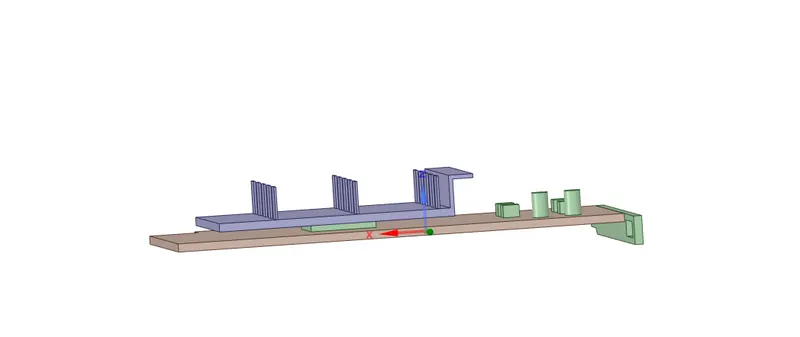
Geometry
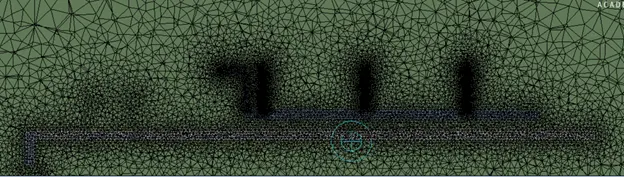
Meshing
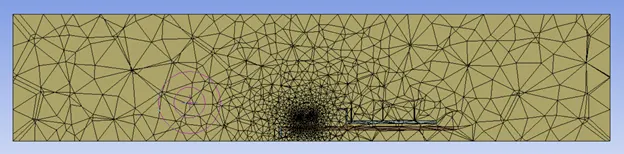
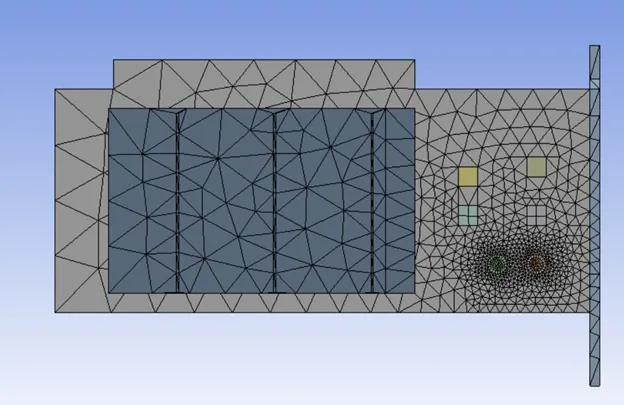
Baseline Mesh
Element size: 10.2 mm
Nodes: 15921
Elements: 84878
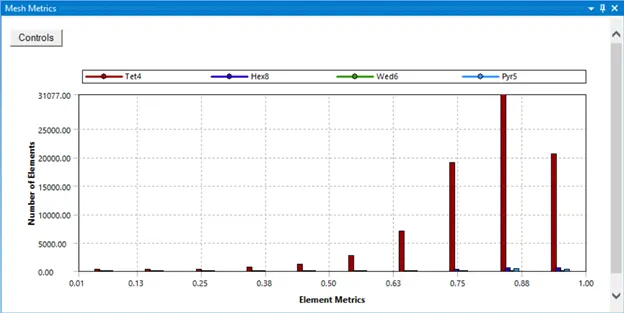
Mesh Quality
Refined Mesh
Element Size: 2 mm
Nodes: 697588
Elements: 4105653
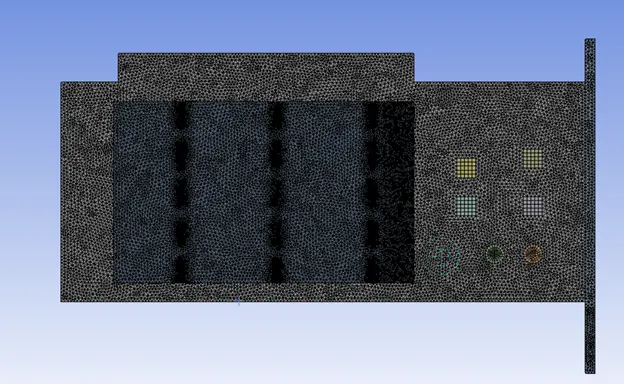
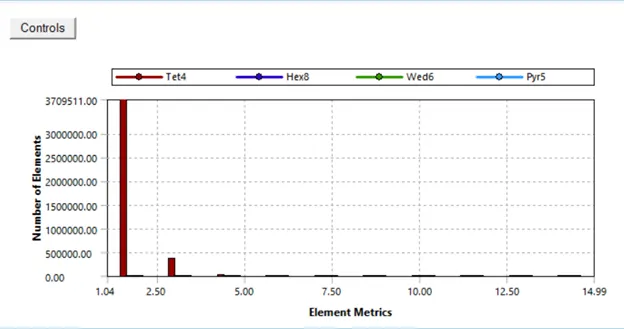
Mesh Quality
|
Mesh |
Nodes |
Elements |
|
Coarse |
15921 |
84878 |
|
Refined |
697588 |
4105653 |
Solver Setup
Pressure Based Solver
Steady State
Energy Equation on
Turbulence Model: K-Omega SST
Materials
|
Component |
Material |
Density (kg/m^3) |
Specific Heat (j/kg-k) |
Thermal Conductivity (w/m-k) |
Viscosity (kg/m-s) |
|
Processor |
Gold |
19320 |
129.81 |
297.73 |
- |
|
Fins |
Aluminium |
2719 |
871 |
202.4 |
- |
|
Base |
Steel |
8030 |
502.48 |
16.27 |
- |
|
Domain |
Air |
1.225 |
1006.43 |
0.0242 |
1.7894e-05 |
Boundary Conditions
|
Case 1 |
Case 2 |
Case 3 |
|
|
Inlet Velocity (m/s) |
3 |
1 |
5 |
Initialization Method: Hybrid
Time Step Size: 1
No of iterations: 500
Results
|
Velocity = 3m/s |
Baseline mesh |
Refined Mesh |
|
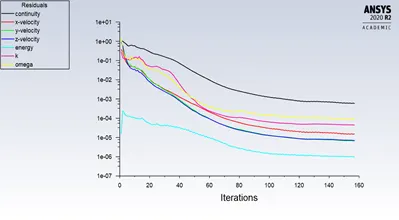
Residuals |
 |
 |
|
Remarks |
From the above plots, we can see that the simulation has converged |
|
|
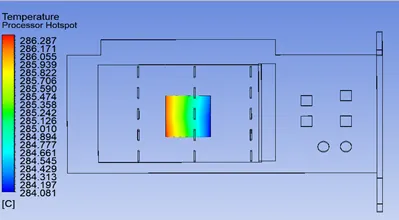
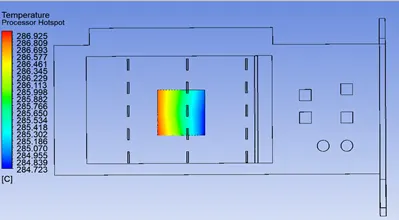
Processor Hotspot |
 |
 |
|
Remarks |
The Maximum temperature is 286.29⁰ C |
The maximum Temperature is 286.93⁰ C |
|
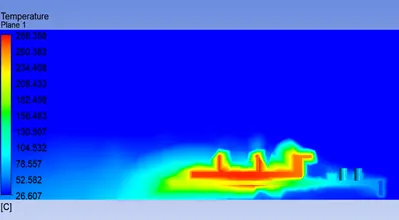
Global Hotspot |
 |
|
|
Remarks |
Maximum Temperature is 278.2⁰ C |
Maximum Temperature is 278.83⁰ C Minimum Temperature is 26.6⁰ C |
|
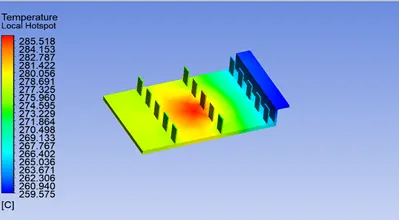
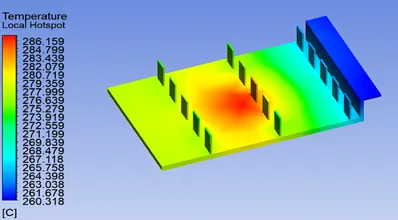
Local Hotspot (Fins and Processor) |
 |
 |
|
Remarks |
The Maximum Temperature is 285.52⁰ C |
The Maximum Temperature is 286.16⁰ C |
|
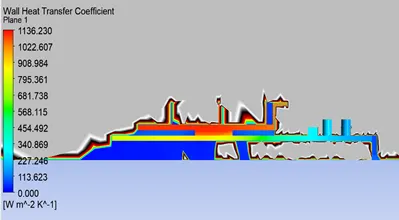
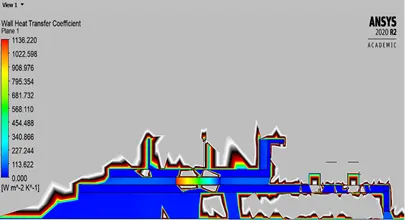
Wall Heat Transfer Coefficient |
|
 |
|
Remarks |
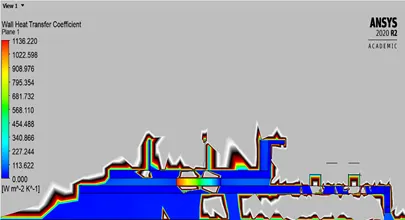
The Maxiumum Wall Heat Transfer Coefficient is 1136.23 Wm^-2K^-1 |
The Maxiumum Wall Heat Transfer Coefficient is 1136.23 Wm^-2K^-1 |
|
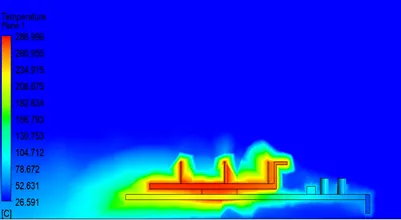
Temperature Contour |
 |
 |
|
Velocity |
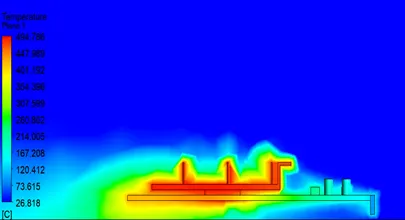
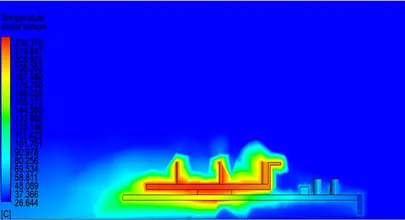
1 m/s |
5 m/s |
|
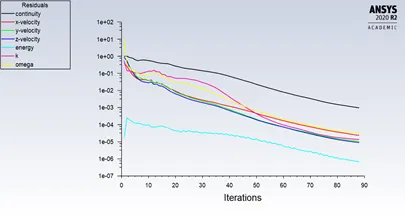
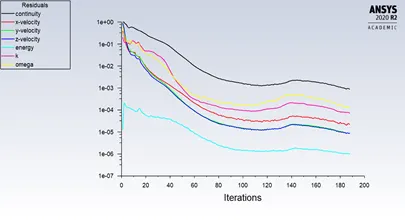
Residuals |
 |
 |
|
Remarks |
From the above plots we can see that the simulation has converged |
|
|
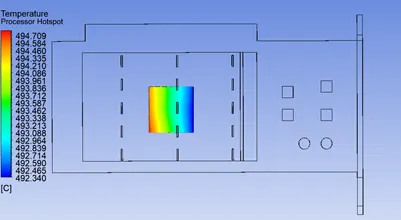
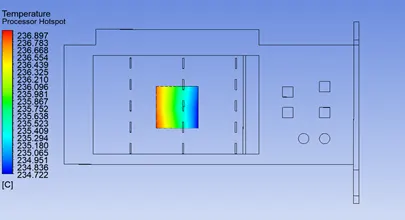
Processor Hotspot |
 |
 |
|
Remarks |
The Maximum Processor temperature is 494.7⁰C |
The Maximum Processor Temperature is 236.9⁰C |
|
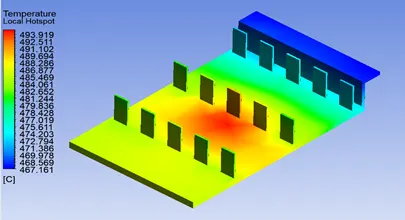
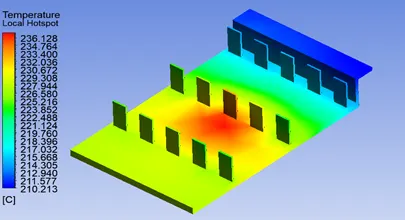
Local Hotspot (Fins and Processor) |
 |
 |
|
Remarks |
The Maximum Temperature is 493.92⁰C |
The Maximum Temperature is 236.13⁰C |
|
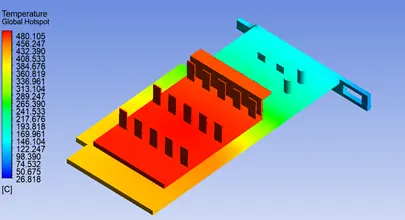
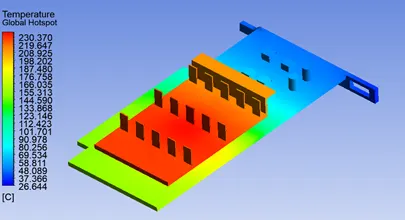
Global Hotspot |
 |
 |
|
Remarks |
The Maximum Temperature is 480.10⁰C The Minimum Temperature is 26.82⁰C |
The Maximum Temperature is 230.37⁰C The Minimum Temperature is 26.64⁰C |
|
Temperature Contour |
 |
 |
|
Wall Heat Transfer Coefficient |
 |
 |
Conclusion
|
Velocity |
Coarse Mesh (3m/s) |
Refined Mesh (3m/s) |
1 m/s |
5 m/s |
|
Maximum Processor Temperature (⁰C) |
286.29 |
286.93 |
494.7 |
236.9 |
|
Wall Heat Transfer Coefficient |
1136.23 |
1136.23 |
1136.23 |
1136.23 |
The Maximum Temperature doesn’t change if mesh quality is changed.
The maximum temperature decreases when the cooling fluid passes over the graphic card at a higher velocity.
The fins closer to the processer get heated up more.