Week 5 - Rayleigh Taylor Instability
Aim
Perform and compare the Rayleigh Taylor instability simulation for 2 different mesh sizes and a different fluid with the refined mesh
To explain the effect of mesh size on simulation.
To show a steady-state approach might not be suitable for these types of simulation
Define and find Atwood number
To explain how the variation in Atwood number affects the behaviour of the instability.
Introduction: The Rayleigh–Taylor instability, an instability of an interface between two fluids of different densities which occurs when the lighter fluid is pushing the heavier fluid.
Theory: Rayleigh-Taylor (RT) instability takes place when a lighter fluid supports a heavy fluid, then any perturbation of the interface grows and leads to spikes of the heavier fluid penetrating into the lighter one and the interface becomes unstable. The contact discontinuity between the two fluids is unstable to perturbations that grow by converting potential energy to kinetic energy, causing bubbles of the low-density fluid to rise, and spikes of the high-density fluid to sink. If the light fluid is above the heavy fluid, the interface is stable.
Examples:
Water suspended above oil in the gravity of Earth, mushroom clouds like those from volcanic eruptions and atmospheric nuclear explosions, supernova explosions
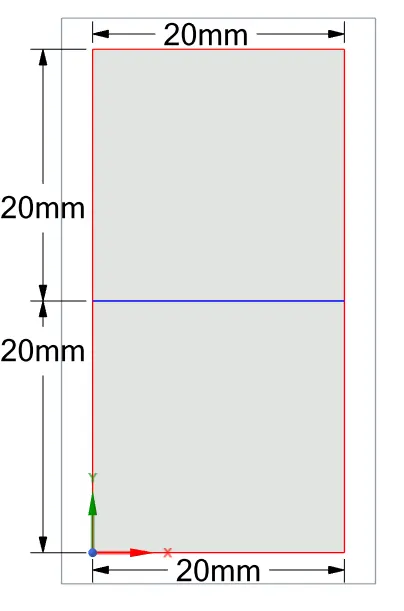
Geometry
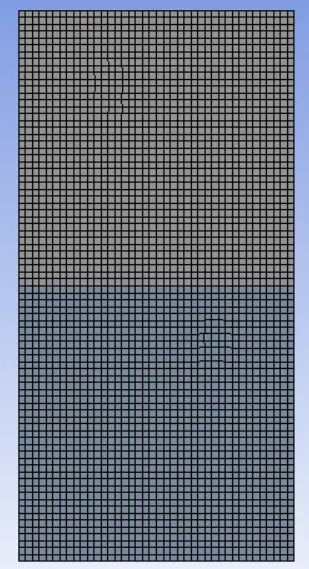
Mesh
Case 1
Element Size: 0.0005 m
Nodes: 3321
Elements: 3200
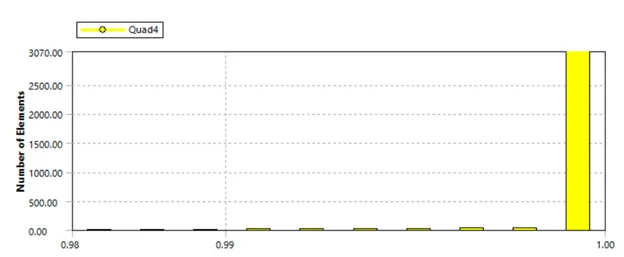
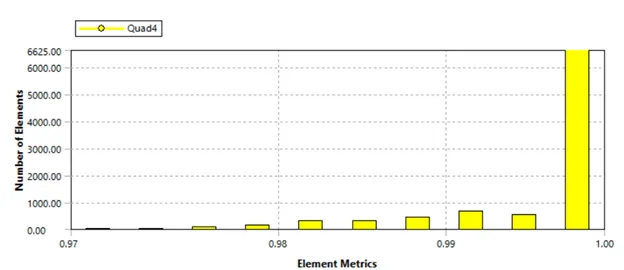
Element Quality
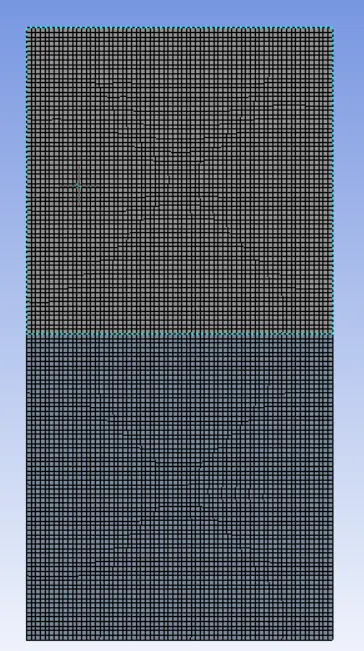
Case 2 & 3
Element Size: 0.0002 m
Nodes: 9180
Elements: 8978
Element Quality
Solver Set up
Type: Pressure Based
Time: Transient
Gravity enabled
Gravitational Acceleration: -9.81 in Y direction
Turbulence Model: Laminar
Multiphase Model: Volume of fluid, Implicit
Materials ( Case 1 and 2)
Primary Phase: Air
Density: 1.225 Kg/m^3
Viscosity: 1.78*10^-5
Secondary Phase: Water
Density: 998 Kg/m^3
Viscosity: 0.001003
Materials Case 3
Primary Phase: User
Density: 400 Kg/ m^3
Initialization Method: Standard
Patch:
Water Volume fraction
Water surface: 1
Air Surface: 0
Time step size: 0.005
No of time steps: 1000
Result
Case 1
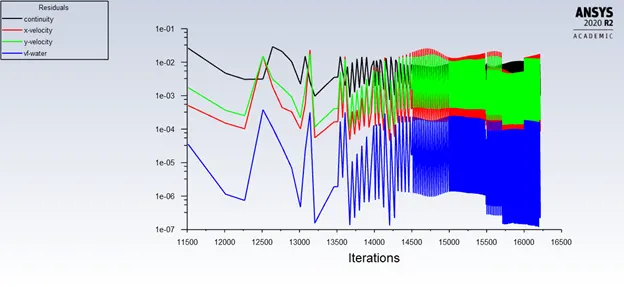
Case 2
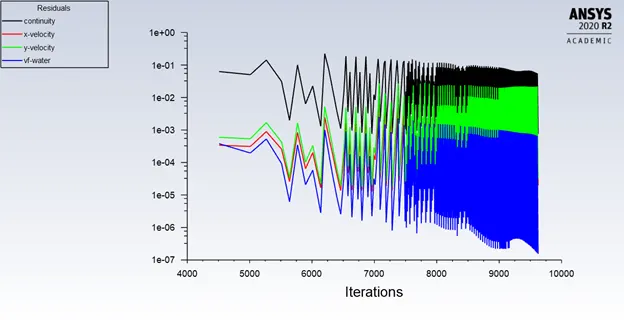
Case 3
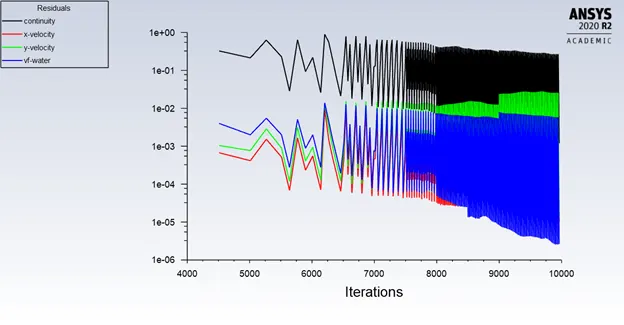
Observation
While observing the first two cases with the same material but finer mesh size, we notice that the vortices, bubbles and shockwaves are much more apparent with finer mesh size.
When a denser material than air is used, it takes longer to settle down and reach equilibrium.
Steady state solution is not used as the aim is to capture the transition of the fluids and not the end result.
Atwood Number
The Atwood number (A) is a dimensionless number in fluid dynamics used in the study of hydrodynamic instabilities in density stratified flows. It is a dimensionless density ratio defined as:
A= ρ1 - ρ2/ ρ1 + ρ2
where
ρ1 = density of heavier fluid
ρ2 } = density of lighter fluid
Case 1 and 2
A= 998-1.225 / 998 + 1.225 = 0.99
Case 3
A = 998-400/998+400 = 0.43
For low Atwood number, the instability is symmetrical and linear for a larger time.
For large Atwood number, the growth rate is non linear and the instability is less symmetrical.