Week 6 - CHT Analysis on a Graphics card
Aim: To perform CHT analysis on a graphics card with velocity variation 1 m/s to 5 m/s with any three random values.
To find the maximum temperature and heat transfer coefficient attained by the processor.
prove that simulation has achieved convergence with relevant plots.
To identify the potential hotspots.
What is the meaning of CHT ??
Heat transfer is the movement of thermal energy due to the temperature difference. There are three modes of heat transfer a)conduction b)convection c)radiation
a)conduction: In conduction heat is transferred with the help of molecular vibration and movement of free electrons in the material, It is the dominating mode of heat transfer for solid objects. The rate at which heat will be transferred from one place to another is governed by Fourier's law of conduction.
Fourier's Law Of Conduction:
The rate of heat flux is directly proportional to the thermal conductivity of the object and the temperature gradient in that direction
Heat transfer in the x-direction
`dot q_{x}=-k_{x}*A_{x}*(delT)/(del x)`
b)convection: In convection heat is transferred with the help of bulk motion of fluid around the solid object. Heat transfer by convection is governed by
`dot q = h*A_{s}*DeltaT`
c)Radiation: This type of heat transfer in which heat is transferred with help of electromagnetic waves. It does not require any medium. Heat transfer is governed by
`dot q=sigma*A*T^4`
CHT is referred to as the conjugate heat transfer in which both conduction as well as convection are involved in heat transfer. The conjugate heat transfer is involved where fluid and solid objects are transferring the thermal energy.
The graphics processing unit is the active component of heat generation so it is required to distribute heat so that the temperature of the GPU will not increase above a certain point. The heat is distributed with the help of fins, base, and forced convection. If the temperature of the GPU is not maintained properly the performance of GPU will decrease so it is required to design a proper cooling system for the GPU.
The heat transfer from the GPU occurs by fins, base, and air. Fins and the base will help with conduction and air will take away heat by convection. For increasing the heat transfer by conduction it is required to select material with higher thermal conductivity or we can increase the cross-sectional area of fin or base but due to space constrain it's not possible.
So the other option is to select the material with higher thermal conductivity. But if our aim is to increase further then it is necessary to increase heat transfer by the convection. The heat transfer by the convection depends on the surface area, temperature difference as well as surface(convective) heat transfer coefficient(h). The temperature difference is not in our hands so we have to increase the h.
convective heat transfer coefficient depends on
- type of flow (laminar, turbulent)
- type of fluid
- surface roughness
PRE-PROCESSING
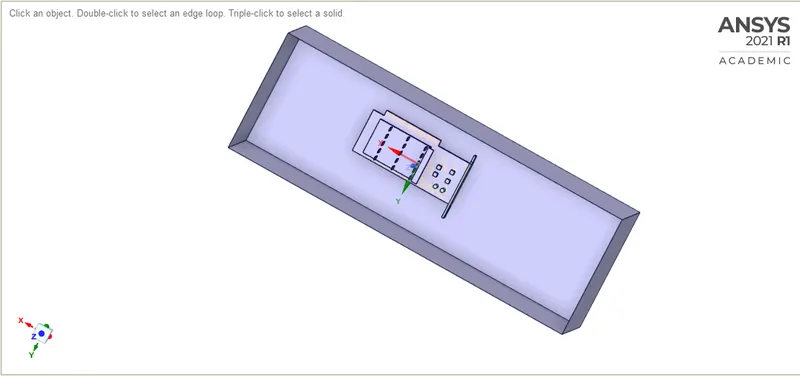
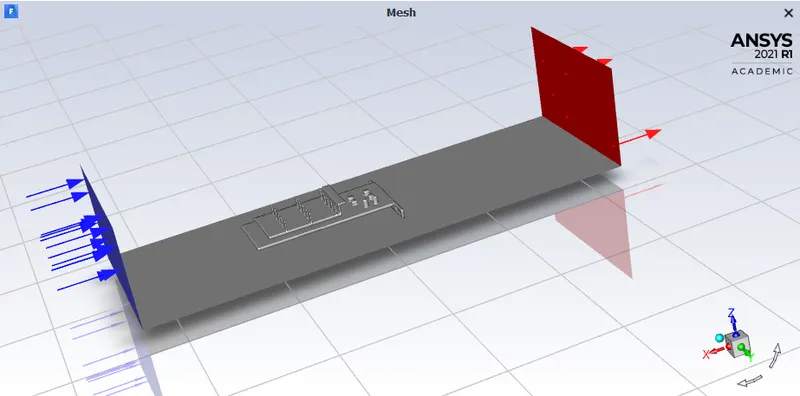
As shown in the figure the Graphics card unit is imported in the SpaceClaim.Inlet is in the negative x-direction.
Dimensions of enclosure
Length=191mm, width=65 mm, Height=40.505 mm
Cross-Sectional Area in x direction =2632.825 mm2
wetted perimeter(l)=211.01 mm
Reynold's number calculation for the flow
freestream velocity=1 m/s
wetted perimeter=l=211.01 mm
cross-sectional area=2632.825 mm2
Hydraulic Diameter=Dh=49.90 mm
`R_{e}=(rho*u_{infty}*D_{h})/mu`
=3377.2099
Re>2000 the nature of flow is turbulent.
Topology is selected as share so that we get the conformal mesh through out domain and information can run easily.
MESHING
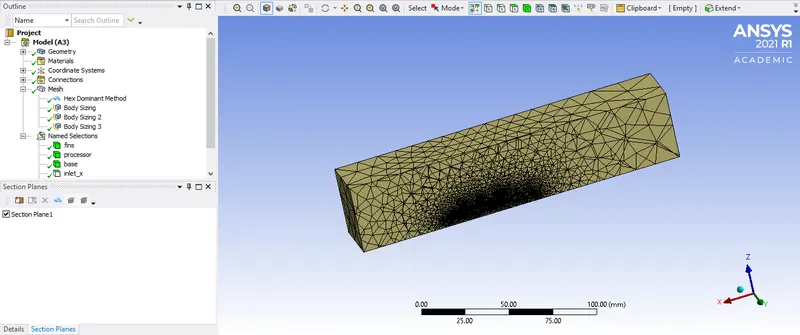
For meshing the body sizing is selected for the fins, base and processor.
Case 2
fins:element size =1mm
base :element size=1mm
processor :element size=1 mm(hex dominant)
total elements=239443
Case 2
fins:element size 0.8mm
base :element size=0.8mm
processor :element size=0.8 mm(hex dominant)
total elements=295958
Case 3
fins:element size:0.5 mm
base :element size :0.8 mm
processor :element size:0.6 mm
Total elements:451968
| GRID INDEPENDENCE TEST | ||||
| Number of elements | Maximum temperature of GPU | surface heat transfer coefficient | the area-weighted temperature of GPU | |
| 239443 | 324.147 | 4.4547 | 323.9969 | |
| 295958 | 324.0595 | 4.3659 | 323.9052 | |
| 451968 | 323.8448 | 4.8473 | 323.6719 | |
From the grid independence test, we can conclude that there is not much change in maximum temperature as well as the area-weighted temperature of the processor with increasing the mesh refinement so increasing cells further will only increase the computational time.
So further Simulation is carried out with the mesh setup of Case 3(451968)
SOLVING
Solution Setup for the simulation
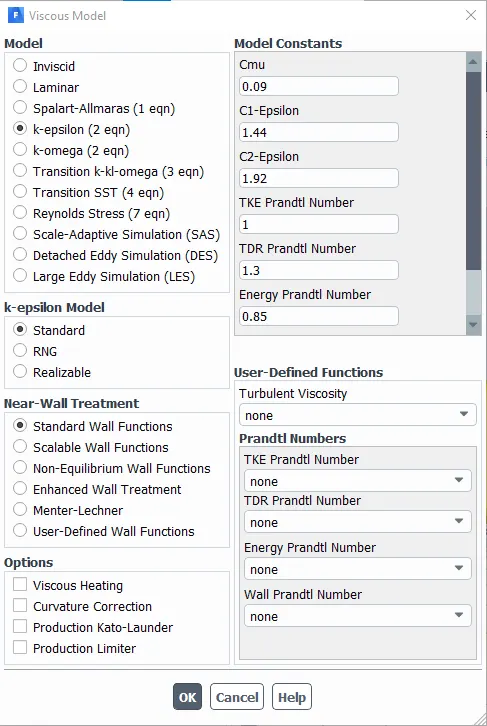
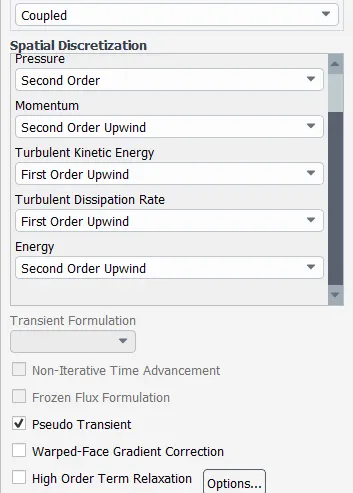
Here Re>2000 for the internal flow so viscous model chosen is K-epsilon turbulence model with standard wall function.
The solution method is selected as coupled, and the pseudo transient model it will give faster convergence for the simulation.
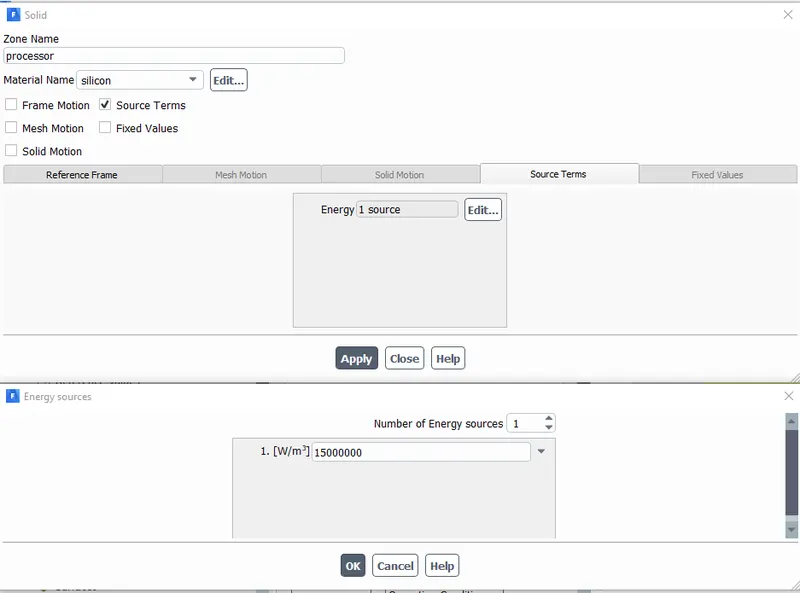
Heat Generation in Processor
The processor consumed 0.96 W/mm3 power so the source term is 15000000 W/m3.
Materials Used For Domain
| Material | Density(kg/m3) | Specific Heat(J/kg*K) | Thermal Conductivity(W/mK) |
| Aluminum | 2719 | 871 | 202.4 |
| Fr-4 | 1850 | 950 | 0.29 |
| Silicon | 2329 | 710 | 149 |
| Air | 1.225 | 1006.43 | 0.0242 |
POST-PROCESSING
Free Stream Velocity=1 m/s
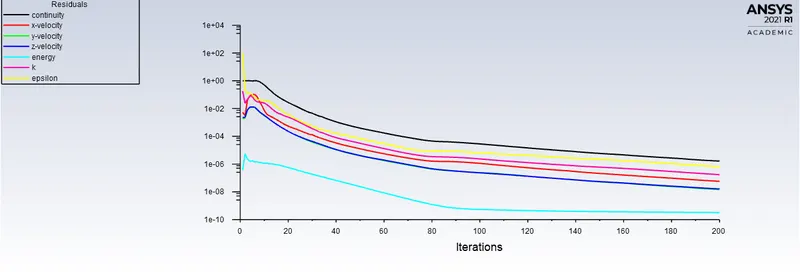
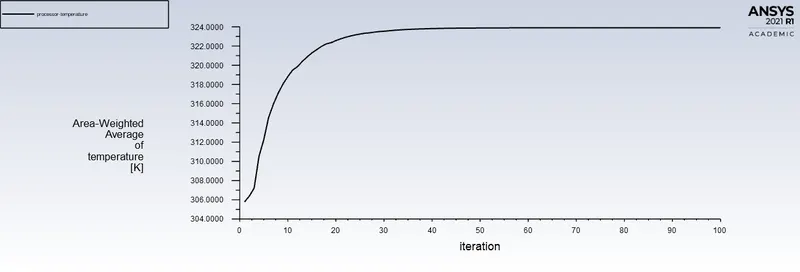
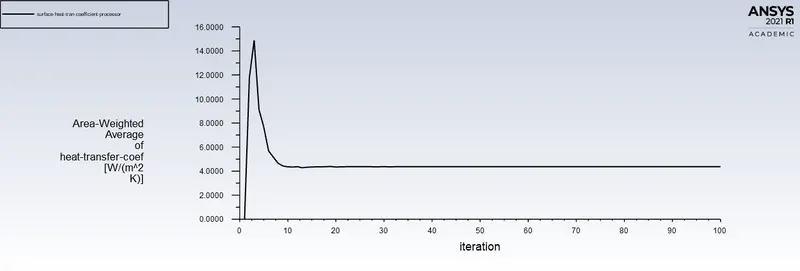
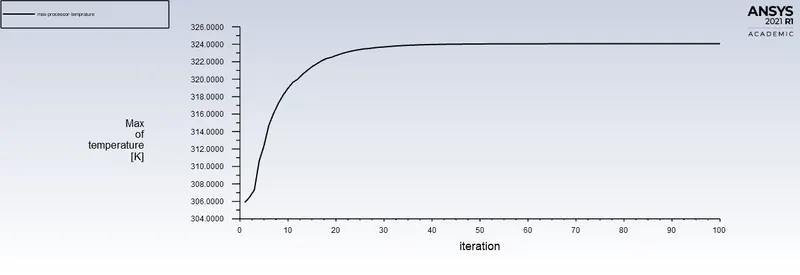
Convergence:
From the plots of surface heat transfer coefficient, the maximum temperature of processor we can see that solution is converged near about 50 iterations.
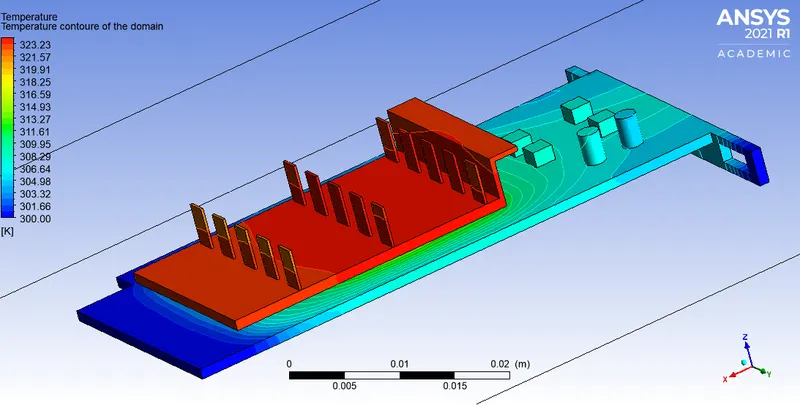
FOR `U_{infty}=1 m/s`Temperature distribution on domain
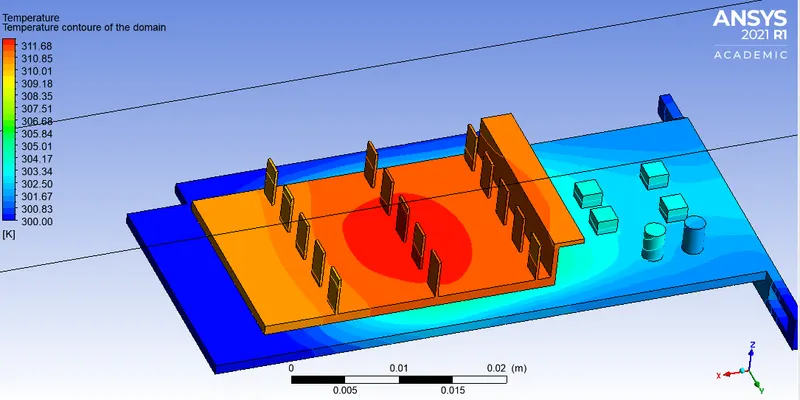
For `U_{infty}=3 m/s` Temperature distribution on domain
`"for " U_{infty}=5 m/s` Temperature distribution on domain
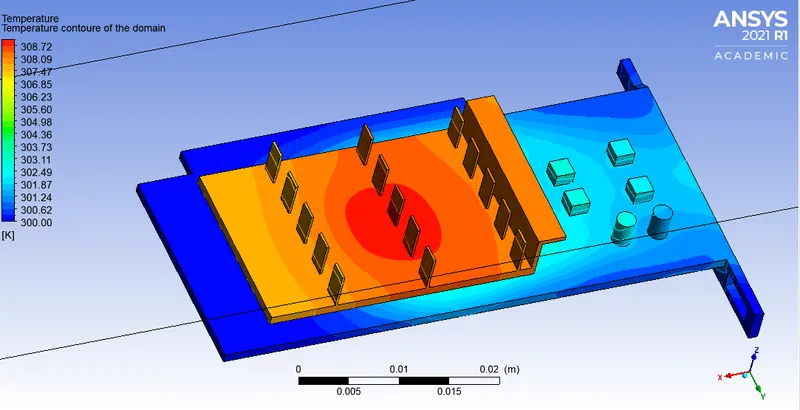
From the figure, we can conclude that the high-temperature zone is in the middle of the fins which is above the processor, so the potential hotspot is considered as fins as well as processor.
Local Temperature Distribution For Fins and base for `U_{infty}=5 m/s`
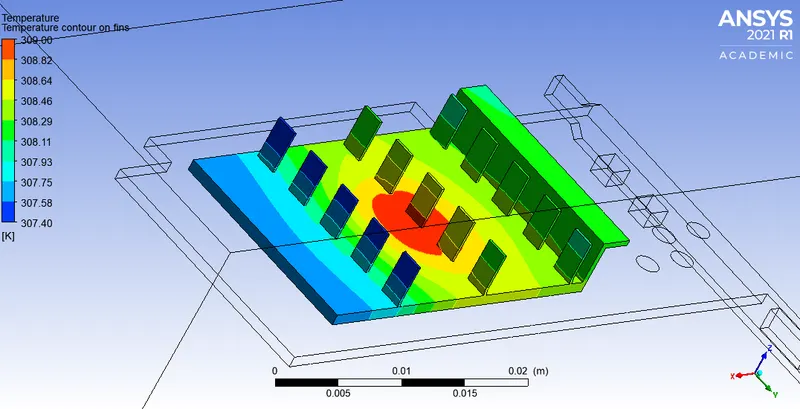
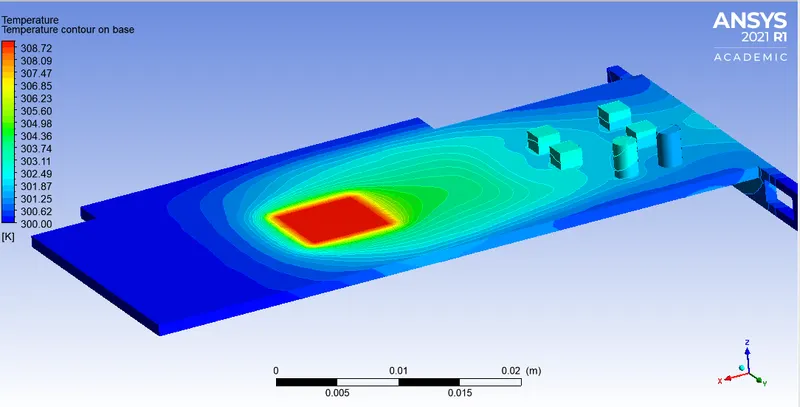
Potential Hotspots on Fins and Base.
| Effect of velocity | |||
| Velocity | Max Temperature | Avg Temperature | Avg h |
| 1 m/s | 323.8448 | 323.6719 | 4.8473 |
| 3 m/s | 312.1038 | 311.9351 | 7.06474 |
| 5 m/s | 309.03 | 308.8645 | 9.1425 |
Conclusion:
1)Increasing the `U_{infty}` will reduce the maximum temperature of the processor.
2)Increasing the `U_{infty}` will reduce the Area weighted temperature of processor.
3)Increasing the `U_{infty}` will increase convective heat transfer coefficient.