Week-6 Challenge: EV Drivetrain
AIM:- Understand the EV & HEV Drivetrain, Power circuits, and basics of Induction & DC Motors.
Objective:-
- To Understand different power converter circuits, used in Electric and Hybrid Electric Vehicles.
- Calculate the EV steady-state speed of the following question.
- To understand the importance of the Motor working principle. And its selection in EV & HEV As per requirement.
#Ques 1- Which types of power converter circuits are employed in an electric and hybrid electric vehicle?
Introduction:- With the increasing interest in energy efficiency, energy cost, and environmental protection, the development of electric vehicles (EVs) technology has been obvious nowadays. The oil resources on the earth are limited and the new discoveries of it are at a slower pace than the increase in demand especially with the increase in the world population so that the need for alternatives is becoming crucial.
The technologies involved in EVs are diversified and include electrical and electronics engineering, mechanical engineering, automotive engineering, and chemical engineering. EVs depend on which called electric propulsion, in which an electric motor is used to drive the vehicle instead of the internal combustion engine (ICE) and the energy sources are batteries, fuel cells, or capacitors instead of gasoline or diesel fuel in the conventional ICE vehicles.
Thus, power electronics technology plays an important role in the electrical propulsion system in order to efficiently drive the electric motor of the vehicle and control the power converters and the associated electronic circuits.
Power device:- Power device technology has made tremendous progress. These power devices have grown in power rating and performance by an evolutionary process. Among existing power devices, including the thyristor, gate turn-off thyristor (GTO), power bipolar-junction transistor (BJT), power metal-oxide field-effect transistor (MOSFET), insulated-gate bipolar transistor (IGBT), static-induction transistor (SIT), static-induction thyristor (SITH), MOS-controlled thyristor (MCT), and MOS turn-off thyristor (MTO), the IGBT is almost exclusively used for modern EVs. Nevertheless, the power MOSFET has also been accepted for that and low-voltage low-power EVs.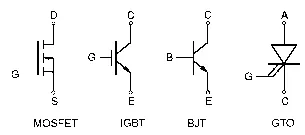
To emphasize the role of PECs, the architecture of different electrified vehicles are reviewed and compared.
Power Converter:-
There are two major power electronic units in the general configuration in HEVs or EVs
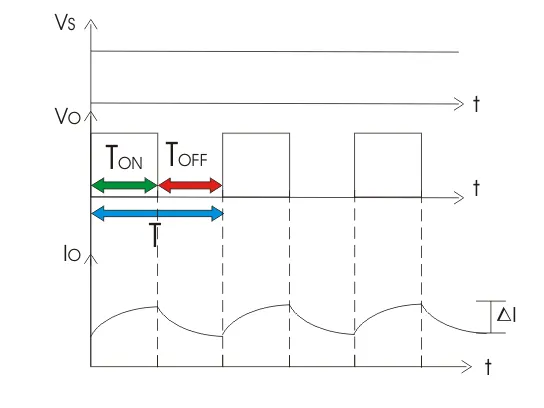
1. DC-DC converter (Chopper) - To achieve high voltage, another power electronics device called a boost converter(Chopper) boosts the battery voltage before sending the DC electricity to the motors, inverters/converters, sensors, control systems, and other interface electronics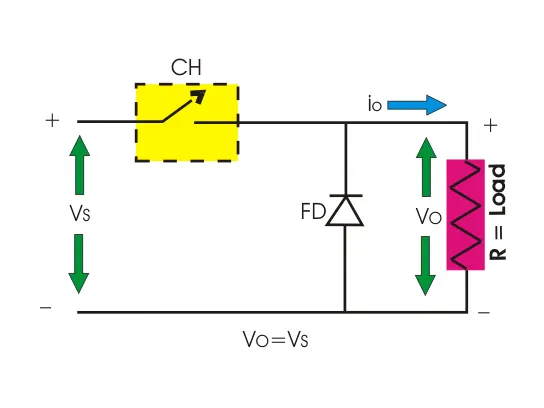
2. DC-AC converter (Inverter) - Inverter (power electronic) takes direct current (DC) electricity from the battery and converts it to alternating current (AC) electricity and sends it to the motor. The electric motor (electric machine) uses the AC current to create torque (mechanical power) to power the wheels for propulsion.
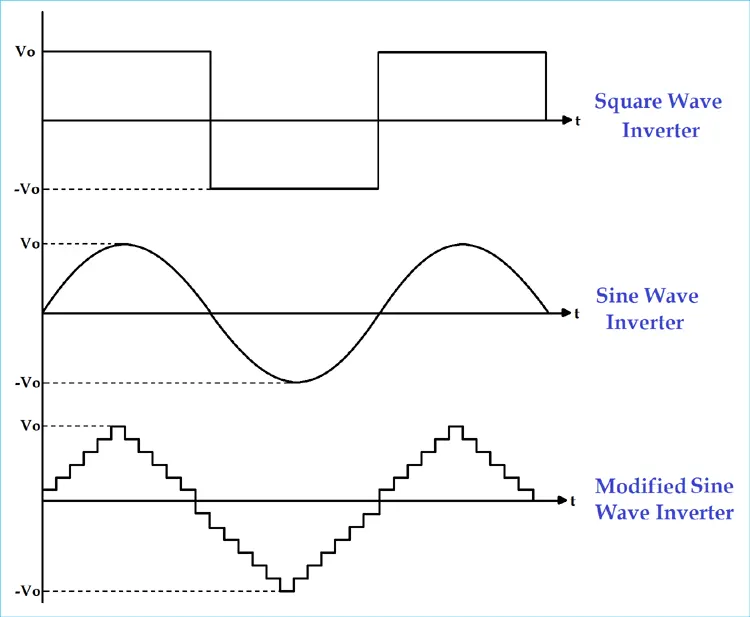
There are three types of inverters.
- Square wave inverter - This is the least used but simplest type of inverter. The output waveform of this inverter is a square wave
- Modified sine wave inverter - This inverter is also known as a quasi wave inverter. This inverter generates the signal near to the sine wave. But it cannot generate the smooth sine wave.
- Sine wave inverter - This is the most efficient and complex type of inverter. It generates the pure sine wave which is a similar waveform to the grid power. All AC equipment designed to work on the sine wave signal.
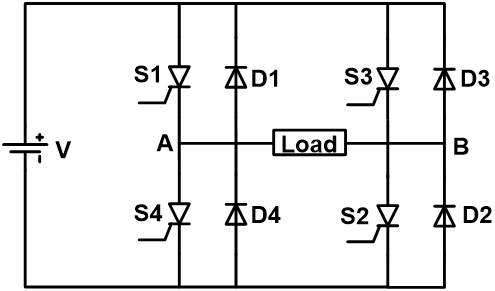
There are 2 more converters:-
3. AC-AC (Voltage Regulator)- AC to AC converters is used for converting the AC waveforms with one particular frequency and magnitude to AC waveform with another frequency at another magnitude. This conversion is mainly required in case of speed controlling of machines, for low frequency and variable voltage magnitude applications as well.
4. AC-DC (Rectifier)- A rectifier is an electrical device that converts alternating current (AC), which periodically reverses direction, to direct current (DC), which flows in only one direction.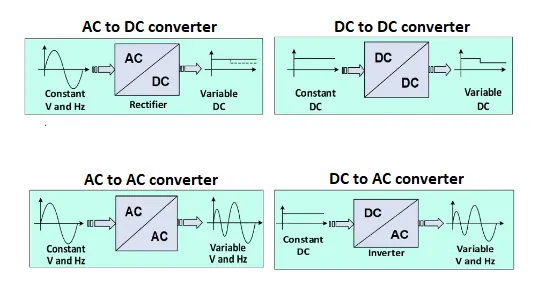
#Ques 2- An Electric Vehicle's powertrain with a 72V battery pack is shown in the diagram below. The duty ratio for acceleration operation is 'd1' and for the braking operation the duty ratio is 'd2'.
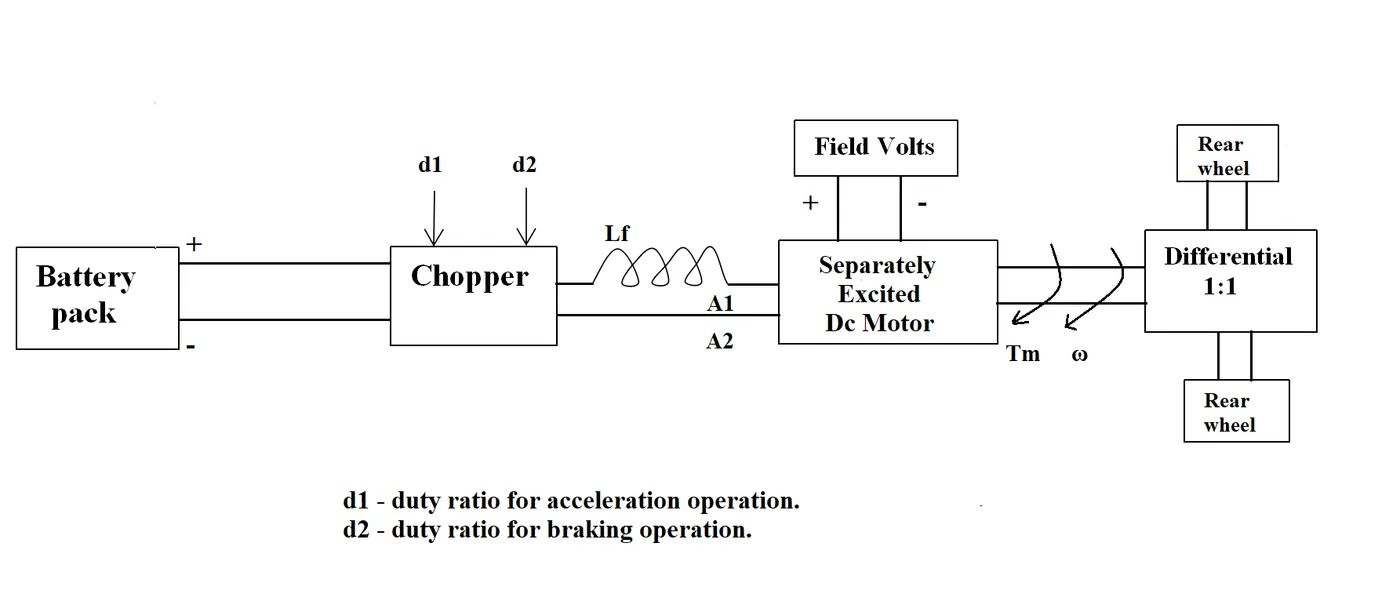
The other parameters of the electric vehicle are given below,
Motor and Controller Parameters:
Rated Armature voltage= 72 V
Rated armature current= 400 A
Ra= 0.5Ω, KΦ= 0.7 Volt second
Chopper Switching frequency= 400 Hz
The vehicle speed-torque characteristics are given by the below equation

Duty cycle is 70%
Calculate EV Steady state speed
Solution-
Rated Armature voltage including duty cycle
V = 72 x 0.7 = 50.4V
We have an equation for Speed of DC motor-
`omegam = V/(kphi) - (Ra)/((Kphi)^2) times T`
on Rearranging, in terms of Torque
`T = (V times Kphi)/(Ra) - (omegam times (Kphi)^2)/(Ra)`
On comparing the Speed Torque characteristics, and putting the values
`24.7 + 0.0051 times omega^2 = (50.4 times 0.7)/0.5 - ((0.7)^2 times omega)/0.5`
`0.0051omega^2 + 0.98omega - 45.86 = 0`
In order to find the Speed of DC Motor, we have to find the roots of the above quadratic equation:-
For Quadratic equation `Ax^2 + Bx + C =0`
Roots are'
`x = - b pm sqrt (b^2 -4ac)/(2a)`
We get the value of Motor speed,
`omega1 = 38.91` rad/s
`omega2 = -231.07` rad/s
but, speed cannot be negative
so, Speed of DC Motor = `omega1 = 38.91` rad/s
#Ques 3- Explain in brief the Author’s perspective. "Induction Versus DC brushless motors by Wally Rippel, Tesla"
In the blog, The Author is sharing his views, comparing DC Brushless Motor and Induction Motor. He has put the positive & negative of both sides of the Motors. He briefly explained to them and tell the difference.
Brushless DC Motor- A brushless DC motor is an electronically commuted DC motor that does not have brushes. The controller provides pulses of current to the motor windings which control the speed and torque of the synchronous motor.
- In the case of a Brushless DC motor it has permanent magnets (instead of electromagnets) for the Rotor, which produces a rotating magnetic field.
- Permanent magnet generates a DC (Direct Current) magnetic field instead of an AC magnetic field
- DC (Direct Current) magnetic field interacts with the magnetic field of the Stator to generate motion.
- The current in the Stator’s electromagnet can be varied by using an inverter to change the speed of motion.
Inductance Motor- An induction motor or asynchronous motor is an AC electric motor in which the electric current in the rotor needed to produce torque is obtained by electromagnetic induction from the electromagnetic induction of the stator winding
- Induction motors unlike BLDC motors have electromagnetic Rotor (as opposed to permanent magnets).
- The current is supplied to the stator which results in the generation of emf, this emf comes in contact with the rotor, then the current induced in the rotor.
- Both the Rotor (inner movable part) and the Stator (outer part) are electromagnets.
- Electric current produces torque (or motion) by maintaining electromagnetic induction.
- Electromagnetic induction is produced from the magnetic field of its winding.
Advantages & Disadvantages of Brushless DC Motor & Induction Motors
For BLDC Motors:
Advantages:
- BLDC motors generate much less heat as compared to Induction Motors. This results in significant efficiency improvement. Much less energy (or electricity) is lost in generating heat. That is why you find most BLDC motors having high efficiency.
- In DC brushless motor, the strength of the magnetic field is adjustable. When at low speed the maximum torque is required magnetic field should be maximum, i.e. inverter and motor current maintained at their lowest optimized efficiency.
- Can be very easily connected to Solar Power or Battery Power. The power generated through solar is DC and that stored in the battery is also DC.
- BLDC motors work almost at unity power factor. This means if you are on a commercial or industrial connection where you are charged for Maximum Demand (MD) or penalized for bad power factor. You can save your electricity bill by moving to BLDC motors.
- They are more powerful, with higher speed ranges, and higher dynamic responses. These BLDC motors are therefore suitable for high-speed applications (10,000 rpm or above) and are known for their excellent speed control.
Disadvantages:
- For bigger loads (industrial scale) an induction motor with inverter control will have better efficiency (magnetic losses increase with machine size with BLDC motors). But on an average BLDC motors have better efficiency.
- A nontechnical disadvantage in India: very few mechanics really understand BLDC motors well, so getting support can be difficult as well as costly.
- Inverter electronics can be complicated and difficult to maintain in varied climatic conditions in India.
For Induction Motors:
Advantages:
- Induction motors are robust and can operate in any environmental condition be it highly polluted or explosive environments.
- They are cheaper and nearly maintenance-free in cost due to the absence of brushes, slip rings, etc. In a noninverter controlled induction motor, there are no electronics to worry about.
- If speed variation is not required then induction motors can give better efficiency at peak load.
- In the case of induction motor, as machine size grows, losses do not necessarily grow.
- The construction of an induction motor is cheaper than DC brushless motor, due to the no use of permanent magnets.
Disadvantages:
- Less efficient as compared to BLDC motors on average.
- Lower power factor and can at best give a power factor of 85% (or 0.85).
- Motion generates heat that can reduce the efficiency of the motor.
- The speed variation of the induction motor depends upon the frequency input, it is difficult to control.
Learning Outcome:-
- Understand the EV & HEV Drivetrain.
- Understand different power converter circuits, used in Electric and Hybrid Electric Vehicles.
- Understand the importance & working principle of Brushless DC Motor & Induction Motors.
Reference:-
https://en.wikipedia.org/wiki/Induction_motor
https://en.wikipedia.org/wiki/Brushless_DC_electric_motor
https://www.tesla.com/blog/induction-versus-dc-brushless-motors