Week-6 Challenge: EV Drivetrain
Q1. Which types of power converter circuits are employed in electric and hybrid electric vehicle?
Ans:
The types of power converters which are widely used in an Electric Vehicle are:
- AC – DC Converter (On Board Charger): AC to DC converters are most commonly used in Plug-in Hybrid Electric Vehicles (PHEV) & Plug-in Electric Vehicles (PEV). These vehicles get their propulsion power from an external electricity source (charging stations) which is alternating current. The battery needs to be charged using a direct current source. For this purpose, AC to DC converter is employed in a PHEV & PEV.
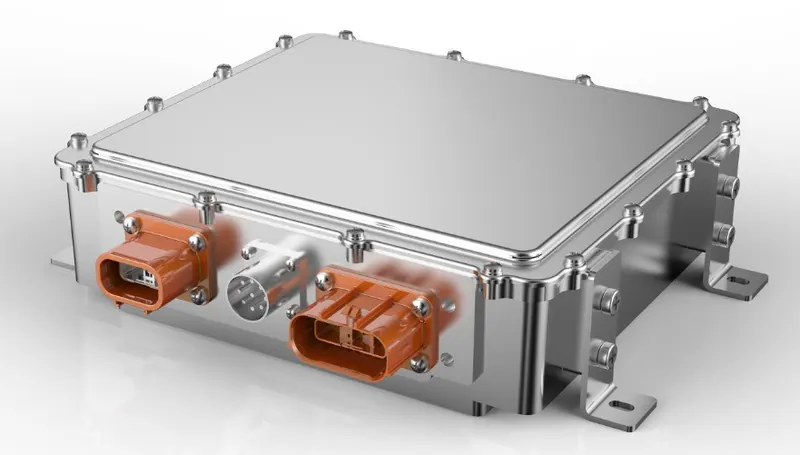 Fig: 6.6KW onboard charger
- DC – DC Converter(Chopper): DC-DC converters can be used to interface the elements in the electric power train by stepping up or stepping down the voltage levels. By introducing DC/DC converters one can choose the voltage variation of the devices and the power of each device can be controlled. The power of the DC/DC converter depends on the characteristics of the vehicle such as top speed, acceleration time from 0 to 100 Km/h, weight, maximum torque, and power profile (peak power, continuous power).
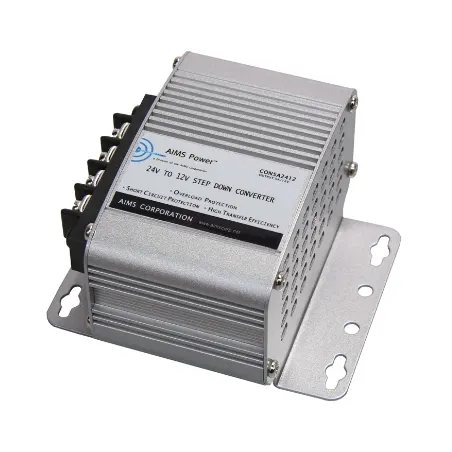 Fig: 5amp 24V to 12V DC-DC converter
- DC – AC Converter (Inverter): The DC/AC converter is required to convert the dc power to a suitable ac power for the electrical machine. The power output from battery pack (DC current) is converted using inverter to be used in electric motor (AC current).
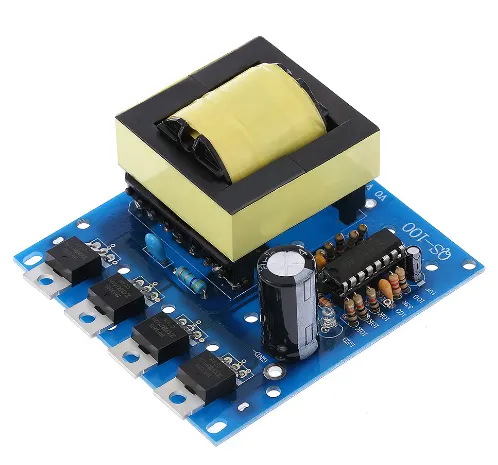
Fig: 12V DC to 230V AC inverter board
Q2. An Electric Vehicle's powertrain with 72V battery pack in shown in the diagram below. The duty ratio for acceleration operation is 'd1' and for the braking operation the duty ratio is 'd2'.
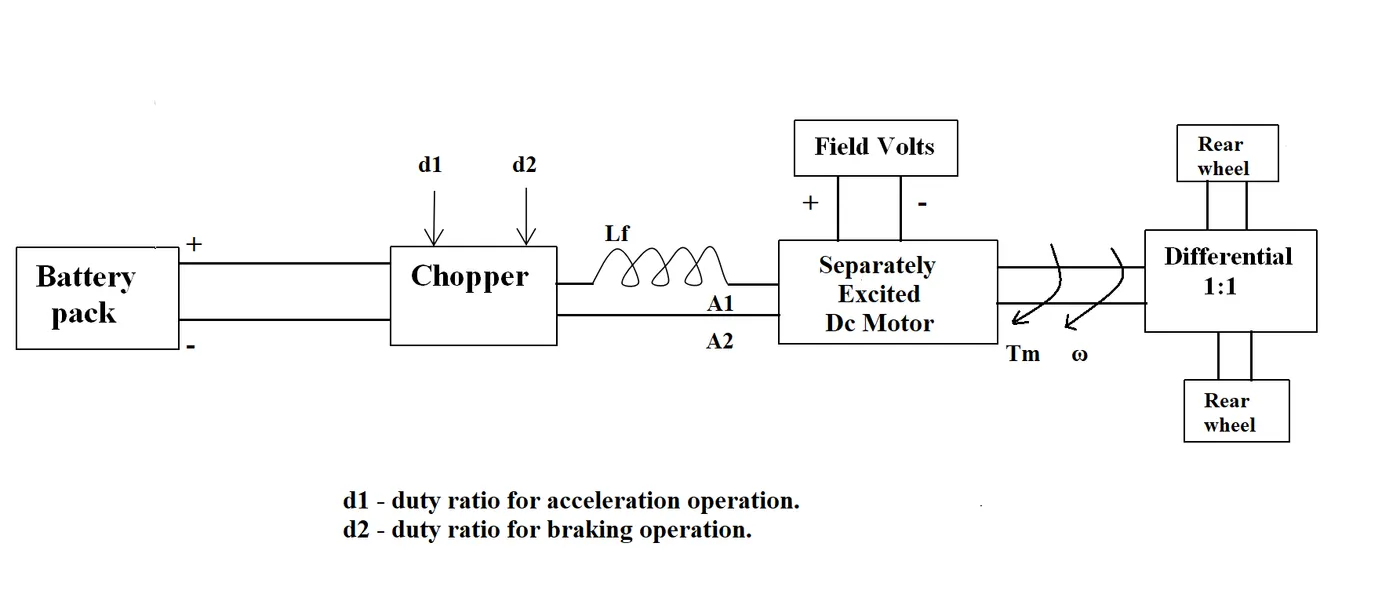
The other parameters of the electric vehicle is given below,
Motor and Controller Parameters:
Rated Armature voltage= 72 V
Rated armature current= 400 A
Ra= 0.5Ω, KΦ= 0.7 Volt second
Chopper Switching frequency= 400 Hz
The vehicle speed-torque characteristics are given by the below equation

What is EV steady state speed if duty cycle is 70%?
Ans:
Here at 70% duty cycle we get rated armature voltage of,
V=(70/100)*72=50.4 V .......(1)
We know the torque equation of motor,
w=V/Kϕ - (Ra/(Kϕ^2))T
=> Tm= [-(w-(V/Kϕ))Kϕ^2] / (Ra)
Tm=[(V*Kϕ) - (w*Kϕ^2) ]/ Ra ......(2)
Subtitute values in (2)
Tm=[(50.4*0.7)-(w*0.49)]/0.5
Tm =[70.56 - 0.98w] ......(3)
Since differential(motor to Wheel) is in ratio 1:1 Tv=Tm,
equating (1) and (3),
24.7+(0.0051)w^2 = [70.56 - 0.98w]
=> 0.0051w^2 + 0.98w -45.86 =0
By solving equation,
w = -231.07 , 38.91
Result:
For motoring action the steady state speed is 38.91 rad/sec.
(i.e) steady state speed at 70% duty cycle is 38.91 rad/sec=371.5 rpm.
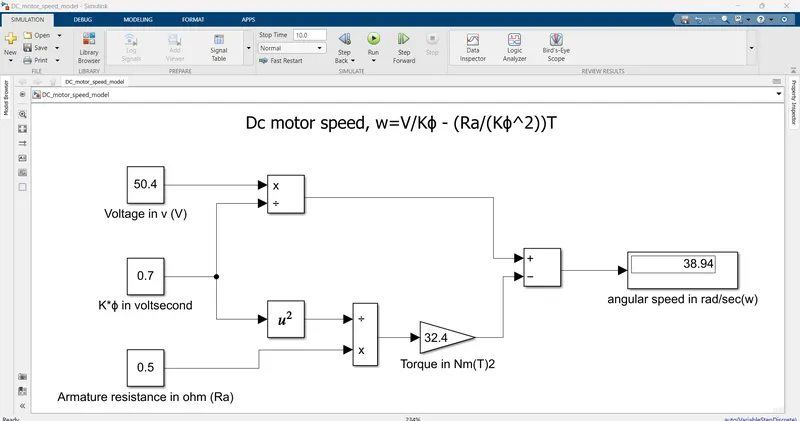
Q3. Develop a mathematical model of a DC Motor for the below equation using Simulink.
w=V/Kϕ - (Ra/(Kϕ^2))T
Ans:
Simulink model:
Result:
We have verified this mathematical model by giving the values of torque T, voltage V, armature resistance Ra and Kϕ From question 2.
The result was, angular speed w = 38.94 rad/sec
Q4.Refer to the blog on below topic:
Induction Versus DC brushless motors by Wally Rippel, Tesla
Explain in brief about author’s perspective.
Ans:
According to Wally Rippel, DC brushless drives will likely continue to dominate in the hybrid and coming plug-in hybrid markets, and that induction drives will likely maintain dominance for the high-performance pure electrics. The question is what will happen as hybrids become more electrically intensive and as their performance levels increase? The fact that so much of the hardware is common for both drives could mean that we will see induction and DC brushless live and work side by side during the coming golden era of hybrid and electric vehicles.