Week-4 Challenge WOT Condition Part-2
Q1.What is the difference between mapped and dynamic model of engine, motor and generator? How can you change model type?
Ans:
Powertrain Blockset provides two types of engine models: mapped and dynamic. Mapped engines represent macro engine behavior as a set of lookup tables (brake torque, fuel flow, air mass flow, exhaust temperature, efficiency, and emissions) as functions of commanded load and measured engine speed. Dynamic engines decompose engine behavior into individual component models that account for engine dynamics, most notably intake airflow and turbocharger dynamics.
You can switch between engine model types based on your application. Dynamic engine models are suitable for designing control, estimator, and diagnostic algorithms that depend on dynamic subsystem states, for example, in closed-loop AFR control algorithm development. Mapped engine models are suitable for analysis and design activities that do not require engine subsystem dynamic characteristics, for example, in engine and transmission powertrain matching analysis for fuel economy, emissions, and performance tradeoffs.
Mapped Model: -
- It uses a prebuilt data in lookup table for the simulation of powertrain block set.
- In mapped model the calculations are very fast.
- Electric losses are need to be specified if present.
Dynamic Model: -
- It uses real time data for calculating every behavior of vehicle characteristic like speed, velocity, drag, wheel braking etc.
- In dynamic model the calculations are time consuming.
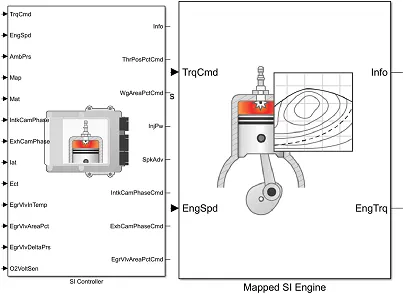
Dynamic and Mapped model of engine
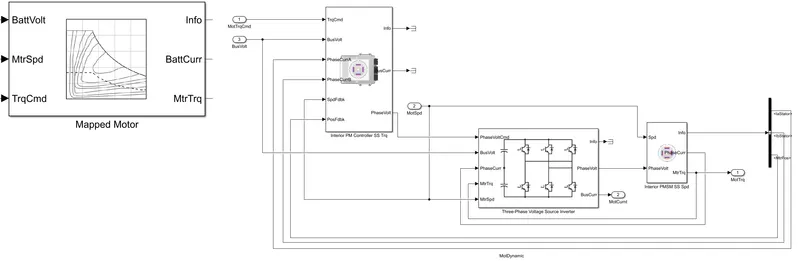
Mapped and Dynamic model of motor
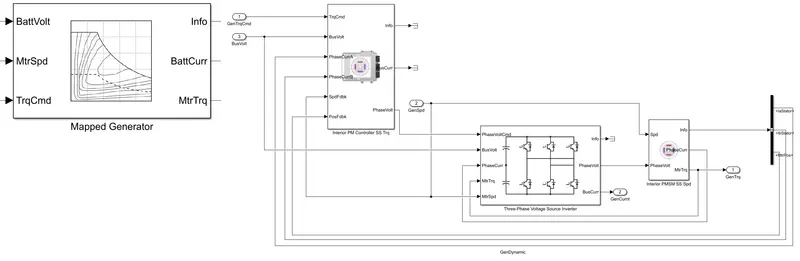
Mapped and Dynamic model of Generator
To changed model type from mapped to dynamic or dynamic to mapped
In the Simulink open the ev reference model, Go to Modelling – System Design – Variant Manager.
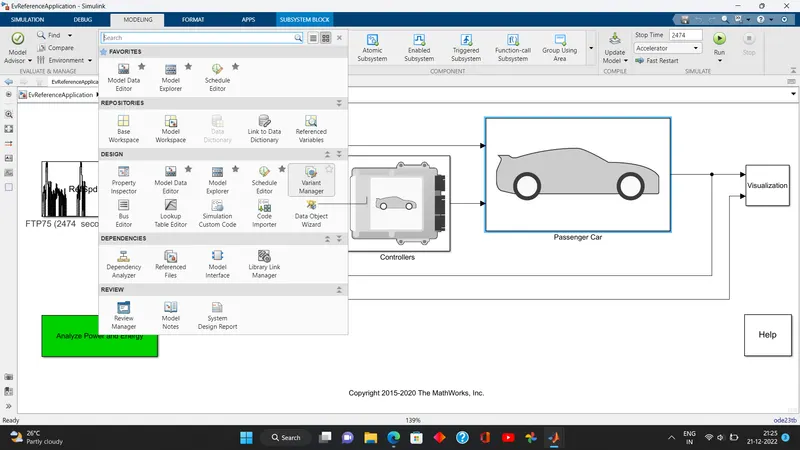
There are Many Submodels we can see.
Now, In the passenger car, there are submodels called Electric Plat & Engine. In the Electric plant, there is Motor submodel from which we can change from the mapped model to a dynamic.
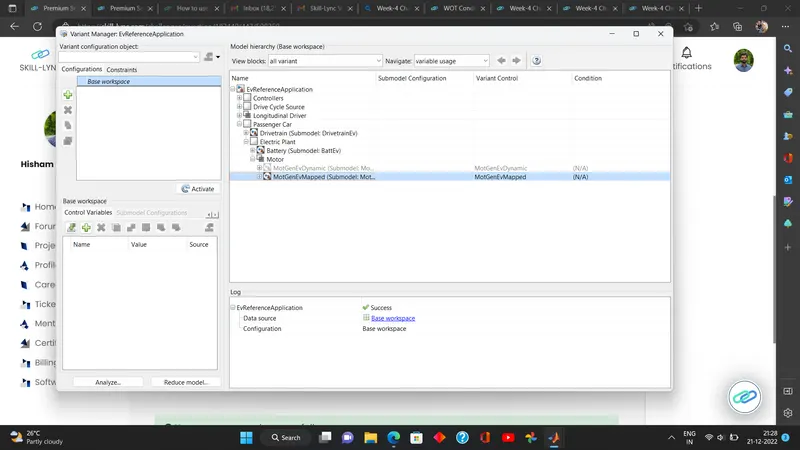
As the default setting is the Mapped model. Just right click and click on “ Set as Label Mode Active Choice” to change from the Mapped model to a Dynamic Model & vice-versa.
Q2.How does the model calculate miles per gallon? Which factors are considered to model fuel flow?
Ans:
A gallon is a unit of measurement for liquids. In America, it is equal to about 3.785 litres. MPG, or miles per gallon, is the distance, measured in miles, that a car can travel per gallon of fuel. MPG is also the primary measurement of a car's fuel efficiency: The higher a car's MPG, the more fuel efficient it is.
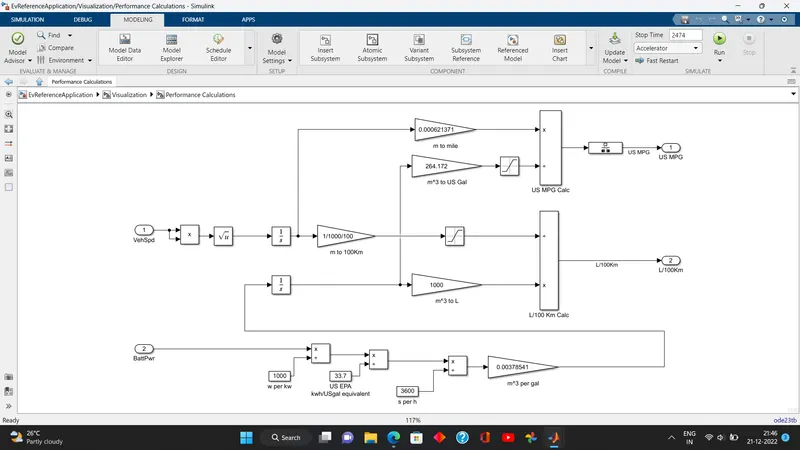
The above MPG calculations are for pure EV which means it contains battery energy alone.
First, we get battery power in watt which is converted in kWatt & further convert into energy in kWh.
Then it is converted into US gallon equivalent energy by dividing it by standard value 33.7. Then it is converted into US gallon per second.
It is multiplied by standard value 0.00378541 to get the volume in m3 per gallon.
Further m3 is converted into US gallon.
On the other hand, the speed of the vehicle is integrated to get distance and the distance which is in the meter is converted into miles by multiplying the standard value 0.000621371.
And finally, MPG is calculated by dividing the miles with gallon.
Factors considered in model fuel flow in EV:
1)Battery power
2)vehicle speed
Q3.Run the HEV ReferenceApplication with WOT drive cycle. Change the grade and wind velocity in the environment block. Comment on the results.
Ans:
For the analysis, we have choosen the HEV multimode reference application model
-> open the model in simulink
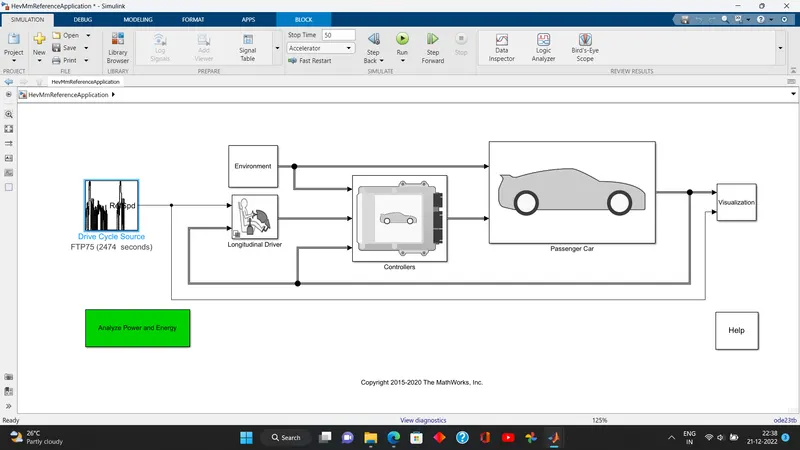
CASE1:
-> change the drive cycle to WOT
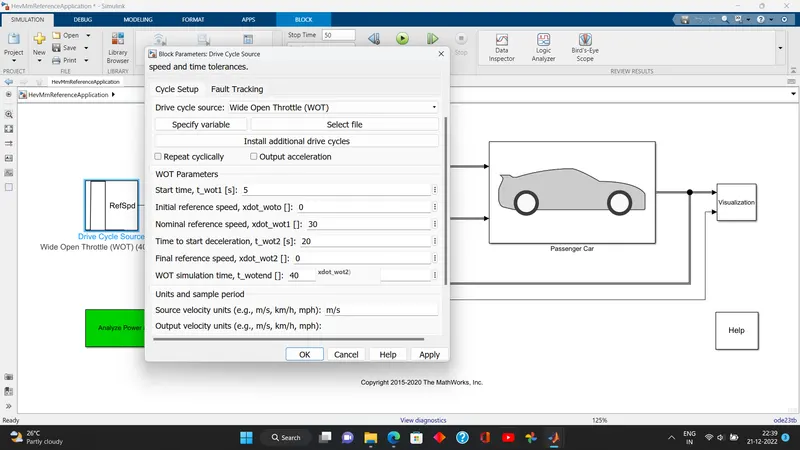
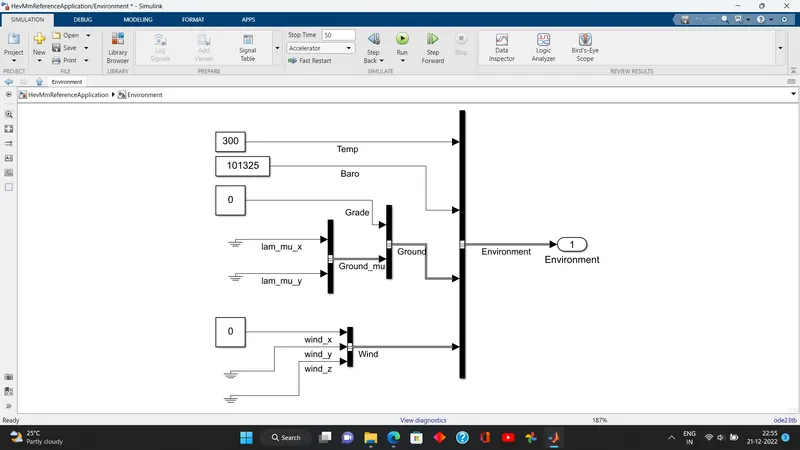
-> Run simulation for 50 sec and open the results
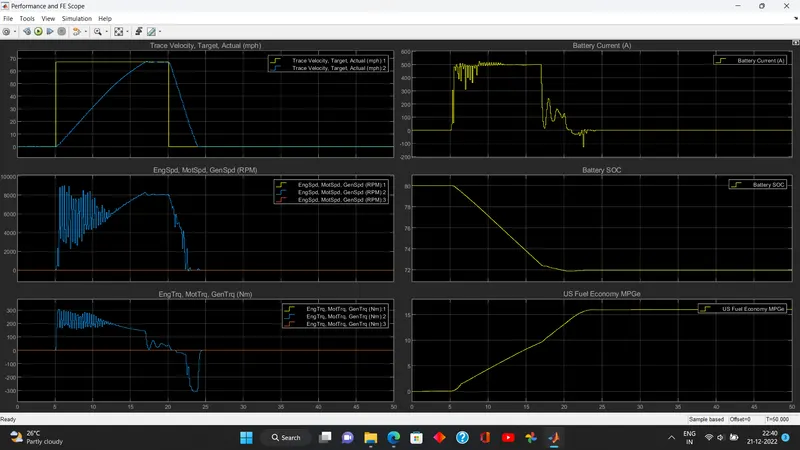
CASE1 Observation:
- The vehcile actual speed reached at the reference speed 0f 67.1 mph in 17 seconds.
- The maximum current drawn from the battery is 520 amps.
- Only the motor was operated and the max RPM reached is 9000 rpm.
- During the acceleration period the battery SOC dropped from 80% to 72% in 15 seconds and there was small amount of regeneration happened during decceleration.
- The fuel economy rises during motor operation mode.
CASE2:
-> Change the grade and wind velocity in the environment block.
Grade = 10
Wind = 5
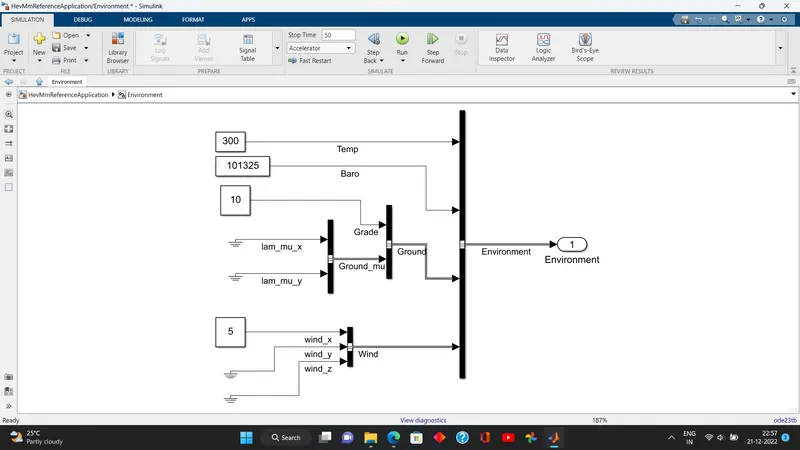
Result:
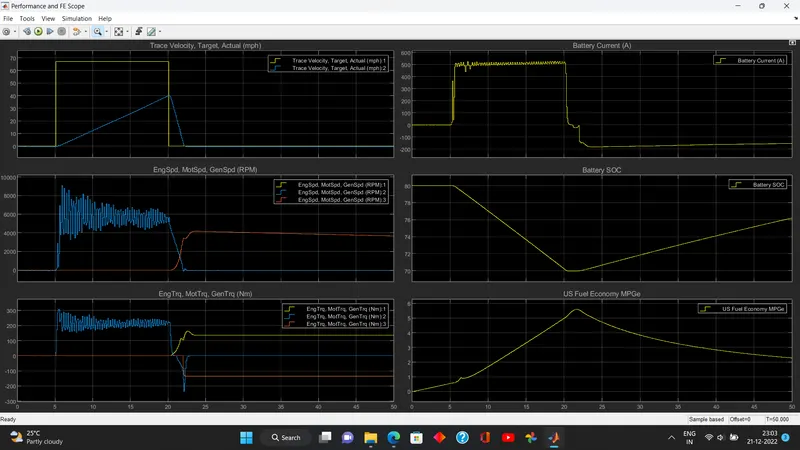
CASE2 Observation:
- The vehcile was able to achieve actual speed of 40 mph only(reference speed 67.1mph) within the wide open throtle time(20sec).
- The maximum current drawn from the battery is 525A and the max charging current was 180A during regeneration.
- Till the battery SOC reached 70%, Only the motor was operated and the max RPM reached is 9100 rpm. After that motor stopped and engine started and max rpm reached was 4200 rpm.
- During the acceleration period the battery SOC dropped from 80% to 70% in 15 seconds and when engine started working battery started recharging and reached 76% SOC in next 30 seconds.
- The fuel economy rises during motor operation and falls when using engine mode.
Q4.Keeping all other parameters same, compare the simulated results of hybrid and pure electric powertrains.
Ans:
-> open the EV reference application model in simulink
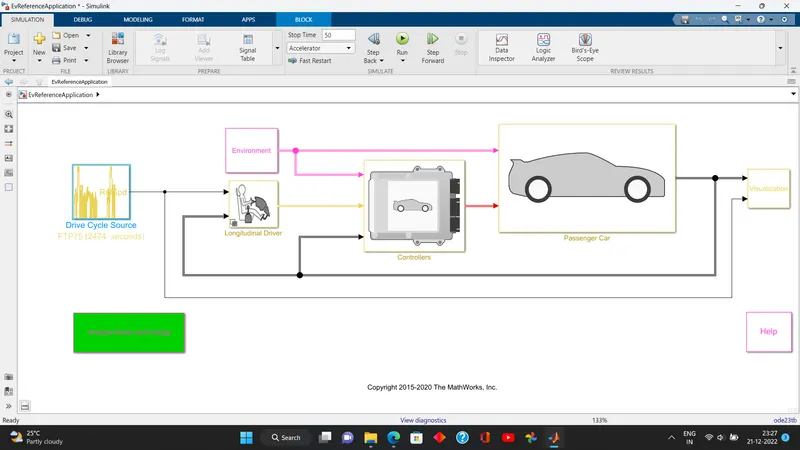
-> change the drive cycle to WOT with same environment conditions used as above
Grade=10
Wind=5
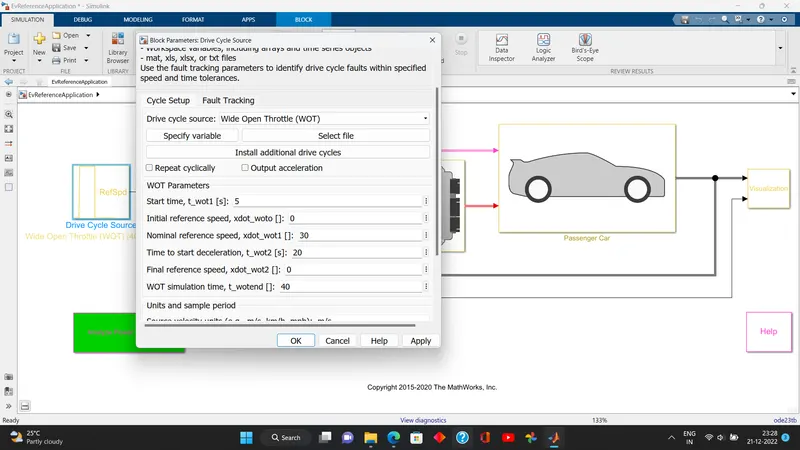
-> run simulation for 50 sec
results:
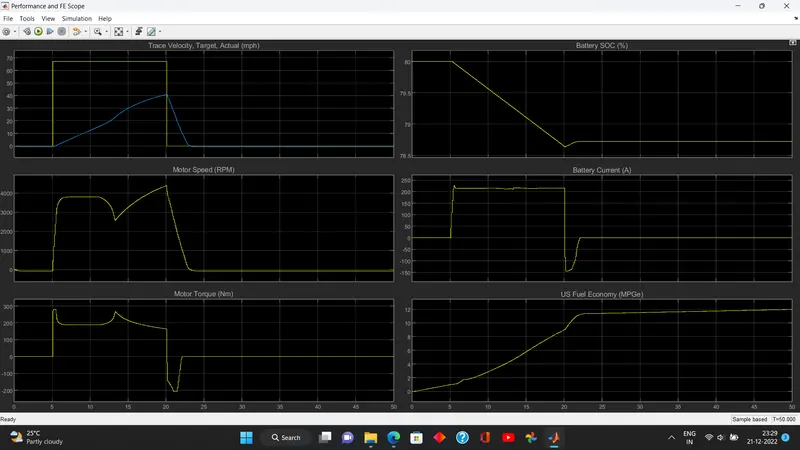
Observation:
- The vehcile was able to achieve actual speed of 40 mph only(reference speed 67.1mph) within the wide open throtle time(20sec).
- The maximum current drawn from the battery is 225A and the max charging current was 145A during regeneration.
- The max motor RPM reached is 4380 rpm with a torque of 140Nm. Initialy the torque was maximum 280Nm and motor speed was gradually increasing to top speed which in turn reduced the torque.
- During the acceleration period the battery SOC dropped from 80% to 78.6% in 15 seconds andwhile decceleraion(regeneration) recharged to 78.7% SOC in next 15 seconds.
- The fuel economy reaches a max of 12 MPGe